
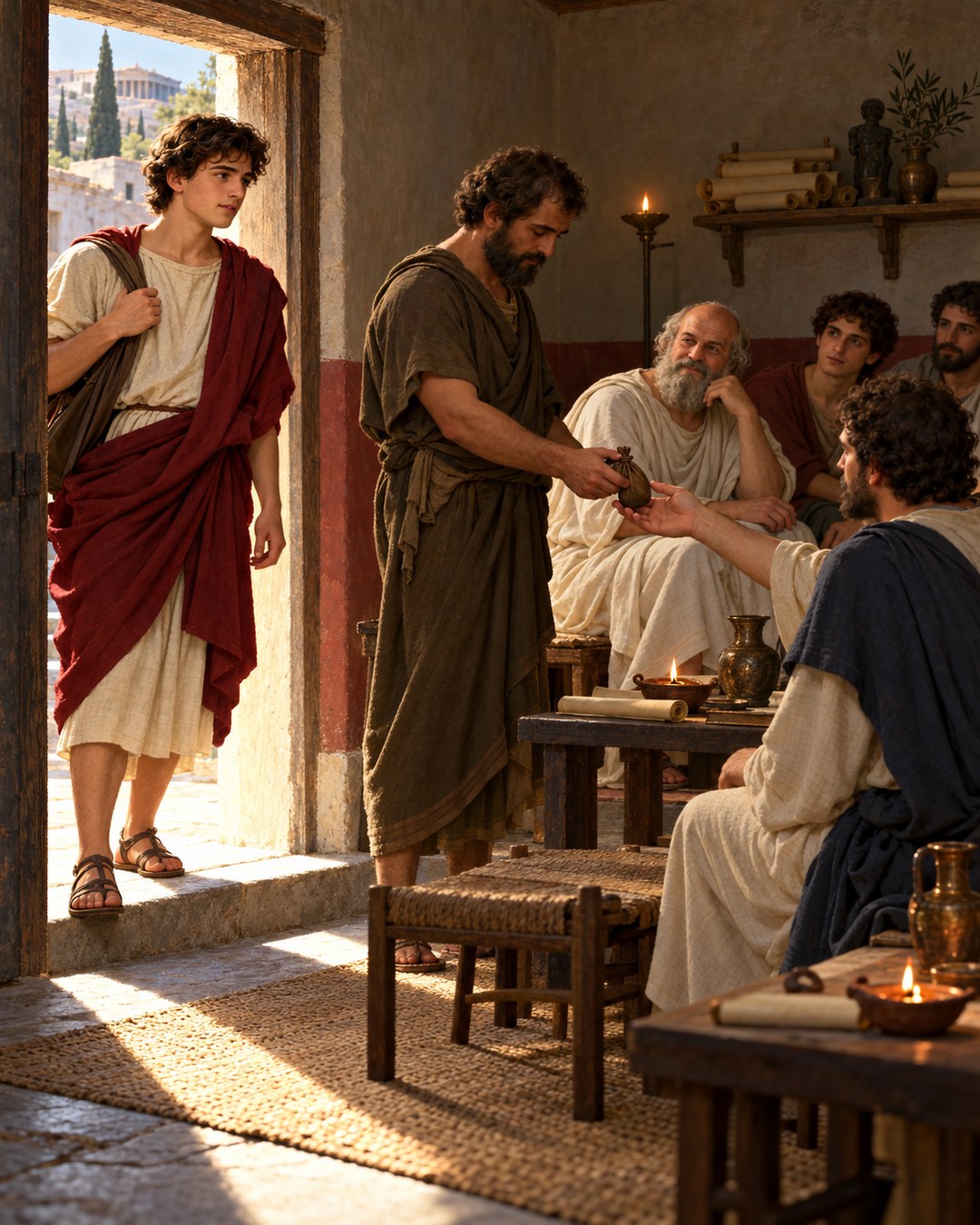
Phaedo gave his name to Plato’s dialogue on the immortality of the soul. Before he could enter that literary afterlife, someone had to buy him.
Aulus Gellius says Phaedo of Elis was enslaved despite noble character and intellect. Some writers reported an even harsher boyhood under a master who was a pander. Socrates urged Cebes to intervene; Cebes purchased Phaedo and gave him the chance to study philosophy.
The sequence should not be softened into a tale of talent naturally finding its level. Talent was present. Access was not.
A Famous Dialogue Can Hide the Material Hinge
Gellius starts with the identity later readers are most likely to know. Phaedo belonged to the famous Socratic circle and lived in close intimacy with Socrates and Plato. Plato placed his name on the dialogue set around Socrates’ final hours.
That prominence can make the route look inevitable in retrospect. Once a person becomes the title of a canonical work, every earlier obstacle risks becoming merely the dramatic prelude to greatness.
Gellius refuses that smooth line. Phaedo was a slave. His intellect and personal nobility did not dissolve ownership. According to some writers, his master exploited him sexually in boyhood. The chapter reports the allegation without turning suffering into decorative colour.
The distinction between capacity and condition is central. Phaedo could possess the mind suited to philosophy while lacking freedom to join its institutions. A circle of teachers, books and conversation was physically near yet socially closed.
The journeys in Euclides’s disguised nights with Socrates show a student overcoming distance and legal danger to reach a teacher. Phaedo’s barrier was different. He was property; he could not solve that condition by walking farther.
Socrates Asked, but Cebes Had to Act
Gellius assigns separate roles. Socrates made an earnest request. Cebes bought Phaedo. The purchase gave him the opportunity to study philosophy.
This is not modern emancipation paperwork, and the chapter does not provide price, witnesses or legal formula. The secure facts are the request, the buyer and the consequence.
Socrates recognized the person who ought to be allowed to learn. Recognition alone was insufficient. Cebes converted concern into a transaction capable of changing Phaedo’s daily life.
The moral discomfort cannot be removed: liberation appears through the same market that enabled enslavement. Gellius does not pause to theorize that contradiction, but his verbs preserve it. Cebes bought him; study followed.
Opportunity also means more than passive permission. Philosophical formation required time, company and repeated discussion. Phaedo entered a network in which questions could be tested and memories of Socrates shaped into discourse.
The nearby account of Pythagorean novices enduring two silent years presents education as a deliberately controlled sequence. Phaedo first needed control over his own presence before any curriculum could begin.
Phaedo Became an Author, Not Only a Saved Student
Gellius says Phaedo later became a distinguished philosopher. He adds that tasteful discourses by Phaedo about Socrates were still circulating.
That final detail changes the direction of transmission. At first Phaedo receives an opportunity from Socrates and Cebes. Later, readers receive Socratic material through Phaedo.
Plato’s dialogue made Phaedo a character and witness. Phaedo’s own works made him an author. Gellius keeps both facts in view, preventing the historical man from disappearing completely inside another writer’s title.
We cannot recover those discourses from this chapter or pretend to quote what it does not preserve. “Tasteful” is Gellius’s judgment, and circulation is the evidence he supplies. The loss of the works makes that small notice especially valuable.
The transformation is therefore concrete without becoming miraculous. Enslaved boy, purchased student, recognized philosopher, circulating author: every stage depends on a changed relation to people and institutions.
Gellius’s wording also makes memory collaborative. Socrates becomes knowable through several students, not one authorized channel. Phaedo’s access enlarged the body of voices able to interpret the teacher.
A List of Enslaved Philosophers Refuses an Isolated Exception
Gellius then broadens the chapter. Phaedo was not the only enslaved person to become a philosopher.
He names Menippus, whose work Marcus Varro imitated in satires Varro himself called Menippean. Pompylus, enslaved by the Peripatetic Theophrastus, had a philosophical reputation. So did Persaeus, associated as a slave with the Stoic Zeno, and Mys, enslaved by Epicurus.
The list links intellectual schools to unfree labour without claiming each life followed Phaedo’s route. We are not told that every master recognized a student or that every purchase ended in freedom.
Diogenes supplies a deliberately sharp variation. He was freeborn and later sold. Asked by Xeniades what trade he knew, he answered that he knew how to govern free men. Xeniades admired the reply, bought and freed him, then entrusted his children to his governance.
The reversal works as Cynic wit, but it also depends on power. Diogenes could redefine his expertise in speech; Xeniades still controlled purchase and manumission.
Finally Gellius names Epictetus. His former slavery, he says, was too recent in memory to need written rehearsal. For Gellius’s audience, the philosopher’s status had not yet become obscure antiquarian knowledge.
The catalogue is not proof that slavery was open to talent. Its exceptional names point in the other direction. For each remembered philosopher, countless enslaved minds had no Socrates to notice them, no Cebes to act and no text to preserve their speech.
Phaedo’s story survives because intervention broke one chain of exclusion. The philosophical lesson begins before any argument about immortality: a mind cannot join a conversation if ownership controls where its body may go.
The chapter’s catalogue also reveals how philosophical households depended on people whose status could be obscured by the fame of the school. The names of Theophrastus, Zeno and Epicurus are familiar labels for doctrines. Gellius places Pompylus, Persaeus and Mys beside them and makes enslavement part of intellectual history.
That placement should not be mistaken for equal authorship in every case. Gellius calls the men philosophers of repute but gives different amounts of information. Phaedo’s works, Menippus’s influence and Diogenes’ reply receive narrative form; other names survive in a sentence. Uneven evidence is itself part of the record.
Diogenes’ answer—he knew how to govern free men—turns the buyer’s question against the market. A “trade” expected from a slave becomes a claim to educate the buyer’s household. The wit is memorable because social position and asserted competence point in opposite directions.
Still, the story ends only when Xeniades acts. Admiration leads him to purchase, free and entrust children. As with Phaedo, a brilliant sentence does not execute its own manumission.
Epictetus closes the list differently. Gellius assumes living cultural memory can carry what older figures require books to recover. That confidence proved temporary; later readers need the written reminder. The chapter thus demonstrates its own value. Status that “everyone knows” in one generation can disappear behind a famous body of thought in another.
Reading the names together changes the map of ancient philosophy. Schools were not populated only by free citizens strolling voluntarily into lectures. Enslavement, purchase, release, household labour and patronal choice determined who could listen, speak and leave work bearing a name.
Phaedo’s own survival in the record therefore has two distinct channels. Plato’s title kept his personal name attached to a major dialogue, while Gellius remembered works in which Phaedo spoke about Socrates for himself. Confusing those channels would make him only a character in someone else’s book. Keeping them separate restores the later philosopher who taught, composed and was judged for the quality of his own discourse. The purchase opened study; study eventually produced testimony that other people chose to read.
Sources
Aulus Gellius, Attic Nights, 2.18.