
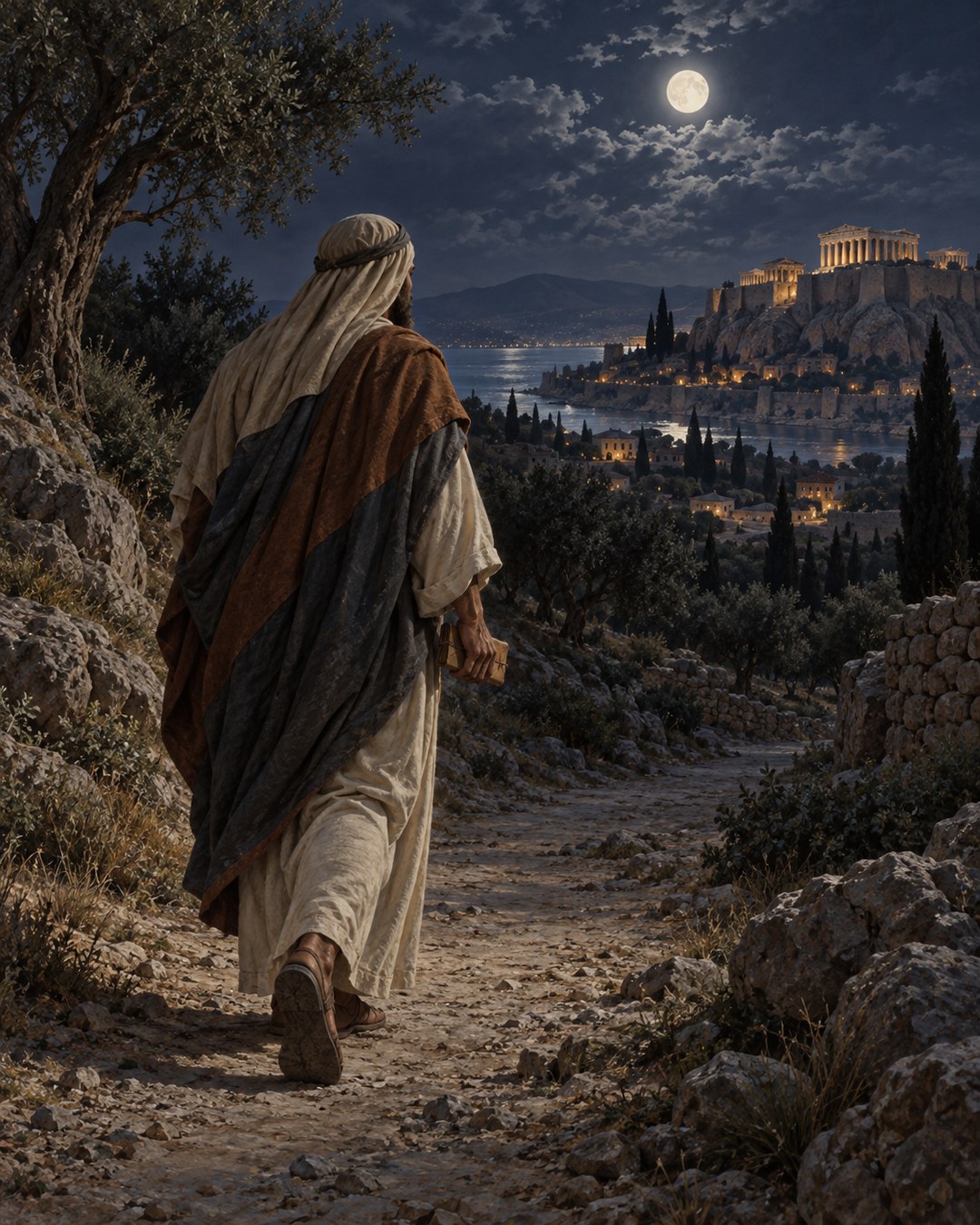
Darkness gave Euclides a narrow opening. Athens had decreed death for any citizen of Megara who set foot inside the city, yet Socrates was teaching there.
Euclides put on a long tunic, a parti-colored mantle and a veil. He walked from Megara after nightfall, listened for part of the night, then started home before dawn.
Aulus Gellius says the return journey alone covered somewhat more than twenty miles.
Taurus Used an Old Journey to Measure Young Students
The story reaches us as a lesson told by Calvenus Taurus, a celebrated Platonist whom Gellius knew. Taurus encouraged his pupils toward philosophical study with examples he considered wholesome and demanding.
Euclides of Megara was his sharpest example. Gellius calls him “the Socratic,” identifying the relationship that made the journey meaningful. Before the hostile decree, Euclides had been accustomed to visiting Athens and listening to Socrates.
The route therefore connected an existing student to an established teacher. Euclides was not chasing a rumor about a famous man he had never met. A civic order interrupted a practice that already belonged to his life.
Taurus’s choice of example matters. He could have praised a philosopher’s conclusion or a polished speech. Instead, he praised attendance under constraint. The teaching begins before Euclides reaches Socrates because every practical decision demonstrates what the conversation is worth to him.
The lesson is not simply “work harder.” Gellius preserves the pieces of a system: a prohibition tied to identity, concealment suited to darkness, a short intellectual visit and a long return calibrated to dawn.
That concreteness keeps devotion from dissolving into a compliment. Anyone could call philosophy valuable. Euclides reorganized clothes, sleep, distance and personal safety around gaining a few hours of it.
The recent discussion of Chrysippus’s fragile skull makes an abstract argument memorable through one physical mechanism. Taurus does something similar with education: the road makes appetite for learning visible.
A Death Decree Turned a Neighboring Road into a Border
The Athenians had decreed that any citizen of Megara discovered setting foot in Athens should suffer death. Gellius attributes the measure to intense hatred for their neighbors.
He does not date the decree in this chapter or explain its wider diplomatic history. Those gaps should remain gaps. The force of Taurus’s anecdote comes from the rule as stated: origin alone made presence capital danger.
A road that had once carried Euclides toward familiar teaching now required concealment. The obstacle was not distance by itself. He could walk the miles. The obstacle was becoming legible as a Megarian once he entered Athenian space.
The decree joined geography to identity. It did not forbid a particular argument or name Socrates. It made the student’s body unlawful inside the city, regardless of why he came.
That structure explains why disguise, rather than secret notes or a bribe, occupies the center of the account. Euclides needed to cross a watched social boundary by changing what strangers thought they saw.
Gellius does not describe checkpoints, patrols or a formal gate inspection. Images of those mechanisms would go beyond the evidence. What he gives us is the legal threat, the neighboring communities and the clothing Euclides used to pass.
The danger also makes the journey asymmetrical. Reaching Athens was only half the task. A successful visit required leaving again without discovery, before daylight removed the cover on which the disguise depended.
Cloth and Darkness Created a Temporary Identity
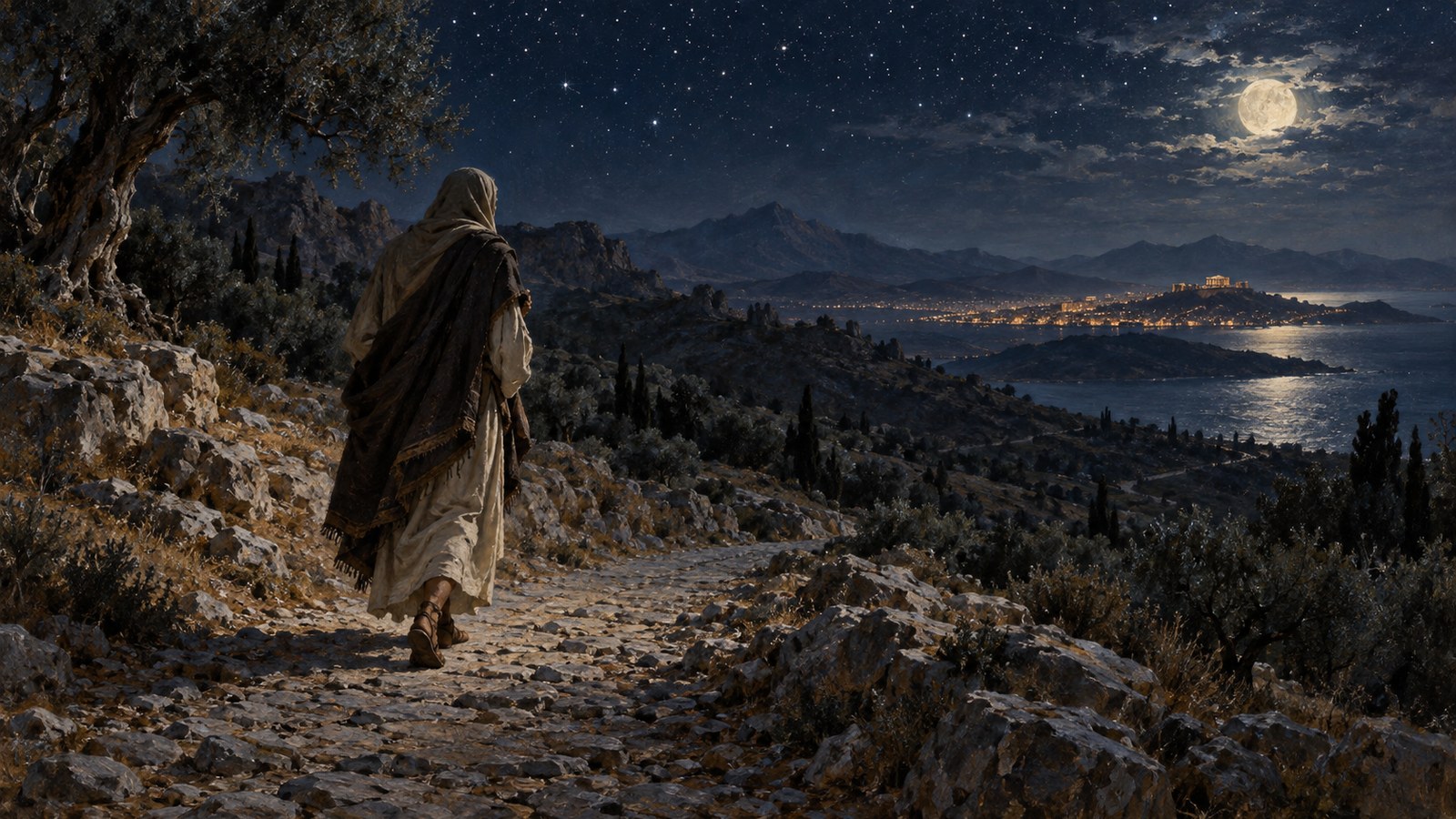
Euclides set out at nightfall as darkness came on. He wore a woman’s long tunic, wrapped himself in a parti-colored mantle and covered his head with a veil.
The three garments form a complete visual strategy in Gellius’s sentence. Length changed the outline of the body, color and wrapping shaped the outer layer, and the veil reduced recognition of the face.
Gellius reports the disguise without turning Euclides into a comic character. Taurus’s lesson depends on seriousness: the clothing is equipment selected for access to a teacher under threat of death.
Darkness worked with the cloth. In full daylight, close inspection could expose features that night softened. At night, a plausible silhouette and covered head might allow a traveler to remain one more unremarkable figure on the road.
The disguise did not erase danger. It transferred the plan’s success to conduct. Euclides had to sustain the appearance while walking into a hostile city, spending hours there and making the return trip in the same clothes.
There is no need to invent fear in his thoughts. The decree supplies objective risk; the repeated journey supplies determination. Gellius’s restraint is more powerful than an imagined interior monologue.
Clothing also answers the decree on its own terms. Athens targeted a Megarian citizen. Euclides presented observers with a different social reading long enough to reach Socrates. The law remained in force, but recognition failed.
Like the blank objects in the account of pruning, accounts and refined silver, the garments are useful because of an operation they perform. They remove identifying cues from view until only a safe appearance remains.
A Few Hours of Conversation Cost Most of the Night
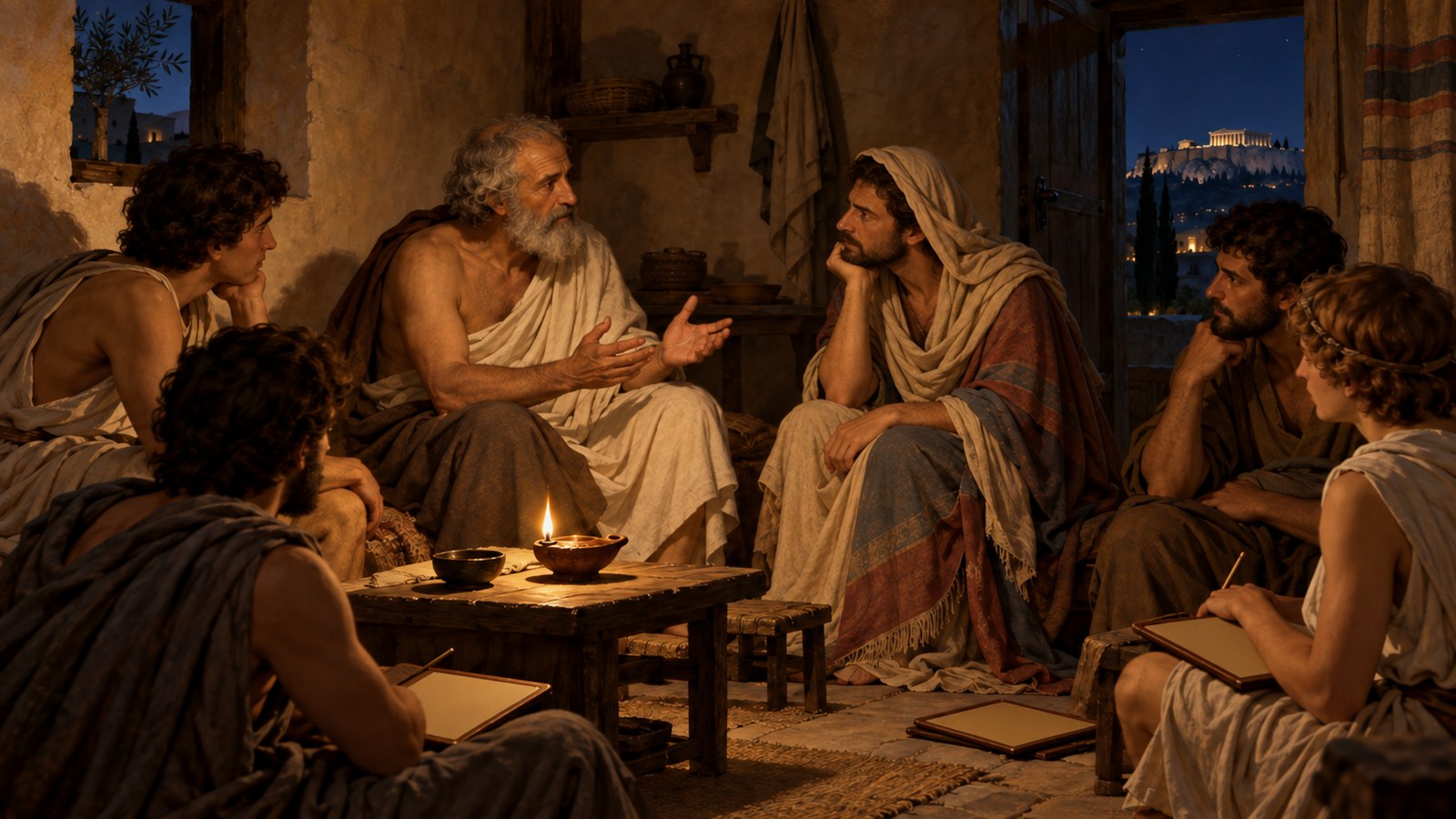
Euclides did not arrive for a public festival or remain in Athens for days. He came so that he might share at least some part of the night in Socrates’ teaching and conversation.
“Some part” is a revealing limit. Travel consumed hours on both sides. Darkness determined departure, and dawn imposed the return. The intellectual portion sat compressed between two long walks.
Gellius says Euclides went back just before dawn in the same disguise. The phrasing makes the schedule cyclic. Arrival did not end the plan; sunrise was already pulling him home while he listened.
The distance was somewhat more than twenty miles. The text attaches that measurement to the return from Athens to Megara, but the outward journey covered the route as well. Taurus’s audience would understand that the lesson involved sustained effort, not one dramatic doorway.
The road changed the texture of conversation. Every additional exchange with Socrates consumed time that could have widened the margin before daylight. Every early departure surrendered teaching already purchased by the inward journey.
Taurus therefore presented philosophy as an allocation problem. Euclides assigned the usable hours of night between movement, concealment and attention. Desire showed itself through the schedule he accepted.
The story does not tell us which Socratic question was discussed on any particular night. That absence keeps the emphasis on access. Before a doctrine can change a student, the student must arrive where the doctrine is being examined.
Waiting Teachers Reversed Every Part of Euclides’s Effort
Taurus ended with a contrast from his own day. Philosophers ran to the doors of rich young men to offer instruction. Once there, they sat and waited until nearly noon.
The pupils, meanwhile, slept off the previous night’s wine. Night had been spent on drinking, morning on recovery and teaching on delay.
Every element reverses Euclides. He went to the teacher; teachers now went to pupils. He used the night to secure conversation; the wealthy students used it to make themselves unavailable. He returned before dawn; they had not risen by nearly noon.
The contrast also changes who bears the cost. Euclides paid in walking, danger and lost sleep. Taurus’s contemporary philosophers absorbed the inconvenience while rich pupils controlled the timetable.
This is social criticism as much as educational advice. When teachers court wealth, access becomes easy for the pupil and humiliating for the instructor. The lesson’s value can appear lower precisely because the person receiving it has rearranged nothing.
Taurus did not ask his students to reproduce Euclides’s illegal crossing. He asked them to recognize the difference between wanting instruction and allowing instruction to wait outside.
Gellius’s anecdote survives because its logistics are unforgettable. A decree says death. A veil lowers. A road extends through darkness. A few hours with Socrates end before the sky brightens.
More than twenty miles bought Euclides no credential recorded here and no promise of comfort. It bought another night in the room where questions mattered enough to reorganize his world.
Sources
Aulus Gellius, Attic Nights, book 7, chapter 10.