
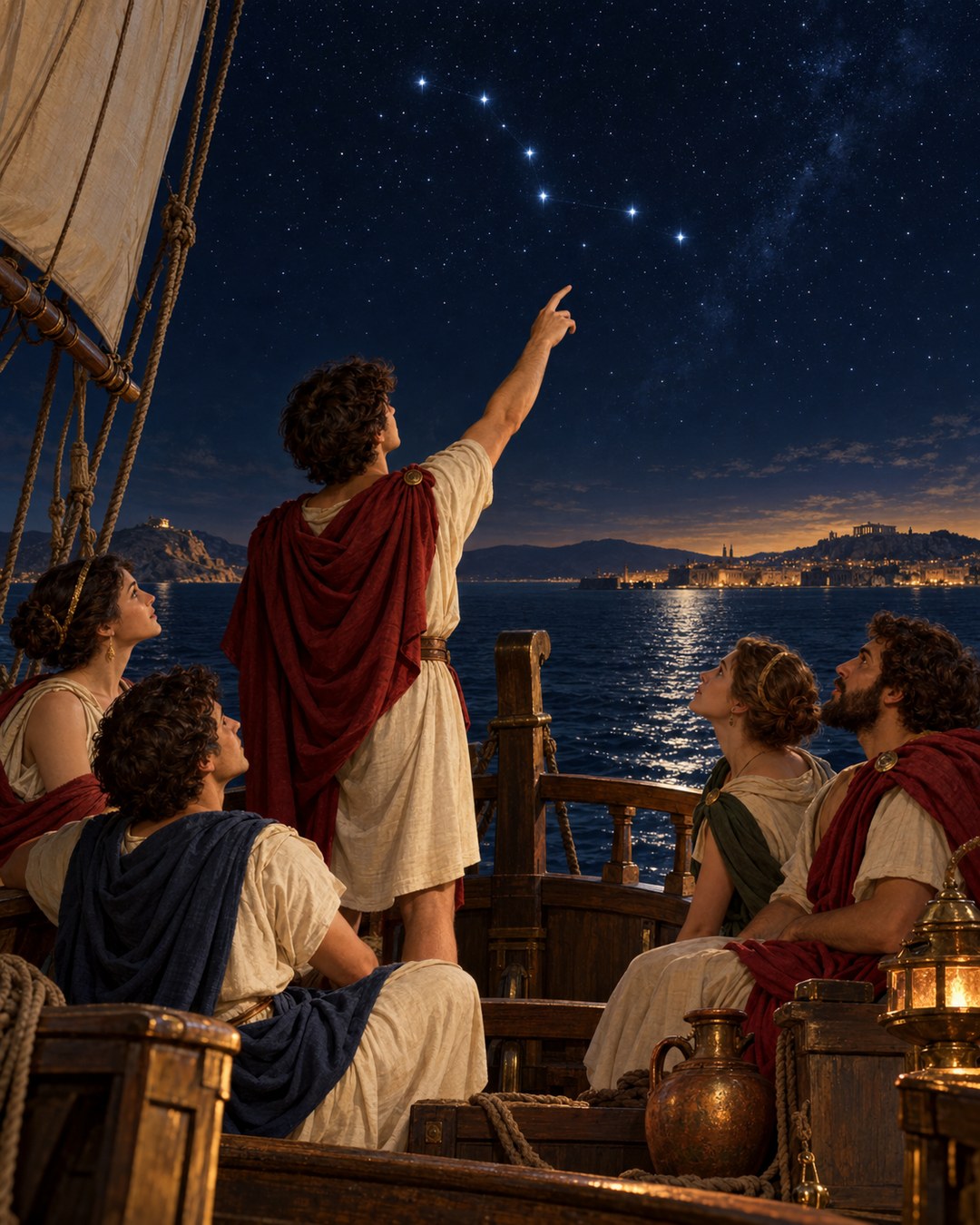
The sea between Aegina and Piraeus was calm, the summer sky clear, and a mixed group of Greek and Roman students sat together in the stern.
They looked upward and disagreed productively. Which stars made the Wain? Which Bear was great or little? Why did Homer call one pattern the only constellation that never set when other stars also stayed above the horizon?
Then Aulus Gellius turned the question homeward. Why did Latin call the group septentriones? “Seven stars” was not enough.
A Boat Became a Moving Classroom under a Stable Sky
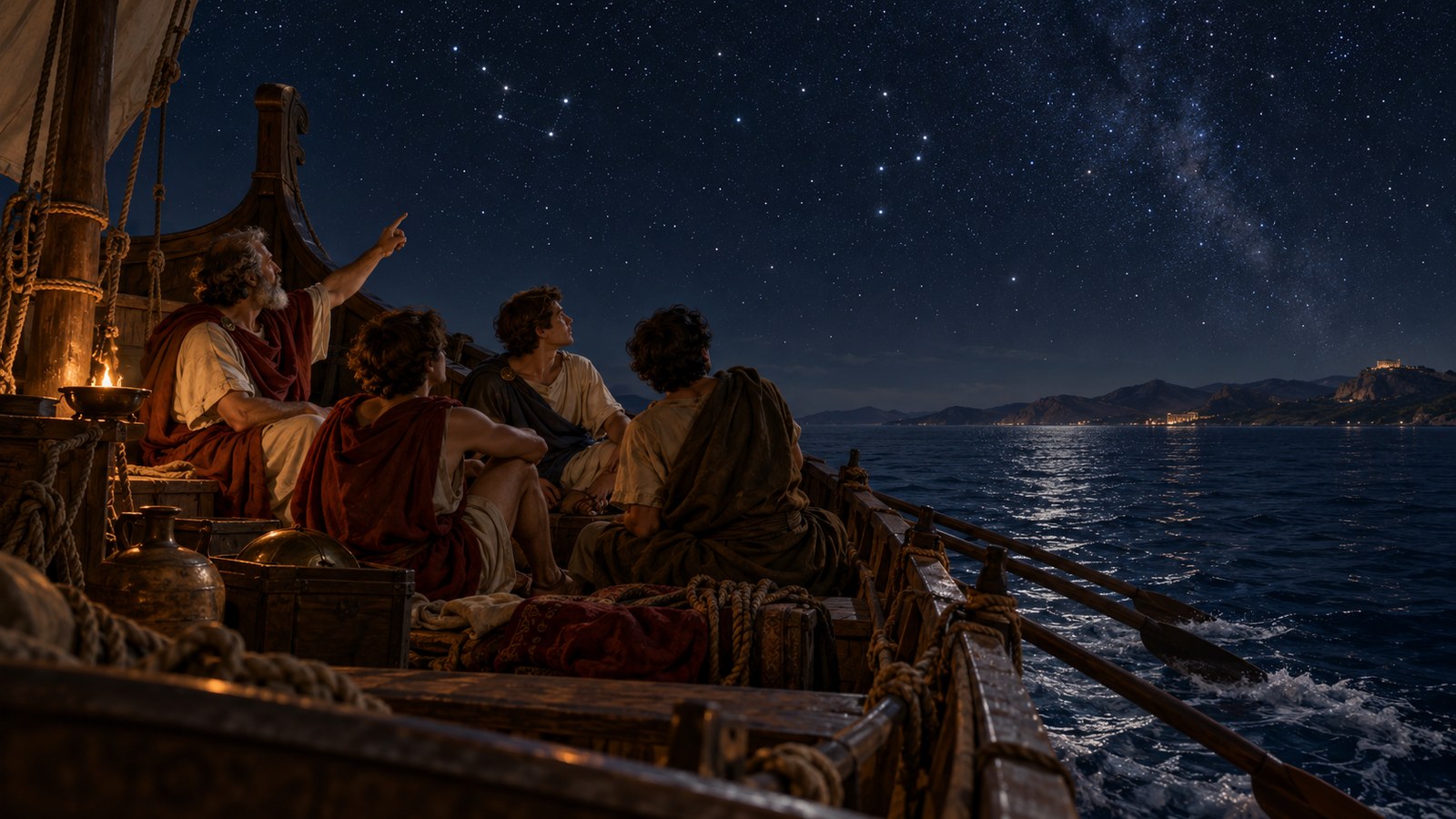
Gellius fixes the conditions before giving the etymology. The travellers were crossing at night from Aegina to the Piraeus. The season was summer. Sea and sky were calm and bright.
Those details create time for attention. A rough passage would direct eyes toward sail, oar and stomach. A clear, slow crossing lets passengers remain in the stern and watch the northern sky while the boat advances.
The company itself matters. Greeks and Romans pursued the same studies but brought different inherited names. Their shared object was overhead; their languages divided it into images.
This was observation without a telescope or drawn chart. Orientation came from recognition, memory and the visible relation among stars. The night could test whether a claimed pattern still held as hours passed.
The scene resembles the patient watching in Pliny’s spring above Lake Como. In both cases, leisure and duration matter. One group watches a waterline repeat; the other watches a constellation move without disappearing.
Gellius does not tell us that sailors needed the debate to steer. The participants are students engaged in learned conversation. Their boat supplies a setting, not a claim that the etymology saved a voyage.
Wain, Bears and Boötes Offered Competing Pictures
The Greek discussion moved among the Wain, Boötes and the Great and Little Bear.
A constellation is not a physical line in the sky. Its figure is an act of connection. Stars separated by darkness can become a vehicle, an animal or a driver when memory supplies the outline.
The Wain emphasizes construction. Gellius’s later explanation says early Greeks used that name from the form and arrangement: the seven stars suggested a wheeled vehicle and its pole.
The Bears organize nearby stars through animal bodies. Boötes adds a human or herding figure. A single region of sky therefore becomes a cluster of related stories and spatial aids rather than one universally obvious object.
Homer’s line sharpened the observational problem. If the poem describes the Bear as the only constellation that does not bathe in Ocean, what should readers do with other stars that also do not set?
Gellius records the question, not a complete astronomical treatise resolving every latitude and textual issue. Its value lies in the habit of comparison: poetic authority is placed beside what observers can see.
The group did not need to reject Homer to notice the tension. Ancient learned conversation often began where a memorable verse and a visible world failed to align perfectly.
Seven Was Correct but Incomplete
Gellius then challenged the Romans. Why septentriones?
The first element looks easy: septem, seven. Gellius explicitly refuses to stop there. A word has another part, and saying that seven stars are visible does not explain it.
Some grammarians treated triones as an empty addition. They compared it to another calendrical word in which, they claimed, a sound followed a meaningful number without contributing an independent idea.
That answer annoyed the question rather than satisfying it. Gellius wanted the whole thought contained by the name.
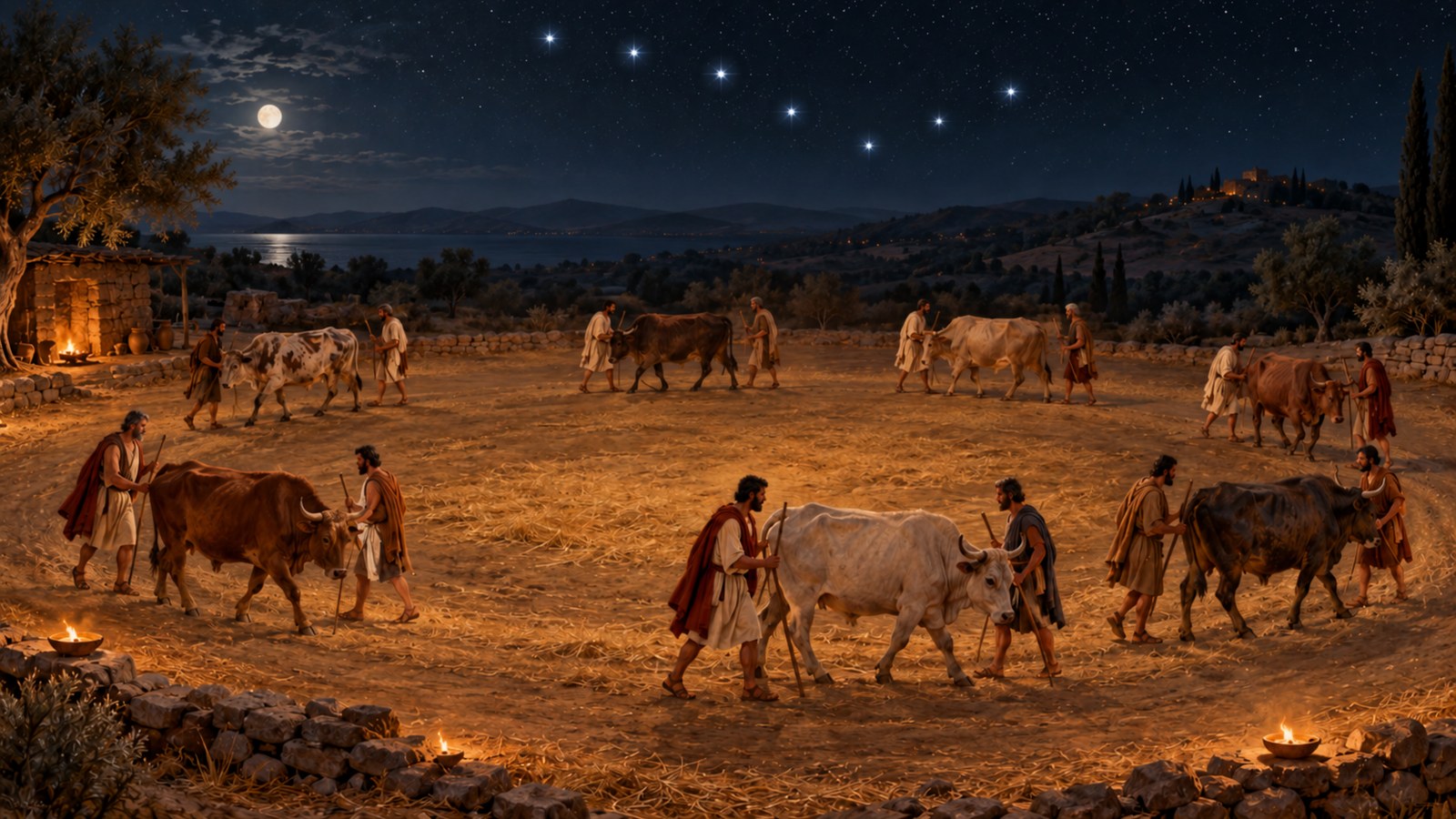
One companion turned to Lucius Aelius and Marcus Varro. On their account, triones was rustic language for plough oxen—animals fitted to working the earth.
The etymology therefore joins number to labour. The name means not merely “the seven” but something like “the seven plough oxen.”
Whether modern historical linguistics accepts every step is a separate question. Gellius’s chapter securely preserves an ancient explanation and the reasoning that made it attractive.
Rotation Made the Rural Image Work
The oxen explained movement as well as count.
The seven stars circle through the northern sky. To an observer, their repeated turning could resemble yoked animals moving over cultivated ground. The comparison takes a familiar earthly pattern and raises it overhead.
That differs from the Wain without contradicting the same visible points. The Greek vehicle image emphasizes arrangement: box, wheels and pole. The Latin oxen image emphasizes circular labour.
Agriculture supplied a mental model because turning draught animals were ordinary enough to think with. The sky became intelligible through work done at ground level.
The passage also shows why translation between constellation names is not simple substitution. “Wain” and septentriones refer toward the same stars while carrying different mechanisms. One asks what shape the points make. The other asks what their motion resembles.
Roman writing repeatedly converts repeated natural motion into a problem of names and causes. Moonlight in Pompey’s attack on Mithridates mattered tactically because celestial position altered shadows. Here the stakes are quieter, but position over time still drives interpretation.
By dawn, the students would have reached land and the brightest stars would fade. The debate endured because Gellius wrote down not only the proposed answer but the setting in which the question became visible.
The best part of that setting is its refusal of a classroom wall. Greek poetry, Latin antiquarian scholarship and rural vocabulary meet in a boat’s stern. Above them, the stars keep turning whether called vehicle, bear or oxen.
The word debate also records social texture among students. Gellius jokingly challenges his Roman companions as “barbarians” when they cannot immediately unpack their own Latin term. Greek learning carries prestige, but the answer he wants comes from Latin antiquarians and a rustic vocabulary.
That reversal matters. The apparently sophisticated speaker knows Homeric problems; the rural word supplies the missing mechanism. Learned inquiry succeeds by crossing levels of language rather than ranking one permanently above another.
The seven oxen image depends on repeated turning. A single glance can count points and perhaps see a wagon. Watching through the advancing night adds motion. The students’ time at sea therefore supports the explanation physically: the sky has enough duration to display the action contained in the name.
At the same time, the passage is not a report of experimental proof. A constellation does not demonstrate its etymology merely by rotating. The observed motion makes Varro’s account memorable and plausible to the discussants; it does not recover a recorded moment when the first Latin speaker coined the term.
Gellius preserves both pleasure and caution by staging the explanation as conversation. One companion offers what ordinary grammarians say. Another prefers Aelius and Varro. Readers hear alternatives rather than receiving a dictionary decree stripped of disagreement.
The boat scene therefore models a compact research practice: inspect the object, reject an answer that explains only half the word, consult older authorities and test their image against motion. No one reaches the stars, but the group improves the question.
The constellation remains useful precisely because every proposed picture is partial. Seven points do not resemble full-bodied oxen, a complete wagon or a bear in any literal way. Viewers select relations—count, line, rotation—and let culture complete them. Gellius’s companions know this. Their argument is not over whether a wagon physically hangs above the mast, but over which inherited comparison best explains a name. The clear sky gives them shared evidence; language determines what each observer has been trained to notice in it.
Sources
Aulus Gellius, Attic Nights, 2.21, reporting explanations associated with Lucius Aelius and Marcus Varro.