

Caecilius’s Necklace delighted Aulus Gellius and the people reading with him. Then someone opened Menander’s Greek original.
The Latin comedy did not suddenly acquire factual errors. Its characters and plot remained recognizable. What changed was the standard of hearing. Read alternately beside Menander, the adaptation seemed dull and lifeless.
Attic Nights 2.23 is valuable because Gellius does not leave that verdict as prestige. He places three corresponding scenes side by side and asks readers to notice where voice, pace and character moved.
A Good Isolated Reading Failed the Alternating Test
Gellius says he often read Roman comedies adapted from Menander, Posidippus, Apollodorus, Alexis and other Greek writers. On their own, the Latin plays could seem witty and charming—almost impossible to surpass.
The impression changed when source and adaptation were matched passage by passage. Alternating the readings made the Greek brilliance act like a stronger lamp beside the Latin text.
This is a method, not only a preference. Memory can forgive a translation because it retains plot and jokes. Parallel reading reduces that generosity. A reader can ask who speaks, what image appears, how long the sentence waits and where the scene turns.
Gellius applies the method to Plocium, “The Necklace.” He and his companions had enjoyed Caecilius. Taking up Menander did not prove that their first pleasure was false; it revealed what the pleasure had not measured.
The competitive reading recalls the writers competing beside Mausolus’s new tomb. There, composition is judged in a formal contest. Here, two texts compete because curious readers choose to place them together.
Gellius even compares their difference to the unequal armour exchanged by Diomedes and Glaucus. The joke is severe: the plots may correspond, but literary value does not trade evenly.
The Husband’s Complaint Needed a Particular Voice
The first scene belongs to an old husband with a rich wife. She has forced him to sell a skilled and attractive maid because she suspects the woman is his mistress.
Menander’s husband complains through sharply observed domestic humiliation. His wife’s wealth controls the house; her jealousy controls who may remain in it. The humour depends on self-exposure. He resents her and also reveals his own compromised position.
Gellius prints the two versions so others can judge. His criticism is not that Caecilius forgot the basic event. Wife, suspicion and expelled servant survive. What thins is the pressure generated by exact phrasing and character-specific bitterness.
A broad Latin complaint can announce that marriage to a rich woman is miserable. Menander’s scene, in Gellius’s account, makes one husband’s misery arrive through the face everyone must now look at and the servant no one may see.
The difference matters theatrically. Actors need motives that can live in gesture and pause. A generic maxim invites declamation. A jealous household detail lets the speaker look toward a door, lower his voice or implicate the audience in embarrassment.
Gellius’s own quotation and commentary are not a complete performance record. We do not know every movement of ancient actors. But the comparison securely shows him listening for dramatic voice rather than checking only whether the narrative information crossed languages.
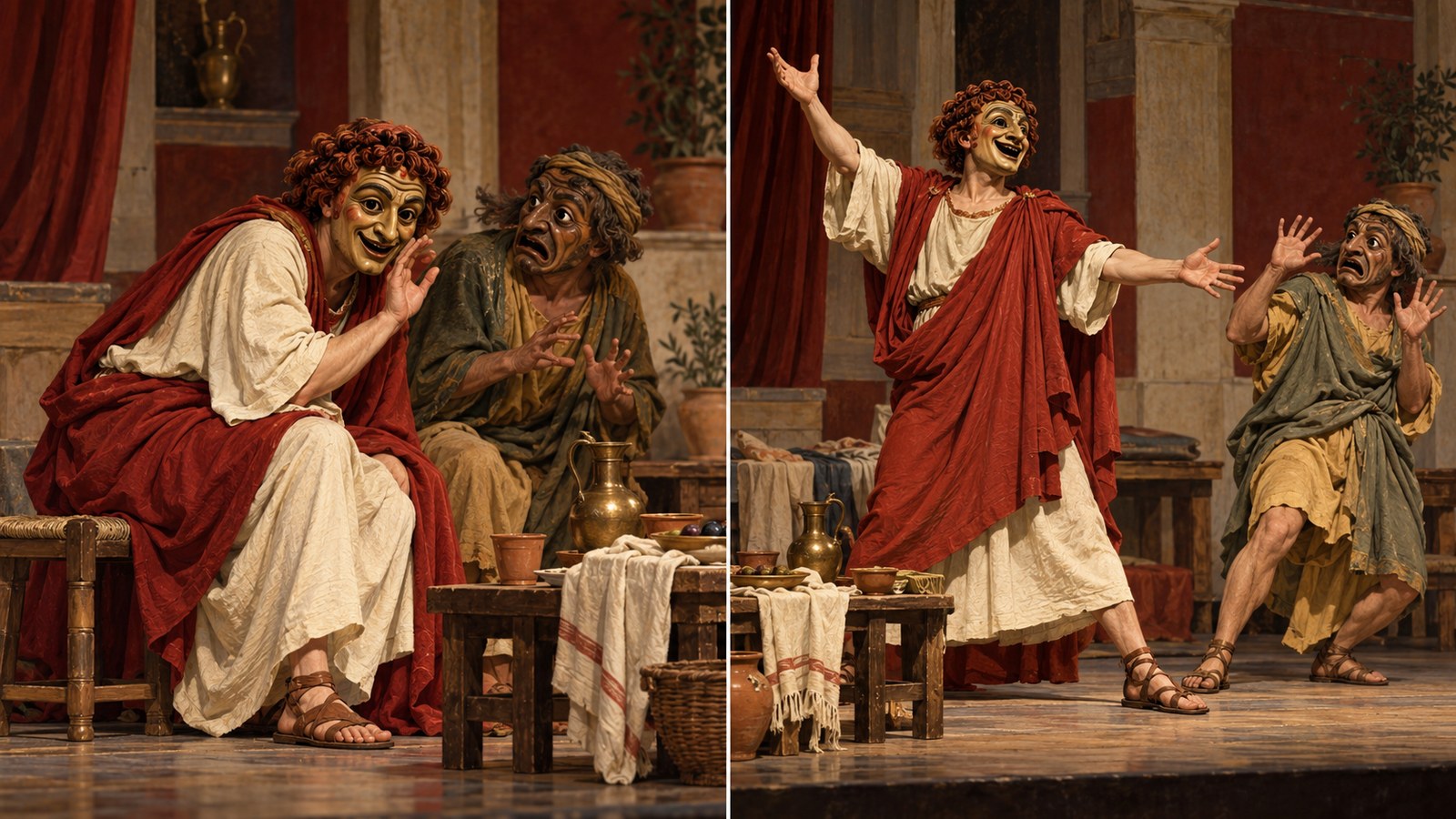
Consolation Lost Its Hesitation
The second comparison changes emotional temperature.
A friend consoles a young man whose intended bride was violated shortly before the wedding. She has given birth, and the young man does not yet know that the child is his. Recognition and reconciliation lie ahead, but the scene must first hold uncertainty.
Gellius admires the hesitant, intimate movement of Menander’s consolation. The friend’s speech does not sound like a public lecture pasted into a private crisis. Its broken rhythm belongs to someone trying to guide another person through pain and incomplete knowledge.
Caecilius, in Gellius’s judgment, expands or hardens the material into something more commonplace. The ethical content may remain—endure misfortune, listen, do not act rashly—yet the texture of one friend approaching another weakens.
This is where “literal accuracy” becomes an inadequate measure. A translator can preserve propositions while changing relationship. If consolation becomes a polished maxim, the speaker no longer feels his way toward a wounded listener.
Roman audiences certainly knew forceful sententiae, just as readers of Trimalchio’s deceptive dinner know that performance can overwhelm substance. Gellius asks for something more local: does this speech belong to this mouth at this moment?
Removing the Nurse Rewired Recognition
The third comparison concerns the child’s identity.
In Menander, a nurse notices the infant’s resemblance to the young man. Her presence gives recognition a particular observer—someone positioned close enough to mother and child to see family likeness emerge.
Caecilius removes the nurse from that part and redistributes observations among other characters. Plot information still travels. The child can still be identified. But the route changes.
That change demonstrates why adaptation is structural. A character is not a container holding lines that can be poured elsewhere without residue. Who notices resemblance determines intimacy, credibility and comic timing.
The nurse also links domestic labour to knowledge. She has access because care places her beside the newborn. Remove her, and recognition may become a statement delivered by someone with a different relation to the household.
Gellius does not claim that adaptation must never alter a source. His own chapter recognizes Latin comedy as an established practice. His complaint is comparative and specific: these alterations fail to reproduce qualities he can point to in Menander.
The three scenes build a coherent test. The old husband asks whether a complaint carries an individual voice. The friend asks whether consolation preserves hesitant intimacy. The nurse asks whether recognition belongs to the observer who makes it dramatically persuasive.
That is more useful than declaring “Greek good, Latin bad.” Gellius teaches a reading procedure. Enjoy the version alone. Then open the source, align the scenes and ask what the new language has done to character.
Caecilius’s play survived the first evening’s laughter. It failed only when another scroll entered the room.
There is also fairness in Gellius’s decision to copy the passages. He announces a strong preference, but he does not ask readers to accept it without exhibits. Others can compare the lines and decide whether his ear has overvalued the Greek.
That openness matters because adaptation has goals beyond verbal closeness. A Latin playwright may answer audience expectation, metre, casting or stage convention. Gellius does not reconstruct those pressures, so his judgment remains literary rather than a complete production history.
Even within that limit, the selected examples are exact. He does not complain that Caecilius is vaguely less elegant across an entire career. He points to the husband’s characterization, the friend’s cadence and the nurse’s removal. Criticism becomes useful when it names a changed mechanism.
The nurse is particularly instructive because her absence proves that translation operates on personnel. Once lines move between speakers, social knowledge moves too. A household attendant’s close observation can become a free citizen’s exposition, and the recognition acquires a different texture even if the infant remains the same.
Gellius’s reading circle gives the comparison a second theatrical life. The comedy no longer exists only as actors before an audience. Friends voice both versions around open scrolls, making sound and alternation part of criticism.
That scene offers a durable lesson without requiring obedience to Gellius’s taste. Read adaptations as works capable of pleasure. Then align them with sources closely enough to see where they choose a new effect. The gap may be loss, gain or deliberate transformation—but it should not remain invisible.

Sources
Aulus Gellius, Attic Nights, 2.23, comparing Menander and Caecilius’s Plocium.