

Favorinus said the eye could separate more colours than language could name.
Fire, blood, purple, saffron and gold could all be called red, yet no one looking at them would mistake one material for another. Marcus Fronto answered that Latin was richer than the philosopher allowed.
Their discussion ended not with an abstract chart but with a horse and a palm shoot. The rare colour spadix, Fronto explained, took its force from the reddish-gold branch freshly cut from a palm.
Gout Kept Fronto Seated but Not Silent
Favorinus was on his way to visit Fronto, the former consul, who was suffering from gout. He invited Gellius along. Other learned men were present when talk turned to colours.
The domestic setting matters. This was not a dyer’s workshop or a formal lecture. It was a visit to an ill public intellectual where conversation moved through examples available to memory, literature and ordinary sight.
Favorinus began with a perceptual claim: the eye detects more distinctions than words express. Basic terms such as red and green gather many shades under single names.
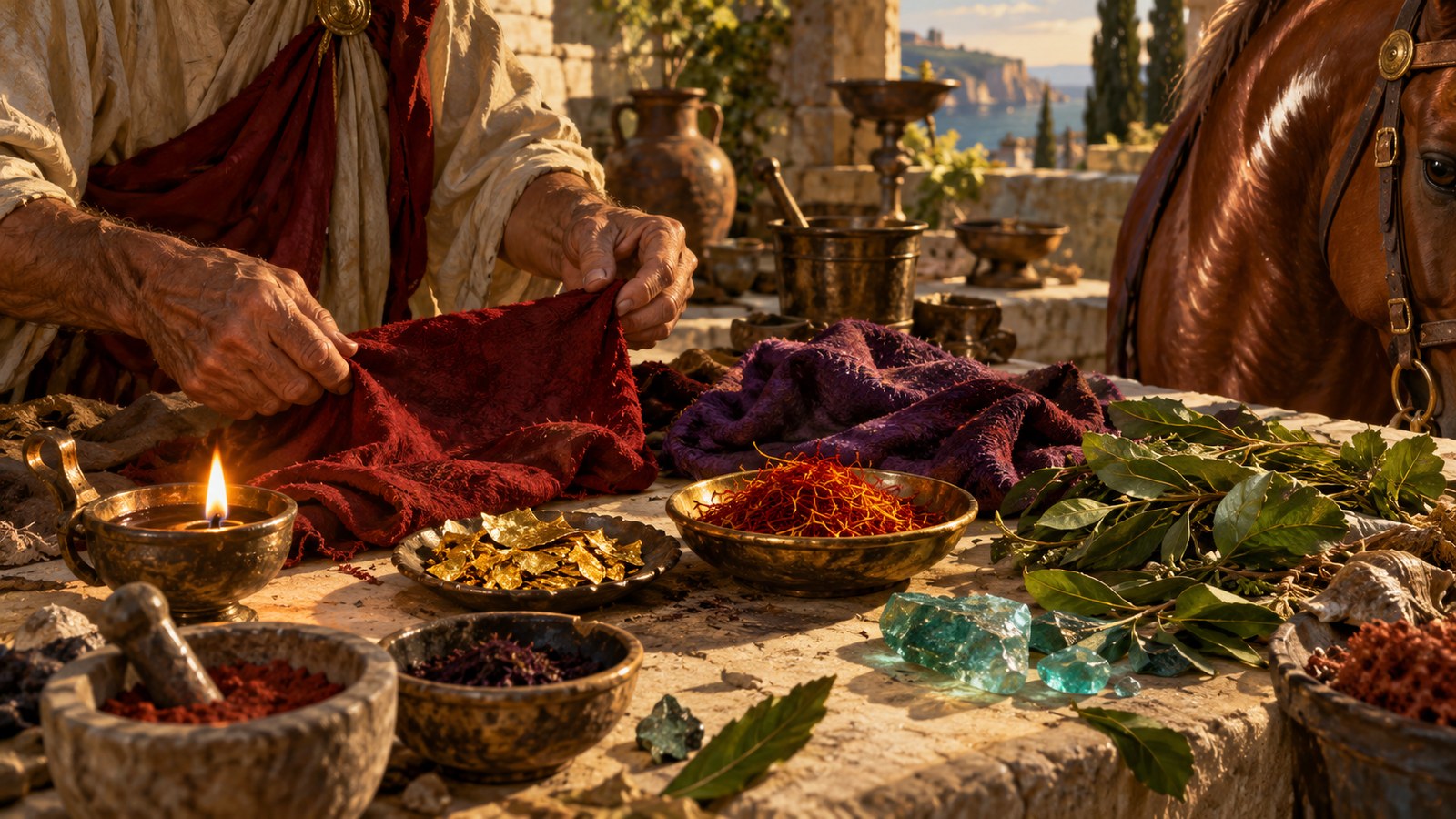
His red examples are material. Fire glows differently from blood. Purple cloth, saffron and gold occupy other parts of the family. Latin can call them fiery, blood-red, saffron, purple or golden, but then it borrows the names of things to refine a broad colour.
That borrowing is not a failure of vision. It is one way vocabulary grows. A speaker points to a familiar substance whose appearance listeners can retrieve.
The process resembles craft evidence in the copper plates turned green by vinegar vapour. There, a colour reveals a material change. Here, materials provide the comparisons from which colour speech is built.
Greek Richness Provoked a Latin Counter-Inventory
Favorinus claimed that Greek marked varieties of red more fully. He listed terms that could intensify, lighten or mix the basic impression.
Fronto did not deny Greek abundance. He denied that Latin was helpless. His answer gathered Latin words whose ranges touched red, yellow, darkening and green.
The exchange is not a modern scientific classification. Neither man produces measured wavelengths or standardized samples. Their evidence is usage: poets, familiar substances and what educated speakers understand a word to evoke.
That makes overlap unavoidable. A colour term may shift with object and context. The same word can lean toward flame in one line and toward a horse’s coat in another.
Favorinus’s challenge also exposes translation risk. If one language offers several near terms and another often relies on compounds or material comparisons, a neat one-word substitution may erase the shade an author intended.
Fronto’s counter-inventory therefore defends expressive resources, not perfect equivalence. Latin can approach the distinction through inherited vocabulary, qualification and literary precedent.
Sea and Foliage Refused to Stay Simply Green
Green presents the same problem as red.
Fresh foliage, older leaves, seawater, glass and dyed material do not occupy one visual point. Light, depth, surface and mixture alter what the eye receives.
Gellius’s chapter lets the speakers move among those objects because colour becomes clearer through contrast. Place gold beside saffron and their kinship does not erase difference. Place sea beside leaf and “green” begins to split.
Ancient readers also met colour through costly substances and crafted surfaces. Purple was not merely a hue detached from cloth and dye. Gold brought reflectivity. Saffron carried plant, scent and use.
This material density helps explain why vermilion walls protected under wax required a process, not merely a colour choice. A named red lived in mineral, binder, wall, light and maintenance.
Favorinus is therefore right at the level of perception: a small vocabulary cannot exhaust visible variation. Fronto is right at the level of speech: languages recruit comparison, context and rare terms to do more work than a list of basic names suggests.
Their disagreement becomes productive because neither side can settle it by counting dictionary entries alone. A word’s range must be tested where writers use it.
Spadix Joined Horse Coat to Palm Wood
Fronto’s most memorable example comes from Virgil’s description of horses.
The rare word spadix describes a reddish or chestnut colour. Fronto connects it with the Greek word for a palm branch. A fresh shoot cut from the palm carries a reddish-gold appearance, making it a natural comparison for a horse’s coat.
The explanation moves through three media: plant, animal and poem. A reader who has seen the cut shoot can imagine the coat; a poet can compress that comparison into one unusual term.
The horse is not literally palm-coloured in every light. Nor is the branch a manufactured colour standard. The strength lies in a shared visual neighborhood: red warmed toward gold or chestnut.
Fronto’s etymology also answers Favorinus on his own ground. Latin need not possess an isolated technical label for every shade if literary usage preserves a dense comparison inside a word.
Gellius records the discussion because vocabulary can store observation. The speakers do not merely argue national pride. They ask how names carry the eye’s distinctions from one person to another.
The setting returns at the end. Fronto is physically limited by gout, yet the conversation travels from his room to flame, blood, sea, foliage, horses and palms. Colour language performs that travel by carrying small pieces of material memory.
Favorinus’s opening remains true: the eye will always outrun a fixed list. Fronto’s reply remains useful: speech is not confined to fixed lists. It can point, compare, borrow and revive an old poetic word until a listener sees the shade.
The debate also separates a colour from the object carrying it only imperfectly. Fire emits light, gold reflects it, blood darkens, and purple depends on textile and dye. Calling all of them red identifies kinship while leaving their behaviour unresolved.
For makers, those differences are practical. A painter, dyer or mosaicist cannot substitute saffron for metal simply because a speaker groups both near yellow-red. Material determines durability, gloss, texture and change under illumination.
Gellius does not interview those craftspeople in this chapter. His speakers are philosophers and literary men. Their examples nonetheless preserve a world in which colour vocabulary was learned through contact with substances, animals and plants rather than a detached digital code.
The horse brings another complication: coats vary across the body and with grooming, age and sunlight. Spadix is useful not because every viewer will select an identical modern swatch, but because the palm shoot provides a vivid center for the term’s range.
Poetry then stabilizes the rare word by placing it in memorable context. A reader may not use spadix in daily speech, yet Virgil’s line and Fronto’s explanation keep the comparison available.
The argument never produces a winner’s trophy. Favorinus has exposed lexical compression; Fronto has demonstrated resources hidden inside supposedly poor Latin. Gellius preserves the exchange because the friction itself teaches readers to look again—first at the word, then at the thing, then back at the word.
There is no contradiction in saying that a language has few basic terms and many precise effects. The first claim concerns inventory; the second concerns use. Speakers can narrow a broad term with an object, revive an uncommon adjective or arrange two colours in contrast. Fronto’s defense works at that practical level. He does not need Latin to mirror Greek item for item. He needs to show that a Roman poet can make a reader distinguish this horse from every animal described only as red, yellow or brown.

Sources
Aulus Gellius, Attic Nights, 2.26, reporting a discussion between Favorinus and Marcus Fronto.