
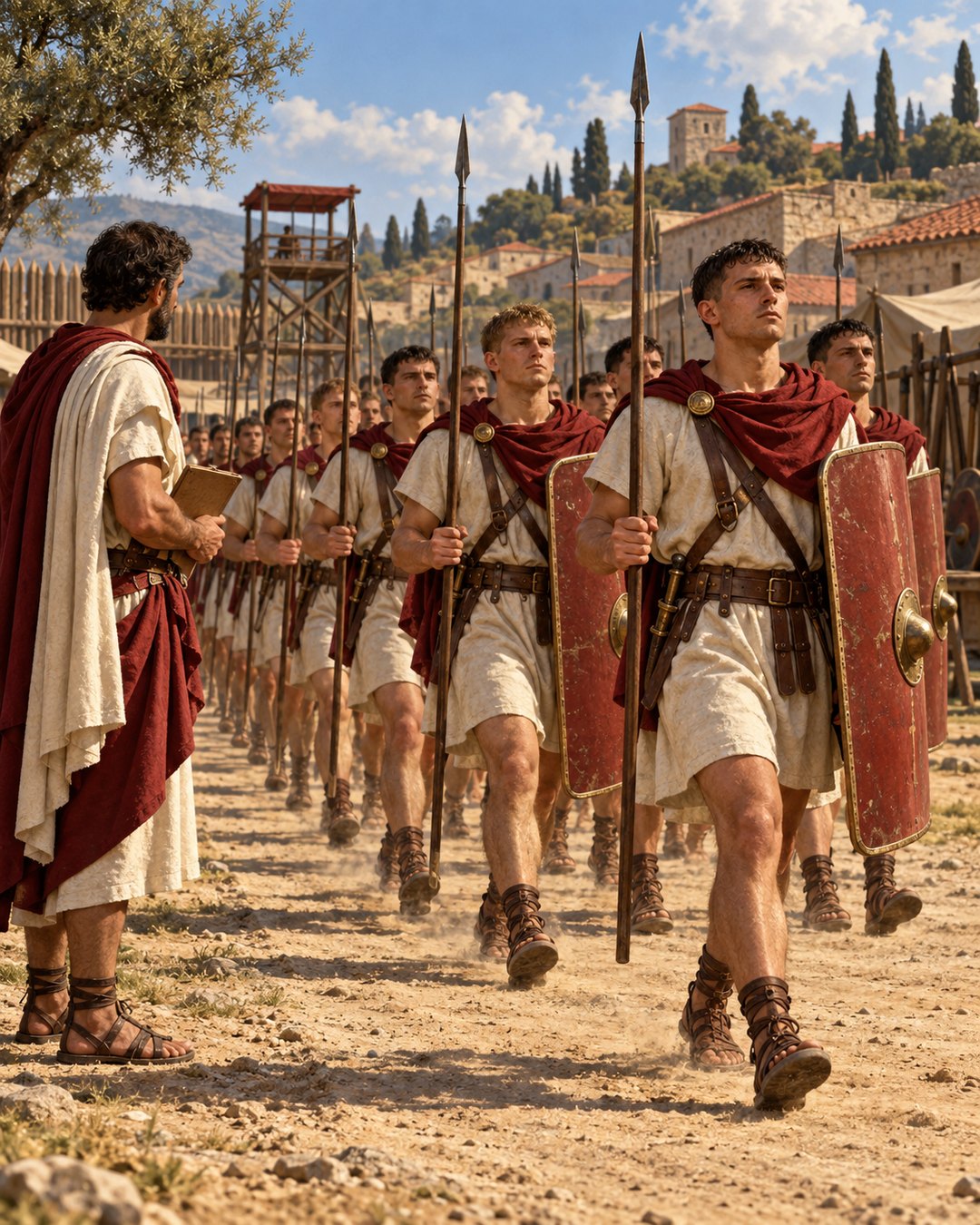
The Roman recruit’s first contest was not necessarily with an enemy. It was with the pace of the men beside him. Vegetius prescribed a military step that covered twenty Roman miles in five summer hours, then a faster full step that covered twenty-four in the same span. Those figures sound like a test of endurance. His explanation makes them a test of order.
An army on the road had to move quickly and evenly. If its files stretched, clumped or broke apart, speed could create the weakness it was meant to prevent. Vegetius warned that a divided and disordered force faced its gravest danger from the enemy. The measured pace therefore joined legs to formation. A recruit was learning not simply how fast he could walk, but how reliably a column could arrive together.
The clock belonged to the whole column
Vegetius begins the exercise with the military step. Recruits were to learn it at the opening of their training because marching order mattered on a journey and in battle. Quickness without equality of pace was not enough. The skill had to be made habitual through constant practice.
The first standard was twenty Roman miles in five summer hours. The second was sharper: twenty-four miles at the full step in the same time. Vegetius gives no name to an individual winner. No fastest recruit is praised. The useful result is collective, because a body of soldiers can preserve intervals only when its members understand the same tempo.
That emphasis separates the timed march from a modern race. A racer may succeed by dropping everyone else. A soldier in formation could turn personal speed into a gap, and a gap into confusion. The number on the route mattered because it set a shared expectation. Distance and time translated discipline into something officers could see.
Other exercises made individual weapons familiar. A recruit striking the six-foot practice stake learned to direct blows at a fixed target. The marching standard addressed a different target: the moving relationship among many bodies.
Twenty-four miles marked the edge of walking
Vegetius distinguished the military step from the full step rather than treating every hurried movement as the same. Twenty miles belonged to the regular military pace. Twenty-four represented a faster walk. Beyond that point, he said, movement became running, whose distance could not be defined in the same way.
The distinction gave training a sequence. Recruits first acquired an even, repeatable walk. They then learned to increase its speed. Only after the measured walking paces did Vegetius turn to running without a fixed mileage. The structure kept urgency from swallowing control at the start.
Five summer hours also supplied a practical frame rather than an abstract command to “march hard.” The standard could be attempted again. A unit that failed to cover the route or arrived spread out exposed a problem before a campaign made that problem lethal. Exercise converted future pressure into a rehearsed morning.
Vegetius was writing about military customs he wanted restored, not recording every march made by every Roman army. His numbers are prescriptive. They tell us what he thought disciplined movement should look like. That makes the pairing especially revealing: the ideal was not merely long distance, but long distance completed at a named pace.
Running had jobs rather than a mileage
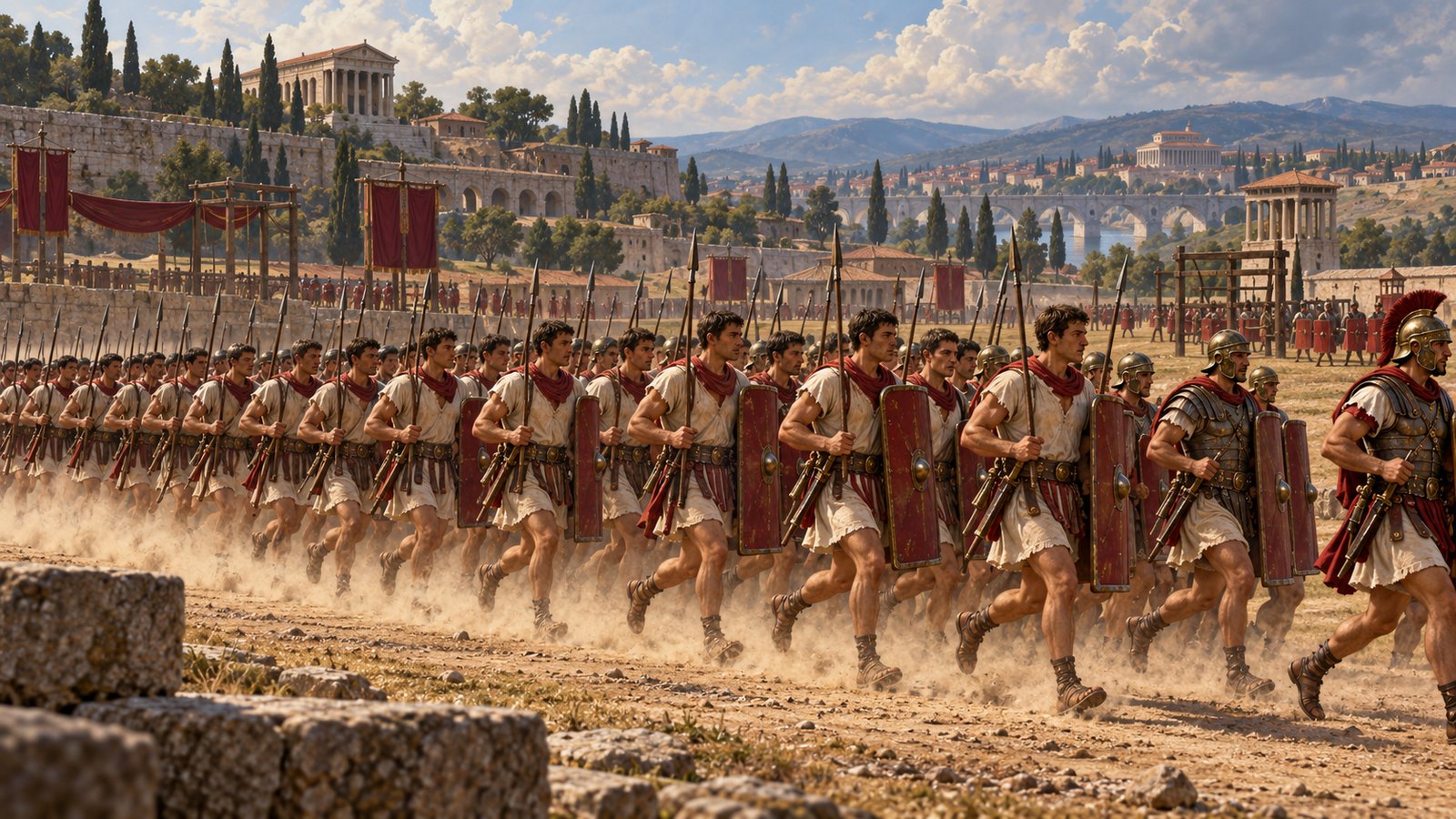
Once the pace became a run, Vegetius stopped assigning a fixed distance and began listing uses. Younger soldiers should run so they could advance against an enemy with greater force. They should reach useful ground quickly and arrive before opponents trying to occupy the same place.
Running also belonged to reconnaissance. A soldier had to go out briskly and return even faster. In pursuit, speed helped close on those fleeing. These are different scenes—charge, seizure of terrain, scouting and pursuit—but each rewards movement at the right moment rather than motion for its own sake.
The absence of a running mileage fits that variety. A hill might be near; a report might have to cross a longer space; a pursuit might stop or extend according to the enemy. Walking pace could be standardized over a route. Running answered a changing tactical demand.
Vegetius’s recruit was therefore not trained as a single-speed machine. He moved through a controlled range. The steady step carried the army. The full step accelerated it without turning the column into a race. Running supplied a burst when ground, information or a withdrawing opponent made seconds valuable.
A ditch tested whether momentum survived terrain
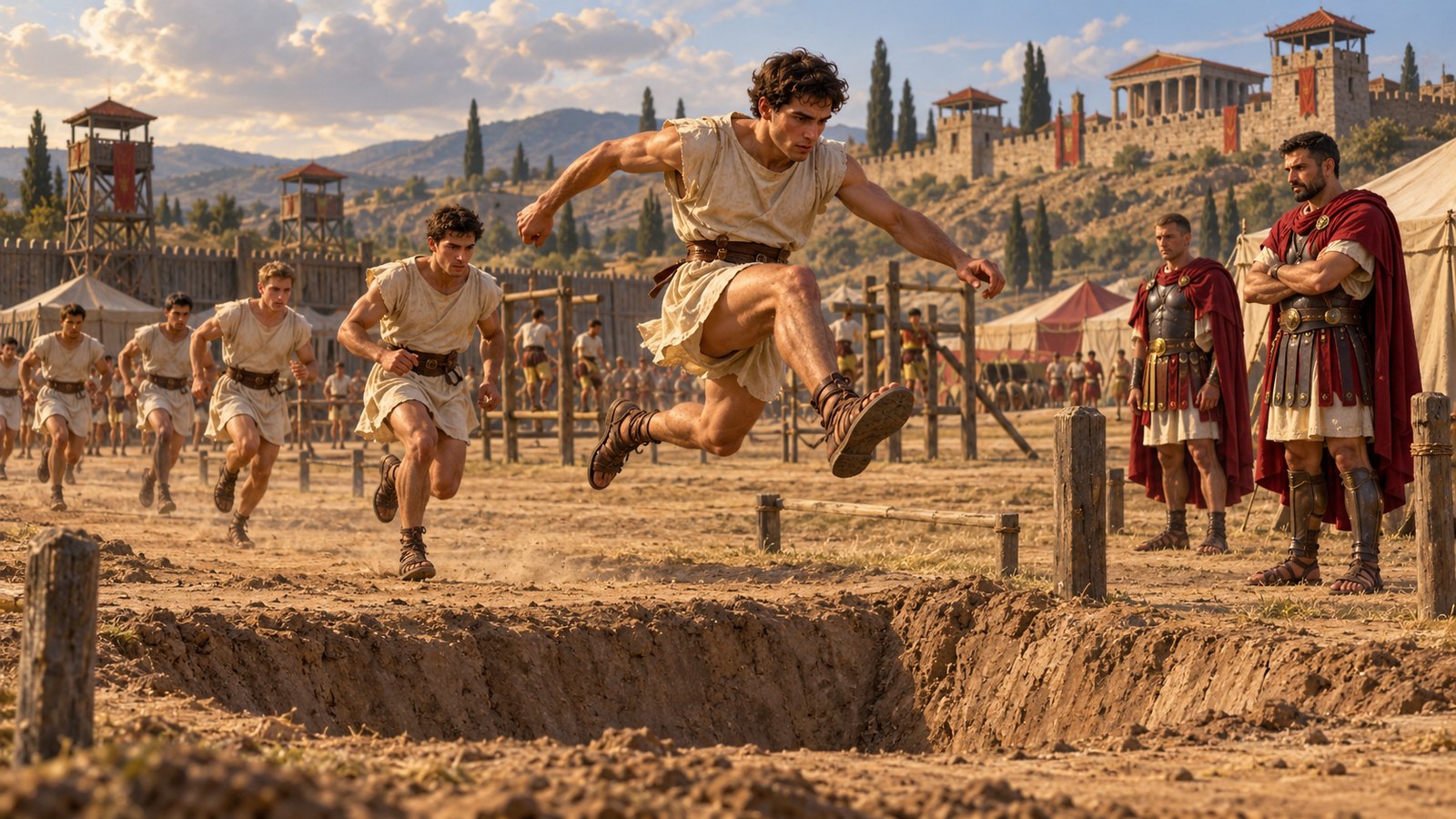
Jumping completed the set. Vegetius wanted soldiers practised in crossing ditches and getting over obstructing heights. A column might keep perfect pace on a road and still lose its coherence when the ground interrupted it. The obstacle exercise taught bodies to carry movement across a break.
This was not an ornamental athletic display. Ditches could protect camps and positions; uneven ground could separate a quick advance from a stalled one. A recruit who hesitated at the lip forced those behind him to check their pace. Many small hesitations could compress one part of a line while opening another.
Vegetius even imagined the run and jump inside close combat. A fighter arriving with both could dazzle or unsettle an opponent and strike before the other man had prepared to guard or resist. The language may magnify the effect, but the mechanism is clear: trained momentum shortens the opponent’s time to react.
Weighted equipment trained another side of the same problem. The doubled wicker shield and practice weapon made ordinary arms feel lighter later. Running and jumping made broken ground feel less exceptional. Both methods tried to make battlefield difficulty familiar before fear and fatigue arrived with it.
Pompey became the competitive example
To close the lesson, Vegetius reached for Sallust’s portrait of Pompey. The commander competed with the agile in jumping, with the swift in running and with the strong in exercise with a bar. Vegetius used the example to connect command with repeated bodily practice.
The point was not that every recruit could become Pompey, or that one anecdote proves how all legions trained. It gave the manual a memorable human figure. The commander’s readiness against Sertorius was attributed not to status alone, but to exercises performed frequently by himself and his soldiers.
That example returns the chapter to habit. A timed standard is useful only when repeated often enough to become a pace rather than a special effort. Running toward ground and jumping a ditch help only when the movement survives equipment, surprise and the pressure of other bodies.
Five hours and twenty miles provided a number, but the deeper unit was the formation. The recruit learned to match a common stride, accelerate without scattering, run when the task changed and cross an interruption without stopping those behind him. Vegetius’s distances were demanding. Their military meaning came from everyone reaching the far end as an army.
The sequence also explains why the chapter links walking, running and jumping instead of filing them as unrelated athletic talents. Each exercise protects continuity under a different kind of pressure. The shared step protects it across distance. Running protects it when urgency compresses time. Jumping protects it when terrain breaks the route.
Vegetius does not promise that fitness cancels surprise. He offers rehearsal for predictable forms of disruption: a rival trying to seize the same ground, a scout who must return quickly, a fugitive opening distance, or a ditch interrupting an advance. The trained soldier has already met the movement even if he has not met this particular enemy or landscape.
Seen that way, the five-hour rule was less about celebrating hardship than about making movement legible. Officers could recognize whether recruits held the prescribed pace, whether a column remained coherent and whether faster motion began only when its purpose justified the loss of a fixed standard.
Sources
Vegetius, Epitome of Military Science, 1.9. James Grout, “Flavius Vegetius Renatus.”