
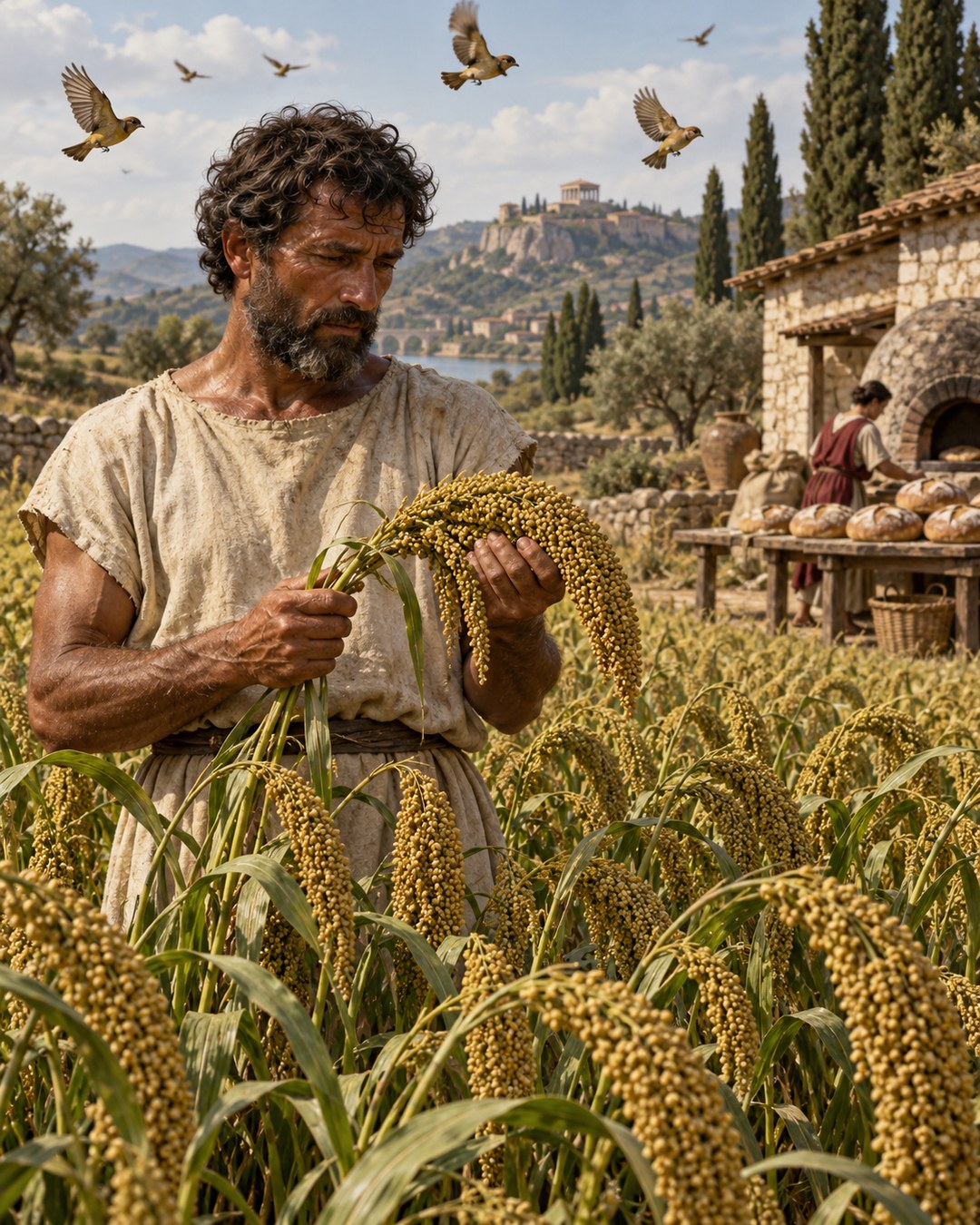
Pliny the Elder could look at a millet head and see a bargain split between a farmer, a flock of small birds and a cook. The birds took their portion in the field because thin skins left the grain exposed. The kitchen answered with expansion: Pliny reports that one peck of millet produced sixty pounds of bread, while a much smaller measure soaked in water became a full peck of porridge.
Those figures do not turn his encyclopedia into a modern yield trial. They reveal what Pliny thought worth measuring. Millet occupied a vulnerable seed head, a particular place in the sowing calendar and a remarkable place in the pot. Its value came from the whole sequence, not from the plant alone.
The Pleiades divided one sowing calendar from another
Pliny begins by sorting grain according to season. In the Italian practice he describes, wheat and barley belonged among winter grains, sown around the setting of the Pleiades and nourished in the earth through winter. Common millet and Italian millet belonged to the summer group, sown before the constellation’s rising.
The sky supplied a shared marker, but it did not force one universal timetable. Pliny says that Greece and Asia sowed all grains after the Pleiades set. Italy used both dates, and some crops could even receive a third sowing in spring. Agricultural time was therefore local knowledge expressed through a celestial clock.
Terminology shifted with that practice. Some people called common millet, Italian millet, lentils, chickpea and groats-wheat spring grains. Bread wheat, barley, beans and turnip were classed as autumn-sown. The labels mattered because they bundled plants with decisions about weather, soil and labour.
This seasonal sorting offers a useful contrast with the sealed trenches that were said to preserve wheat for decades. Storage tried to suspend time after harvest. Millet’s calendar governed the risk before a stalk appeared.
Thin skins made birds co-owners of the field
Once the plant emerged, its construction created another negotiation. Pliny describes the two millets as rising into knotted, hollow straw. He then compares the ways crops protect seed. Wheat and barley carried ears defended by beards; legumes enclosed fruit in pods; sesame and poppy used capsules.
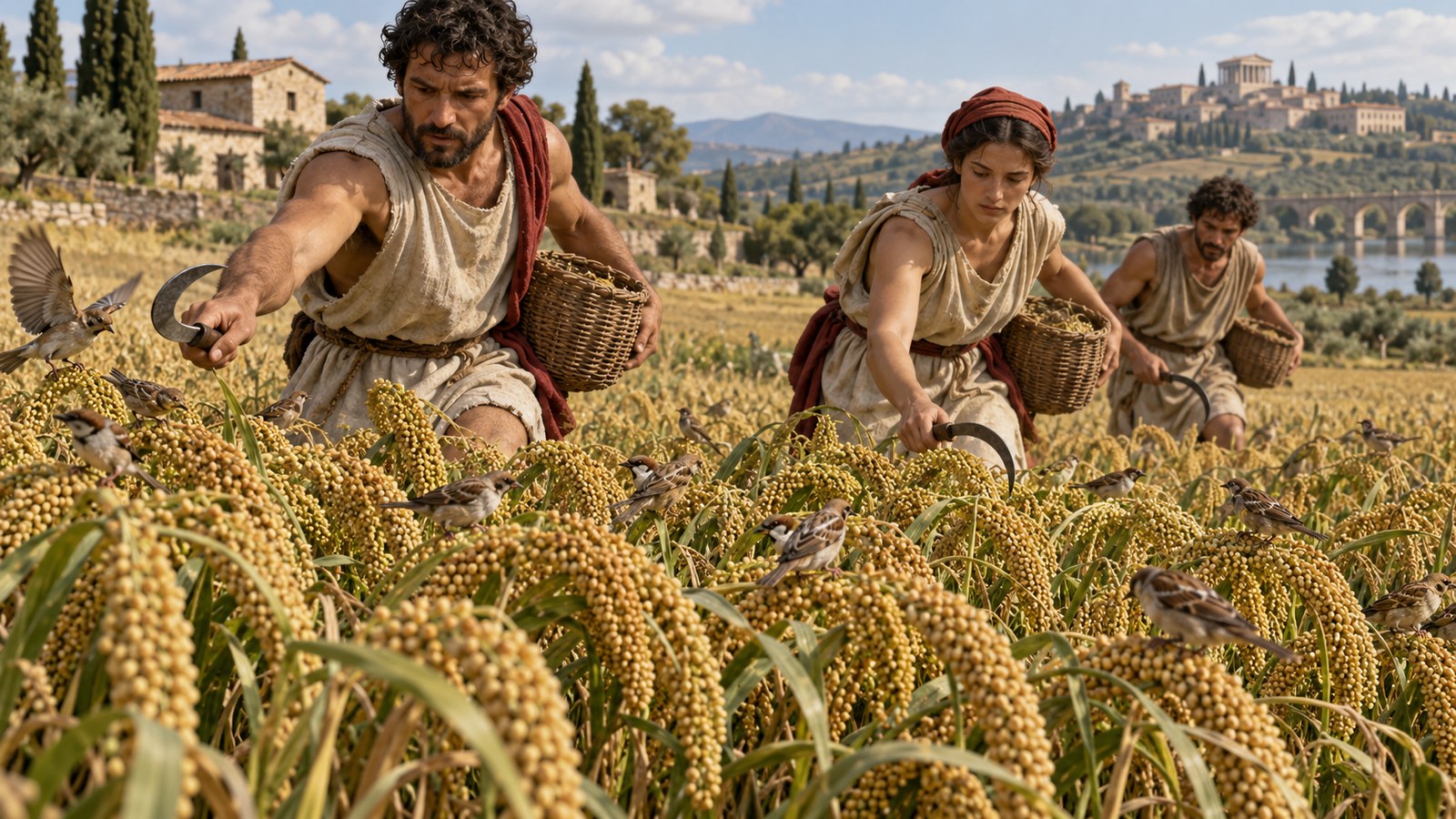
Millet offered less armor. Its grains sat inside thin skins accessible to small birds. Pliny calls the result a kind of joint ownership between the birds and the grower. The joke is concise because the physical problem was visible: a ripening head could be harvested from above before the human harvest arrived.
Panic, a related grain in his discussion, carried a drooping head packed with seed. Pliny derives its name from its panicles or tufts and says the longest head could extend to a foot. Millet differed in the curved hairs embracing its seed. These were not decorative botanical observations. Head shape affected how grain hung, how it could be reached and how a field announced ripeness.
Pliny lists white, black, red and purple forms. He also notes varieties of panic, including a full-breasted kind clustered with little tufts and a double point. His compressed catalogue preserves a grower’s world in which “millet” was not one uniform substance. Colour, branching and seed arrangement distinguished what the field offered.
The bakehouse reversed the field’s apparent weakness
Exposure did not make millet a failed crop. Pliny shifts directly from the vulnerable head to food. Several kinds of bread were made from millet, he says, though very little bread came from panic. The distinction keeps the two grains from collapsing into interchangeable names.
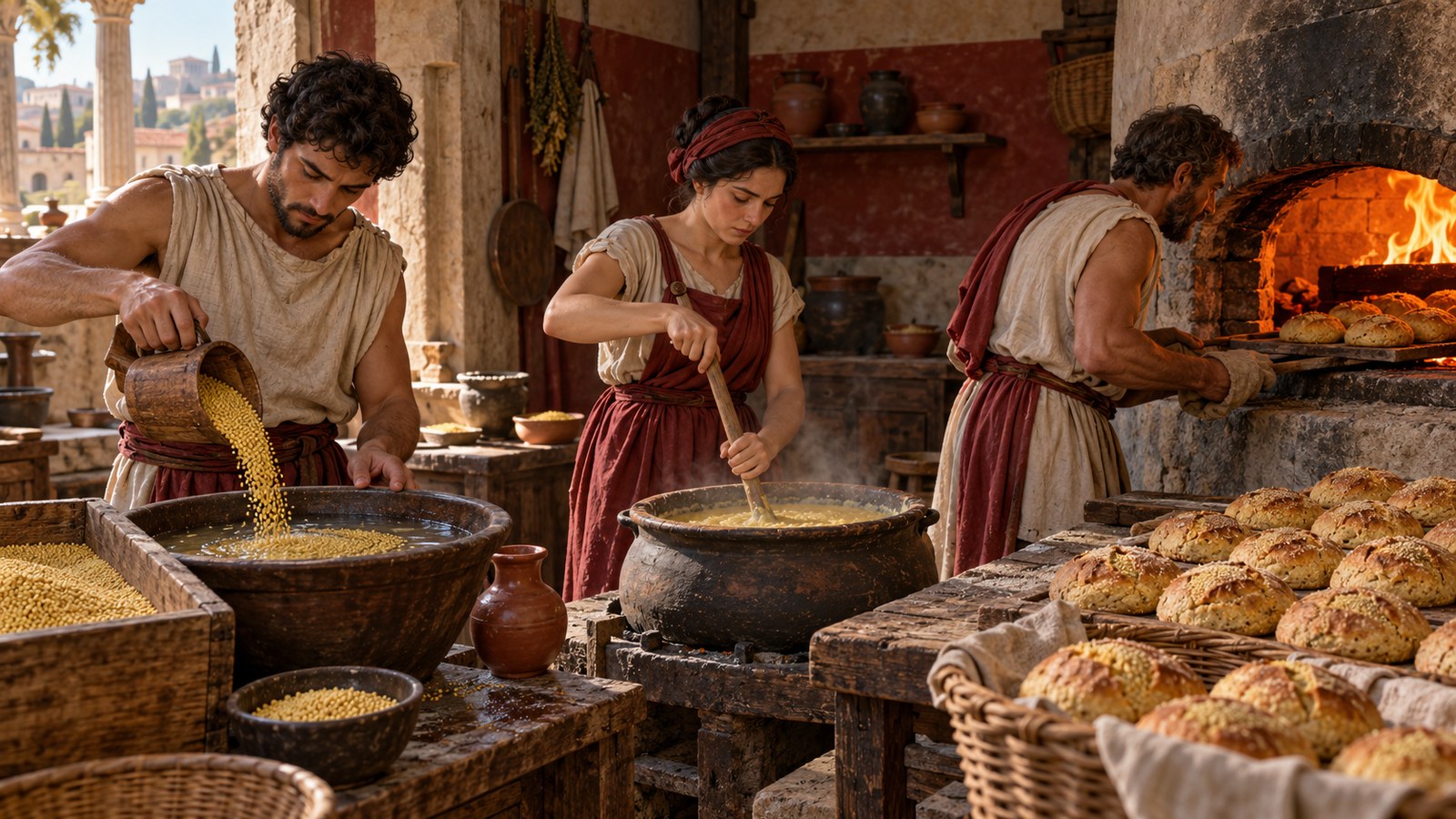
Then comes the number that changes the scale of the passage: a peck of millet yielded sixty pounds of bread. Pliny says no grain was heavier or swelled more in baking. The field measure and the finished weight are not the same kind of unit, and his text does not provide the controlled conditions a modern baker would require. What matters here is the ancient claim about transformation.
Water made that transformation especially plain in porridge. Three-sixteenths of a peck, soaked, produced a peck of food. A household did not experience grain only as sacks in a storeroom. It experienced the grain after grinding, wetting, heating and dividing it among bowls.
The same attention to separation appears in the sloped threshing floor that moved heavier kernels toward its edge. That process used weight to sort a harvest. Millet’s kitchen value came when moisture and heat made a modest volume occupy more space.
A recent Indian arrival stretched seven feet high
Pliny ends this part of the discussion with a newcomer. A black, large-grained millet from India had been introduced into Italy within the previous ten years, he says. That short interval gives the catalogue a contemporary edge. He was not describing only crops imagined as ancestral and fixed.
The imported plant looked different enough to demand measurements. Its stalk resembled a reed and rose seven feet. Large hairs, called its mane, surrounded the head. Pliny calls it the most prolific of all kinds of corn and reports that one grain produced three-sixteenths of a peck.
Again, this is Pliny’s reported observation, not a result that can be transferred uncritically into modern agronomy. Yet its placement is revealing. Variety entered the encyclopedia through novelty, visible form and multiplication. Origin alone did not explain why the crop mattered; height and output did.
The ten-year note also prevents a simple story in which Roman agriculture merely repeated inherited routines. Seed moved. Growers tested unfamiliar material. An author in Italy tried to fit a recent arrival into an older vocabulary of millet, corn, stalk, hair and measure.
Measures connected loss, labour and appetite
The passage never gives us a named farmer standing in one identifiable field. Instead it gives a chain of practical comparisons. The Pleiades set or rose. Stalks became hollow and knotted. Panicles drooped. Birds reached thinly covered seed. Bakers and cooks watched grain swell. A foreign stalk rose seven feet.
Each observation changes the unit of attention. Calendar rules belong to regions. Seed coverings belong to plants. Theft belongs to flocks. Pecks and pounds belong to storage and food preparation. Pliny’s achievement is not experimental precision by present standards, but the decision to keep those scales beside one another.
That is why the birds’ “joint ownership” is more than a pleasant aside. It names a cost before the crop is converted into food. The sixty pounds and the expanded porridge name the compensating advantage afterward. A grower could lose some grain at the head while a household valued how far the remainder went.
Millet therefore appears as neither poor substitute nor botanical curiosity. In Pliny’s account it is a crop whose exposed structure, flexible calendar and swelling grain produced a distinctive economy. The farmer did not own every seed that ripened. The kitchen, however, could make the human share become much larger than it first looked.
The measurements also discipline the story. Pliny does not say that every field produced the same return or that every loaf followed one recipe. He reports capacities in the units his readers recognized. Repeating those numbers as ancient claims preserves their force without pretending they answer questions the text never tested.
What survives is a field-to-table argument built from concrete things: a constellation, hollow straw, a drooping panicle, thin skins, pecks, pounds, water and bread. Millet’s history sits in the connections between them. Its weakness was visible before harvest, and its strength became visible only after human work changed the grain.
Sources
Pliny the Elder, Natural History, 18.10.