
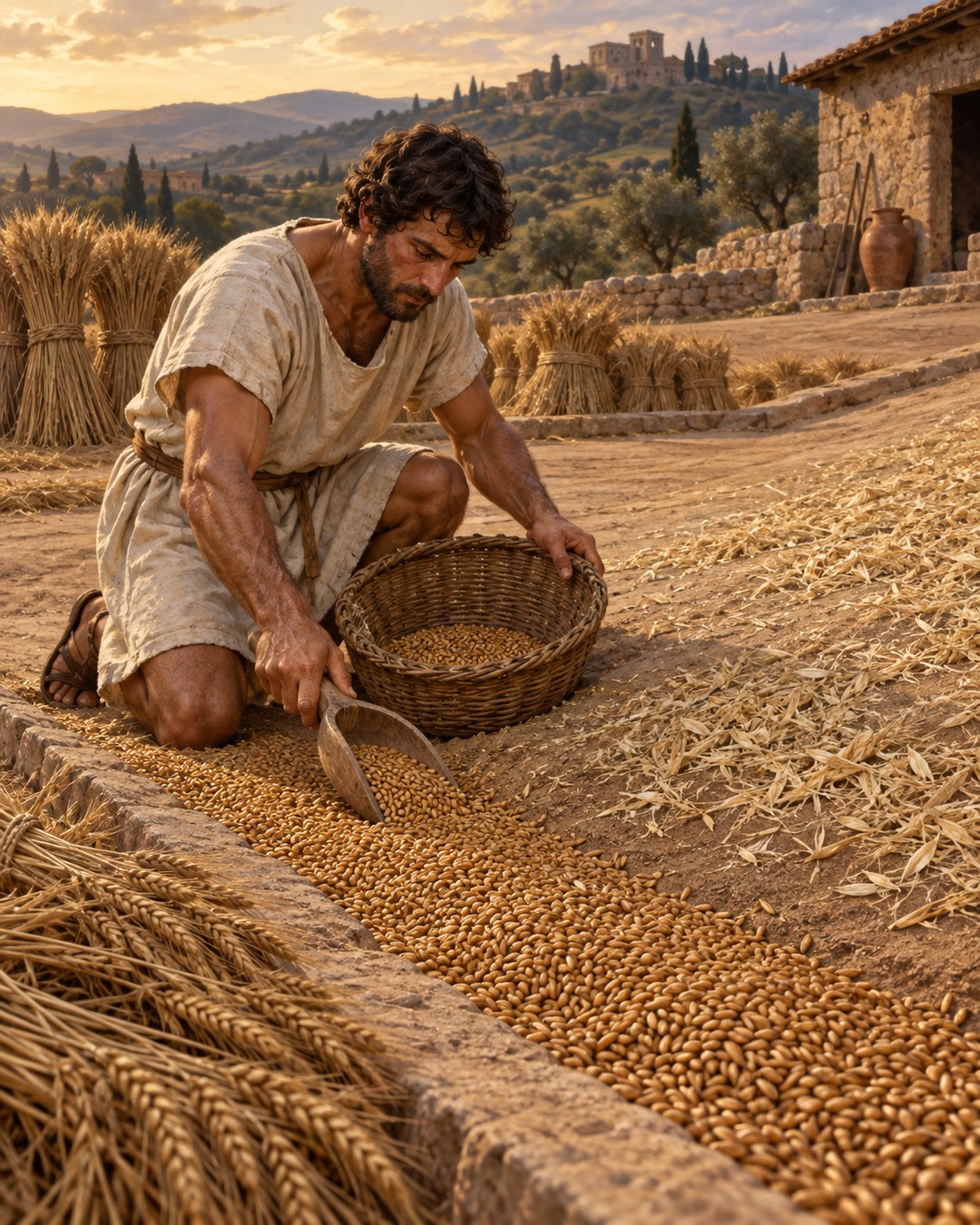
The best seed waited at the low edge of the floor.
Pliny told farmers to reserve the grain that fell to the bottom of the threshing floor. It was the heaviest fraction, and in his account weight supplied the best practical sign of quality. The floor had already helped separate crop from straw and chaff. Its slope could also decide which kernels returned to the earth.
That first choice was not enough. Age, colour, the spacing of grain on the ear and the appearance of a broken kernel all entered the inspection. Then soil moisture, rain and sowing density changed how the selected seed was cast.
A harvest became next year’s crop through a sequence of small tests, not one dramatic invention.
The Floor Sorted More Than Chaff
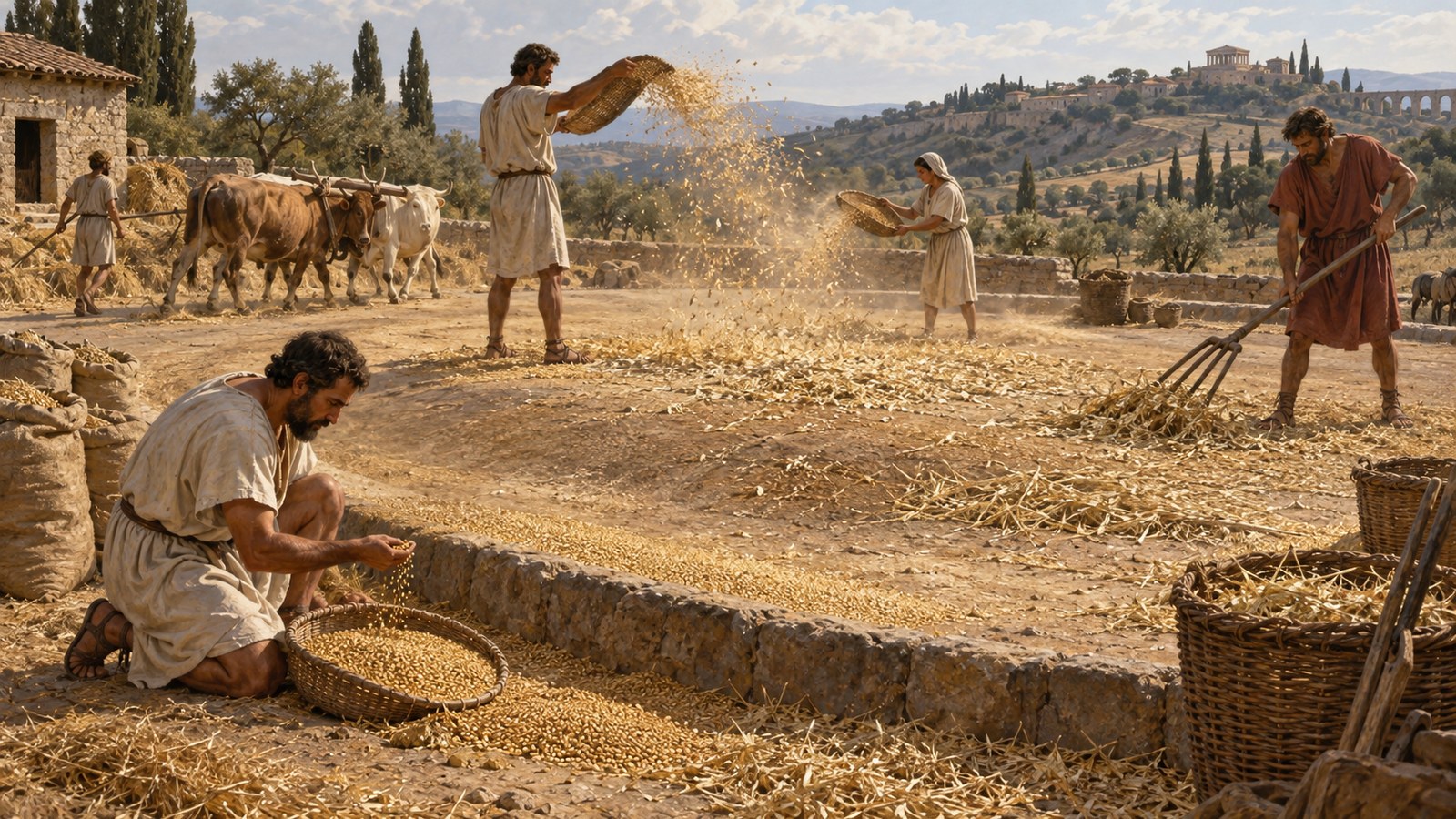
A Roman threshing floor was a working surface. Grain could be loosened from ears, trampled or dragged, tossed, swept and gathered there. The process explored in the story of hooves, flint and wind at harvest separated useful grain from the lighter mass around it.
Pliny adds another selection inside that work. The grain that reached the bottom of the floor was to be kept for sowing because it was the most weighty. The recommendation makes sense as a physical procedure even without a balance. A slightly raised center and inclined sides encouraged dense kernels to collect lower down, where the farmer could reserve them as a distinct batch.
The floor therefore created a gradient. Material did not leave threshing as one perfectly uniform heap. Its position could preserve evidence about how it had moved. Grain concentrated at the low edge had passed a rough test that required no marked weight and no inspection of every kernel.
This did not mean every heavy object was seed or every lighter kernel was useless food. Winnowing, cleaning and visual judgment still mattered. Pliny’s point is narrower: when choosing the portion entrusted with the next crop, relative weight offered a practical ranking.
The advice also shows why each harvest stage mattered beyond convenience. Another article follows the curved blade used to gather standing grain. Once that cut crop reached a coherent, prepared floor, an incline could guide movement rather than trapping the best grain in irregular hollows.
Selection began in architecture. Before the seed entered a basket, the shape of the workplace had already helped divide it.
One Harvest Had Several Ages
Weight did not rescue seed that had waited too long. Pliny ranks the most recent year’s growth first, seed two years old below it and seed three years old worst. Beyond that, he calls it unproductive.
The ranking forced a farmer to know not only what a sack contained but when it had been harvested. Grain stored for food might remain valuable while becoming a poorer wager for germination. Seed grain therefore needed an identity through time.
That requirement had consequences for storage and household memory. Batches could not be mixed casually if the intention was to preserve the youngest for sowing. The advice implies labels in practice without requiring written tags: separate bins, separate vessels, remembered locations or some other disciplined distinction between harvest years.
Pliny presents a definite rule, not an experiment with percentages. His categories are blunt. Their practical effect is clear nevertheless. A farmer choosing between old reserves and the latest crop was told to privilege freshness, then apply the physical tests to that preferred material.
The order matters. The heaviest grain from an exhausted batch was not automatically equivalent to the heaviest grain from last year. Age and density answered different questions. One concerned retained capacity across storage time; the other compared quality inside a harvest.
Together they narrowed a large food stock into a smaller seed stock. What people ate and what they planted came from the same crop, but the future portion was selected by stricter rules.
Colour and Fracture Opened the Kernel
Pliny next moves from the heap to the hand and mouth. Ears with intervals between their seeds were to be rejected. The preferred grain had a reddish hue. When broken between the teeth, it was supposed to present the same colour within; a whiter interior counted as inferior.
These checks changed scale. The floor compared masses through movement. Ear spacing was visible before threshing. Colour could be judged on the surface. Biting opened a sample and let the farmer examine what the husk concealed.
The tooth test was not a chemical analysis, and Pliny does not give a numerical threshold. It was a repeatable sensory action. A kernel could be held, broken and compared with the appearance expected from better seed.
Modern readers should resist turning every ancient observation into a timeless scientific law. The translation’s notes even question whether all grain interiors match Pliny’s colour claim. What matters historically is the decision system he records: farmers combined age, location on the floor, weight, ear form and fracture appearance rather than trusting one sign.
Each check also had a different failure mode. A full-looking ear might conceal inferior kernels. A reddish exterior might not continue inside. Heavy grain might still be old. Multiple observations reduced dependence on any single impression.
The procedure was economical because it sampled at useful stages. Whole ears could be rejected early; a chosen batch could be gathered by position; individual kernels could then be opened for closer inspection. The amount of labor increased only as the candidate seed pool became smaller.
Moisture Changed the Calendar and Density
Selection ended at the field, where the same seed behaved differently under different conditions. Pliny recommends earlier sowing on humid ground so rain will not leave the grain to rot. On dry spots he advises sowing later, shortly before a shower, so seed does not lie ungerminated for long.
The two instructions seek the same result through opposite timing. Wet ground creates danger from prolonged moisture. Dry ground creates danger from delay without enough moisture. The calendar could not be detached from the soil underfoot.
Sowing density changed with timing as well. Early seed was to be cast thick because germination would take longer. Later seed was to be cast more thinly so emerging plants did not suffocate one another.
Pliny does not supply a universal count per patch in this chapter. He gives relationships: wetter and drier, earlier and later, thicker and thinner. A farmer had to translate them into the field in front of him.
This makes the advice less like a recipe and more like a chain of conditional choices. The selected kernel carried promise, but placement could still waste it. Good seed on the wrong day or at the wrong density remained a bad investment.
The field was therefore another sorting device. It sorted decisions by moisture and weather, requiring the sower to adjust before any green shoot made success or failure visible.
The Right Foot Kept the Hand Even
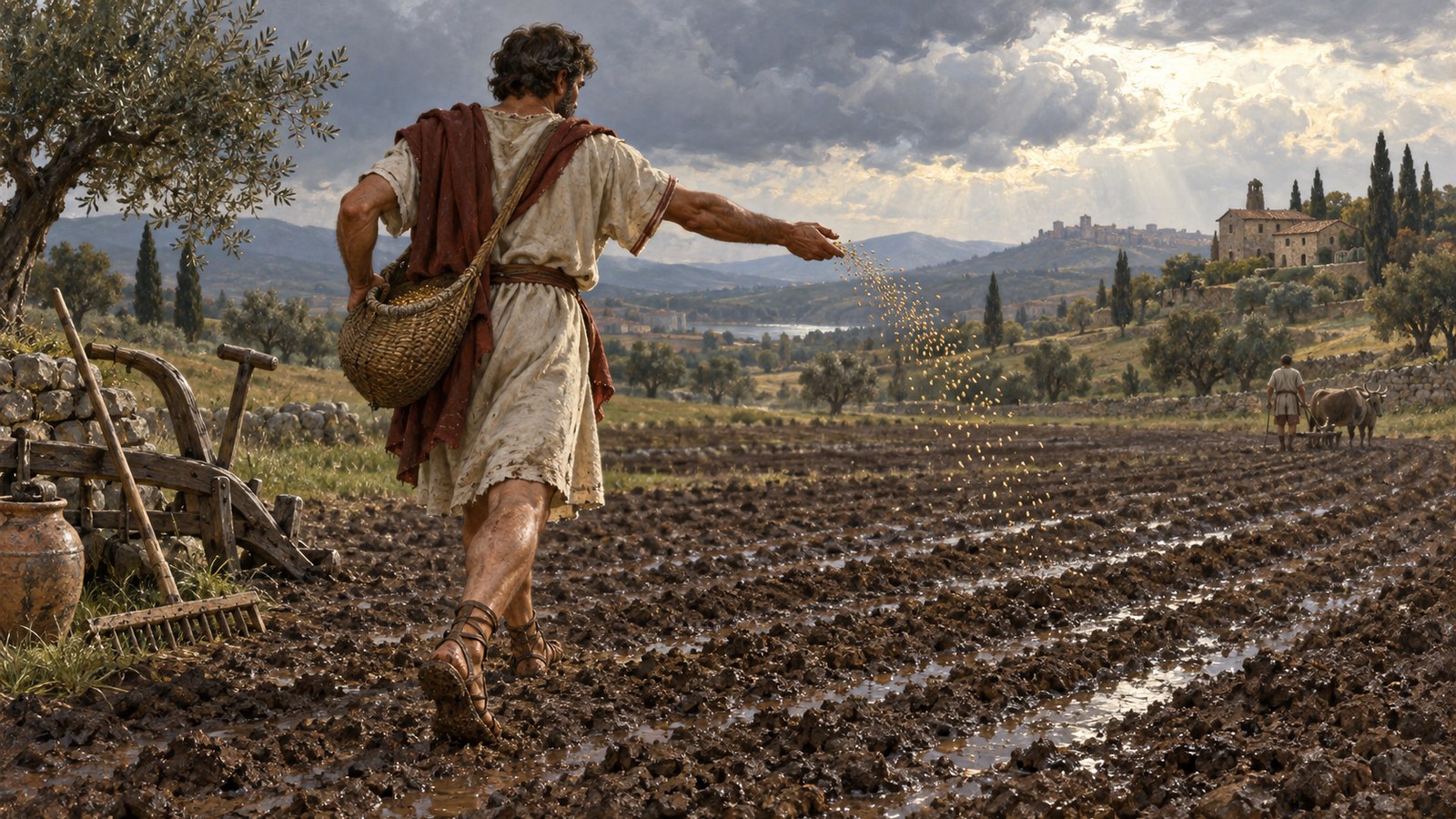
Finally, Pliny describes the body of the sower. To scatter seed evenly, the hand was to keep time with the step and move with the right foot.
Broadcast sowing had no machine metering each release. Regular coverage depended on coordinating gait, arm motion and the amount held in the hand. Linking the cast to one foot made a repeating cycle. Each stride supplied a cue for the next arc of seed.
The technique turned walking into measurement. The foot did not count grain, but it stabilized intervals. The arm did not draw a grid, but a practiced sweep could cover ground more consistently when synchronized with a familiar pace.
Evenness mattered because the density decisions described by Pliny had to become spatial reality. A farmer could intend a thin sowing yet create crowded patches if handfuls fell irregularly. Rhythm translated an abstract choice about density into repeated movement across the field.
The full process now runs from floor to foot. A slope concentrated the heavy kernels. Memory separated younger seed from older. Eye and tooth tested form and colour. Soil and rain set timing. Step and hand distributed the final selection.
No single stage guaranteed a harvest. Their value lay in sequence. Pliny’s account preserves a craft in which buildings, senses, weather judgment and trained movement all participated in choosing what the next agricultural year would inherit.
Sources
Pliny the Elder, Natural History 18.54.