
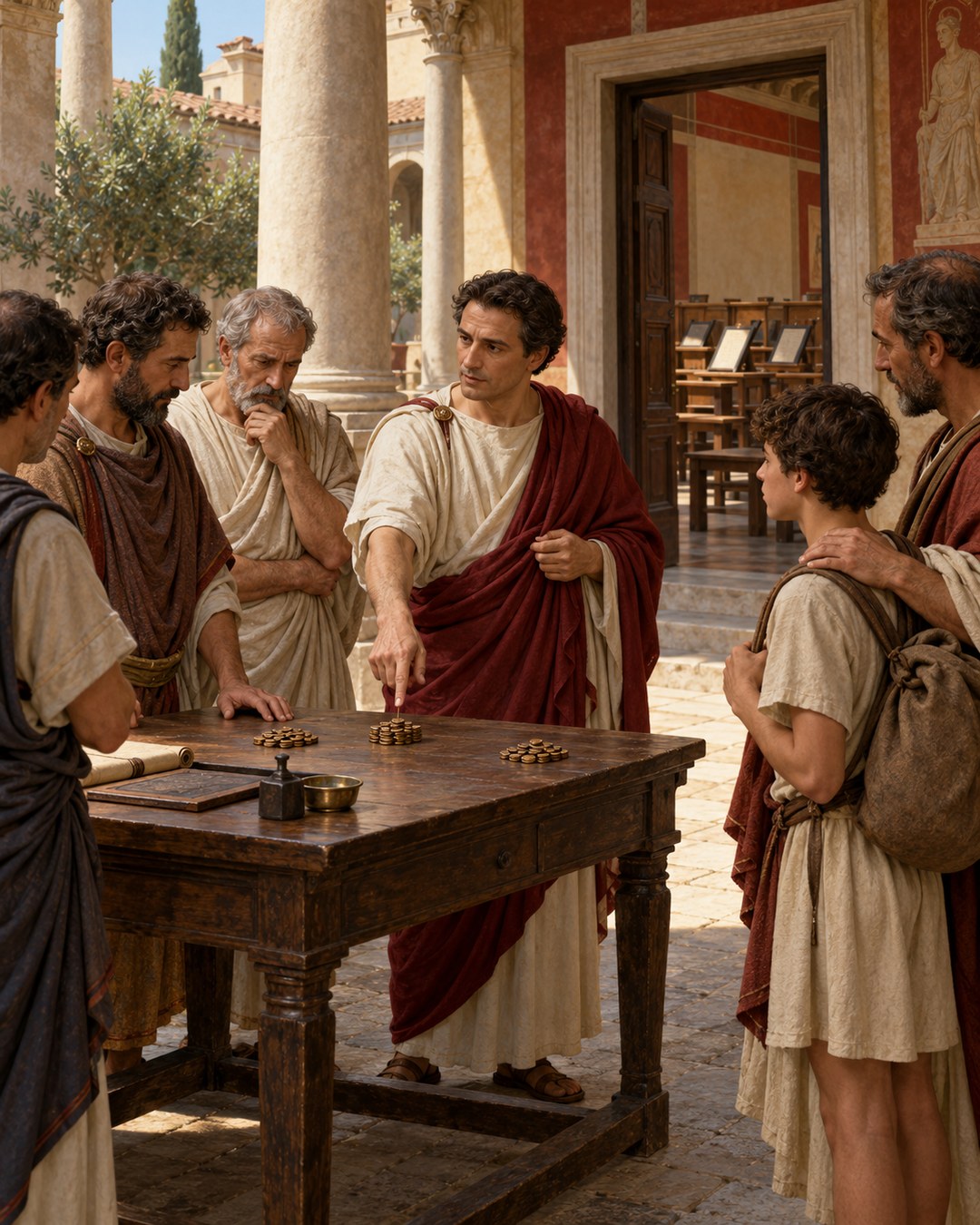
The problem appeared in a boy’s answer. Pliny the Younger met a young man from his native district and asked whether he continued his studies. Yes—but at Mediolanum. When Pliny asked why he did not study at home, the father standing beside him supplied the reason: Comum had no teachers.
Pliny’s response was not simply to endow a school. He offered one third of whatever local parents agreed to raise and then stopped short of the whole sum. That limit was deliberate. A gift large enough to change the town, he argued, should remain incomplete enough to keep the people using it attentive.
The letter to Cornelius Tacitus preserves a small design for municipal action. Families would convert travel expenses into salaries. Parents would choose teachers because their own money was at stake. Pliny would match ambition without controlling appointments. Tacitus would widen the search without promising anyone a post. Patronage worked here through divided responsibility.
A journey to Mediolanum exposed the missing school
The opening scene is conversational rather than administrative. A minor came to pay his respects while Pliny visited his native district. The questions moved from study to place, then from place to absence. The father’s “we have no teachers here” turned one family’s arrangement into a civic defect.
Pliny happened to have several fathers within hearing. He told them local schooling would let children remain in their native place, live under parental observation, and avoid the costs of lodging and travel. Money was already being spent on education; it was simply leaving town alongside the students.
The proposal depended on aggregation. Each household alone might not hire the quality of teacher it wanted. Combined contributions could create a stipend. The expenses attached to sending several boys elsewhere could become the revenue of a shared institution at home.
This was not modern universal schooling. The conversation concerns families able to educate sons away from home, and Pliny addresses fathers as the decision-makers. Yet it catches a real organizational threshold: a town could possess pupils, money, and ambition while still lacking the mechanism that gathered them into one local market for teachers.
One third made the patron’s gift conditional
Pliny had no children, but he described the community or state as occupying the place of child or parent. He promised one third of the sum the townspeople subscribed. The amount was proportional, not fixed. If parents raised more, his obligation rose with theirs.
That arrangement converted generosity into leverage. A complete private endowment might have produced a school quickly, but it would also have made the school appear to belong to the donor. A matching share required local agreement before his money could operate. It encouraged contribution without replacing it.
Pliny says he would have offered the whole amount if he had not feared a familiar corruption. Teachers paid entirely at public expense could be chosen to serve private interests. His anxiety was not that education lacked public value; he had just framed it as service to the community. The danger lay in separating appointment from the people who would bear consequences.
The choice contrasts with the censors who closed new Latin classrooms at Rome. That episode made education a question of custom and censorial authority. At Comum, the pressure ran in the other direction: a local notable wanted to create capacity, but tried to prevent his own money from dissolving local scrutiny.
Parents kept the right to choose
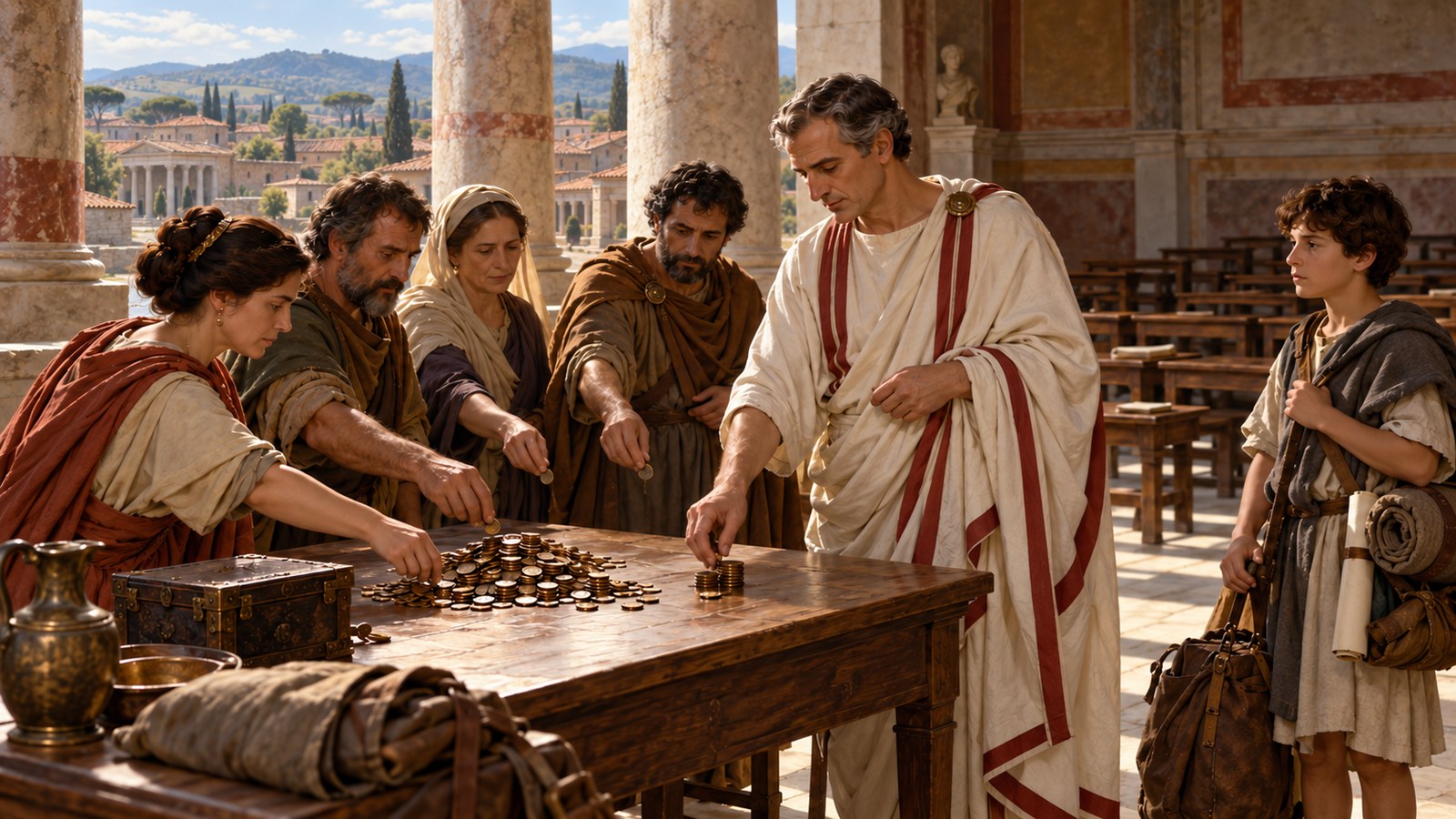
Pliny placed appointment explicitly with parents. People who might be careless with another person’s money, he reasoned, would inspect the use of their own. A teacher receiving Pliny’s share would also need to earn theirs.
This logic made payment a form of oversight. Parents were not merely beneficiaries asked for a symbolic contribution. Their stake justified their authority and was supposed to sharpen judgment. The patron supplied capital but denied himself the final personnel decision.
He also promised that a larger contribution would please him more. The matching structure had no incentive to keep the community’s ambition small. Every extra local payment enlarged the school’s available salary and his own expense at the same ratio.
Pliny imagined an outcome beyond stopping departures. Distinguished teachers might attract pupils from surrounding towns, reversing the existing flow toward Mediolanum. A school would keep local children near parents first; success might then turn Comum into the destination from which other families calculated lodging and travel.
The hopes belong beside the training that prepared Roman students for public speech. Pliny’s letter does not specify a curriculum. It instead exposes the institutional work before instruction begins: finding a salary, recruiting expertise, assigning the hiring decision, and persuading families that a local classroom can compete with an established centre.
Competition mattered on both sides. Comum had to offer enough money and confidence to draw a qualified teacher away from other opportunities. Parents had to believe that local instruction justified abandoning a known route to Mediolanum. The matching fund could improve the salary, but reputation and collective trust would determine whether a classroom actually filled.
The proposal also redistributed daily supervision. Bringing boys home did not merely save lodging fees. It placed conduct, study, and household influence within the same town. Pliny presents that proximity as morally superior, a claim that serves his argument but also identifies what families purchased when they paid for education elsewhere: expertise at the cost of distance.
Tacitus could recruit, but he could not promise
Pliny wrote to Tacitus because learned people gathered around him. He asked his friend to look for possible teachers, yet added a strict condition. No candidate was to receive a pledge of employment. The parents needed a perfectly free hand to judge and choose.
A prospective teacher could travel to Comum on confidence in his own ability, not on a private assurance from two famous literary men. That condition protected the division of roles. Tacitus searched. Pliny paid. Parents appointed. Candidates demonstrated that they deserved the post.
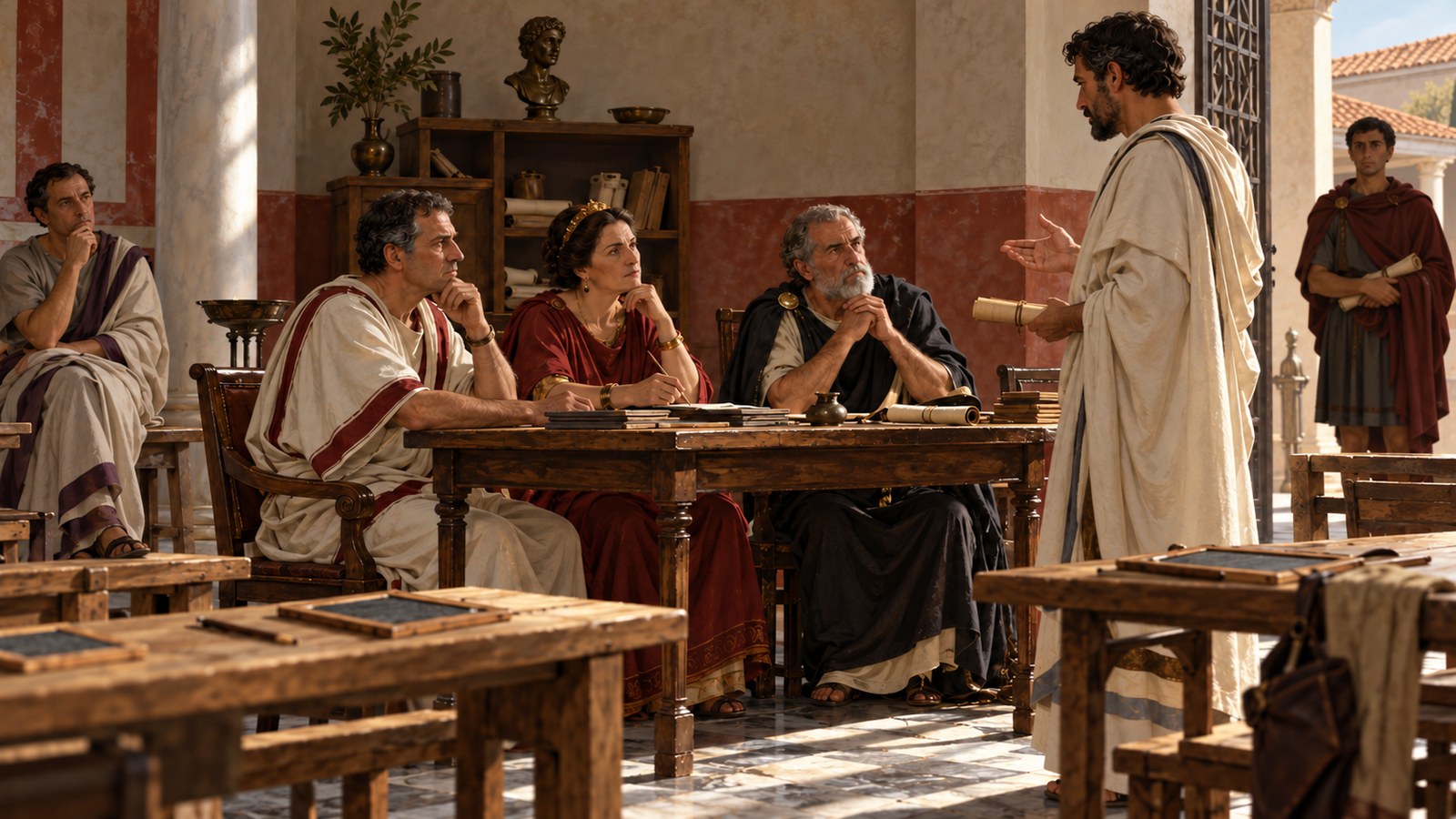
There was risk for the candidate. Travel to Comum brought no guarantee, and confidence had to substitute for patronal certainty. Pliny’s safeguard for parents thus shifted uncertainty onto teachers. The institution he imagined was participatory, but not equally secure for everyone involved.
There was risk for the donor as well. A proportional promise left the final cost open until the subscription closed. Pliny accepted that uncertainty because the amount itself would measure local seriousness. A small response limited his exposure and the school’s reach; a large response made both more ambitious.
Pliny even narrowed his stated responsibilities to sympathetic interest and his financial share. The wording is self-conscious, and the letter naturally presents his own conduct in a favourable light. It should not be mistaken for a neutral constitutional document. Nevertheless, the boast depends on recognizable constraints. His reputation as patron improves because he claims not to capture the institution he helps fund.
The school existed first as a conversation in front of several fathers, then as a request carried toward Rome. Its creation required social pressure, pooled household budgets, distant professional networks, and a donor willing to leave two thirds unpaid. The absence of teachers was local; the solution crossed Comum, Mediolanum, Tacitus’s circle, and Pliny’s estate.
One third was not a timid gift. It was the hinge of the whole plan. By refusing to remove every cost, Pliny tried to preserve choice, attention, and shared ownership. His money could make a school possible, but only the parents’ money could make it accountable on the terms he proposed.
Sources
Pliny the Younger, Letters, 4.13.