
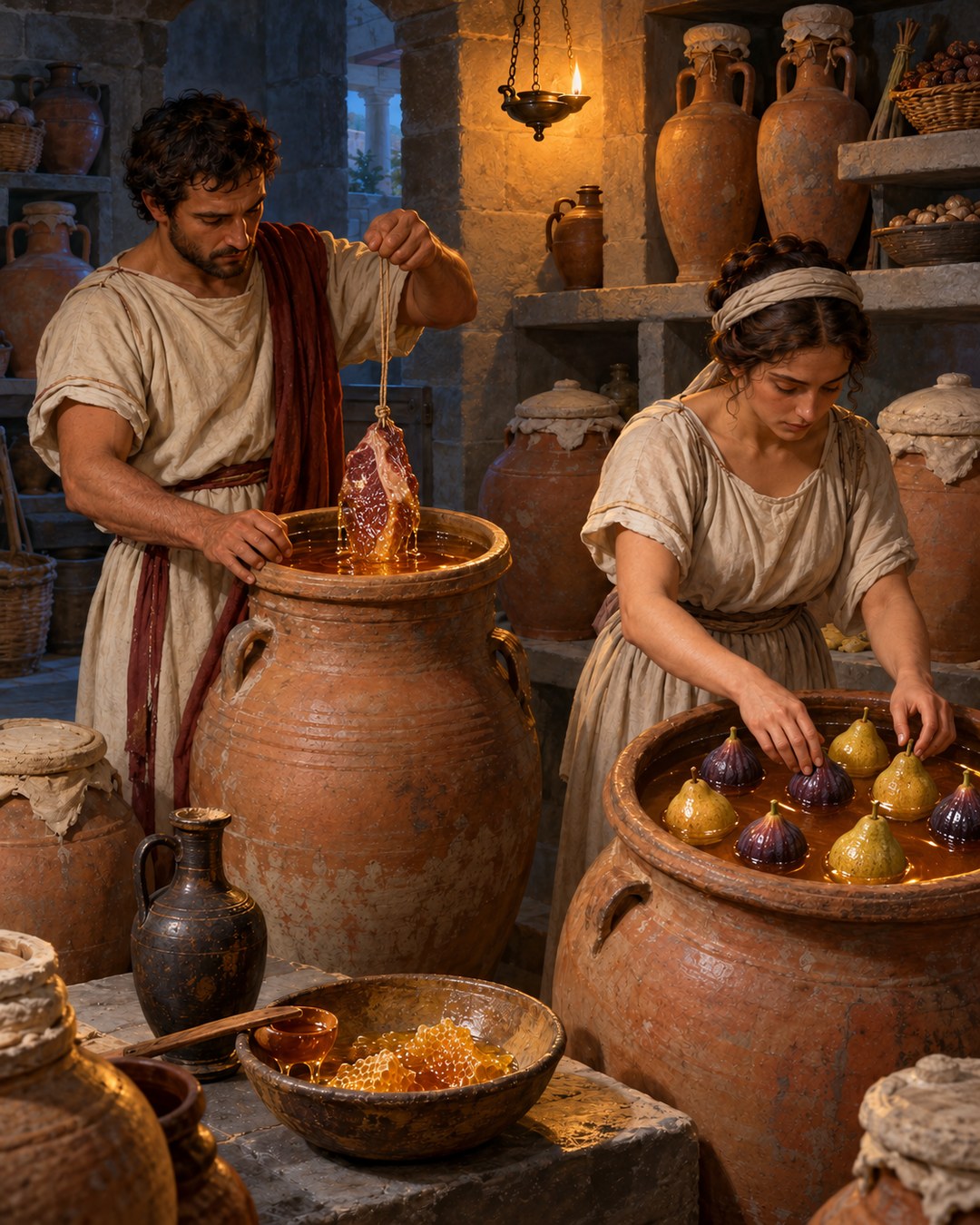
A piece of meat disappeared beneath honey, but the season still mattered. The Roman cookbook transmitted under the name Apicius says the treatment could keep fresh meat in winter, while summer reduced the promise to only a few days. That qualification is more revealing than the boast in the recipe title. The cook did not possess one magic preservative. Heat, moisture, contact, and the shape of the container continued to set limits.
Across the short preserving instructions in Book 1, the same practical questions return in different forms. Should the food touch liquid, air, another piece, sunlight, or the wall of a jar? Should it be suspended, stacked, buried, or kept apart? Honey and vinegar appear repeatedly, but their use changes with the object. Read together, the recipes form a compact household grammar for controlling contact.
Meat met honey, but winter set the clock
The most arresting instruction begins with fresh meat and no salt. The cook is told to cover it with honey and suspend it in a vessel, taking portions as needed. Cooked meat could receive the same treatment. The method combines immersion with elevation: the food sits inside a protective medium but does not simply lie on the bottom of an open pot.
The recipe immediately narrows its own claim. Winter offered the useful keeping period. In summer, the meat lasted only a few days. The writer therefore recognized preservation as seasonal labour. A method that delayed spoilage in cold weather did not cancel the effect of heat, and a household needed to plan quantity and use accordingly.
Another instruction for cooked pork, beef, or tender cuts replaces a single covering with a mixed pickle. Mustard, vinegar, salt, and honey had to cover the meat completely. The command is spatial as well as culinary. An exposed corner defeated the design. The point was not merely flavouring the surface but removing the untreated boundary between food and its surroundings.
Salted meat posed the opposite problem. Instead of adding more protection, the cook tried to make an already preserved food less harsh. It was boiled first in milk and then finished in water. Preservation and preparation were separate stages: salt extended usefulness, while the later sequence made the result agreeable at the table.
Vinegar entered while fish was still hot
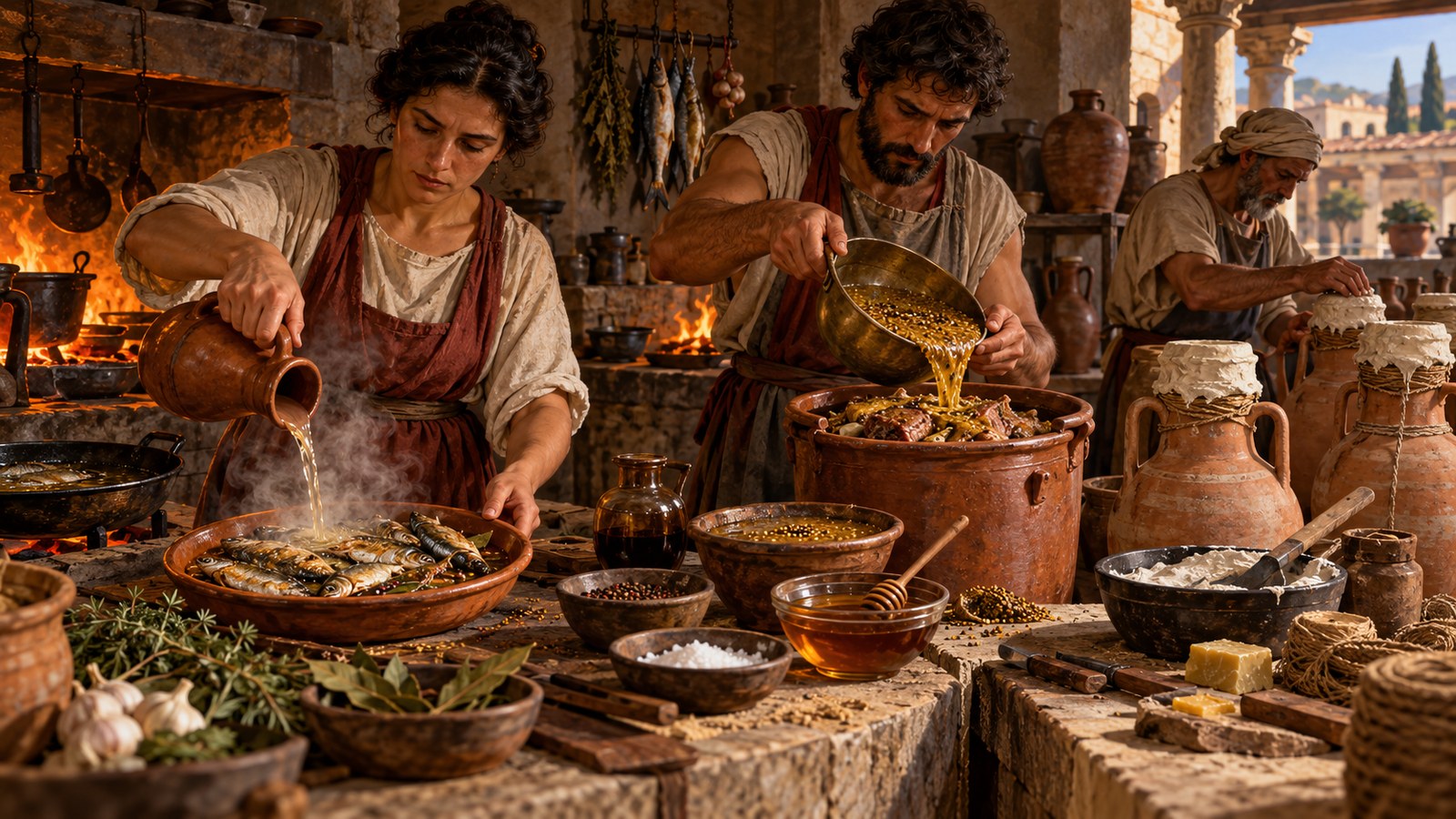
Fried fish received a much shorter instruction: pour hot vinegar over it immediately after frying. Timing carried the method. The fish was not allowed to cool on a platter and meet the vinegar later. The preserving liquid entered while heat still belonged to the cooking process.
Oysters demanded preparation of the vessel itself. The container was fumigated with pitch, washed with vinegar, and only then filled. Here the food did not monopolize attention. The jar or barrel could carry its own smells, residues, and openings; treating it was part of treating the oysters.
These terse recipes resemble the material precision behind the production and circulation of garum, but their scale is different. Garum joined fish, salt, time, and trade in a recognizable commodity. The preserving notes stay close to the household moment when cooked fish, oysters, or meat might otherwise be lost.
The brevity also warns against pretending that the text gives modern guarantees. It records intended techniques, not controlled experiments. “Keep” could mean delay, carry through a season, protect until service, or rescue value for a limited interval. The explicit summer warning makes that modest reading unavoidable.
Fruit survived by avoiding wounds and neighbours
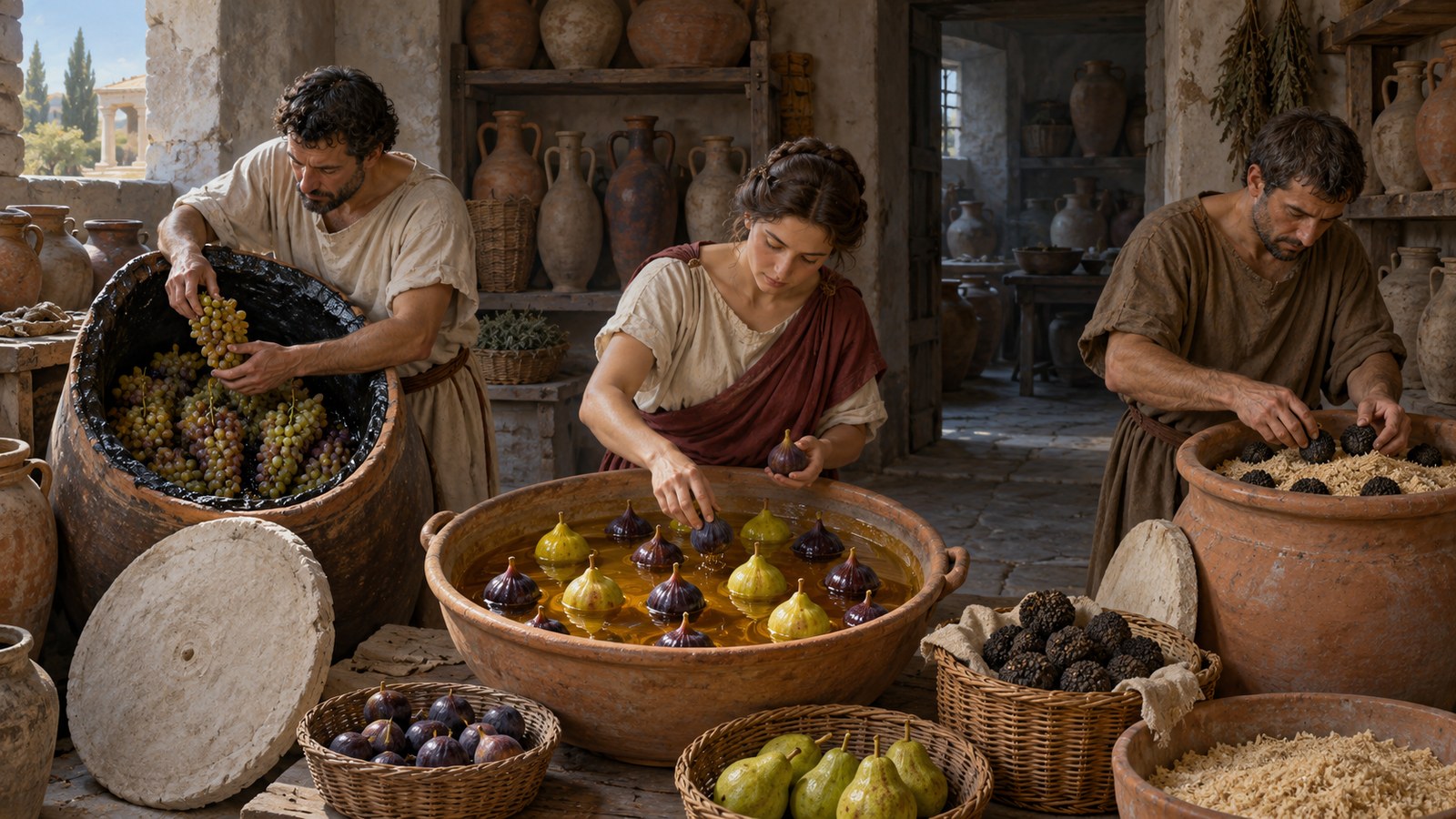
Grapes were selected in perfect condition, submerged in rainwater reduced by one third, and closed inside a pitched vessel sealed with plaster. The jar then went to a cool place beyond the sun. Liquid, coating, seal, and location worked as a chain. Omitting the cool darkness would leave the other steps to fight a larger burden.
The same entry offers barley material as another covering for grapes. That alternative changes the mechanism from liquid immersion to dry separation. What remained constant was the attempt to stabilize the space around each bunch and prevent bruised fruit from becoming the centre of decay.
Quinces were chosen with stems and leaves and covered by honey and reduced must. Figs, apples, plums, pears, and cherries likewise retained their stems, but they received another crucial instruction: arrange them in honey so they do not touch one another. The preserving medium mattered, yet spacing mattered too.
That rule transforms the jar from a storage void into a planned arrangement. A cook had to inspect fruit, reject damage, preserve the natural closure at the stem, and lower each piece without creating a packed mass. Honey filled the gaps only after selection and placement had reduced points of injury.
The concern with intact produce belongs beside Columella’s instructions for hanging grapes inside sealed jars. Both accounts treat preservation as architecture at a small scale. Supports, surfaces, headspace, and seals decide what food touches during the weeks when nobody is watching it.
Selection also front-loaded the labour. “Perfect” grapes and carefully chosen fruit were not repaired by the preserving medium; damaged specimens were excluded before sealing. The instruction to keep pieces from touching reduced the chance that one weak point would spread through the whole store. A jar’s success therefore began at the sorting table, where workers sacrificed quantity for a more stable arrangement.
The recipes reveal different time horizons without giving a calendar for each one. Some foods needed to survive from harvest into a later season. Others only had to bridge the interval between frying and service, or between purchase and the next meal. The same verb—keep—covered several household problems, so the physical details are more trustworthy than the grand titles attached to them.
Suspension, sawdust, and shade made containers active
Citron was placed in a vessel, sealed with plaster, and suspended. Truffles were kept away from water, layered alternately with dry sawdust, sealed, and deposited in a cool place. Hard-skinned peaches followed yet another route: one day in brine, careful rinsing, salt and savory, then immersion in vinegar.
No single ingredient explains that range. The citron recipe trusts isolation and suspension. The truffle recipe excludes water and uses dry particles to separate and surround. The peach recipe moves through successive liquids and seasonings. The chosen sequence follows the food’s texture and expected failure.
Containers therefore did more than hold finished provisions. Pitch could line them. Plaster could close them. A vessel could hang rather than stand. Dry sawdust could divide its contents, while a reduced liquid could fill every space. Cool shade became part of the container system even though it lay outside the jar.
These arrangements also demanded labels in memory even when no written tag survives in the recipe. A sealed grape vessel, suspended citron jar, truffle pot, and meat crock could not be opened casually without disturbing the environment that preserved them. Household workers needed to remember contents, preparation date, season, and intended use from the vessel’s place, shape, closure, or an accompanying convention.
The material cost was distributed across ordinary supplies. Honey represented stored agricultural value. Vinegar and reduced must required earlier processing. Pitch and plaster turned pottery into tighter equipment. Barley material and sawdust made agricultural or workshop by-products useful as cushioning layers. Preservation joined several production chains inside one storeroom.
The manual’s household intelligence sits in these physical verbs: cover, suspend, pour, seal, cool, separate, rinse. They are less glamorous than the elaborate sauces for which Apicius is famous. They also expose a daily economy in which losing prepared meat or perfect fruit meant losing labour already spent on slaughter, cooking, harvest, purchase, and transport.
Honey did not make Roman food timeless. It helped workers redesign the food’s immediate environment. Vinegar arrived hot or cold according to the task; fruit retained stems and distance; winter enlarged one method’s margin while summer cut it down. The preserving jar was a managed space, and success began by deciding what was allowed to touch.
Sources
Apicius, Book 1.7–12.