
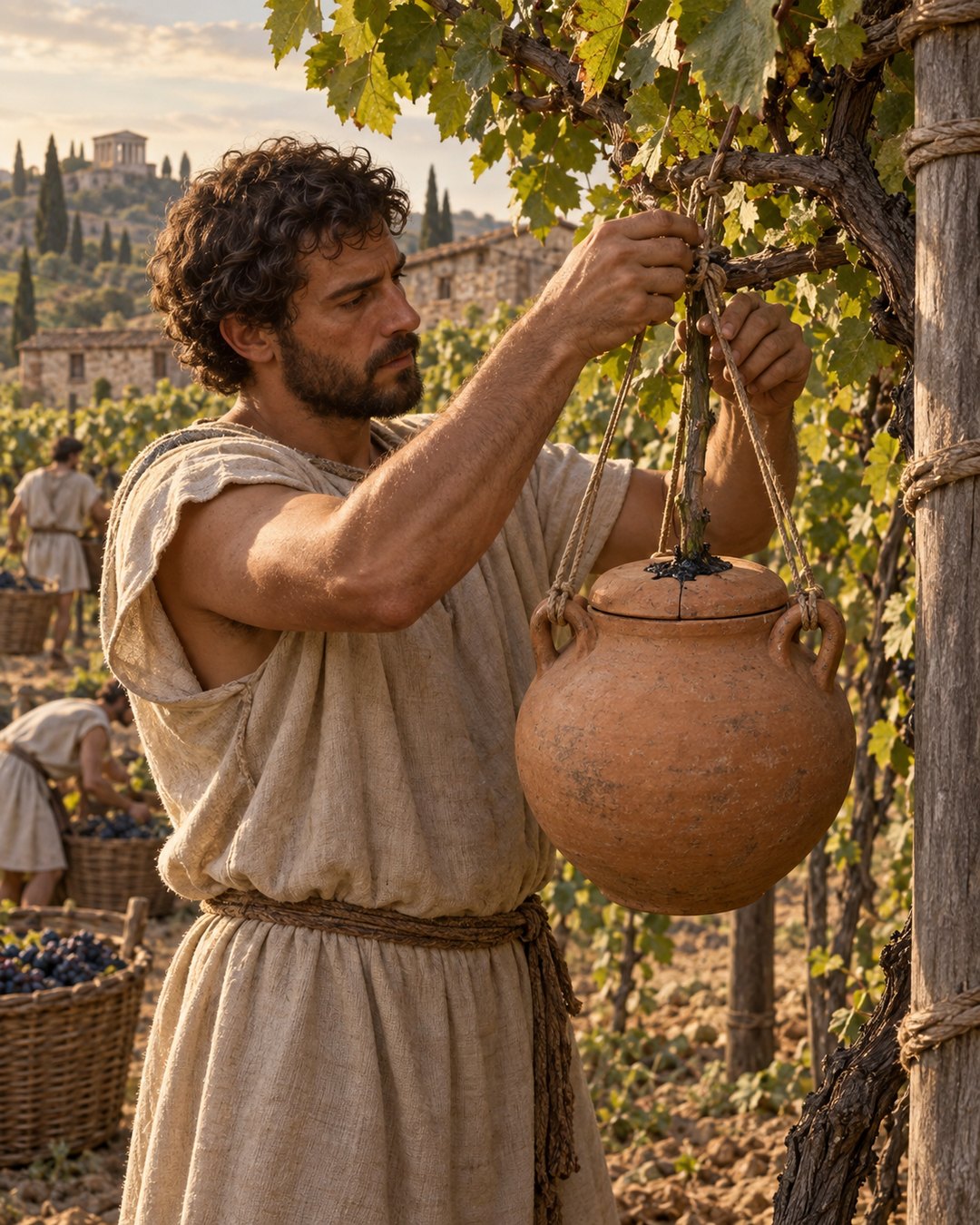
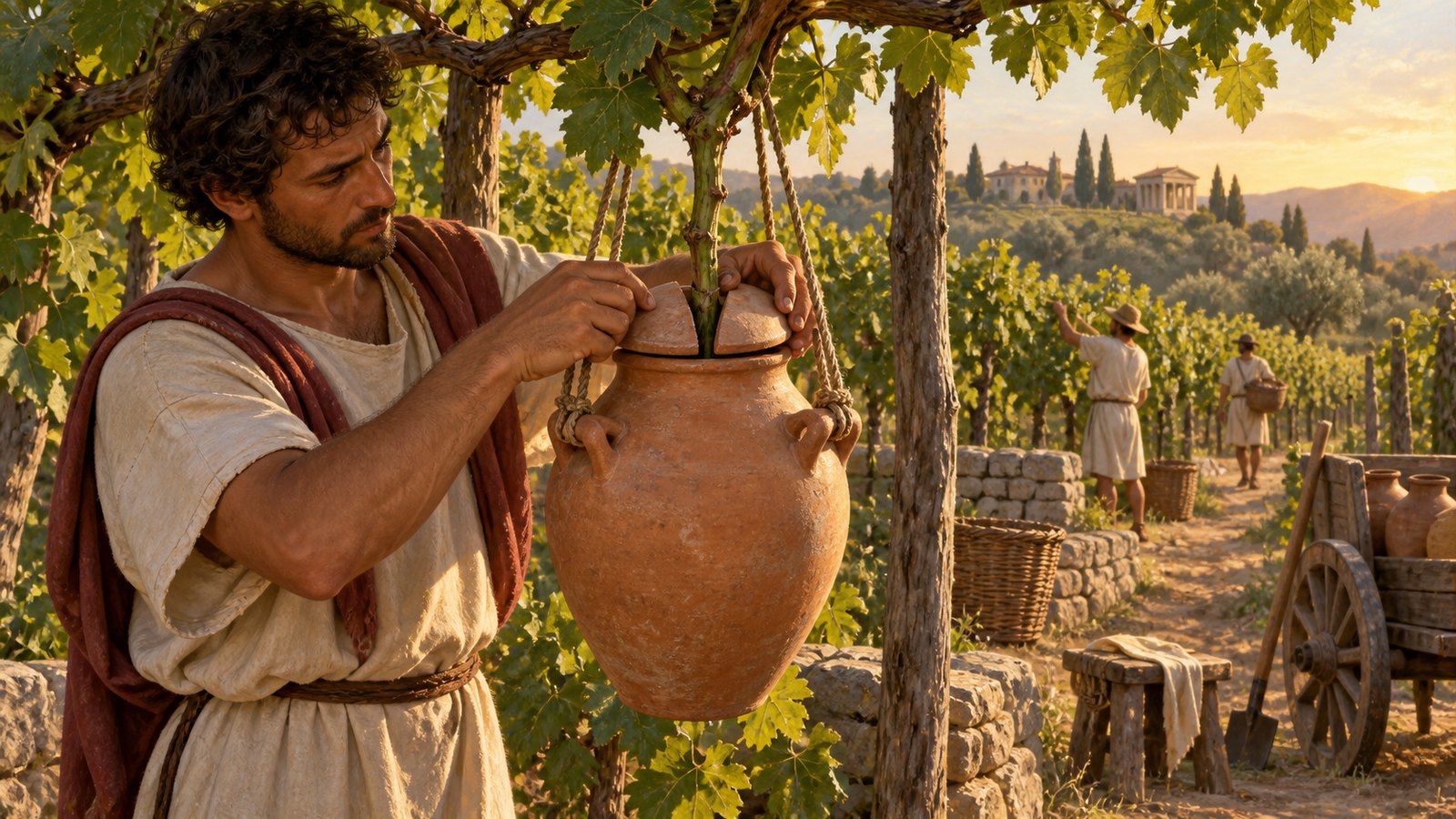
One grape bunch remained attached to its vine while a clay vessel closed around it. The pot had four handles so cords could suspend it from the plant. Its lid came in two pieces, allowing the halves to meet around the living stem. Inside, the fruit hung loosely enough to touch neither wall nor cover.
Columella calls this the most certain of several ways to keep grapes. The design looks extravagant because it moves storage into the vineyard before harvest. Instead of cutting a bunch and then trying to slow its decline, the worker built a small sealed chamber around fruit that still drew life from what Columella calls its mother vine.
Every feature answers a physical problem. Four handles distribute the hanging load. A divided lid closes without severing the stem. Pitch blocks moisture from passing through the clay, while straw-tempered mud thickens the outer seal. Empty space protects the berries from pressure and abrasion. The result is not merely a jar but a preservation device assembled around living produce.
A Divided Lid Closed around a Living Stem
A normal lid assumes that whatever goes into a vessel has already been detached. Columella’s method reverses that order. The bunch enters while it remains on the vine, so an intact cover cannot be lowered over it without trapping or breaking the stem. The answer is a lid divided through the middle.
Once the hanging pot receives its bunch, the two cover pieces approach from opposite sides. They meet around the stem and conceal the fruit beneath. Columella’s description does not give measurements or a drawn profile, but it makes the operating relationship clear. The opening must accommodate the connection to the vine while the joined halves close the chamber.
The vessel itself is meant to receive one bunch loosely. That word rules out cramming several clusters into a convenient container. It also explains the instruction that the grapes touch no part of the pot. A berry pressed against clay would face bruising, trapped moisture and a direct route for damage. Suspension makes air space part of the equipment.
Four handles turn that spacing into a stable arrangement. Columella says the pot is tied to the vine by them. One attachment point could tilt the load; two would offer less control over a container surrounding delicate fruit. He does not spell out a theory of balance, but the prescribed handles make the vessel something that can be hung rather than merely placed.
Pitch and Straw-Clay Built a Barrier on Both Sides
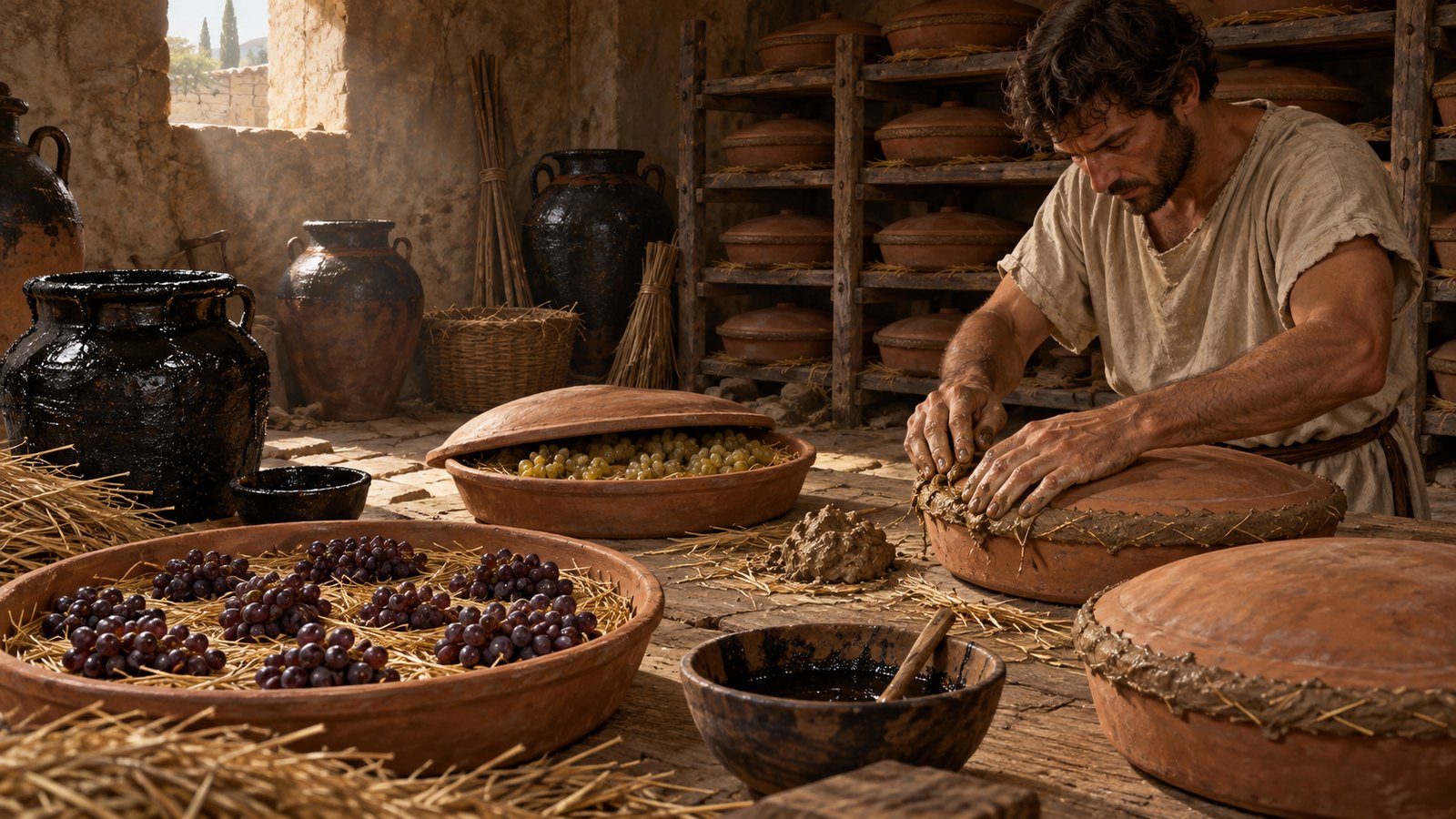
Columella requires careful pitching inside and outside the pot and its cover. Fired clay can admit moisture through its fabric and joints. A coating changes the surface, while the thick layer of straw-tempered clay added after closure reinforces the assembled shell.
The two materials do different work in the description. Pitch belongs directly on vessel and lid. Straw and mud wrap the closed container afterward. The lid’s center seam and the point where it meets the pot create paths that a loose cover would leave open, so the final coating treats the vessel as a joined structure rather than a collection of pottery pieces.
The emphasis on sealing appears throughout Columella’s other grape methods. In one, a new clay dish is filled with very dry straw that has been screened free of dust. Grapes rest on it, another dish covers them, and straw-tempered clay closes the circumference. Elsewhere, plates stack inside a pitched storage jar whose cover is smeared with reduced must and stopped with ash.
These instructions resemble neither decorative table service nor long-distance amphora packing. They belong to controlled storage. The ordinary materials—pitch, clay, straw, ash and bran—become useful because the worker prepares their dryness, contact and joints with unusual care.
Dryness Began before the Bunch Entered Storage
Columella’s first control is timing. He says grapes intended for preservation should be taken in clear weather after the fourth hour, when the sun has warmed them and no dew remains. A dry vessel cannot compensate for water carried in on the fruit itself.
His packed-dish method repeats the concern. Straw must be as dry as possible, screened so that it contains no dust. Bunches are laid on top, not buried carelessly. When he describes alternating barley bran and grapes, he again says one bunch must not press another. In another variant, dry poplar or fir sawdust and powdered gypsum supply the surrounding material.
None of these recipes promises one universal answer. They test different combinations of separation, dryness and enclosure. Hanging grapes openly in a granary avoids some contact, but Columella says that method wrinkles the berries and makes them almost as sweet as raisins. The fruit may survive, yet its texture and character move away from the fresh result he wants.
That distinction makes the four-handled pot more intelligible. Preservation was not simply the absence of rot. Columella’s heading promises grapes kept green or fresh into the following year. A method that concentrates sweetness while wrinkling the berry produces a different food, even if it prevents immediate waste.
Several Storage Systems Tested the Same Weak Points
One of the most elaborate alternatives came from Columella’s uncle Marcus. He ordered broad clay vessels shaped like dishes and coated them thickly with pitch inside and out. Purple, bumastus, Numisian and hard-berried grapes were placed separately so bunches did not touch. Covers were sealed with gypsum and then coated again with hard pitch melted over fire.
Weights submerged the finished vessels completely in spring or cistern water. No part could remain above the surface. This method made the seal face a severe test: external water surrounded the storage chamber, so any weak joint could admit moisture. Columella says it preserved grapes extremely well, but adds a sharp limit. Once removed, the fruit had to be eaten that day or it turned sour.
Another design placed reduced must at the bottom of a well-pitched storage jar. Closely fitted crossbars held new clay plates above the liquid so the grapes never touched it. Each layer received a cover before another platform rose above. Separation operated vertically as well as horizontally.
The family resemblance among these systems is stronger than their visual differences. Fruit must not collide. Moisture must be managed. Coatings and seals must interrupt exchange through porous clay. Supports keep grapes away from liquids and hard surfaces. Columella’s four-handled vineyard pot applies the same concerns before the stem is cut.
The process focus recalls the cargo loan that connected pepper and ivory to a chain of transport risks, but the scale is deliberately opposite. That contract followed valuable goods across seas and customs systems. Here, a worker’s attention narrows to one bunch, one seam and the few millimetres separating a berry from a wall.
Even Nearby Apples Could Ruin the Result
Columella closes the section with a warning that expands storage beyond the container. Grapes should not share a place with apples. They should not even stand nearby where the apples’ vapour or smell can reach them, because he says that influence quickly corrupts the berries.
The claim reflects ancient explanation rather than modern laboratory vocabulary, but its practical consequence is precise. A perfectly prepared grape vessel could still belong to a badly arranged storeroom. Preservation therefore required control at three scales: the surface of each bunch, the architecture of its container and the neighboring produce in the room.
He also refuses to make every method universal. Local conditions and the nature of the grapes determine which approach fits. That caveat matters after so many confident imperatives. The instructions are specific, yet selection remains conditional. A technique appropriate to one region, variety or storage place may fail elsewhere.
This practical flexibility connects the vineyard pot to the careful joining of bark, clay and cut wood in Roman grafting. Both processes depend on managing contact rather than possessing a mysterious ingredient. A seal must close where it should, living material must remain undamaged, and the worker must judge weather and condition before acting.
The four-handled jar is memorable because its shape exposes the whole logic at once. It hangs because the fruit is still attached. It opens in halves because the stem must pass through. It is pitched because clay and seams can transmit moisture. It is roomy because pressure harms berries. Its outer coat finishes a chamber built in the open air.
Columella did not preserve a picture, and modern reconstruction should not invent ornament or exact dimensions. His sequence is sufficient. Tie the vessel to the vine, receive a single bunch loosely, close the split lid around the stem, pitch every surface, cover the assembly with straw-clay and keep the grapes clear of the walls. Roman food storage could begin before harvest, one suspended pot at a time.
Sources
Columella, On Agriculture 12.44.