
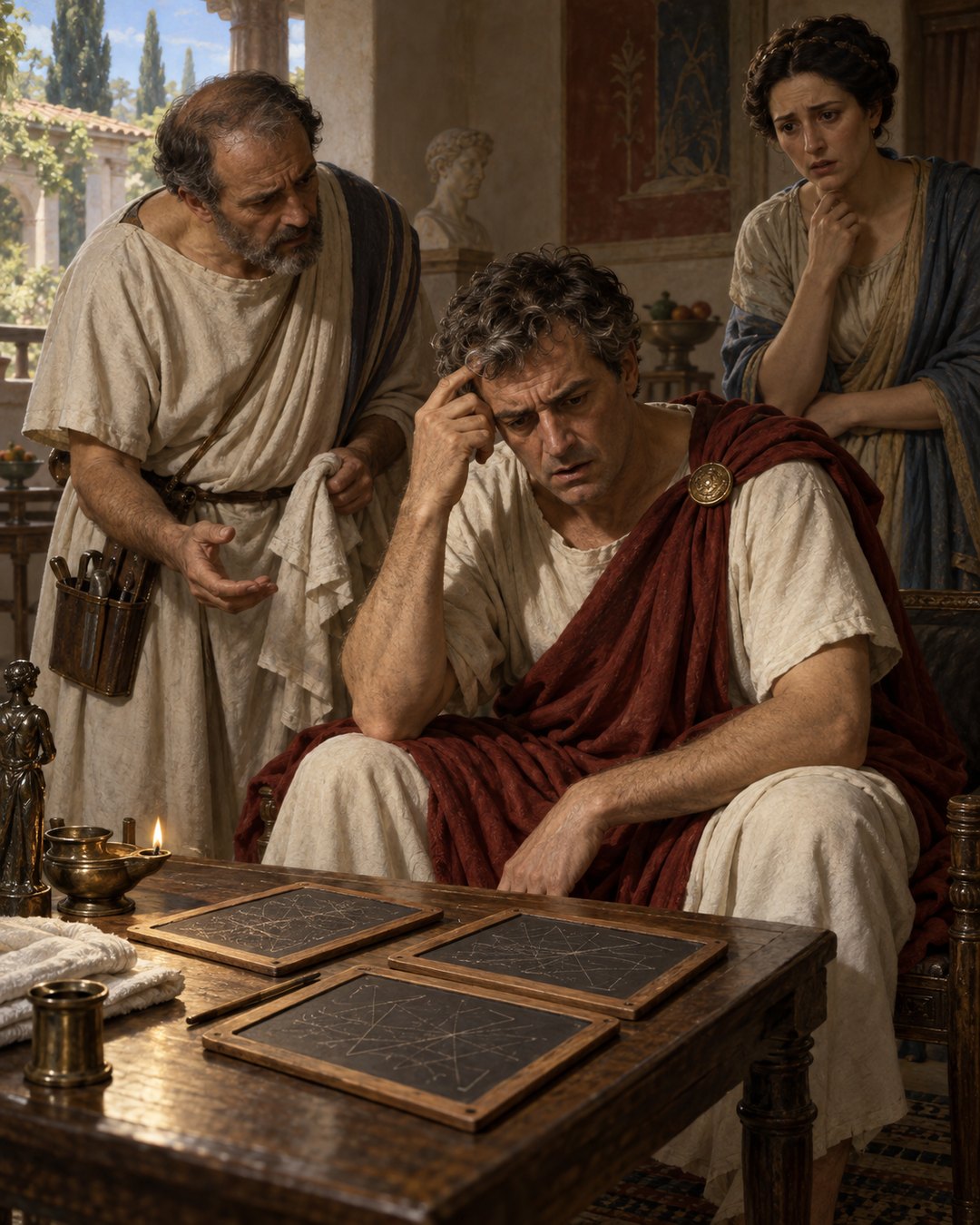
A stone struck an unnamed man, and one category of knowledge vanished. Pliny the Elder says the victim forgot the names of the letters—only those names. He does not say the man forgot his family, his surroundings or the event itself. The damage appears in the account as a narrow blank cut through an otherwise functioning memory.
That example sits near the end of a catalogue that begins with almost impossible command of names, languages and books. Cyrus knows his soldiers. Cineas learns Rome’s political class in a day. Mithridates governs twenty-two nations in twenty-two languages. Charmidas can reproduce a library volume as though the pages remained before him.
Pliny then reverses direction. Injury, illness and fright make memory fail in different shapes. One man loses letters; another loses family and neighbours; another no longer knows his servants; Messala Corvinus forgets his own name. The chapter is not a modern medical case history. Its force comes from arrangement: the faculty praised for holding a kingdom together can surrender one small compartment without warning.
Names Made Exceptional Memory a Form of Command
Pliny opens by calling memory a blessing essential to the enjoyment of life. He immediately admits that choosing its greatest exemplar would be difficult because so many people had been celebrated for it. His first proofs concern names, the points where private recognition and public organization meet.
King Cyrus, Pliny says, knew all the soldiers in his army by name. Lucius Scipio knew the names of the Roman people. The claims stretch belief if read as administrative records, and Pliny offers no method by which either feat was tested. What matters inside his catalogue is the scale attached to personal recall. A commander or statesman appears to hold a multitude without reducing it to an anonymous mass.
Cineas makes that relationship faster. Sent to Rome as ambassador for King Pyrrhus, he supposedly learned the names of every senator and equestrian by the day after his arrival. The marvel is diplomatic rather than theatrical. Correctly naming Rome’s governing men would turn a foreign visitor’s first meetings into demonstrations of attention and control.
These examples differ from the wealthy Sabinus who distributed books among eleven enslaved readers. Sabinus tried to possess other people’s recall as household equipment. Cyrus, Scipio and Cineas embody the opposite fantasy: one mind personally retaining the human map required by office.
Pliny does not pause to prove exact totals. He gathers famous claims whose social meaning his readers could understand. Remembering a name allows recognition to be performed at the instant it matters. In a camp, forum or embassy, memory becomes visible as command over relationships.
Twenty-Two Languages Removed the Interpreter from the Throne
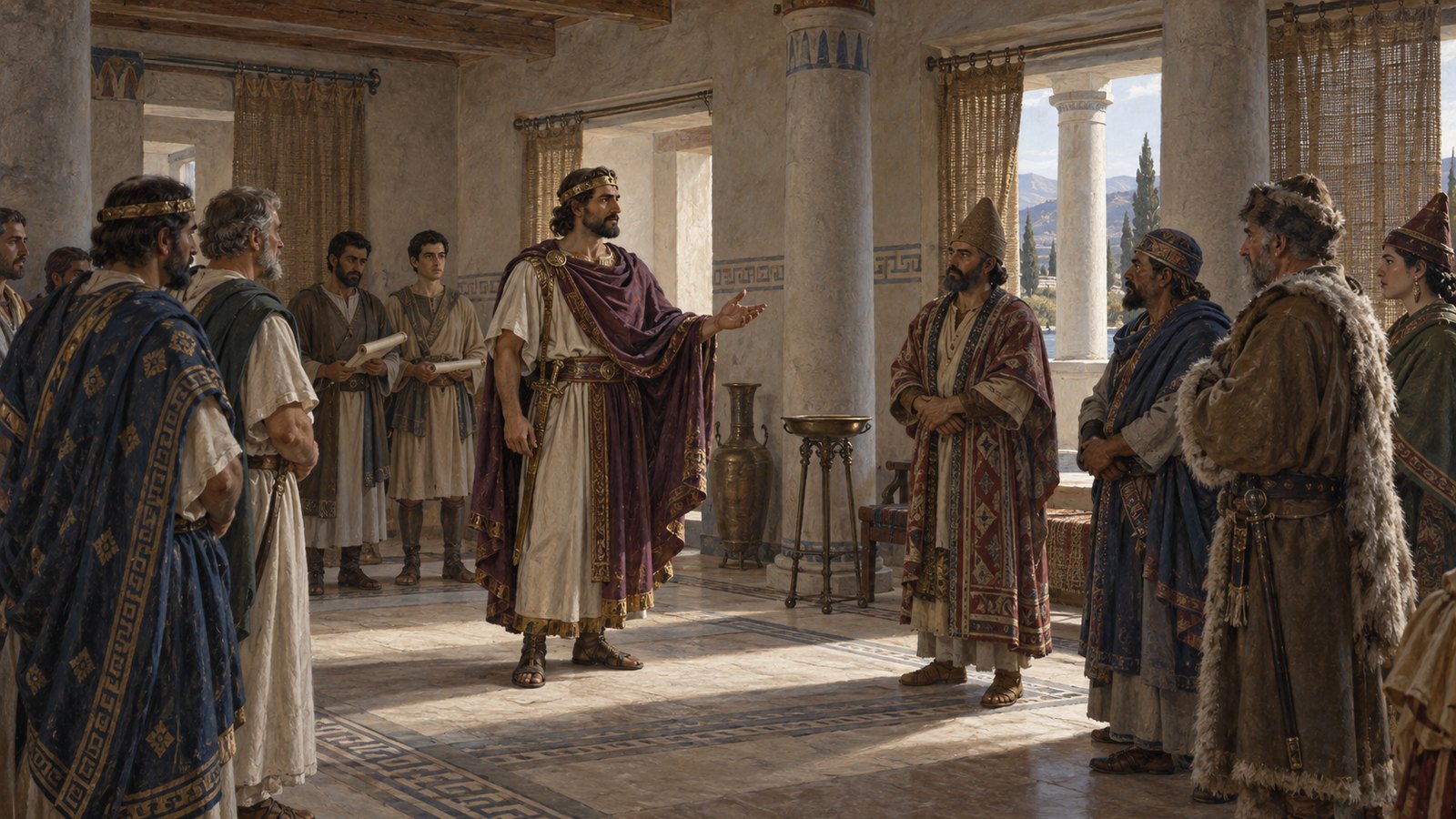
Mithridates expands the catalogue from people to speech. Pliny identifies him as king of twenty-two nations. He says the ruler administered their laws in the same number of languages and could address each people without using an interpreter.
The detail makes memory part of government’s machinery. An interpreter does more than replace one word with another; that person stands between ruler and subject, hearing first and selecting an equivalent. Pliny’s Mithridates removes that body from the exchange. Petitions, judgments and public addresses appear to travel directly between king and nation.
The claim also gives political shape to diversity. Twenty-two is not presented merely as the number of tongues the king could display at dinner. Each language corresponds to a governed people and to the administration of law. Recall therefore supports repeated movement between legal and cultural settings without making one language erase the others.
Pliny’s sentence is brief, so it cannot tell us how fluent Mithridates was in every context or how officials supported his rule. Treating the anecdote as a complete account of Pontic administration would exceed the source. Within the chapter, however, its function is precise. Memory can hold not only lists of names but entire systems of meaningful sound, and political authority benefits when the ruler can summon the right one on demand.
The feat prepares the reader for an even less practical-seeming form of mastery. A Greek called Charmidas, Pliny says, could repeat any book requested from a library exactly as though he were reading. The royal audience and the library are different stages, but both make absence disappear: no interpreter in one, no open volume in the other.
Simonides and Metrodorus Turned Recall into a Practised Art
After inherited talent and celebrated marvels, Pliny introduces technique. Memory, he writes, had been made into an art. He credits the first invention to the lyric poet Simonides and says Metrodorus of Scepsis perfected it so that people could repeat, word for word, exactly what they had heard.
That sentence changes the status of the preceding wonders. If memory can be trained, extraordinary recall is not merely a gift distributed at birth. Arrangement, rehearsal and practiced retrieval can extend it. The achievement remains remarkable, but method enters beside nature.
The chapter itself does not explain a spatial system. Readers interested in that separate mechanism can see how an imagined house could organize a Roman speech. Pliny’s concern in this passage is narrower: he names founders and an outcome, exact repetition of heard words.
His next move makes the confidence in art feel precarious. “Nothing whatever” in a human being, he says, is as frail as memory. Disease, bodily injury and even fright can affect it. Loss may be partial or complete. Training can increase what memory carries, but the chapter offers no technique that makes the faculty invulnerable.
This reversal is the catalogue’s narrative hinge. The same author who races through armies, civic orders, nations and libraries now isolates ordinary pieces of identity. The scale contracts from twenty-two languages to the names of letters, then from public mastery to recognition inside a household.
Four Losses Drew Different Boundaries through a Person
The stone-blow case is disturbing because the forgotten material is so specific. Letter names form a learned sequence used to enter written culture. Pliny says only those names disappeared. He gives no diagnosis, treatment or recovery. The surviving sentence leaves the reader facing a boundary: something separated that knowledge from whatever the man still retained.
A fall from a high roof produces a broader absence. Its victim cannot remember his mother, relatives or neighbours. Here the loss crosses intimate and local relationships. Familiar faces no longer carry the stored connections that made them mother, kin or people next door.
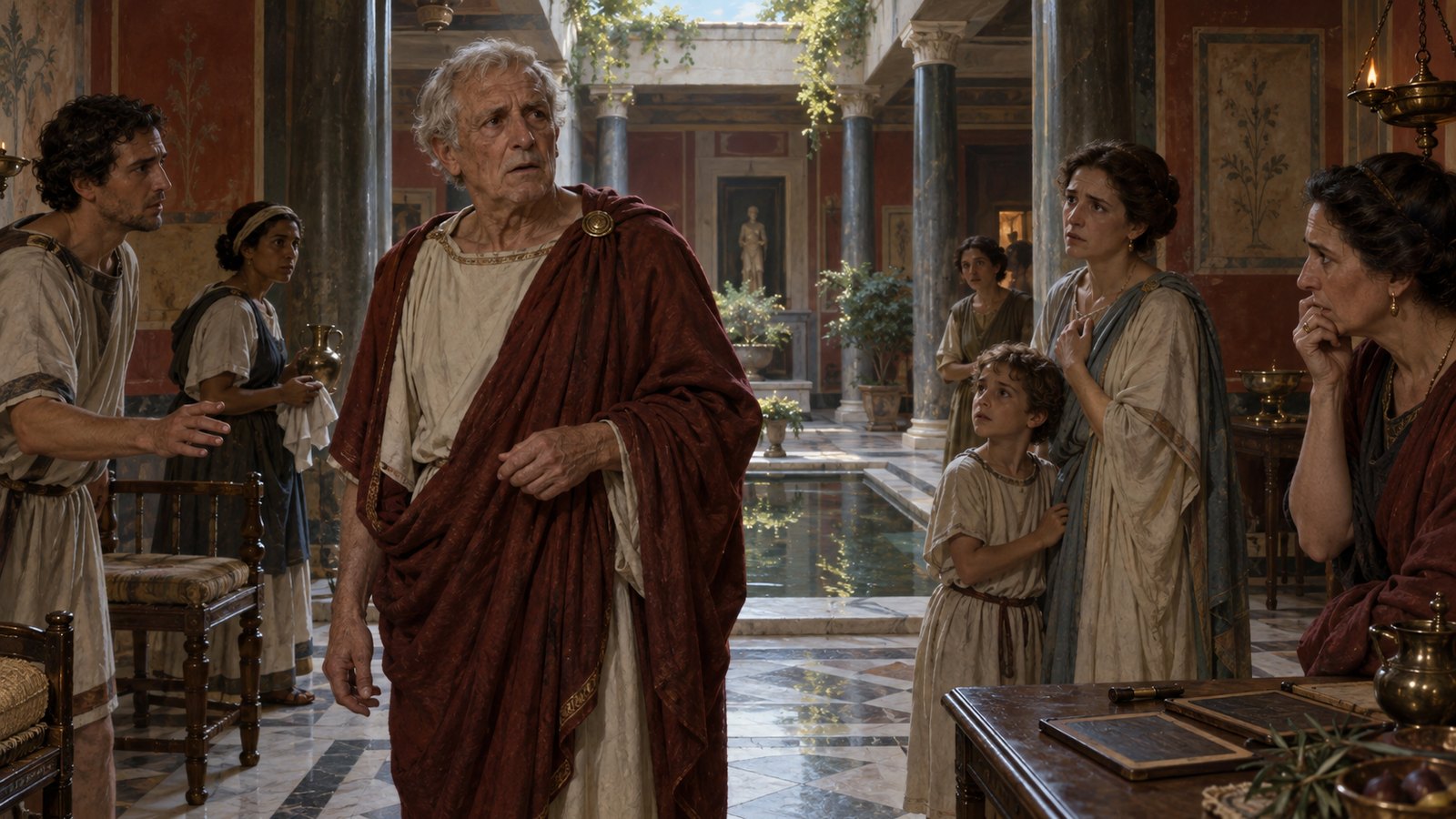
Disease draws another circle. A third person forgets his own servants. The example belongs to a hierarchical household, and Pliny supplies no reaction from the people suddenly unrecognized by the person who commanded them. The case nevertheless brings failure into daily routine. A household could remain physically assembled while its remembered structure disappeared from one mind.
Finally, the orator Messala Corvinus loses recollection of his own name. Pliny chooses a man whose public life depended on speech and identity, then removes the shortest verbal sign by which that identity could be called. The chapter has moved from rulers remembering multitudes to an individual unable to retrieve himself.
Pliny closes with a softer interruption that every reader knew. Memory can seem to escape even while the healthy body rests. When sleep arrives, he says, it is cut off so thoroughly that the vacant mind may not know where it is. Nightly disorientation becomes the familiar edge of the injuries and illnesses just described.
The examples cannot support modern conclusions about the brain, and Pliny’s famous memory feats remain claims in an ancient wonder catalogue rather than measured tests. Yet his sequence captures an observation that survives the marvels: forgetting is not always an even dimming. It can remove letters, relationships, roles or names along different lines.
The man struck by the stone is therefore more than the chapter’s smallest curiosity. His narrow loss breaks the assumption that memory is one container, either full or empty. Pliny begins with minds vast enough to contain peoples and books. He ends with the unsettling possibility that a tiny but essential key can vanish while the rest of the door still appears to stand.
Sources
Pliny the Elder, Natural History 7.24.