
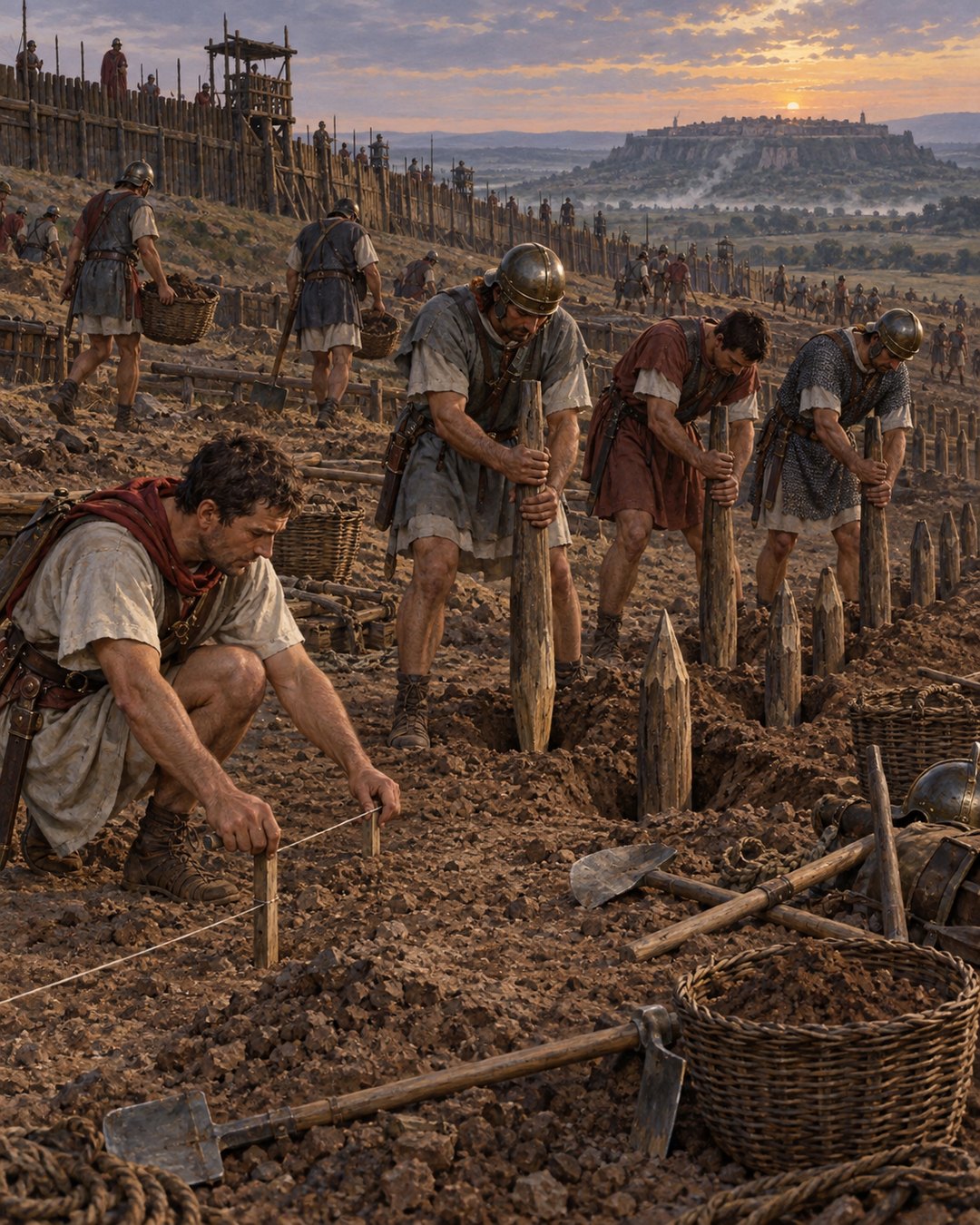
The soldiers outside Alesia planted lilies in eight rows. They were not flowers. Each lilium was a narrow pit three feet deep, tapering toward the bottom around a sharpened stake hardened by fire. Only a short point projected above the ground. Brush hid the opening.
Caesar gives the pastoral name without softening the construction. The pits sat three feet apart in staggered lines, one component of a defensive field that also contained buried branching trunks, scattered iron hooks, deep ditches, a rampart and towers. An attacker who reached the wall had already crossed a landscape designed to interrupt every stride.
The measurements in Gallic War 7.72–74 explain the system’s purpose. These devices were less about spectacular killing than controlled delay. Open ground became a sequence of problems: mass formations compressed at the ditches, feet searched for safe patches, branches caught bodies and equipment, and hidden points punished haste. Each pause gave the defenders above more time.
A Twenty-Foot Cut Kept the Main Works Out of Immediate Reach
Caesar began with separation. He ordered a trench twenty feet wide with vertical sides. The rest of the fortification stood four hundred feet behind it. That distance kept sudden enemy attacks away from laboring soldiers and gave the defenders room to see what was developing before it reached the principal line.
Closer to the rampart came two more trenches. Each was fifteen feet wide and fifteen feet deep. Where the ground was level or low, Caesar diverted river water into the inner one. The obstacle therefore changed with terrain: excavation supplied depth everywhere, while water made part of the circuit harder to cross quickly or fill.
Behind them rose a rampart and palisade twelve feet high. Towers stood at intervals of eighty feet. Parapets and projecting defenses strengthened the top. The dimensions turn the scene into a plan rather than a vague claim that the Romans “fortified” their camp.
That precision recalls the ten-day bridge Caesar drove across the Rhine. Both accounts make engineering serve tempo. At the river, rapid construction created a route where enemies expected a barrier. At Alesia, construction multiplied barriers where relief forces and the besieged hoped to move.
The defenders faced in two directions. Vercingetorix’s army remained inside Alesia, while a Gallic relief force could arrive from outside. Caesar extended a second line to protect against the external threat. The obstacle belt had to buy reaction time even when Roman manpower was divided across a long perimeter.
Five Rows of Buried Branches Caught More Than Feet
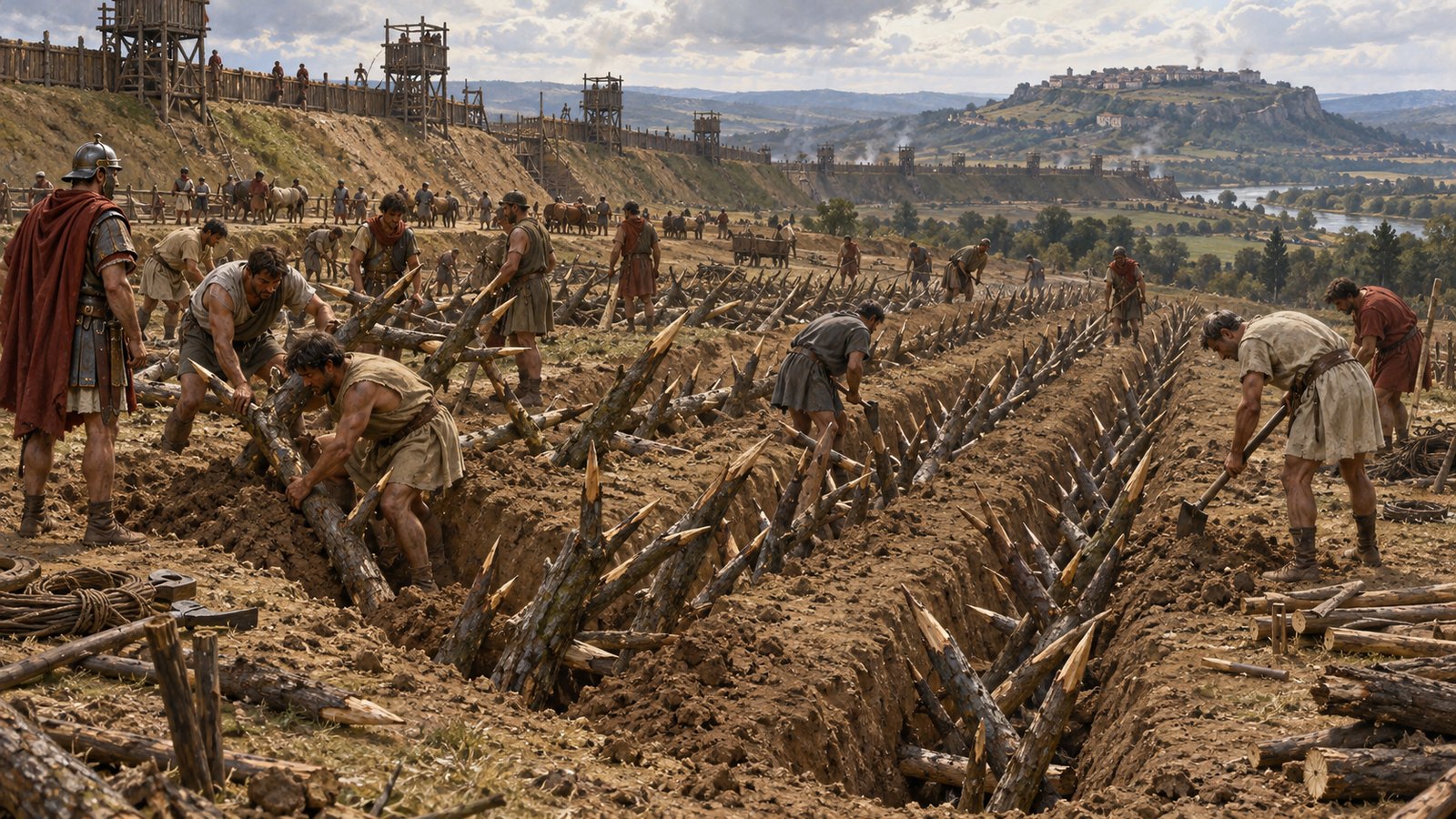
The first concealed device in Caesar’s sequence was called the cippus. Soldiers cut stout branches or young trunks, stripped them and sharpened their ends. They dug continuous trenches five feet deep, set the timber into the bottom and fixed it so that it could not be pulled out easily.
The branches projected together in five rows. Caesar compares their intertwined appearance to a connected mass. Unlike a single upright stake, branching timber could catch shields, clothing and limbs while neighboring points narrowed the route around it. The trap attacked formation as much as an individual foot.
Most of the trunk remained hidden. The attacker saw sharpened branches without immediately seeing how deeply they were anchored or where one obstacle ended and the next began. Removing them under missile fire would demand tools, space and time—the exact resources an assaulting line lacked.
The mechanism contrasts with Roman shields working as a moving wall. A close formation depends on synchronized steps and overlapping protection. Interlocked branches force soldiers to separate, twist or stop, dissolving the regular movement that lets shields support one another.
Caesar’s five rows also created redundancy. Finding one gap did not clear the belt. A formation that passed the first line met the same problem again from a slightly changed angle. The obstacle’s value accumulated through repetition, not through one enormous piece of timber.
Eight Lines of Lilies Turned Careful Footing into a Tactical Delay
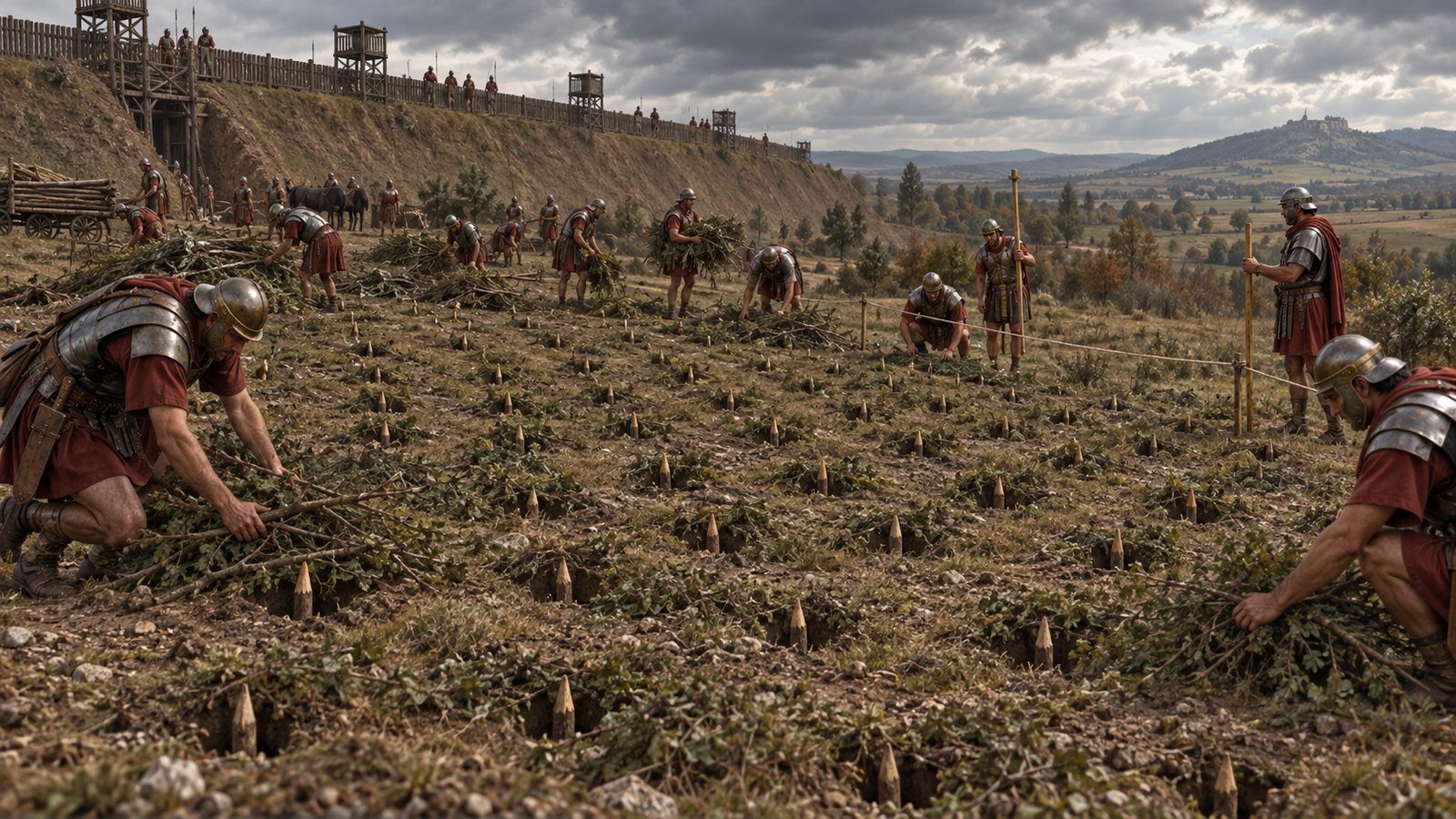
Behind or among the next defenses, soldiers dug the devices called lilies. Each pit was three feet deep and narrowed toward its base. A stake roughly the thickness of a thigh was driven into the bottom, sharpened at the top and hardened in fire. Earth was packed around it so that only about four fingers of point remained exposed.
Then brush concealed the mouth. The name probably came from the flared shape: broad at the surface, narrow below. Caesar records eight rows with three feet between them. The geometry mattered because a person avoiding one pit needed to know where the next row began while moving under pressure.
A lily did not need to stop an entire army by itself. Its uncertainty slowed the front rank. Once one person fell or warned those behind, following ranks compressed. Men looked down when defenders wanted them unable to look up. Ladders, shields and tools became harder to coordinate across ground that could not be trusted.
This was engineered concealment, not magical surprise. Fresh earth, cut brush and repeated patterns might reveal that the field had been altered. Knowing traps existed did not provide a clean lane through eight staggered rows. Discovery could intensify delay because every patch now demanded suspicion.
The lilies also sat within a larger sequence. An attacker tired by ditches and disordered by cippi reached the pits without the speed or spacing with which the assault began. Caesar’s system made each layer prepare the target for the next one.
Scattered Iron Stimuli Closed the Small Gaps in the Design
The smallest obstacles were the stimuli. Caesar describes iron hooks fixed into short wooden blocks and scattered thickly in front of the other defenses. Their name suggests a goad or sting. Unlike the ordered rows of pits, they turned apparently free patches into uncertain ground.
Scale gave the three devices different jobs. Cippi were large, branching and difficult to remove. Lilies were regular hidden cavities with substantial stakes. Stimuli were numerous points that could be distributed wherever engineers expected feet to search for an easy route.
Together they denied a simple answer. Spread out to avoid the large branches, and soldiers became more exposed and harder to command. Rush across the gaps, and concealed pits or hooks punished the pace. Stop to probe, and the rampart’s defenders gained time to use missiles from towers spaced around the circuit.
The design was still dependent on labor. Legionaries had to fell and trim timber, dig thousands of holes, fire-harden stakes, carry iron pieces, measure intervals, anchor each element and disguise disturbed earth. The finished field looked passive, but it embodied days of coordinated work.
A larger siege machine could be defeated by one dramatic countermeasure, as in the Rhodian defense against Demetrius’s giant tower. Alesia’s obstacle belt worked differently. It distributed resistance across countless small decisions made by every person crossing it.
That is what Caesar’s botanical nickname can obscure. The lilies were memorable, but they were never alone. A twenty-foot trench created distance. Paired fifteen-foot ditches absorbed momentum. Five rows of buried branches tore at formation. Eight rows of tapered pits made footing deliberate. Scattered hooks poisoned the remaining shortcuts. Rampart and towers waited behind all of them.
The battlefield outside Alesia was built to spend an enemy’s seconds before Roman defenders spent their strength. Caesar’s measurements let us see the conversion. Feet became pauses, ranks became knots, and open ground became an engineered machine whose moving parts were the attackers themselves.
Sources
Julius Caesar, Gallic War 7.72–74.