
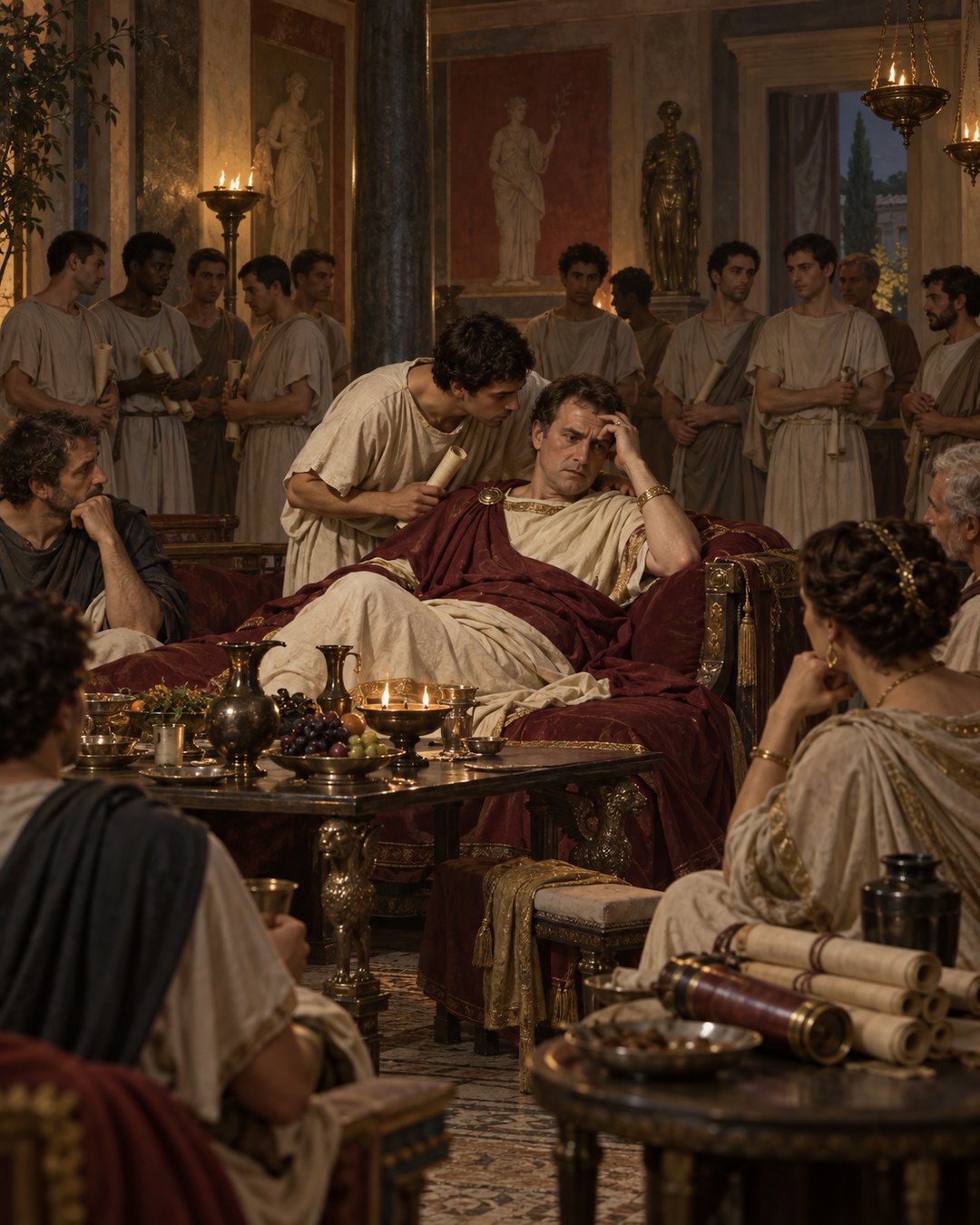
Calvisius Sabinus wanted a learned man’s reputation without a learned man’s memory. Seneca says this rich Roman could forget Ulysses, Achilles or Priam—names his audience was expected to know as readily as the people in its own households. Sabinus did not answer embarrassment with study. He answered it with a shopping list.
One enslaved specialist learned Homer. Another held Hesiod. Nine more were assigned one apiece to the lyric poets. Eleven human memories could then stand at the foot of Sabinus’s dining couch, ready to feed him a verse whenever conversation demanded culture. Each, Sabinus claimed, cost one hundred thousand sesterces.
The arrangement sounds like an extravagant library with a voice attached to every shelf. It also failed in public. Sabinus asked for a line, began to repeat it and frequently broke down in the middle of a word. The people he owned could retrieve literature for him. They could not move it across the final distance into his own memory.
A Familiar Hero’s Name Could Vanish at the Wrong Moment
Seneca begins with Sabinus’s weakness before describing his solution. His memory was not merely imperfect. It sometimes lost the names of three central figures from epic: Ulysses, Achilles and Priam. Seneca sharpens the insult by comparing such names to familiar attendants. For the educated audience of the letter, forgetting them was not an obscure scholarly lapse.
Yet Sabinus desired to appear learned. That verb of appearance controls the whole anecdote. The goal was not quiet reading, careful interpretation or even dependable recollection. He needed literary material at the moment other people could witness him using it. A dinner party therefore became the place where his purchased system would operate.
The system had to bridge two problems. First, somebody needed to preserve a large body of verse accurately. Second, Sabinus needed to perform that verse as though it belonged to him. Enslaved reciters could solve the first problem through training. The second required the host to remember enough of every prompt to keep speaking.
A scheduled Lost Eagles story follows how readers talked Augustus back to sleep. Both households put cultivated voices close to a powerful listener. Sabinus’s scene is harsher and more brittle: the voices were arranged not for rest, but to manufacture a display of knowledge that kept exposing its owner.
Eleven Specialists Turned a Household into a Catalogue
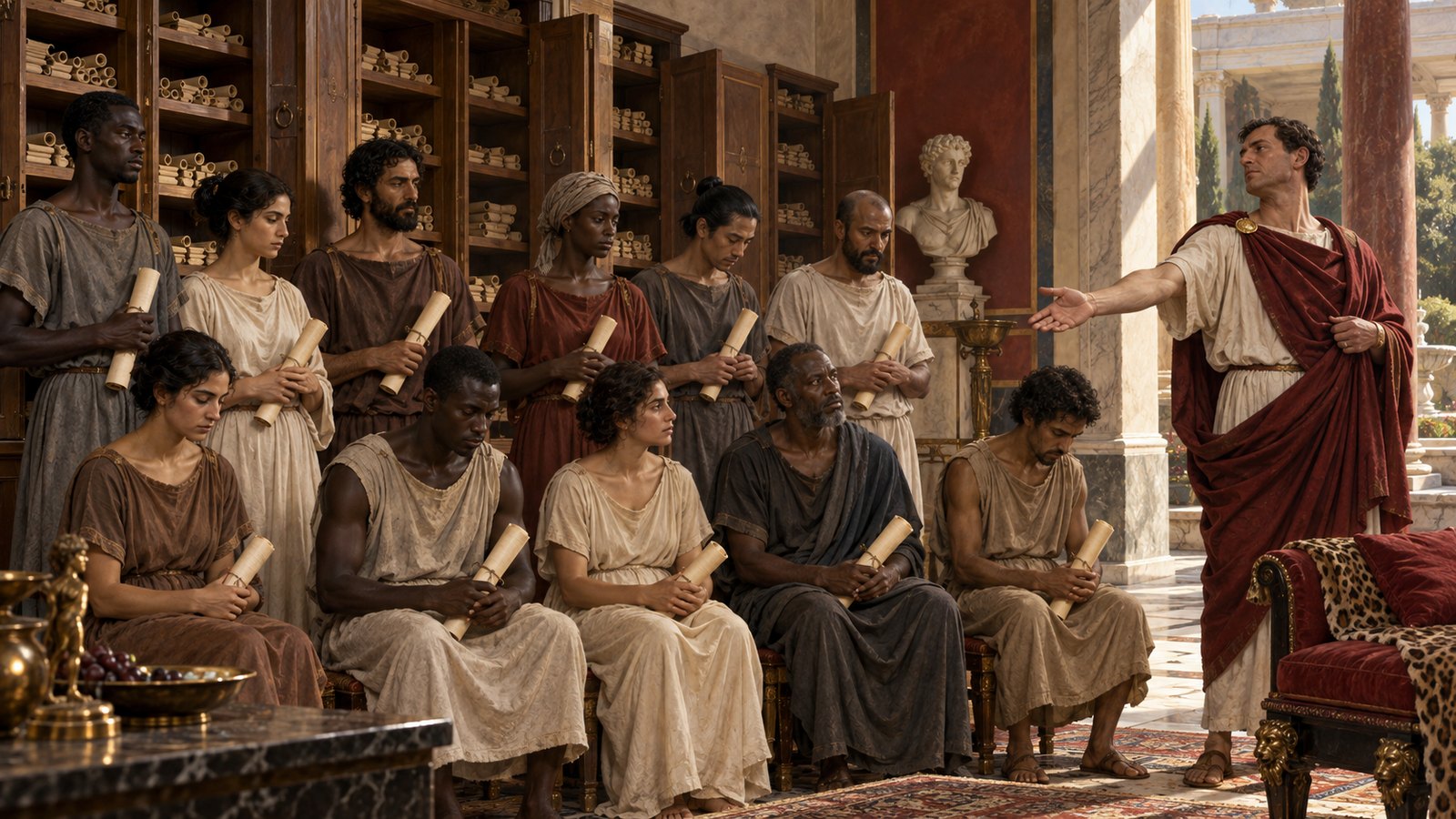
Seneca gives the collection a precise structure. Homer occupied one memory and Hesiod another. Each of the nine lyric poets received a separate specialist. The total of eleven is not a headcount Seneca announces; it follows directly from his inventory. Sabinus organized authors by people as neatly as another collector might organize rolls by cabinet.
Availability did not limit the project. If the required specialist could not be found ready-made, Seneca says Sabinus had one trained to order. The phrase reveals work hidden beneath the joke. Someone had to learn, retain and reproduce the verse on demand. Sabinus purchased the result while the intellectual labor remained in another person.
That separation is essential. Calling the reciters a “human library” can make the scheme sound ingenious, but these were enslaved people compelled to turn memory into household service. Their learning increased the master’s display value, not their freedom. The story’s comedy rests on wealth and coercion even when Seneca directs most of his contempt at Sabinus.
The reported price makes the display more pointed. Sabinus told Satellius Quadratus that every specialist had cost one hundred thousand sesterces. Seneca does not provide a total, and the text does not say all purchases happened together. It does show Sabinus using price as proof that the arrangement deserved respect.
The Prompt Reached His Ear but Not His Mind
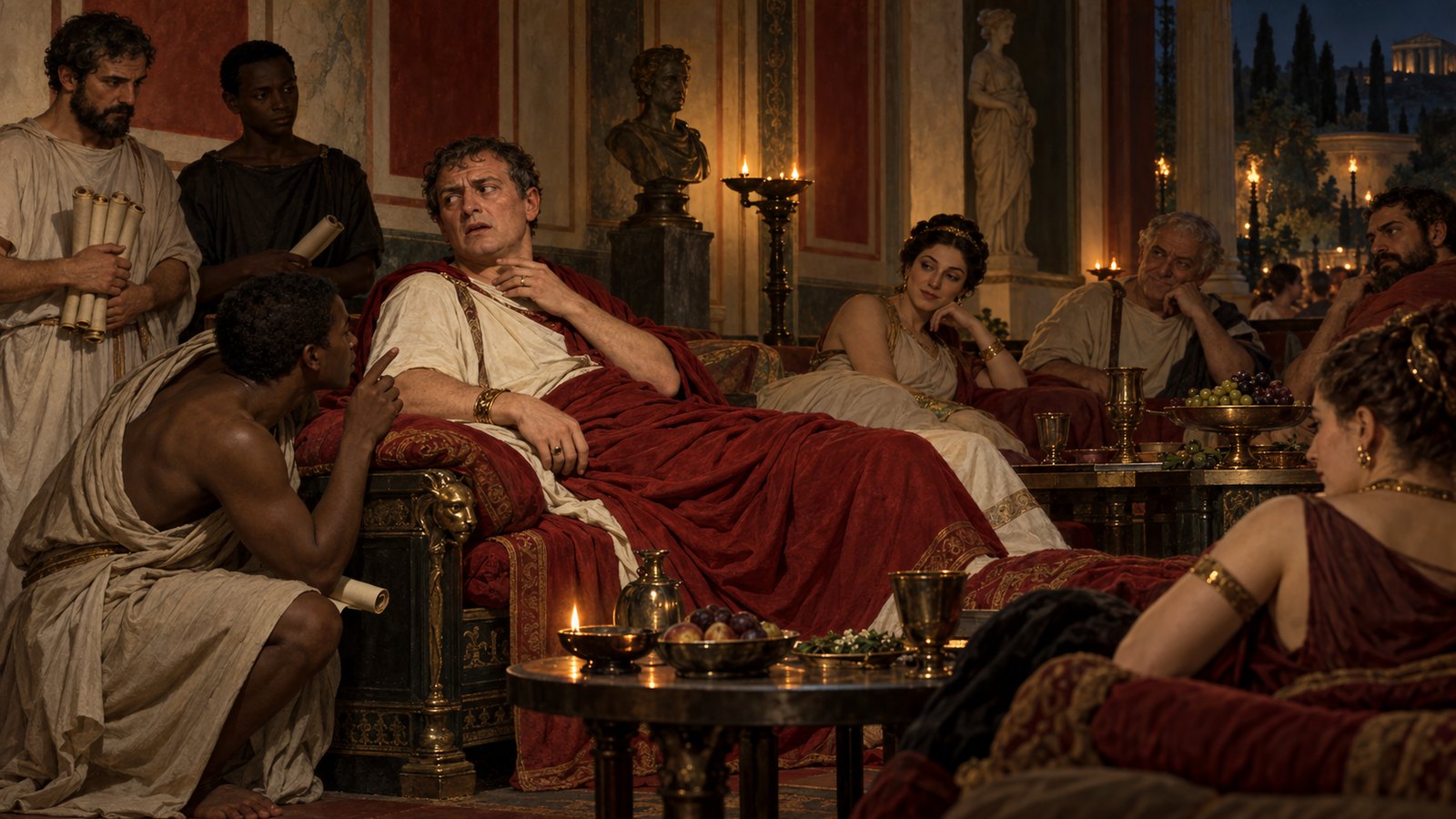
At dinner the specialists waited at the foot of the couch. Sabinus could ask for verses, receive a prompt and repeat it to his guests. The physical arrangement placed stored knowledge close enough to summon without making the source too difficult to see. Every successful quotation still depended on another person standing within earshot.
Then the performance fractured. Sabinus often stopped in the middle of a word. He did not merely forget the next passage after completing a borrowed line. According to Seneca’s caricature, the transfer could fail before one prompted word reached its end. The smaller the failure became, the more completely it exposed the system.
This was not writing used as an honest external memory. Roman readers knew that a scroll preserved words outside the mind. Sabinus instead claimed the contents of other minds as evidence of his own learning. His error was not consulting assistance; it was treating ownership of the assistant as ownership of the ability.
Another Lost Eagles article examines how Caesar moved each letter four places to hide a message. That mechanism transformed information so a recipient could recover it with the right rule. Sabinus’s prompts moved unchanged from one mouth to one ear. The missing mechanism was learning itself.
Quadratus Followed the Purchase Logic into Absurdity
Satellius Quadratus understood where to press. Seneca presents him as someone who lived around rich men by flattering and mocking them. He first suggested that Sabinus hire philologists to gather the fragments he dropped. The joke pictured failed quotations as crumbs scattered around the couch, requiring yet another servant to collect them.
When Sabinus advertised the hundred-thousand-sesterce price, Quadratus answered that the same number of bookcases would have cost less. A case could store Homer without pretending to make its buyer Homeric. By comparing specialists with furniture, Quadratus also repeated the dehumanizing assumption beneath Sabinus’s collection: both people and cabinets had become containers priced for a master.
Sabinus refused the distinction. Whatever anyone in his household knew, he insisted, he knew too. The claim converted property law into a theory of mind. A household could belong to him; therefore its knowledge supposedly belonged inside his identity. Seneca’s anecdote demonstrates the opposite each time Sabinus reaches for a prompt.
Quadratus then applied the same theory to the body. He advised the sickly, pale and thin Sabinus to learn wrestling. When Sabinus protested that he could scarcely remain alive, Quadratus told him to consider how many healthy slaves he possessed. If another person’s memory made Sabinus learned, another person’s muscles should make him strong.
Seneca’s Target Was Knowledge Treated as Property
The story appears inside an argument about work that cannot be delegated. Seneca distinguishes literary assistance from the effort required to improve one’s own mind. A secretary, reader or reciter might supply words. Nobody could perform the inward labor on someone else’s behalf.
That frame keeps the anecdote from becoming only a joke about a forgetful dinner host. Sabinus had successfully acquired expensive expertise. His specialists apparently knew the material he required, remained available and produced verses on command. The household system worked as retrieval. It failed only when Sabinus called retrieval personal possession.
Seneca closes the episode by saying that a sound mind cannot be borrowed or bought. The conclusion is deliberately broader than memory. Sabinus’s money obtained trained voices, an audience-facing apparatus and the temporary sound of quotation. It could not purchase judgment about why a line mattered, the discipline that retained it or the independence to speak when no prompt arrived.
The eleven specialists remain the most concrete evidence of the mistake. Homer, Hesiod and nine lyric poets surrounded one couch, but abundance did not remove dependence. Every added memory gave Sabinus more literature to display and another witness to the fact that the literature was being held somewhere else.
Seneca lets the performance end halfway through a word. Sabinus has paid, summoned the line and opened his mouth. At precisely the point when possession is supposed to become ability, the sentence stops. The silence after the prompt is the one thing no member of his household can carry for him.
Sources
Seneca, Moral Letters to Lucilius, letter 27.5–8.