

A courier could carry Caesar’s words in plain sight while their meaning remained displaced. Suetonius gives the key in a single example: when Caesar wanted to communicate secretly, he wrote the fourth letter after the one he meant. A appeared as D.
No special ink or concealed compartment was required. The protection lay in an agreement. Writer and reader shared a direction and a distance, then applied them repeatedly across the message.
The method was simple enough for Suetonius to explain in one sentence and systematic enough to transform every alphabetic choice. A familiar script became unfamiliar not because its marks changed, but because each mark pointed somewhere else.
That modest device belongs beside Caesar’s larger documentary habits. Suetonius knew collections of his letters, commented on the format of his dispatches to the Senate, and sorted authentic works from doubtful ones. The cipher reveals a ruler treating the route between thought and reader as a problem that could be engineered.
One Fixed Distance Reorganized the Alphabet
The surviving rule is substitution. Caesar’s secretary did not invent a new symbol for every secret word. He selected a normal letter located four places beyond the intended one. The recipient moved back by the same amount.
Suetonius’s example makes the operation tangible. D stands for A. Apply the same relationship to the next intended letter and the visible writing advances again. Consistency matters more than complexity: a changing offset would be harder to remember, but one repeated distance becomes a routine.
The cipher therefore divided literacy into two levels. Anyone who intercepted the message might recognize letters and perhaps pronounce the resulting groups. Only a person who knew the displacement could restore the author’s choices. Reading the marks was no longer identical to reading the message.
This was concealment through excess legibility. Blank space, invisible ink or a hidden tablet might attract attention or fail physically. Caesar’s method allowed a dispatch to remain visibly full of ordinary characters. Its surface announced writing while withholding sense.
Suetonius does not say that every communication used the system. He limits it to matters Caesar wished to convey secretly. Selection was part of security. Routine business could travel routinely; sensitive words received an additional procedure.
The Key Had to Travel Without the Message
A substitution rule works only when both ends possess it. Caesar or a secretary had to encode deliberately, and the intended reader had to know how to reverse the movement. The key could not be explained inside every protected letter without defeating its purpose.
That requirement turned trusted memory into infrastructure. A messenger needed to move the physical document, but did not necessarily need to understand it. The reader’s prior knowledge completed what the courier delivered.
The separation was useful in a political world filled with journeys, military commands and competing loyalties. A seized tablet could still expose names or patterns to a determined analyst, so this was not strong security by modern standards. Yet it increased the work between interception and comprehension.
The method also reduced dependence on one gifted specialist. Once instructed, several correspondents could use the same operation. Four steps forward to write and four back to read made secrecy teachable.
Roman administration often made authority portable through repeated forms. Readers can compare the cipher’s shared procedure with Caesar’s decision to put daily public business into written records. One practice widened access to information; the other deliberately narrowed it. Both changed an audience by changing how words were handled.
Private Letters Sat Inside a Much Larger Paper Life
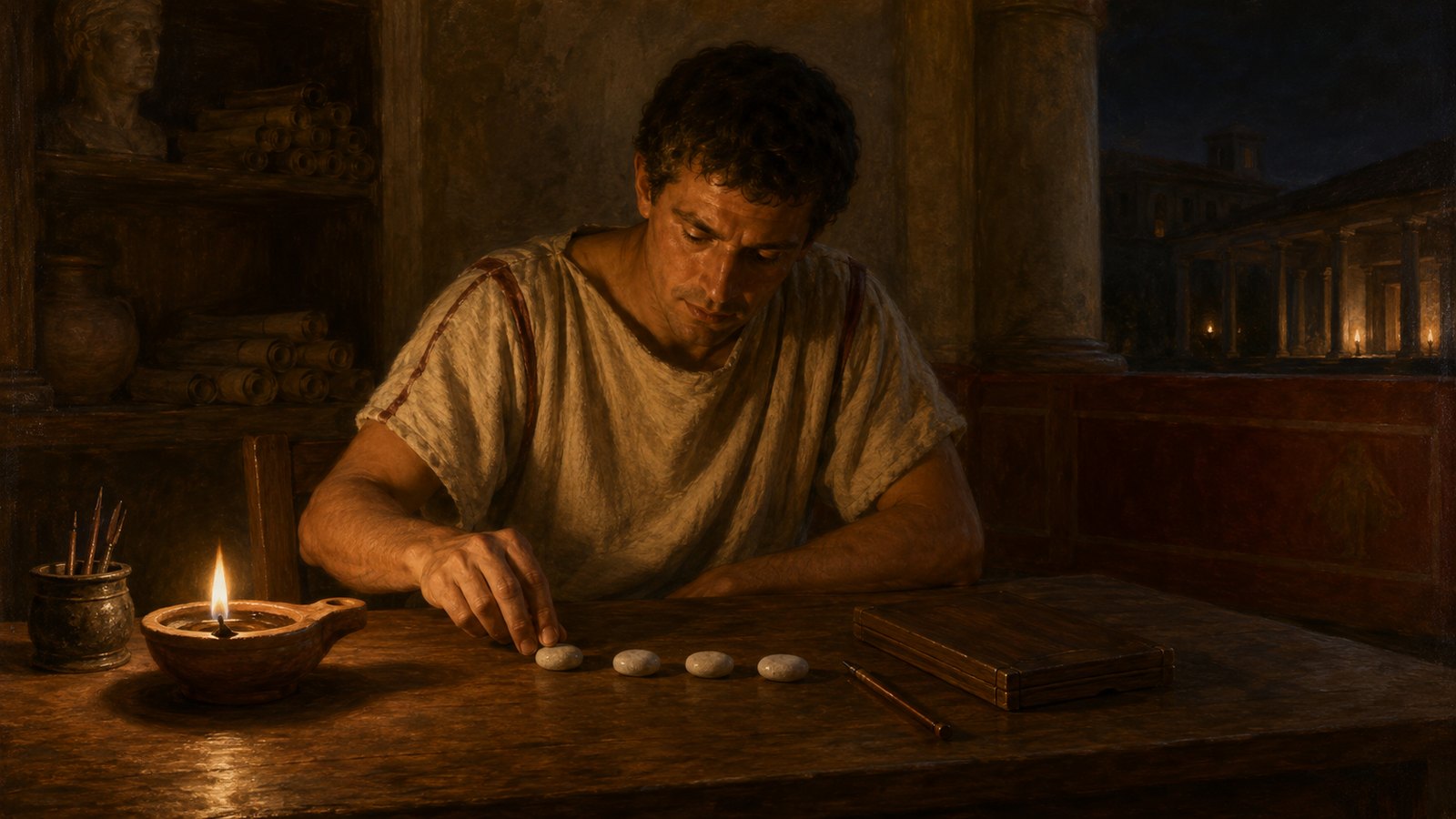
Suetonius places the cipher at the end of a survey of Caesar’s writing. He mentions letters to the Senate, letters to Cicero and letters to friends. These were not isolated scraps in the biographer’s imagination but named bodies of correspondence that readers collected and disputed.
The Senate dispatches carried an additional material claim. Suetonius credits Caesar with arranging official letters as pages in a folded notebook rather than writing them across the full width of a roll. Format affected consultation: a reader could turn through divisions instead of managing one continuous sheet.
That innovation and the cipher solved different problems. The notebook organized access inside a document. The substitution rule controlled access to meaning. One made a letter easier for an authorized reader to handle; the other made it harder for an unauthorized reader to understand.
Caesar’s papers also travelled under pressure. In the Alexandrian escape where he kept documents above water while swimming, the material had to survive a physical emergency. In private correspondence, the danger was not water but another set of eyes.
Neither episode makes paper an accessory to action. Documents were part of action. They carried orders, relationships, evidence and reputation, which is why bodies and procedures were arranged around their survival.
Speed and Secrecy Could Use the Same Writing Habit
Suetonius describes Caesar composing while in motion. He says De Analogia was written while Caesar crossed the Alps to rejoin his army after judicial duties in Cisalpine Gaul. Another work, The Journey, took shape during a twenty-four-day trip from Rome to Further Spain.
These details portray writing as something fitted into command rather than reserved for retirement. Roads, hearings and armies did not end literary or administrative work. They supplied the intervals in which it continued.
A compact cipher suited that environment. It needed no bulky apparatus and no rare material. A stylus, ink or whatever surface already served the letter was enough. The extra burden was mental and procedural.
The same portability carried a weakness. If an opponent learned the fixed shift, every message using it became readable. Repetition created efficiency for Caesar’s circle and opportunity for anyone who discovered the pattern.
Suetonius does not tell us about interceptions, successful attacks or changes of key. Claims about the cipher’s practical effectiveness should stop there. What he securely preserves is the intended mechanism and one worked equivalence.
A Small Rule Marked the Boundary of Trust
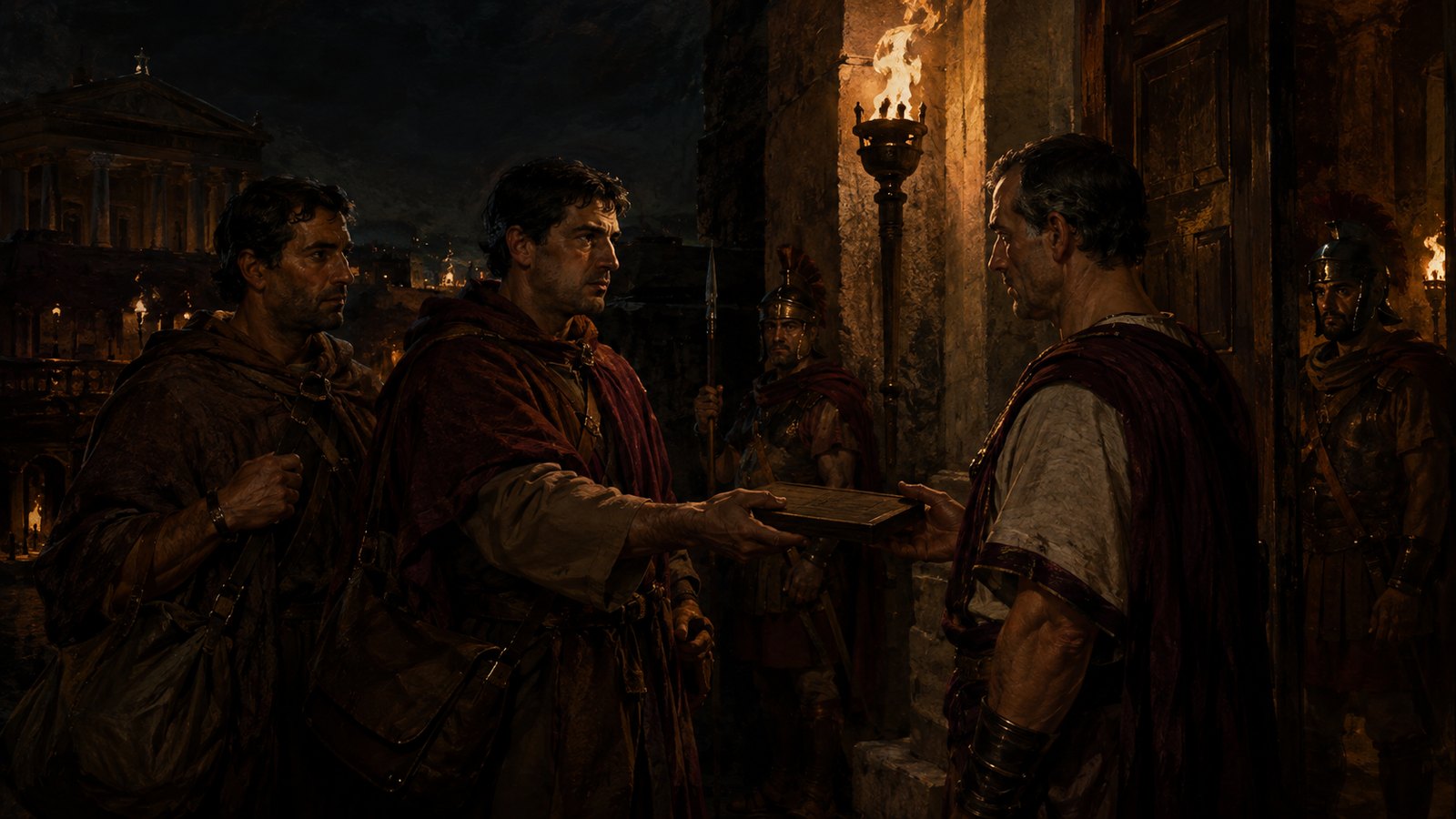
Caesar’s four-place shift did not make language disappear. It placed a narrow gate between recognition and understanding. The gate opened for readers who possessed the rule.
That boundary was social before it was mathematical. The real question was not whether a person knew the alphabet, but whether Caesar’s circle had admitted that person to a shared convention. Trust determined who could turn D back into A.
Suetonius’s broader discussion reminds us that authorship itself could be contested. He labels some texts doubtful, reports that Augustus blocked publication of youthful works, and identifies collections under different names. Words survived, but their status depended on decisions made by later readers and rulers.
The cipher is the most compact of those decisions. Each visible letter says one thing to an outsider and indicates another to an insider. Meaning depends on position, distance and permission.
Caesar commanded legions and reshaped political institutions, yet one of his information tools can be reconstructed without a battlefield or decree. Begin with the intended letter, move four places, and write what appears there. The resulting line is ordinary script carrying an extraordinary condition: it can be read correctly only by someone already trusted with the way back.
Sources
Suetonius, Julius Caesar 56.