
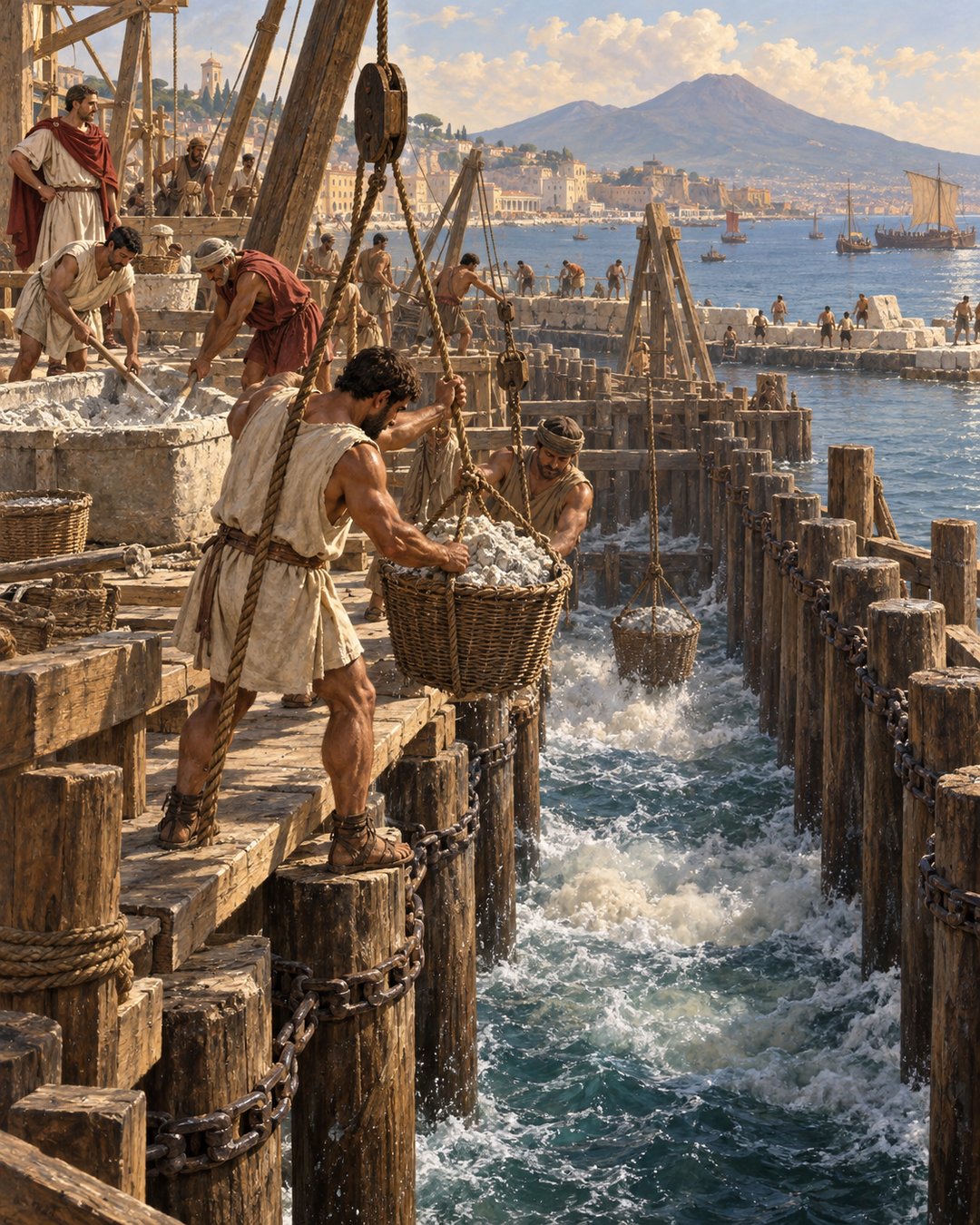
Roman builders stand in seawater beside two lines of oak piles. Chain pieces hold the timbers together while workers excavate and level the bed between them. Above, other hands combine lime with a pale powder brought from the volcanic country around the Bay of Naples. Stones descend into the enclosure, and mortar begins to occupy a place where ordinary work would wash apart.
Vitruvius presents the powder as extraordinary: mixed with lime and rubble, it hardens underwater as readily as in an ordinary building. Yet his harbour instructions do not ask readers to throw a miraculous substance into the waves. The powder belongs inside a sequence of timber work, measured proportions, bed preparation and controlled placement.
That sequence is the deeper achievement. Roman marine concrete was useful not simply because a volcanic ingredient reacted with water, but because builders knew where to obtain it and how to organize a shoreline around its behavior. Material and method entered the sea together.
One Campanian Landscape Supplied an Unusual Powder
Vitruvius locates the material around Baiae and in the territory near Mount Vesuvius. He calls it a species of sand with remarkable natural qualities. When joined to lime and rubble, it could become solid under water without losing the usefulness it had in construction on land.
His explanation belongs to ancient natural philosophy. Heat beneath the mountains, he thought, acted through springs associated with sulphur, bitumen or alum. Internal fire dried and transformed the surrounding earth and porous stone. When water later entered a mixture of these dry, fire-affected substances, their need for moisture made them bind rapidly.
Vitruvius pointed to excavated sweating rooms at Cumae and Baiae where hot vapor rose through the ground. He also invoked the pumice or “sponge-stone” of the Pompeian district as evidence of rock changed by subterranean fire. He did not possess modern volcanic chemistry, but he correctly tied the useful powder to a specific geological environment.
The location mattered operationally. Builders could not assume that any sand beside any hot spring would behave the same way. Vitruvius explicitly warns that regions have different earths and stones. A Roman harbour project therefore began with material knowledge: the powder had to come from the country that produced the property the design required.
Two Measures of Powder Met One Measure of Lime
In the harbour chapter, Vitruvius turns description into a ratio. Powder found between Cumae and the Promontory of Minerva was mixed with water at two parts powder to one part lime. The surviving translation compresses practical decisions about volume, consistency and aggregate, but it preserves a clear proportional rule.
The ratio distinguishes a recipe from admiration. A foreman could organize loads and mixing around repeatable shares rather than describing the ingredient merely as “good” earth. Lime supplied one reactive component; the Campanian powder supplied another; water was not simply an enemy to exclude but part of the setting in which the combination became solid.
A previous Lost Eagles article follows how lime kilns turned stone into Roman mortar. The harbour method begins after that transformation. Burned lime alone does not explain the marine work. Its measured partnership with volcanic powder let masons plan construction where wave action made ordinary binding vulnerable.
Vitruvius says the hardened mass resisted both waves and the force of water. That is a performance claim, not a promise that every Roman harbour wall survived forever. Poor timbering, bad aggregate, an unstable bottom or violent exposure could still ruin a project. His following instructions exist because the ingredient did not remove the need to control those risks.
Oak Piles Made a Worksite Below the Waterline
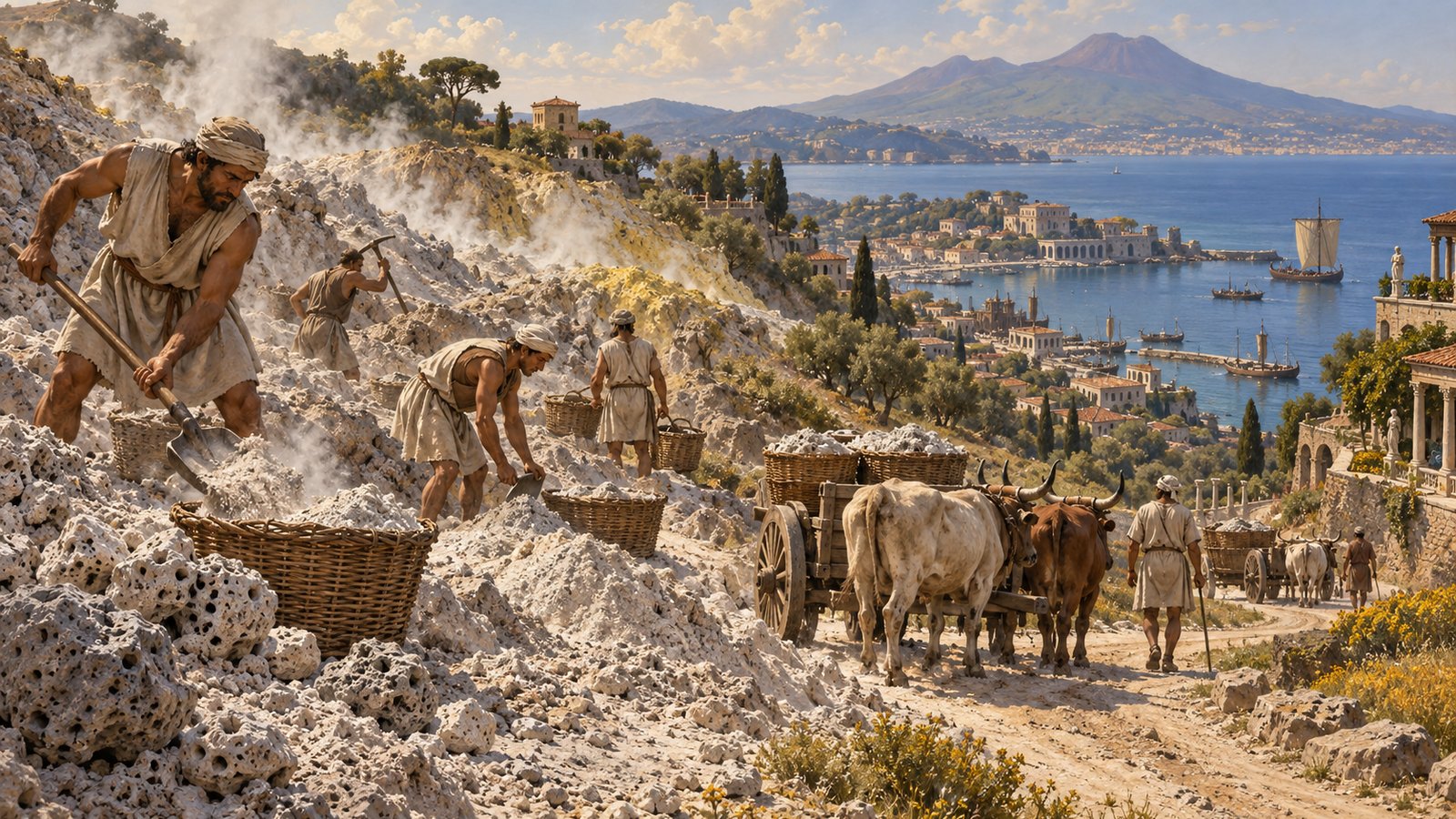
The main method begins with dams, or what modern readers would recognize as cofferdam-like enclosures. Oak piles were tied with chain pieces and driven firmly into the bottom. The timbers defined a bounded strip inside moving water and provided a structure within which excavation and masonry could proceed.
Between the rows of piles, workers dug out and leveled the bed below the waterline. That detail is easy to lose beneath the fame of Roman concrete. A wall could not be trusted merely because its mortar set wet. Its load still needed a prepared base rather than loose, irregular sediment.
Stone and mortar compounded by the stated method then rose until the wall filled the space inside the timber enclosure. The process joined different trades: pile driving, fastening, underwater excavation, transport of aggregate and powder, lime preparation, masonry and supervision of a build whose lower courses could not be inspected like a dry wall.
The future Lost Eagles account of Caligula’s obelisk ship becoming part of Claudius’s harbour foundation shows another spectacular answer to marine construction. Vitruvius gives the less theatrical grammar behind such ambitions: control the bottom, contain the work and match the binder to water.
Open Waves Required a Pier Built to Fall
Vitruvius also understood that a timber enclosure might not survive an exposed coast. If violent waves prevented the dam from holding, he proposed a different operation. Builders prepared a powerful foundation at the edge of the land, keeping part level and arranging the shoreward section to overhang.
Sand supported the overhanging area while a large pier mass was built above. The structure then had to remain for at least two months to set. Afterward the margin containing the sand was removed. Waves washed the support away, causing the finished mass to fall into the sea.
This is controlled collapse used as placement. Instead of forcing workers to maintain a fragile work enclosure in heavy water, the method moved much of the setting period onto shore. The sea that threatened construction later became the force that removed the temporary sand support.
Vitruvius says repetition could carry the work farther outward. Each completed mass extended the usable edge from which another operation might begin. The technique demanded patience and a willingness to build an object in one orientation before letting gravity relocate it into the harbour line.
Without the Powder, Builders Had to Remove the Water
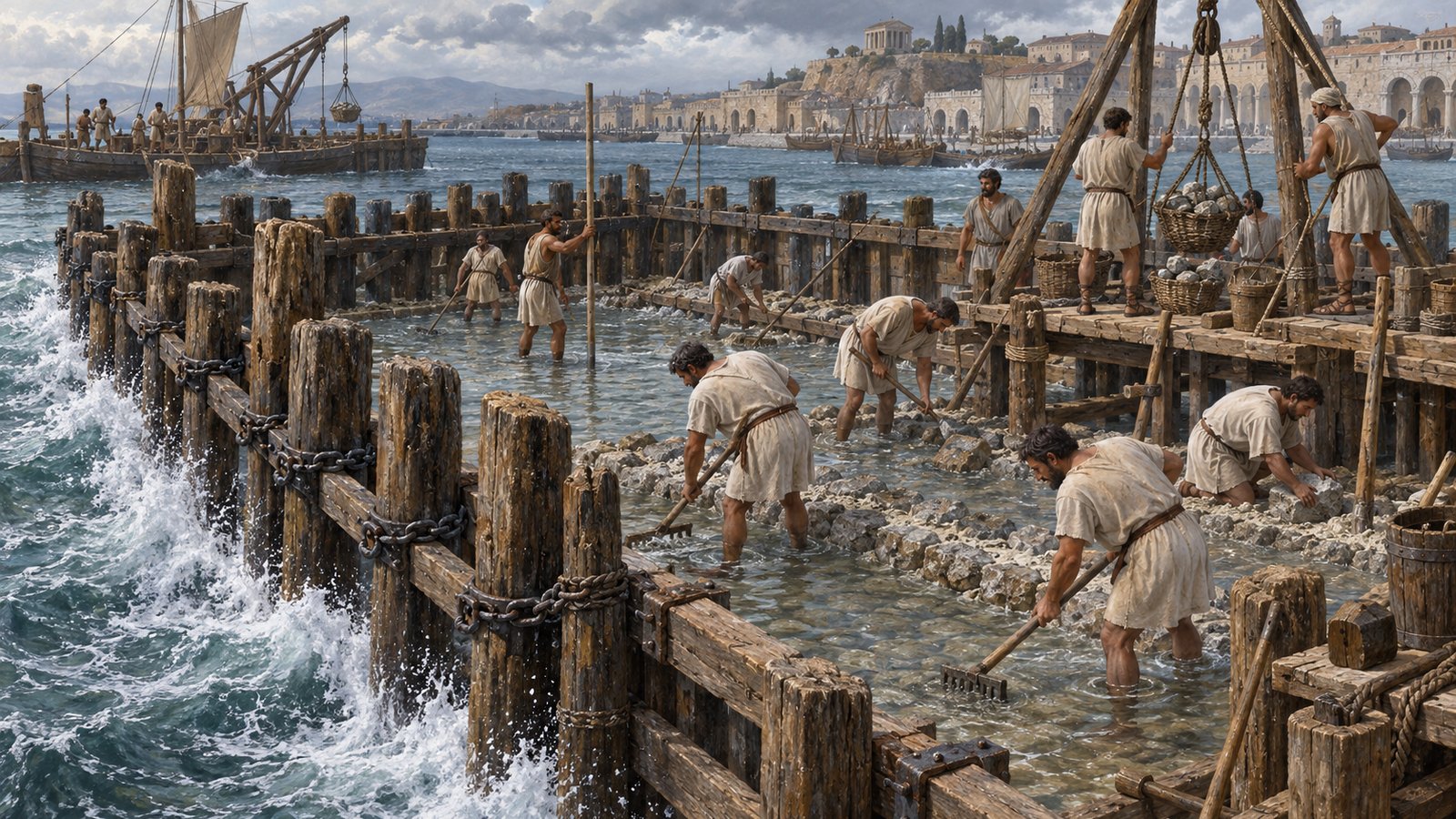
The special Campanian material was not available everywhere. Vitruvius therefore supplies a fallback rather than pretending one recipe served the entire Mediterranean. Double dams could be joined with planks and chain pieces, with the gap between them packed tightly using clay and marsh weed.
Once the barrier was compressed, screw pumps or water wheels emptied the enclosed area. Workers could then excavate foundations in the dry. If the bottom was loose, they dug until reaching a solid layer wider than the intended wall and built with stone, lime and ordinary sand.
Very soft ground demanded more preparation. Charred piles of alder, olive or oak were driven into the bottom, and coal filled the spaces. Squared stones above needed long joints to tie the wall together, while rubble or masonry filled the interior. Vitruvius ends by saying the resulting base could even carry a tower.
The contrast clarifies what the volcanic powder changed. Where it was present, water could remain part of the construction environment while the mortar hardened. Where it was absent, engineering effort shifted toward sealing, pumping and drying. Builders did not possess one universal Roman-concrete trick; they selected a workflow according to material and site.
A harbour wall began in the hills near Baiae, in oak forests, lime burning, chain making and knowledge of a seabed hidden beneath waves. The powder earned its reputation because Roman builders embedded it in that network. Two parts to one made the binder; piles, hands and sequence made the harbour.
Sources
Vitruvius, On Architecture, Book 2, chapter 6, and Book 5, chapter 12.