
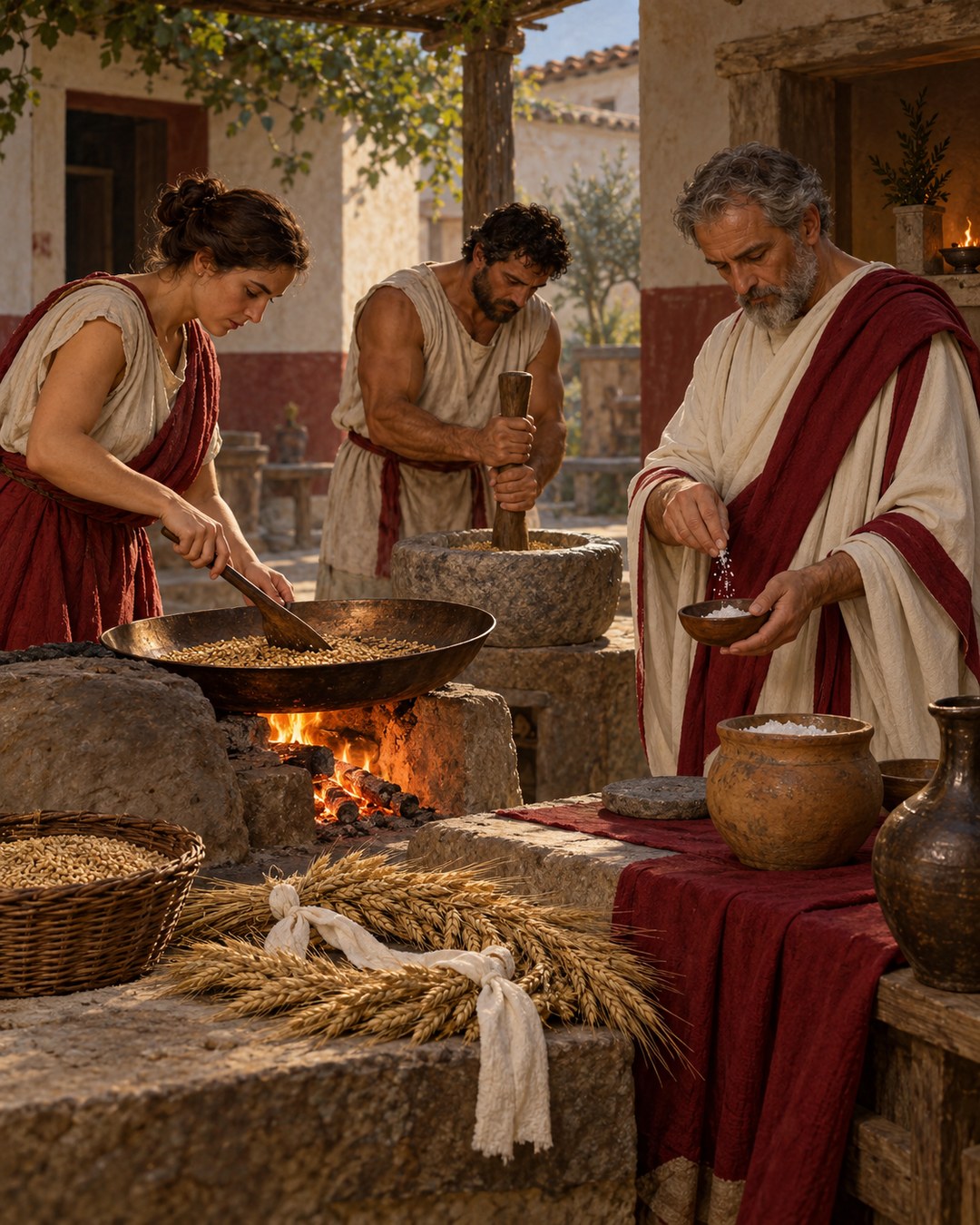
Before spelt could cross from the granary into sacrifice, it had to pass through fire. Pliny the Elder credits King Numa with a rule that made the distinction explicit: grain was not pure enough to offer unless it had been parched. The act that improved food also became a ritual threshold.
That small requirement joined field, hearth, priesthood, and calendar. Grain was grown by households, dried and stored by labour, then transformed again before it could stand between Romans and their gods. Even the first human taste of a new harvest waited on priestly action. Religion did not arrive only at the altar. It entered the sequence of processing.
Pliny’s account looks backward through Roman tradition rather than providing a contemporary record from Numa’s reign. Its value lies in what an imperial author thought explained old practice: purity could be manufactured through correct handling, and permission to consume could be delayed until the crop had acknowledged a divine claim.
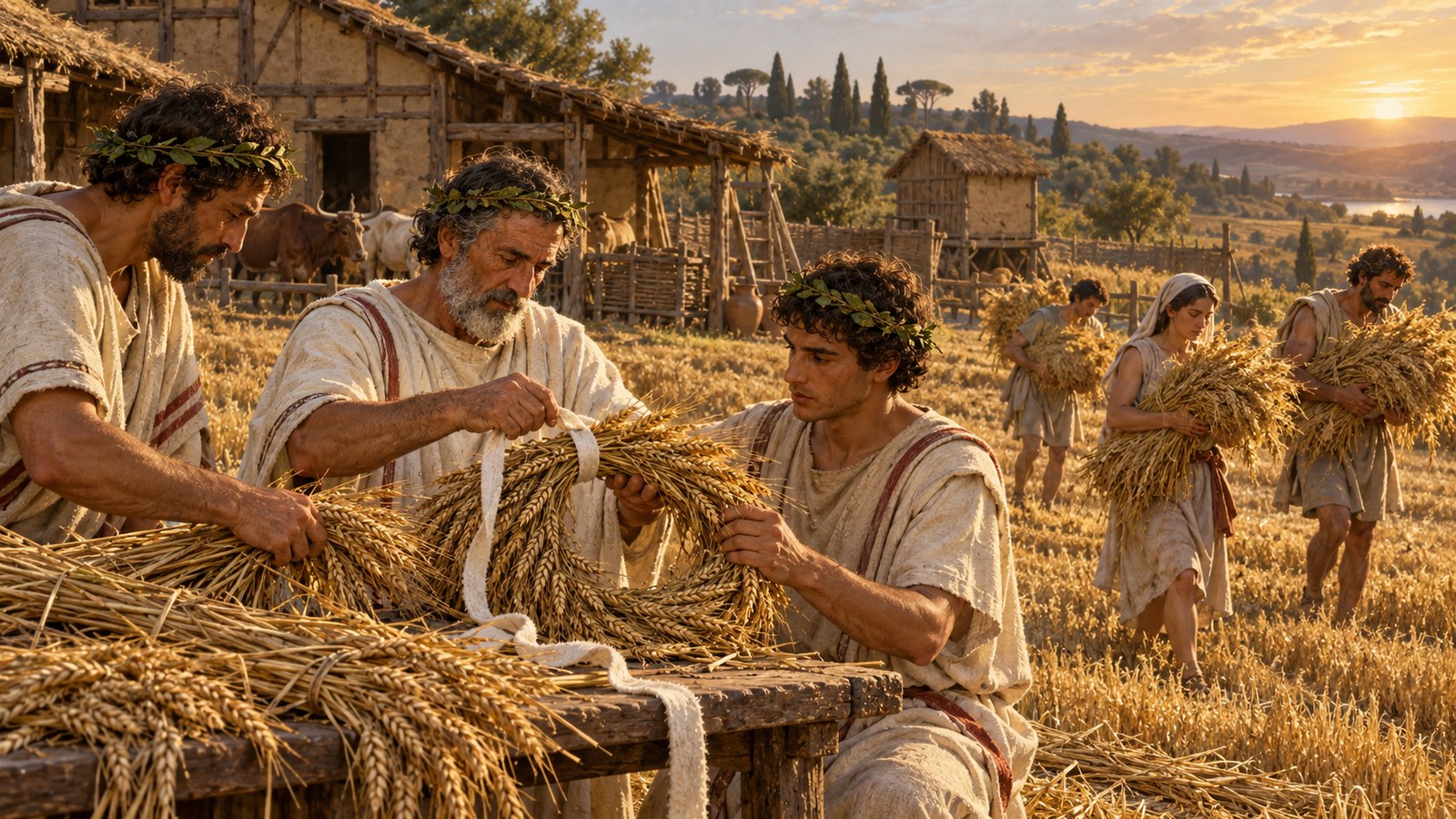
An ear of grain became Rome’s earliest chaplet
Pliny begins with the Arval priesthood. He attributes its establishment to Romulus and describes the brotherhood as the eleven sons of Acca Larentia, Romulus’s nurse, with the founder himself taking the place of a twelfth brother. The genealogy makes cultivated land part of Rome’s family memory.
The priestly distinction was not gold or laurel. It was a wreath of grain ears bound with a white fillet. Pliny calls it the first chaplet used at Rome. The material came directly from the crop whose continuity the brotherhood represented, so the emblem joined office and harvest without disguising either.
Membership, he adds, lasted for life. Exile or captivity did not strip it away. That claim made the wreath more than clothing worn during one ceremony. The office adhered to the person across political and physical displacement, while its grain emblem kept recalling productive land.
This origin story sits beside the rules that selected one Vestal from twenty candidates. Both traditions made priestly status durable through procedure. Yet the Arval sign remained strikingly agricultural: ears gathered into a circle and fixed with a plain white band.
Pliny then contrasts early restraint with later luxury. Two iugera, he says, had once been counted sufficient for a citizen, while imperial wealth demanded pleasure gardens and fishponds on a different scale. The contrast is moralizing, but it locates sacred grain inside an imagined economy of limited plots, measured labour, and visible dependence on harvest.
Numa put purity inside the parching process
The next step belongs to Numa. Pliny credits him with establishing offerings of grain and propitiating the gods with a salted cake. Grain did not reach the divine as an untouched sample scooped from storage. It appeared as material altered by heat, salt, grinding, mixing, and human judgment.
Citing the earlier writer Hemina, Pliny says Numa introduced the parching of spelt because it was more wholesome in that condition. The practical observation alone did not guarantee obedience. The king therefore made a religious rule: un-parched spelt was not pure enough for offering.
That move fused usefulness with obligation. Parching could dry the grain, change its texture, and prepare it for further work. By defining the treated state as pure, tradition made a production step answerable to more than appetite. A neglected hearth process could now be a ritual defect.
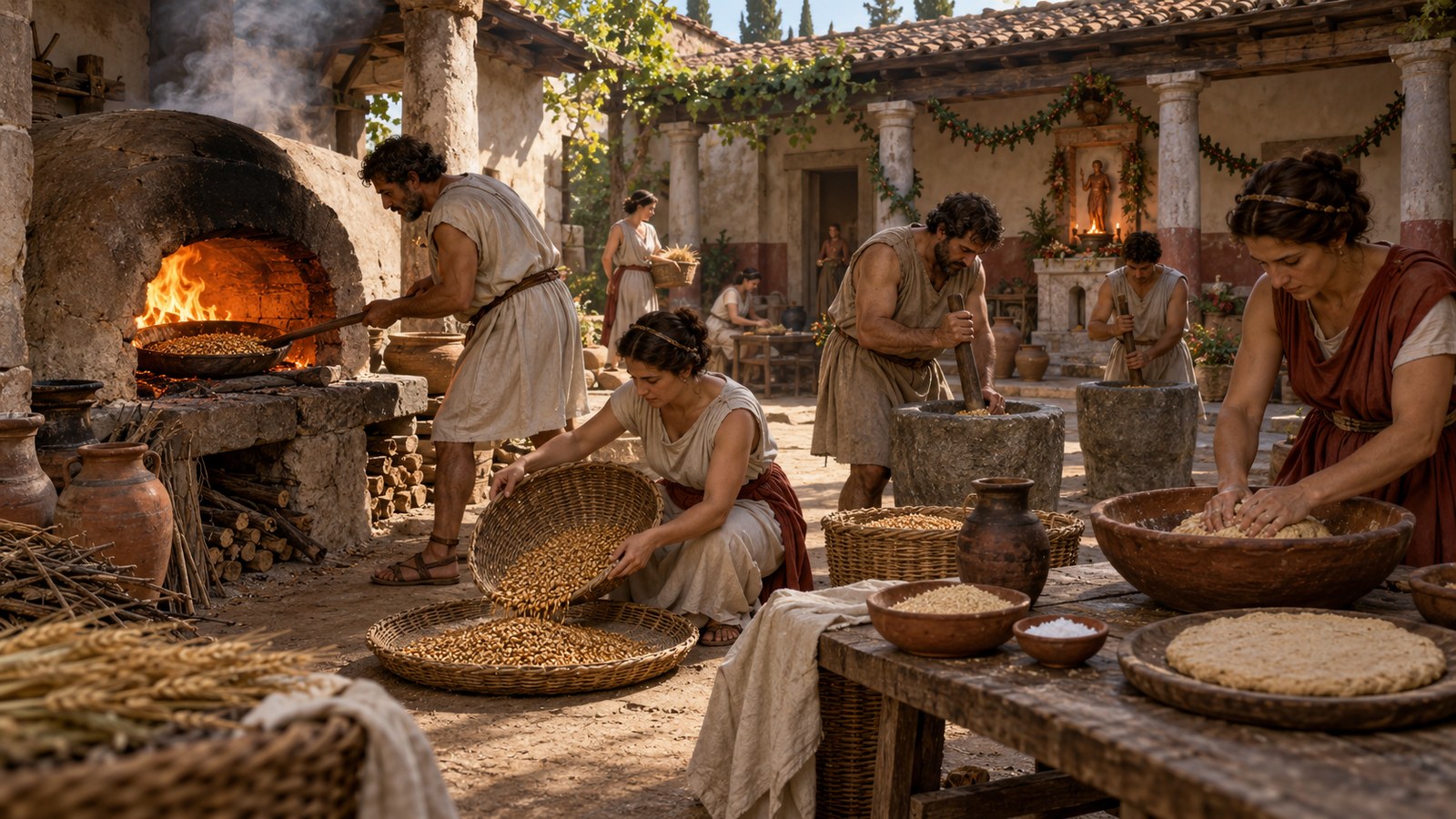
The rule did not say that every parched kernel became sacred. It established a condition for grain that entered an offering. Workers still had to choose sound material, control heat, avoid burning, pound or grind the result, and combine it correctly. Purity was not an invisible label pasted onto raw food; it depended on a sequence that hands could perform badly or well.
The salted cake sharpened that relationship. Salt and grain were ordinary necessities, but measured combination changed their role. At the altar, the mixture marked the offering as prepared according to inherited form. Its force came partly from repetition: the same modest substances repeatedly opened a formal exchange with the gods.
A festival made the oven part of the calendar
Pliny also credits Numa with the Fornacalia, the festival associated with parching grain. A household technique therefore gained calendrical shape. Fire, oven, and crop were coordinated not just by ripeness or weather but by a named observance.
This does not mean every detail of later celebration can be read back into a royal foundation. Pliny is assembling explanations that Romans attached to their institutions. What matters for his argument is that parching deserved public memory. The transformation of spelt was important enough to be assigned an originator and festival.
The oven sat between uncertain harvest and dependable store. Too much moisture endangered grain; uncontrolled heat ruined it. Parching made the worker read colour, smell, sound, and texture. Ritual importance did not remove those material demands. It heightened the consequences of getting them wrong when the batch was destined for an offering.
Fuel and timing tied the rite to household capacity as well. Wood had to be gathered, the oven brought to an even heat, and the grain watched through cooling before pounding began. A rule expressed as purity therefore rested on ordinary competence, repeated often enough that a sacred requirement could be met without turning every preparation into improvisation.
Roman ritual repeatedly relied on such exact preparation. The mixed remains discussed in the Parilia’s combination of horse blood, calf ashes, and bean stalks were effective within a prescribed chain, not as interchangeable symbols. The salted grain cake followed the same broader logic: material, order, and handling belonged together.
Pliny places field boundaries nearby in the story. Early Romans, he says, regarded termini as gods and observed solemn rites for their erection and preservation. Grain purity and boundary worship answered related anxieties. One governed what could cross toward the altar; the other governed where possession and cultivation stopped.
The first taste waited for a priest
The strongest limit appears after harvest. Pliny says people formerly did not taste newly cut grain until priests had made a libation of first fruits. Newly made wine waited under the same restraint. Production could be complete in practical terms while consumption remained ritually premature.
That pause established priority. The gods received acknowledgement before the household treated the crop as ordinary food. A farmer might have cut, carried, threshed, and stored the grain, but effort alone did not authorize the first mouthful in the tradition Pliny describes.
The rule also required coordination. Priests needed material from the new yield; households needed to know that the rite had occurred; grain and wine moved on different agricultural schedules. First fruits turned seasonal abundance into a public sequence instead of a collection of isolated private meals.
Restraint gave the new crop a brief unstable identity. It was owned and useful, yet not fully available. That interval made abundance visible as something received rather than simply seized. The libation then changed social permission without changing the kernel’s physical substance.
Seen together, the wreath, parching rule, salted cake, festival, boundaries, and first fruits form a chain. Cultivation produced grain. Correct heat rendered selected spelt fit for offering. Priestly action opened the harvest to taste. Sacred order occupied the transitions where material changed use.
Pliny’s early Rome is idealized, and his named founders organize practices that developed across time. Still, the account preserves a precise Roman claim about purity. Spelt did not become acceptable because it was ancient or abundant. It became acceptable after work performed in the right way, and people waited for the crop’s divine share before calling the rest entirely theirs.
Sources
Pliny the Elder, Natural History, 18.2.