
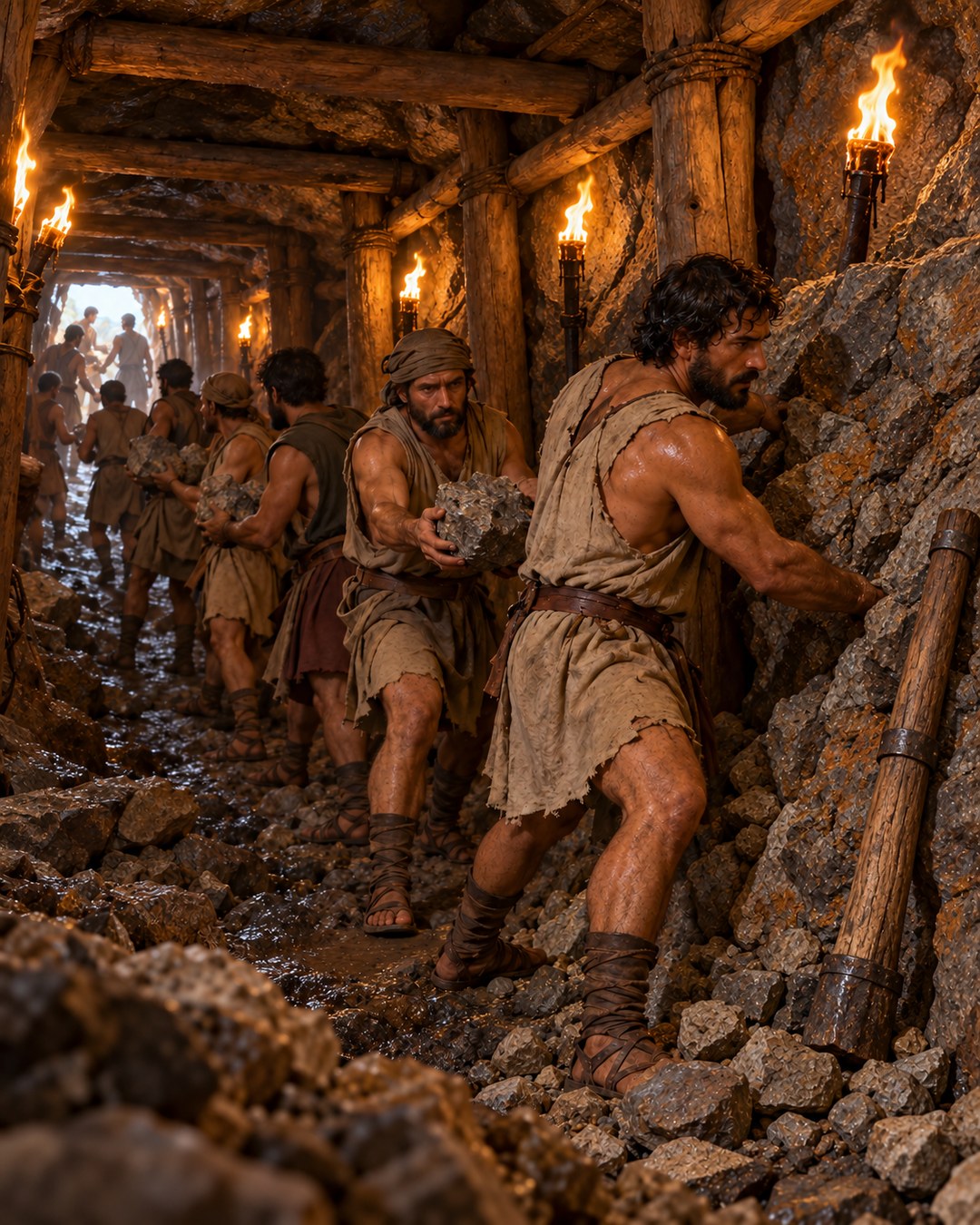
Underground, a torch was more than light. Its burn-length measured the shift. Pliny the Elder says workers drove long galleries into mountains and divided labour by the time a torch lasted, while some passed months without seeing daylight. The precious metal at the end of the chain depended first on a flame that was steadily consuming the air and its own clock.
Pliny’s account of Spanish gold extraction is full of giant gestures: mountains collapse, stored water tears rock away, and engineered channels cross impossible slopes. Yet the system worked through smaller connections. Someone replaced the torch. Someone watched roof supports. Someone passed debris to the next shoulder. Someone cut a level for water. Someone burned the prickly plant that had trapped grains of gold.
The description is technical, moralizing, and sometimes numerically grand. It should not be treated as a neutral production report. Pliny wants readers to see ingenuity and condemn appetite at once. That tension reveals an integrated extraction chain in which the glittering result concealed darkness, danger, and coordination.
Fire supplied both the light and the labour clock
Pliny distinguishes three routes to gold: particles polished in streams, material reached by shafts, and galleries driven deep into mountains. He calls the last workings arrugiae. Their scale “surpasses the labours of the Giants” in his rhetoric, but his first practical detail is a torch.
The duration of each torch set the period of work. Such a clock was inseparable from the underground environment. A flame made faces, tools, supports, and veins visible, but it also produced smoke and consumed fuel. Shift length could be understood without sunlight because the light source itself marked elapsed time.
Pliny says workers might not see day for months. The statement emphasizes extremity rather than giving a roster, yet it captures the separation created by galleries. Those nearest the face depended on an artificial cycle of light, labour, hauling, and replacement that continued independently of sunrise above.
The mountain could close that world without warning. Sudden clefts and subsidence crushed workers, so arches were left at intervals to carry the roof. Empty space was productive only while enough rock or constructed support remained. Every extension of the gallery altered the load that protected and threatened the crew.
The risks stand beside Alpine crystal miners hanging from ropes above exposed rock. Both kinds of extraction placed bodies where ordinary footing and daylight failed. Gold mining added a moving boundary underground: each new cavity made support a fresh calculation.
One hundred and fifty pounds met the hard barrier
When galleries struck silex, workers could attack it with fire and vinegar. Pliny immediately notes the problem: smoke and suffocating vapours filled the confined workings. A technique that broke rock also changed the air, so its usefulness carried a cost that was harder to escape underground.
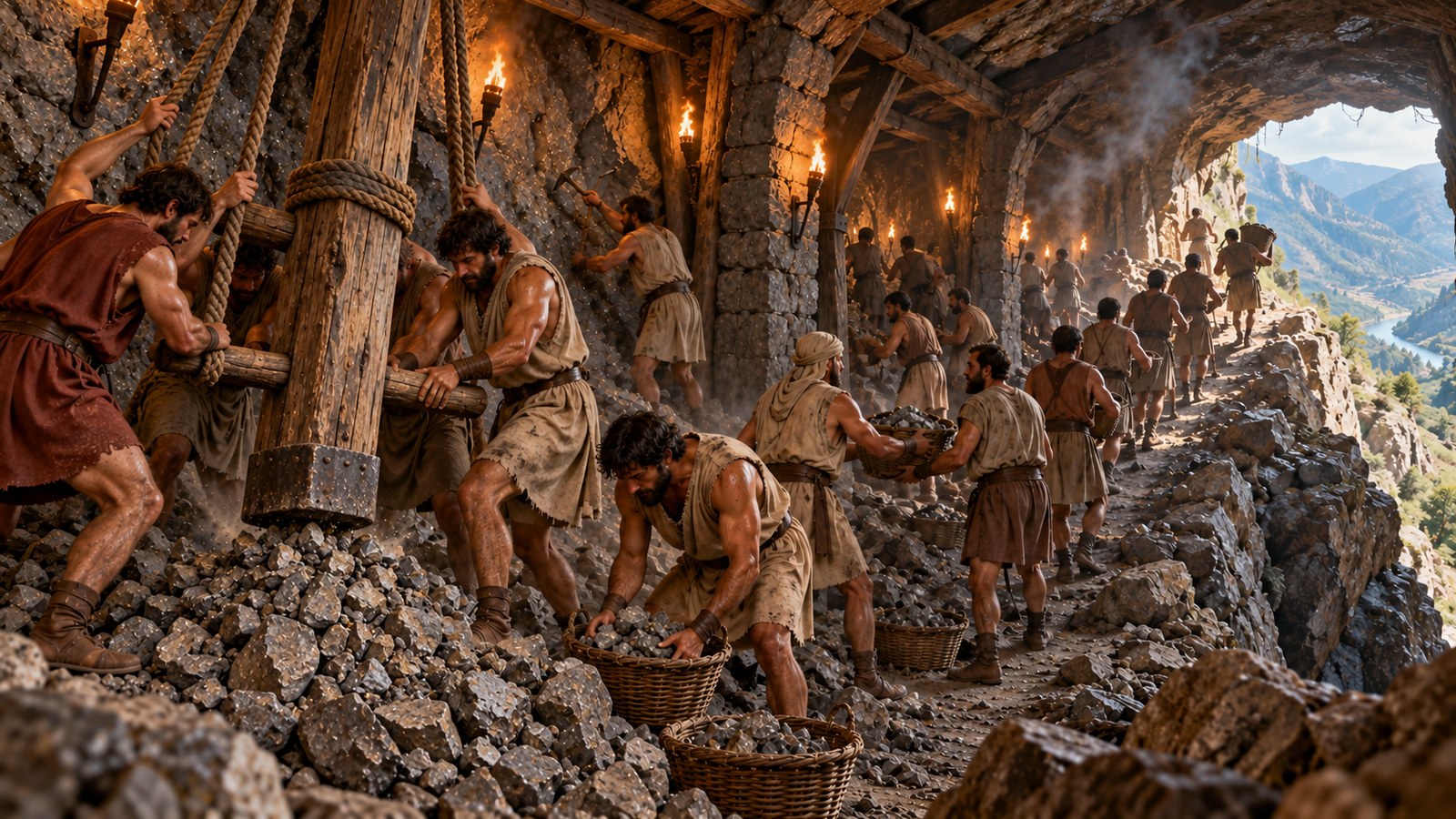
The alternative he describes was physical impact from iron-shod crushing machines weighing 150 pounds. The number conveys more than impressive mass. Such a tool had to be positioned, swung or driven, recovered, and used repeatedly in restricted space. Tool weight reorganized the bodies around it.
Broken fragments then travelled outward on shoulders. Pliny pictures a night-and-day chain in which each worker passed material to the next in darkness and only those at the mouth saw daylight. Extraction was therefore not completed at the rock face. A gallery could choke on its own debris unless a continuous relay cleared what the heavy tool produced.
Some barriers were traced around rather than pierced. Others, including a stubborn clay-and-gravel material Pliny calls gangadia, demanded wedges and hammers. The route through a mountain was not a straight line imposed by a plan. It changed when stone, clay, fumes, and effort made one direction too costly.
Pliny turns that material resistance into moral criticism by saying only greed for gold was more stubborn. The sentence is literary, but it rests on accumulated labour details. His condemnation works because the reader has already entered the smoke, weight, darkness, and passing hands required to make desire physical.
A sentinel heard the mountain before it fell
The most dramatic operation began after excavation. Wooden pillars supporting the prepared mass were cut away in sequence, starting at the far end. Removing them converted temporary safety into planned collapse. The same support that had allowed work now had to disappear for the mountain to break.
A sentinel watched from a peak. Pliny gives him exclusive responsibility for detecting the coming fall, warning the crews by voice and signals, and fleeing. The system depended on communication crossing spaces the sentinel could not enter quickly enough to clear one person at a time.
When the mountain gave way, Pliny describes an unimaginable crash and dense cloud of dust. Even then, miners did not know whether gold would justify the effort. Hope, rather than confirmed ore, had already paid for galleries, supports, tools, hauling, and risk.
The shattered material required water on another scale. Channels sometimes ran from high mountains for what Pliny gives as 100 miles. Their grade needed to drive water forcefully rather than let it drift. Valleys were crossed, rock cut, and wooden troughs inserted where a continuous channel could not rest on soil.
Workers suspended by ropes surveyed and carved routes along cliffs. From a distance, Pliny says, they looked like birds. The image is vivid but serves a technical point: levels had to be carried through places where no one could stand. Gravity became useful only after human lines told water where to fall.
This hydraulic chain connects with the five sluices that released stored water against Spanish rock. Here those reservoirs appear as one stage inside a larger sequence. They were described as roughly 200 feet long and wide, 10 feet deep, with five openings about three feet square. Storage converted a distant flow into a sudden force.
Prickly shrubs caught what the flood carried
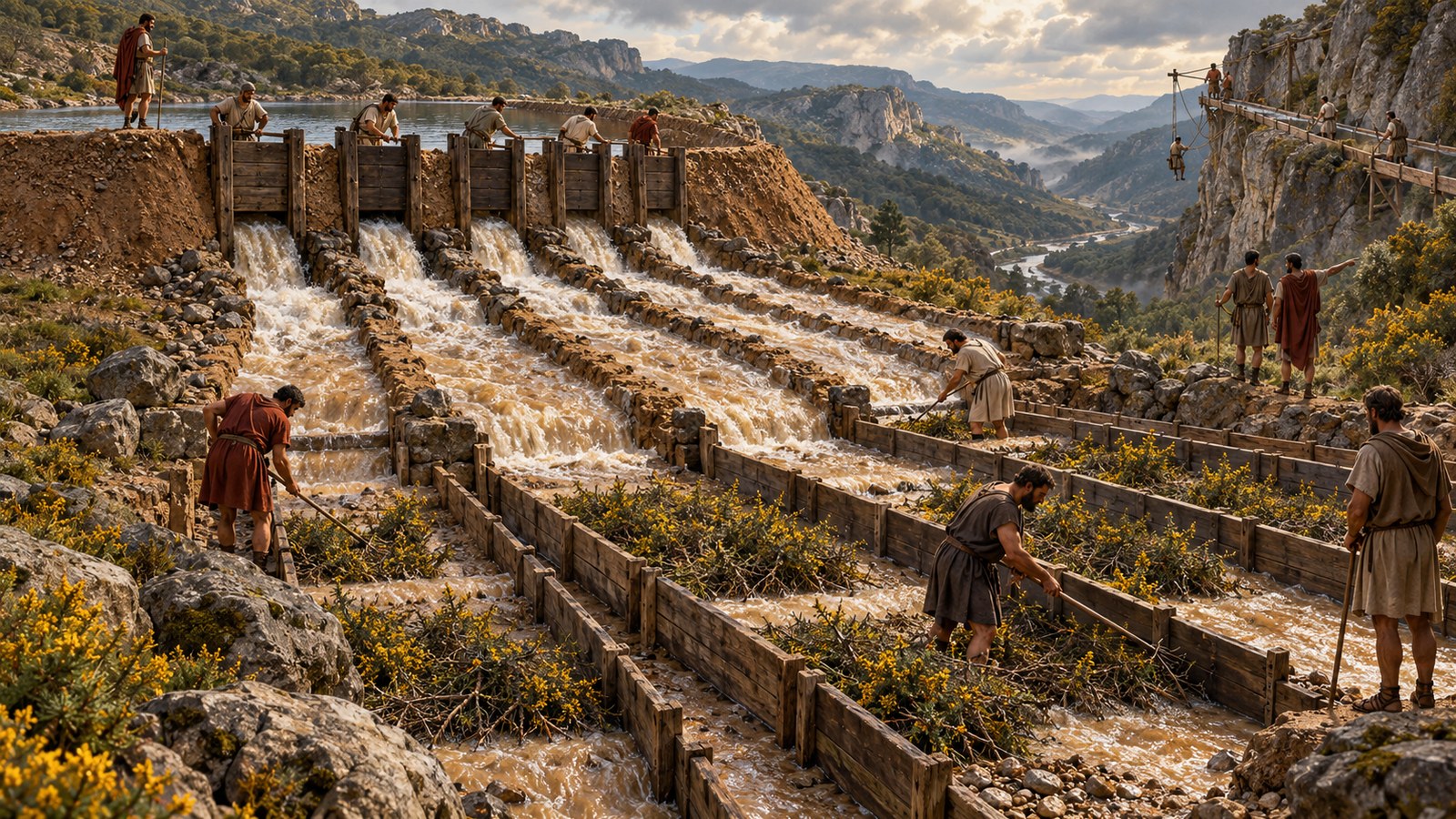
Violent water solved only the bulk problem. On level ground, workers dug trenches for the flow and laid prickly ulex at intervals along the bottom. The plant acted as a filter. Water and earth continued onward while rough branches arrested small pieces of gold.
The captured metal still had to be recovered from its trap. Workers dried and burned the ulex, then washed its ashes over grassy turf so gold could settle. A mountain-scale hydraulic system ended with plant fibre, ash, and a carefully prepared surface.
That final reversal is easy to miss. Fire begins underground as light and time. Later it breaks stone, though at the price of fumes. At the end it consumes the filter so that metal caught among branches can be separated from them. The same element serves three different mechanical roles.
Pliny reports that Asturia, Gallaecia, and Lusitania produced an estimated 20,000 pounds of gold each year by these methods, with Asturia contributing most. The figure comes through unnamed authorities and should be read as Pliny’s scale claim, not a modern audited total. Its narrative purpose is clear: enormous output explains why enormous disruption continued.
Nothing in the chain was isolated. A longer gallery demanded more torch fuel and hauling. More broken rock demanded clear exits. Planned collapse demanded signals. Reservoirs demanded distant channels and surveyed grades. Wash water demanded trenches. Fine recovery demanded ulex and another round of burning and washing.
The title of “gold mine” compresses all of that into the desired substance. Pliny expands it again. His mountain contains clocks, supports, heavy iron, relay lines, sentinels, rope crews, sluices, filters, and workers who cannot see the day. Gold appears only after the system has consumed light, timber, water, plants, rock, and human safety.
Sources
Pliny the Elder, Natural History, 33.21.