
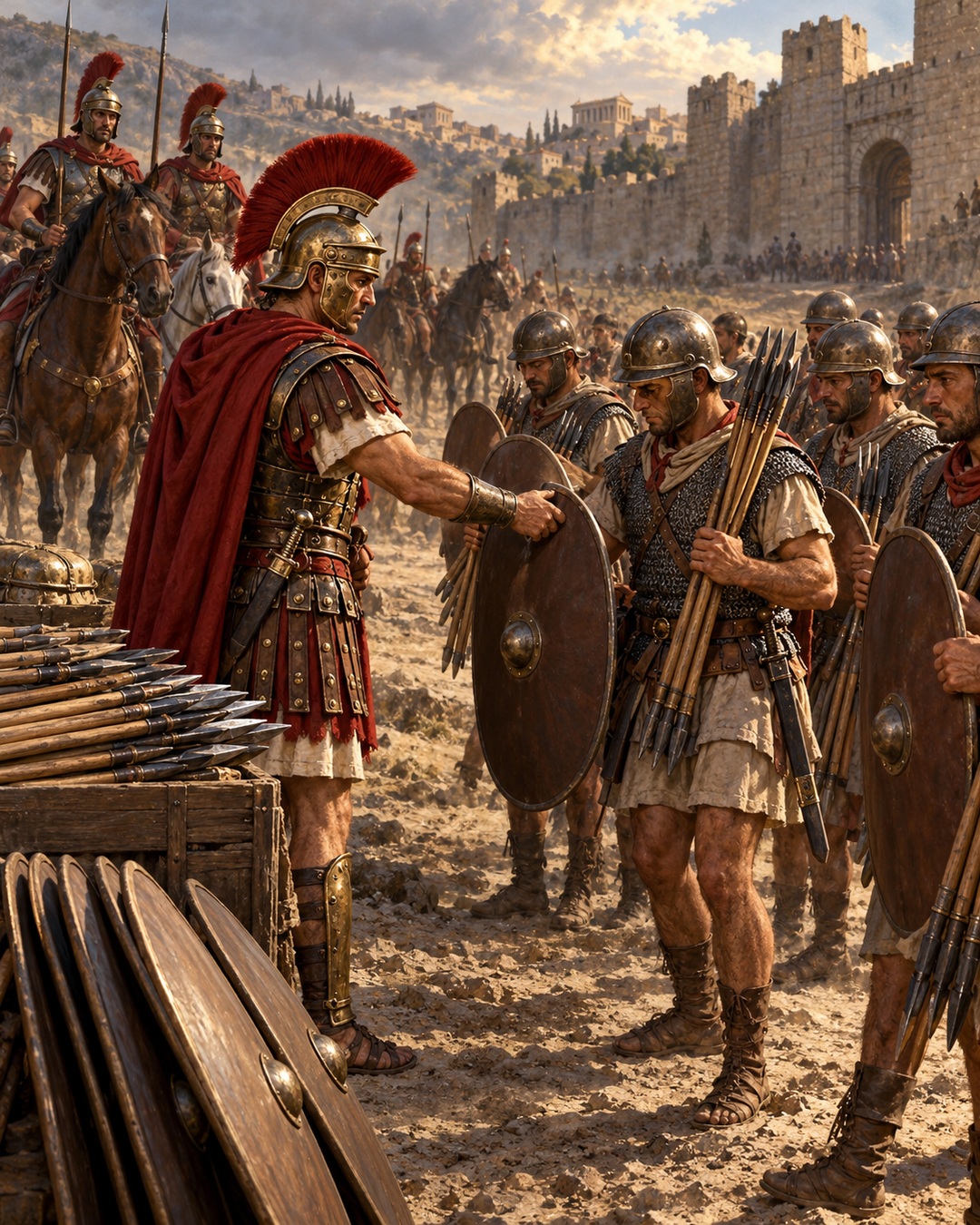
Roman cavalry could not match the Campanian horsemen in the operations remembered by Frontinus. Quintus Naevius, a centurion under the proconsul Fulvius Flaccus, answered by reaching outside the normal cavalry contest.
He chose swift infantrymen of medium stature from across the army. Each received a small shield, helmet, sword, and seven spears about four feet long. Naevius attached these men to the cavalry for the approach, then left them fighting among the enemy horse when Roman riders pulled back.
The missiles struck the mounted system at its most vulnerable moving part. Frontinus says the Campanians suffered, especially their horses; once the animals fell into confusion, Roman victory became easier. The stratagem did not build better cavalry. It changed what cavalry had to face.
Selection created a unit that did not exist on the roster
Naevius began by selecting men from the whole army. Frontinus does not describe a permanent corps with its own long tradition. The centurion identified bodies suited to a temporary task and assembled a new tactical group.
Speed on foot was essential. The men had to keep contact with mounted movement during the approach, survive a sudden change in formation, and act before the enemy riders could simply open distance.
Medium stature may have supported agility and a lower profile among horses, although Frontinus does not explain the criterion. It is safer to treat it as part of Naevius’s stated selection rather than invent a physiological rule.
The chosen equipment limited bulk. A small shield offered protection without enclosing the bearer behind the larger defensive surface associated with heavier infantry. Helmet and sword kept the men capable of close fighting after their spears were spent.
This improvisation differs from the standard pace expected from Roman recruits. March training sought a repeatable baseline across the army. Naevius searched the entire force for exceptional mobility to solve one battlefield mismatch.
Seven short spears made each foot soldier a moving reserve
Each man carried seven spears, each about four feet long. The number matters because the tactic depended on more than one cast. A single missile could miss, glance away, or strike without stopping the encounter.
Seven gave the infantry repeated chances during a compressed engagement. The shorter length kept the bundle more manageable than a set of full-length thrusting weapons, while still giving the thrower distance from hooves and blades.
The bundle imposed its own discipline. A man needed one hand available for the small shield and enough freedom to draw and cast without tangling the remaining shafts. Frontinus does not describe a quiver, strap, or servant, so the safest reconstruction keeps the weapons plain and portable rather than adding an elaborate carrying system absent from the account.
Frontinus does not specify the exact throwing sequence, formation depth, or method of carrying all seven. An image of perfectly synchronized volleys would go beyond the account. What the text supports is concentrated, repeated missile capacity carried by selected foot soldiers.
The sword provided a final layer. Once the spears were exhausted or the formations interpenetrated, the men were not unarmed. The small shield likewise belonged to a sequence: move, throw, survive contact, and exploit disorder.
That economy of carried equipment has little in common with Marius’s system for shifting camp loads onto marching soldiers. The forked pole organized endurance over distance. Naevius’s seven spears organized several violent seconds near enemy horses.
The cavalry delivered infantry to the decisive distance
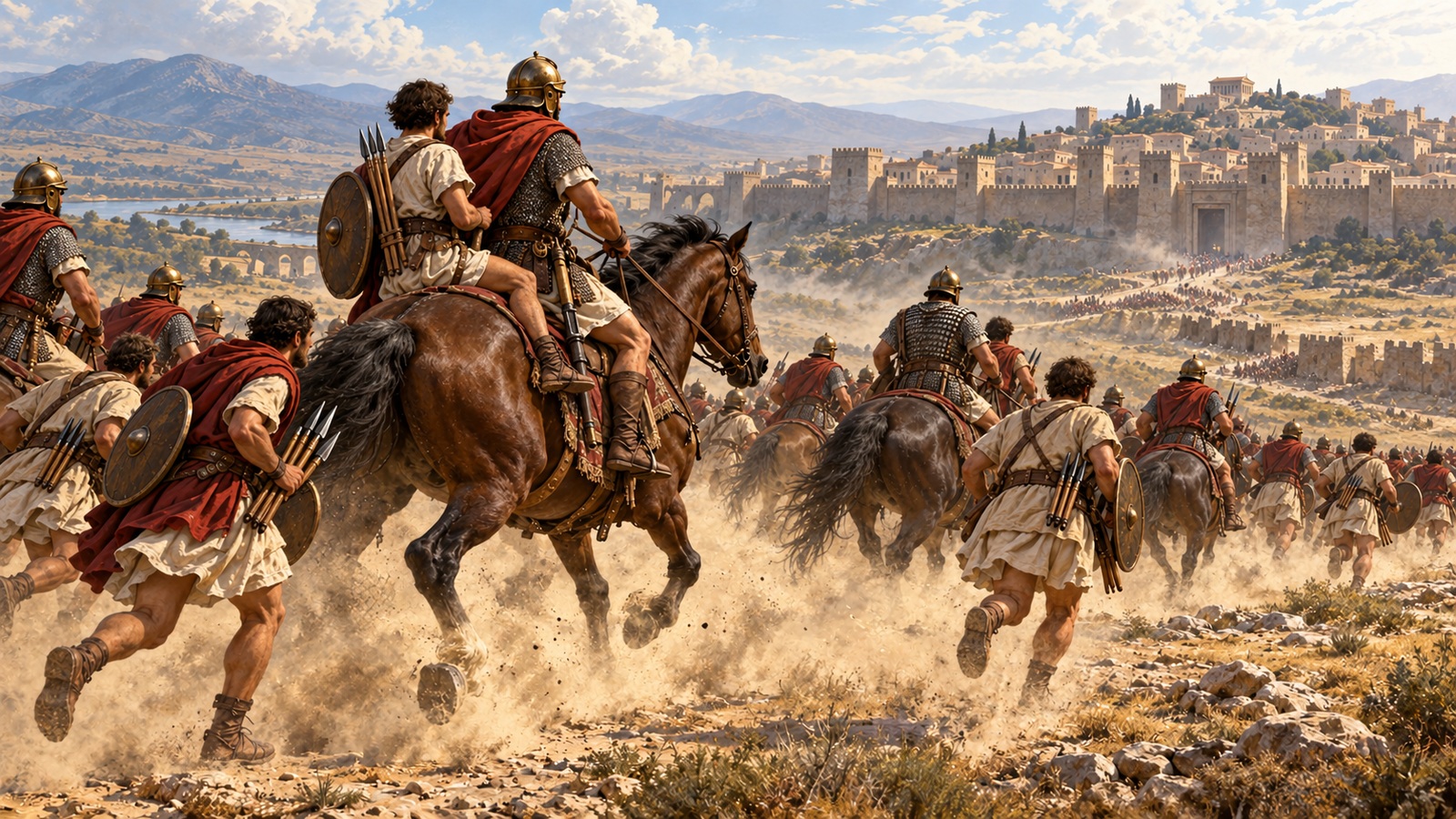
Naevius attached the selected men to the cavalry and ordered the mixed force to advance as far as the walls. Frontinus compresses the transport arrangement, so we should not claim a precise riding posture that he does not give.
The functional point is clearer than the seating. Cavalry supplied the approach speed. The infantry arrived where ordinary foot movement might have been too slow, then occupied the mounted battle rather than remaining behind it.
That borrowed speed was temporary. Once the Roman riders separated, the infantry could not rely on matching a horse over open ground. Their opportunity lay in immediate proximity, where mounts, riders, and other animals reduced one another’s room to accelerate or turn away.
Roman riders subsequently retired, but the selected foot soldiers took position amid the enemy cavalry. A retreat that might normally confirm inferiority instead exposed the Campanians to an unfamiliar close-range threat.
The timing had to be severe. If the Roman cavalry withdrew too early, the infantry would be isolated before reaching effective distance. If it stayed too long, friendly horses and riders could obstruct the throws or share the confusion.
Frontinus presents the result, not the rehearsal. Naevius’s plan required commands that mounted and dismounted men could understand under pressure. The novelty lay not only in equipment but in coordinating two groups through approach, separation, and attack.
Horse confusion broke the advantage before riders were defeated
Frontinus emphasizes that the Campanians suffered, especially their horses. That detail identifies the mechanism. Mounted power depended on animals maintaining movement, spacing, and response while riders used weapons and kept formation.
A short spear did not need to defeat an armored rider directly to matter. A wounded, frightened, or swerving horse could interfere with neighboring mounts. Confusion multiplied through a formation whose strength depended on coordinated motion.
Horses were not machines waiting passively beneath combatants. They responded to noise, impact, pressure, and nearby animals. The tactic exploited that living responsiveness. Even a cast that failed to unseat a rider could force a mount to check, turn, or crowd another pair, buying the infantry another instant.
The selected infantry also presented awkward targets. Once among the horses, they were below the normal line of mounted opponents and dangerous at close range. The enemy could not treat them as a distant stationary infantry block.
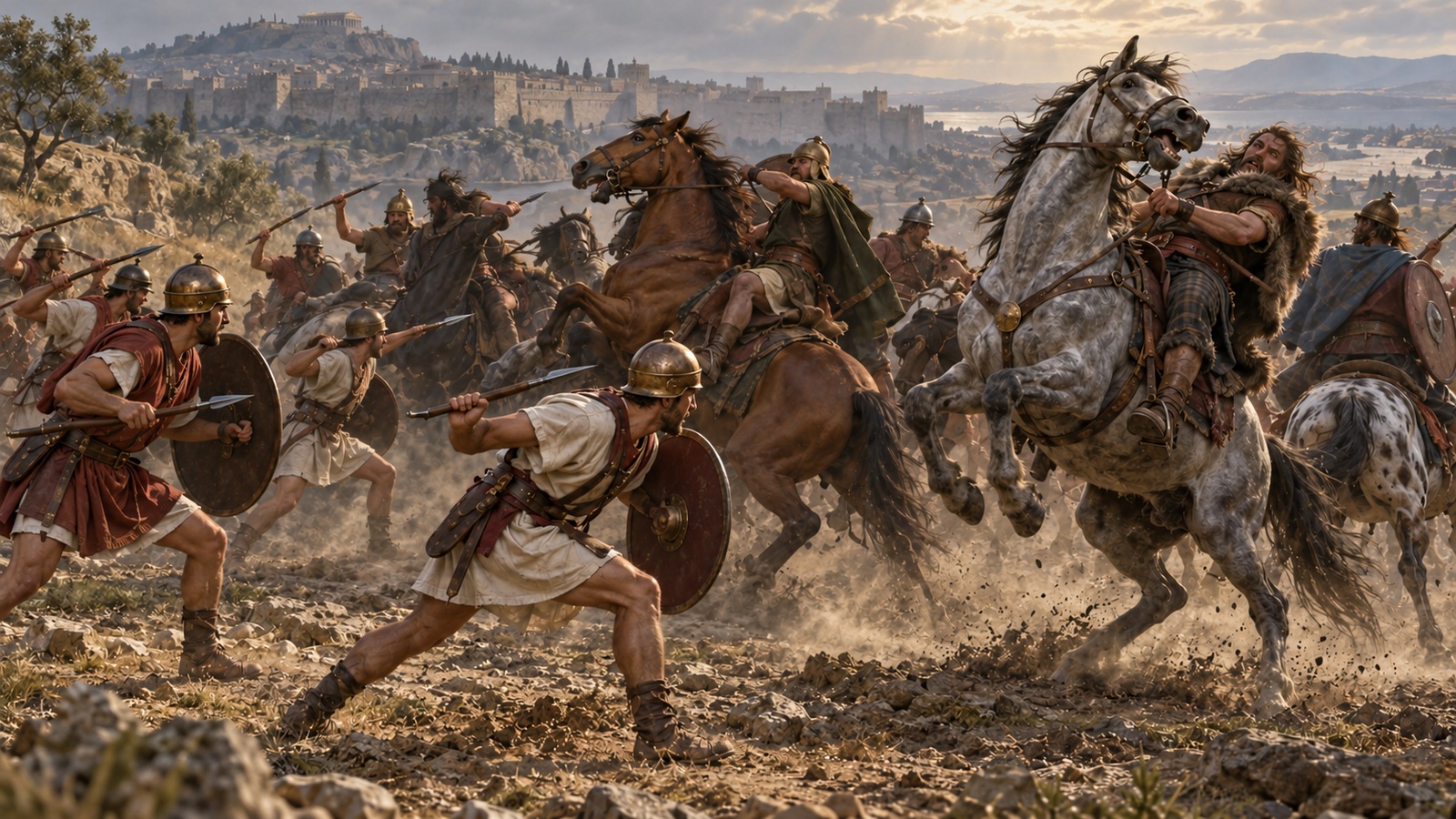
Frontinus says that after the horses were thrown into confusion, victory became easy for the Roman troops. “Easy” belongs to the retrospective moral of a stratagem collection; it should not erase the danger to the infantrymen left in the mounted clash.
The episode survives because it turns weakness into a design constraint. Naevius did not deny that Campanian cavalry was superior in a conventional encounter. He selected different men, changed their load, borrowed speed from friendly cavalry, and aimed repeated force at the animals sustaining the enemy’s advantage.
Frontinus wrote to collect useful examples, and Book Four’s authorship and organization have long attracted scholarly caution. His brief account does not provide a full battle narrative or let us reconstruct every movement with certainty. It records the tactic as an exemplary device.
That genre rewards a clean causal chain: mismatch, selection, mixed advance, withdrawal, missile attack, confusion, victory. The chain may simplify a messier action, but its material details are unusually specific—seven weapons, roughly four feet, small shields, helmets, swords, swift men, and vulnerable horses.
Those details keep the story from becoming a generic claim that ingenuity wins wars. Naevius’s ingenuity had weight and length. It depended on who could run, what he could carry, how close he could get, and whether the cavalry would release him at the right moment.
The outcome belonged to combined arms before the phrase existed. Neither horse nor foot solved the problem alone. Friendly cavalry moved the counter into place; infantry changed the terms of contact; enemy horses converted local impacts into formation-wide disorder. Seven short spears mattered because the entire sequence put them where they could matter.
Its risks reveal the precision of the solution. The selected men could be trampled, cut off, or left beyond support if the withdrawal widened too quickly. Friendly riders could become targets if separation failed. Naevius’s device deserves attention not because improvisation guaranteed success, but because every element answered a particular danger created by the enemy’s superior cavalry.
Sources
Sextus Julius Frontinus, Stratagems, 4.7.29.