
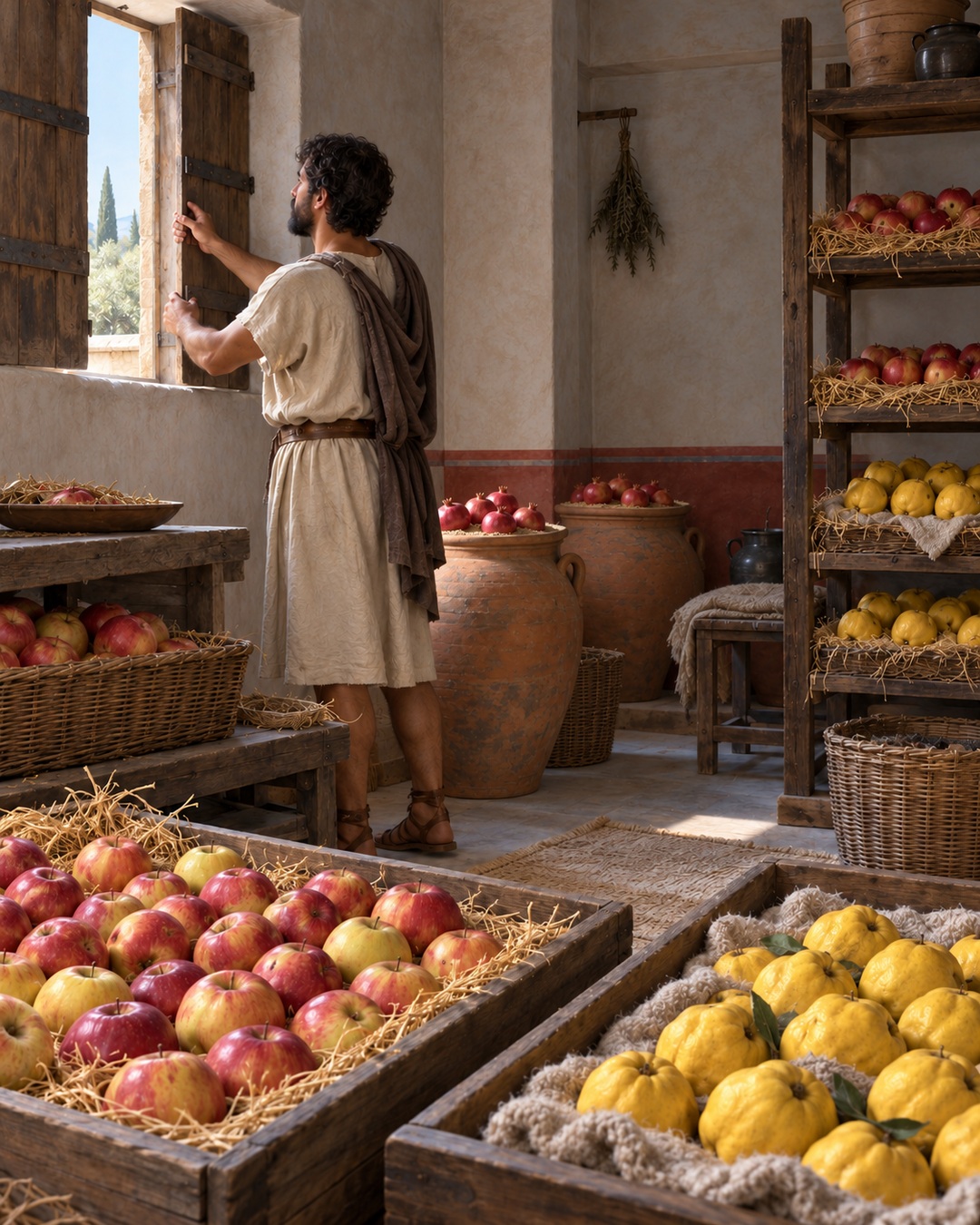
The best window in a Roman fruit room faced north. Cool air could slow loss, but the opening was not simply left to the weather. Varro wanted shutters ready, because a steady wind could draw moisture from stored fruit until preservation became shrivelling.
Inside, apples and quinces did not disappear into one heap. Some lay on straw, some on wool, and some on boards over a hard cement surface. Pomegranate stems entered jars of sand. Quinces could hang apart. Pears might rest in straw or go into boiled must.
This was storage by adjustment. Air, contact, moisture, ripeness, and inspection had to remain in balance. The room even acquired a second life as a dining setting, which let Varro expose the difference between keeping the farm’s produce and buying a rural-looking display in Rome.
The room had to cool fruit without drinking it dry
Varro names several kinds suitable for preserving: smaller and larger quinces, Scantian and Scaudian apples, a small round variety, and fruit once called must-apples but in his day called honey-apples. Naming varieties was the first control, because not every fruit responded to storage in the same way.
His basic environment was dry and cool. Warmth sped deterioration, while dampness threatened the fruit and the room around it. Yet “cool” did not mean exposing produce to every current of air without limit.
North-facing windows admitted the cooler wind. Shutters then moderated it. The keeper had to recognize when ventilation had done enough and when continued airflow would remove too much juice.
That decision could not be made once for the whole season. A newly stored apple, a quince already beginning to soften, and fruit placed nearest the opening would not lose moisture at identical rates. The room called for repeated rounds of observation, with the shutter acting as a coarse but immediate control over the shared air.
That makes the fruit house a device with moving settings. Its performance depended on a person opening, narrowing, and closing apertures as weather and fruit changed. Architecture supplied possibilities; attention turned them into preservation.
The principle differs from the sealed jar layers that kept preserved foods apart. A jar controls a small closed volume. Varro’s room controlled a shared atmosphere while still protecting each item from damaging contact.
Boards, straw, wool, and sand assigned every fruit a place
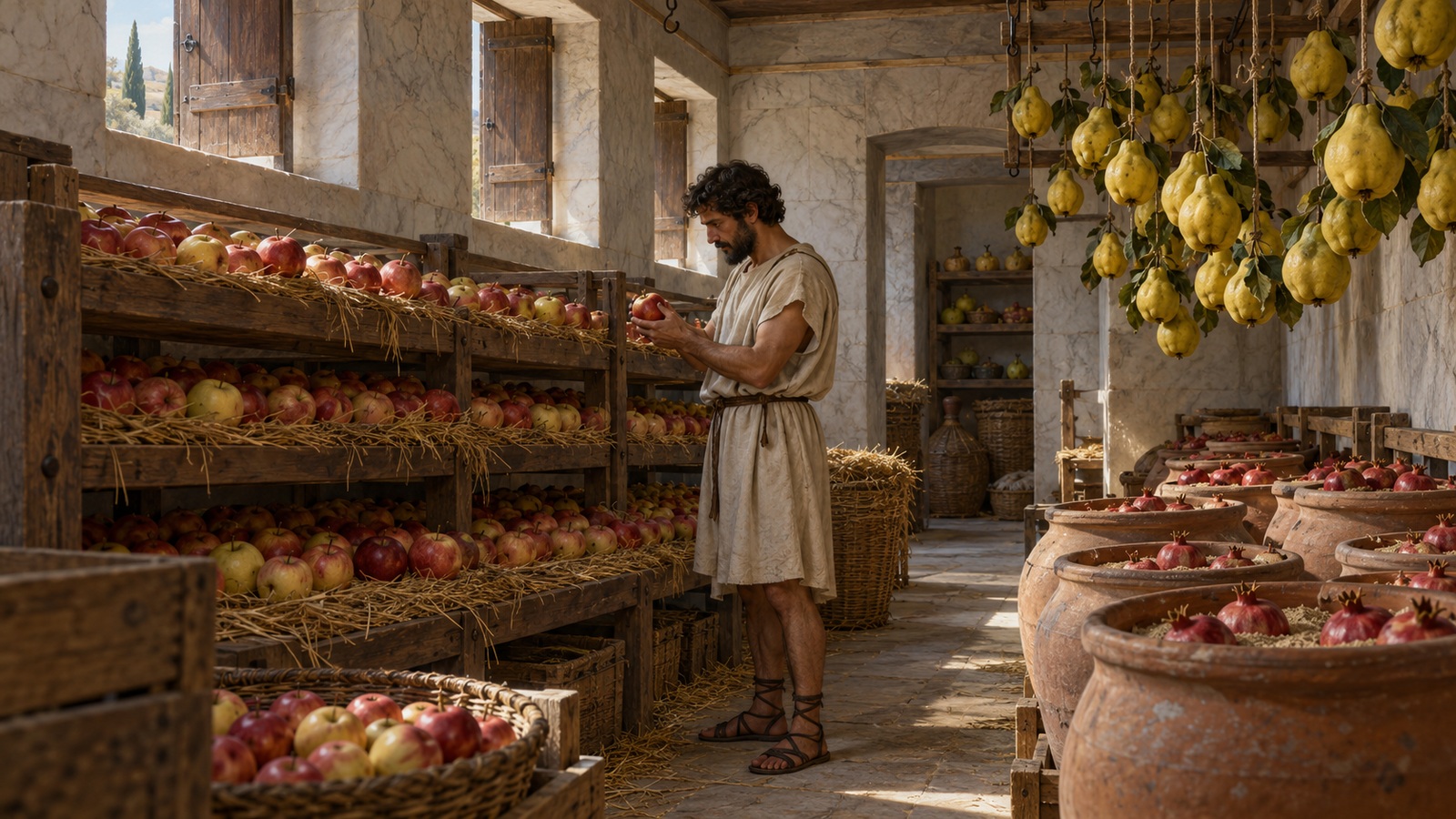
Varro records competing practices for apples. Some keepers placed them on boards laid over the cement floor. Others preferred straw, and others wool. These were not decorative choices. Each surface changed pressure, airflow, insulation, and the visibility of spoilage.
A hard board created an orderly row that could be inspected and turned. Straw separated fruit from cold masonry and distributed contact across a yielding bed. Wool offered another soft layer, though it demanded cleanliness and careful checking.
Every support also created a different failure surface. Fruit touching a board could show a bruise clearly when lifted; fruit nested deep in straw might conceal one. Wool cushioned pressure but could hold debris close to the skin. Varro does not rank the methods, and that disagreement among keepers is itself evidence that storage demanded local judgment rather than one universal recipe.
Pomegranates received a different treatment. Their stems were buried in a jar of sand. The fruit itself remained above while the stem entered a stable, dry medium, reducing the need to stack round bodies against one another.
Large and small quinces could be hung. Suspension removed broad contact with shelves or neighboring fruit and made changes in skin easy to see. It also required sound supports and enough spacing to prevent one failing item from spoiling those beside it.
Pears could rest in straw or be preserved in boiled must. One route depended on the room; the other placed fruit into a prepared liquid. Varro’s list is valuable because it does not force every harvest into a single celebrated technique.
A related logic appears in Columella’s carefully suspended grape jars. Both accounts turn contact and access into design problems, but Varro ranges across an entire room rather than one container.
Marble cement made preservation visible and inspectable
Varro says ceilings, walls, and floors could be coated with marble cement to help keep the room cool. A continuous pale surface also made dirt, leakage, fallen fragments, and pests easier to notice than they would be against rough earth or dark timber.
The coating did not refrigerate fruit in the modern sense. Its usefulness belonged to the whole arrangement: site, orientation, shade, airflow, clean surfaces, and the timing of storage. No single feature could rescue bruised or overripe produce.
Nor was the room an untouched vault. Fruit entered after selection and left in stages. Containers, hanging points, and floor space had to remain accessible enough for removal without knocking neighboring pieces loose. Preservation and circulation through the household were parts of the same design.
Inspection was as important as initial placement. A row on boards or a quince hanging in open view invited repeated judgment. Colour, firmness, wrinkling, and smell told the keeper which fruit should leave first.
This transformed preservation into scheduling. The aim was not to freeze the harvest in one perfect moment. It was to extend useful life and release different batches before their particular margin closed.
The room also organized labor. Someone had to bring clean straw, arrange boards, prepare sand, operate shutters, remove damaged fruit, and carry selected produce onward. The smooth chamber rested on recurring household work that Varro’s compact instructions only partly reveal.
A dining table turned storage into theatre
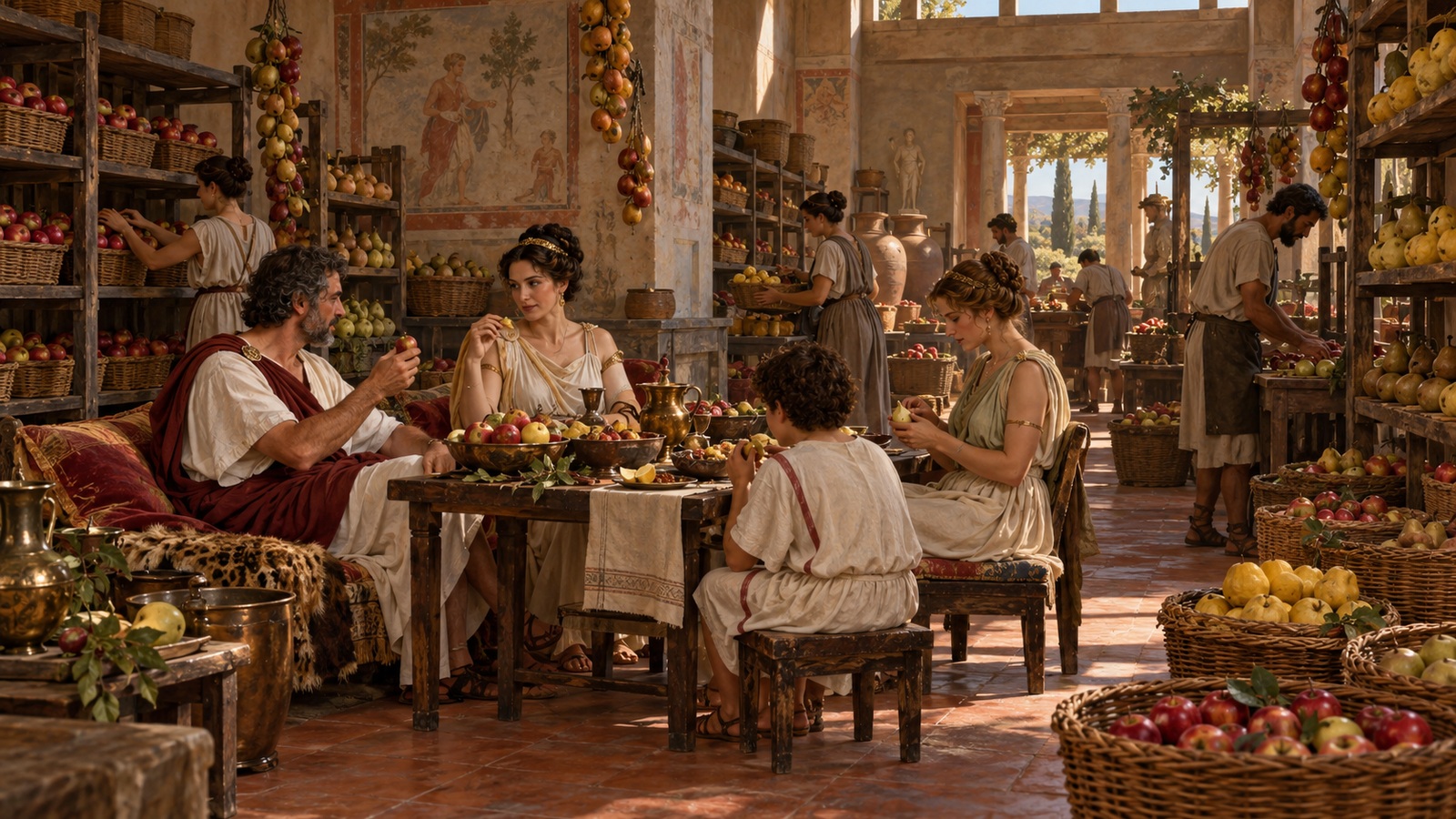
Some owners placed a table in the fruit room and dined among the arranged harvest. Varro compares the natural display to a picture gallery: if people ate surrounded by art, why not eat amid a scene composed by fruit?
Then he sharpens the joke. One should not imitate people who bought fruit in Rome, carried it out to the country, and piled it in the gallery for a dinner party. Such a room performed abundance without proving that the estate had grown or preserved what guests saw.
The criticism distinguishes productive display from purchased scenery. An operating fruit house earned its beauty through selection, coolness, surfaces, and timing. A staged import borrowed the visual language of estate competence.
Varro’s joke depends on guests understanding that language. Rows of sound fruit, a cool chamber, and carefully separated varieties advertised foresight months after harvest. Carrying market fruit back from the city imitated the final appearance while skipping the labor and risk that made it meaningful.
Varro’s own dialogue belongs to elite agricultural literature, so the dining-room anecdote is not a simple window into every household. Many people stored fruit on a smaller scale and without marble-coated galleries. The passage instead shows how technical storage could become a marker of taste and management among wealthy landowners.
Luxury did not erase the practical mechanism. A badly ventilated room would still spoil its contents, however impressive the table. A powerful owner could buy replacement fruit, but Varro treats that purchase as evidence that the display has become detached from husbandry.
The fruit room therefore held two clocks. One measured biological change: cooling, drying, softening, and decay. The other measured social timing: the moment when fruit reached a table, a market, or a guest’s line of sight.
Its north window joined those clocks. Open at the right moment, it bought time for the crop. Left open too long, it reduced plump fruit to a display of failure. Straw, sand, shutters, and cement were modest tools, but together they made seasonality negotiable rather than absolute.
Varro’s most useful lesson is not a recipe to reproduce uncritically. It is the specificity of the choices. One variety, one surface, one draft, and one stage of ripeness could demand a different response from the fruit beside it. Preservation began when the harvest stopped being treated as a heap.
Sources
Marcus Terentius Varro, On Agriculture, 1.59.