
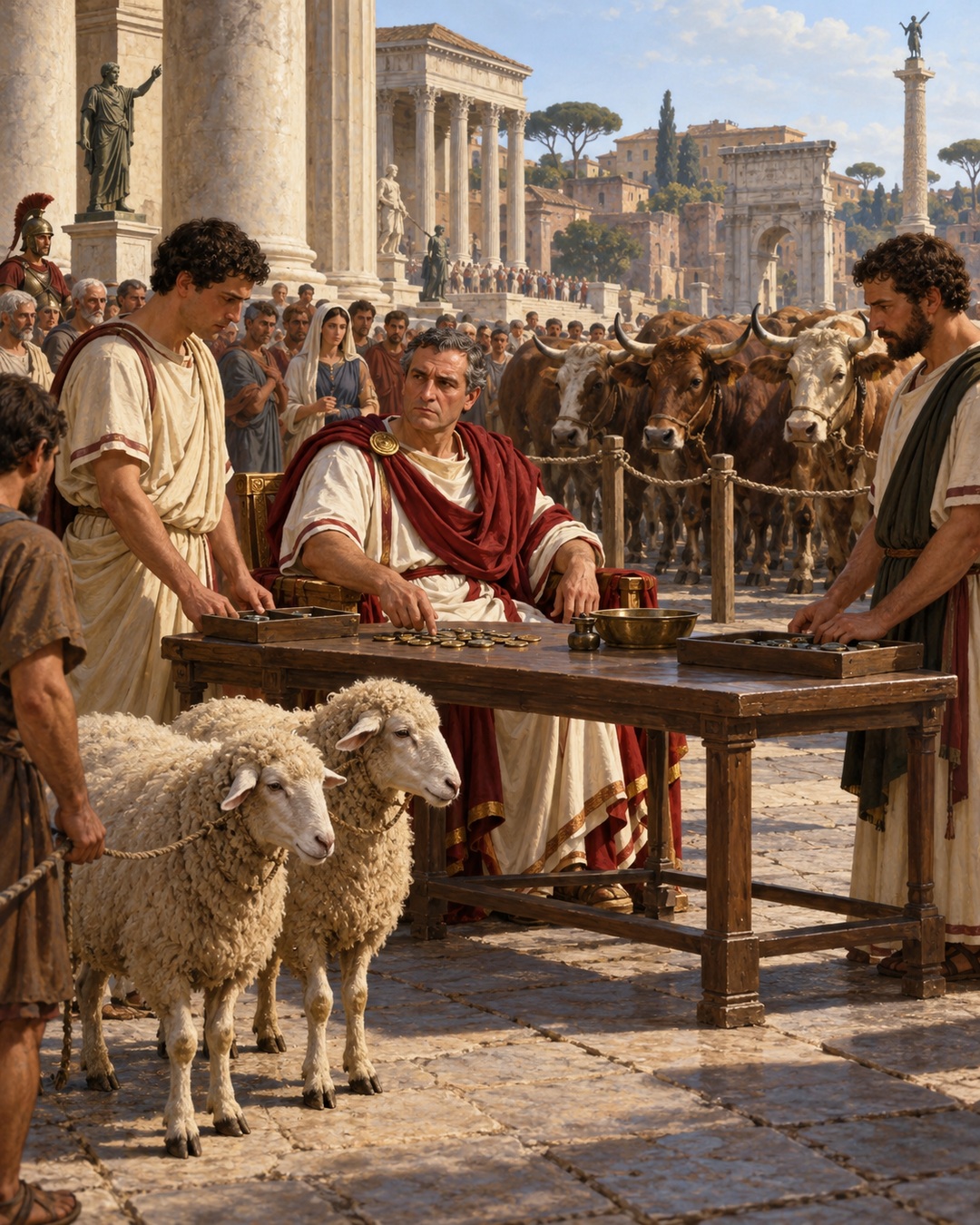
A Roman magistrate could name a fine in animals: at the lowest end, one sheep; at the upper daily limit, two sheep and thirty oxen. The count sounds concrete, but it hid an obvious problem. A thin animal and a valuable animal occupied the same place in the formula while imposing very different losses.
Aulus Gellius says a later rule associated with the Aternian law converted that variation into set bronze values. A sheep counted as ten pieces of bronze and an ox as one hundred. The animals remained in the language of punishment, but valuation no longer depended entirely on whichever specimens happened to be brought.
The reform did not turn the fine into casual arithmetic. Minimum and maximum, repeated-day limits, grammar, and place all mattered. The result was a penalty suspended between herd and coin, inherited speech and public calculation.
The old scale counted bodies before it counted bronze
Gellius opens with an ancient explanation for Italy’s name. Timaeus and Marcus Varro, he says, derived it from an old Greek word for oxen because the land held abundant cattle, pasture, and grazing. Modern etymology need not accept that account for the passage to reveal its governing association: Italy was imagined through livestock.
The same abundance supposedly shaped the upper fine. Thirty oxen stood beside only two sheep. Gellius treats that imbalance as proportional to plentiful cattle and scarcer sheep, not as a random pair of figures.
Livestock made sense as value in an economy where animals supplied traction, food, hides, breeding stock, and visible wealth. Yet a count could not make unlike creatures equivalent. Age, health, size, training, and reproductive value could separate one ox from another before either entered a penalty.
The problem was therefore not that animals lacked value. It was that they carried too much particularity. If a magistrate announced the same number on two different days, the economic burden could change with the herd selected to satisfy it.
This is a different legal mechanism from the fixed copper penalty that made a slap dangerously cheap. There the nominal sum remained stable while purchasing power and social behavior moved around it. Here the unit itself moved because living property could not be uniform.
Ten and one hundred created a public conversion table
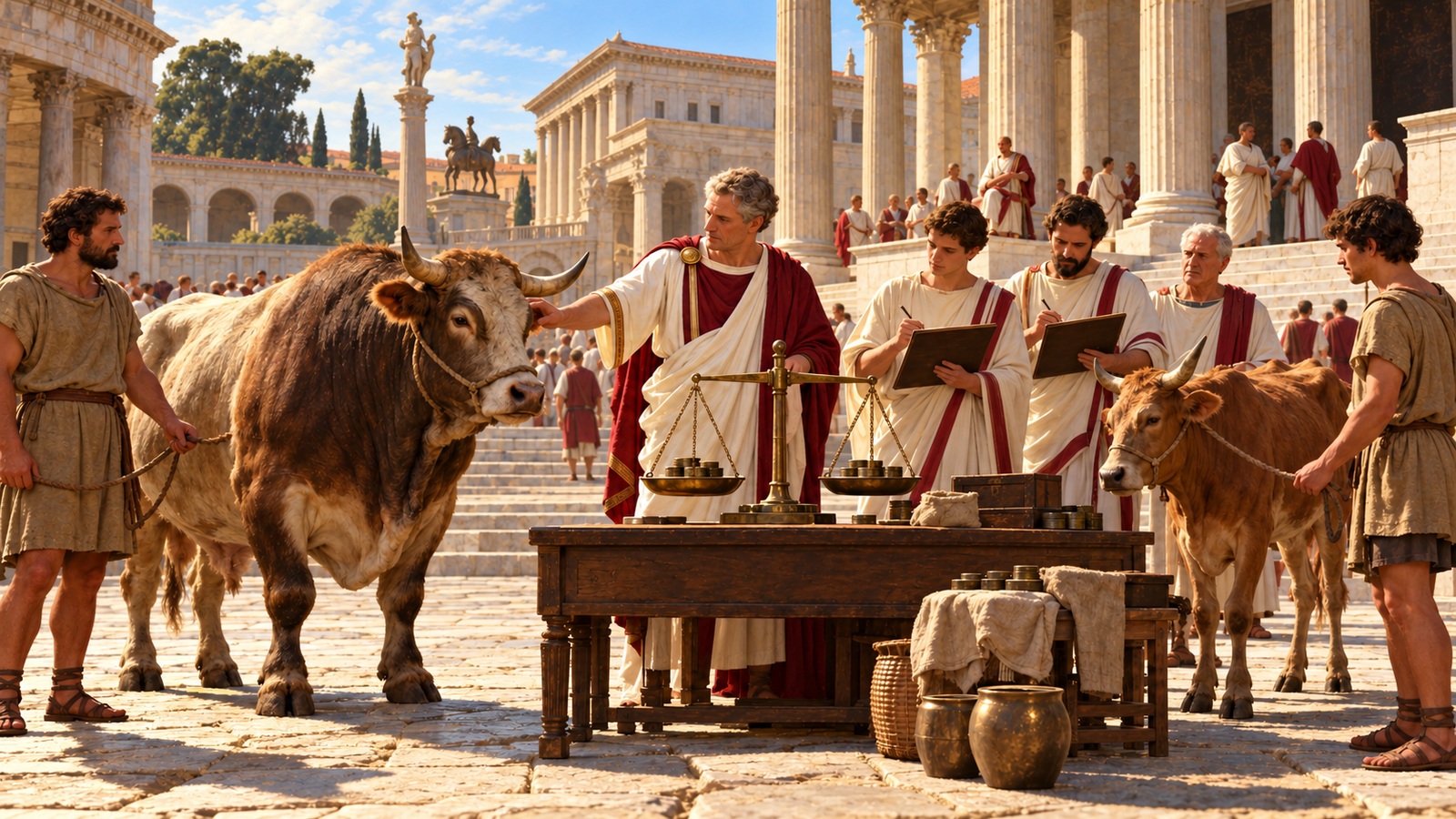
Gellius says the Aternian law assigned ten pieces of bronze to a sheep and one hundred to an ox. That simple ratio made the legal count calculable before a particular animal arrived.
At the stated rates, thirty oxen represented three thousand pieces of bronze and two sheep another twenty. The point is not to translate that total into a modern price. It is to see how a rule replaced a shifting appraisal with a common official measure.
The ratio also exposed the relative assumptions built into the scale. One ox counted for ten sheep, yet the supreme formula allowed fifteen times as many oxen as sheep. The composition of the ceiling therefore cannot be read as a neutral inventory of equal units. It carried an older judgment about which animals were available to be demanded and how their categories fitted the inherited penalty.
The conversion protected more than the person fined. A magistrate gained a standard that could be explained and repeated. Officials recording or reviewing the penalty no longer had to pretend that every ox was economically identical while accepting whatever quality appeared.
Standardization also reduced room for tactical substitution. Without a valuation, a person might try to discharge a large-looking count with weak animals, or an official might demand unusually valuable stock. A stated bronze equivalent narrowed both opportunities even if enforcement could never be perfect.
The animal terms survived because law often carries old forms into new accounting. Sheep and oxen preserved the memory and authority of the earlier scale; bronze supplied comparability. The reform joined rather than simply replaced the two systems.
That combination resembles the way Roman dinner rules attached legal ceilings to specific occasions. Both systems needed categories, thresholds, and a way to decide when ordinary variation had crossed into punishable excess.
A ceiling limited accumulation across successive days
One sheep was the smallest fine in Gellius’s account. The supreme fine was the greatest and heaviest amount, beyond which a magistrate could not lawfully proceed for a run of successive days.
The daily wording matters. A maximum is ineffective if an official can immediately repeat it without constraint. By linking the supreme fine to successive imposition, the rule addressed accumulation as well as the amount of one pronouncement.
It also made time part of legal measurement. The same animals named once and the same animals named day after day were not equivalent acts. Gellius’s description implies that lawful severity depended on sequence: an official had to know not only what he was imposing, but where that imposition stood in a run of days.
The structure gave the magistrate a ladder. A minor failure could meet the one-sheep minimum; greater conduct could move upward; the two-sheep-and-thirty-ox ceiling marked the point where lawful discretion stopped.
Gellius does not provide a complete schedule matching every offense to a precise number of animals. His interest is the language and outer architecture of the fine. That limitation should prevent us from inventing a tidy tariff where the source preserves only bounds and examples.
Even those bounds are revealing. Public power was not pictured as an unlimited claim upon property. The official pronounced a recognized kind of penalty inside an inherited range, and the range itself could be discussed by antiquarians and jurists.
The sentence had to sound right in the proper place
Varro preserved a formula directed against a man who had been summoned but neither appeared nor offered an excuse. The magistrate pronounced one sheep. Gellius dwells on the gender assigned to the Latin word for sheep and says the fine was not considered lawful unless the expected form was used.
To a modern reader, that concern can look like grammar defeating substance. In an oral legal act, however, the words were part of the act. The formula identified speaker, person, default, and penalty in a pattern that witnesses could recognize.
Precision limited improvisation. A magistrate who had to use the established words displayed that he was exercising a defined office rather than announcing private anger. The spoken sentence made authority audible while also exposing a defective performance.
The formula’s conditional structure did practical work. It recalled that the person had been summoned, allowed the possibility of a valid excuse, identified the failure to appear, and only then named the sheep. A witness hearing the full form could recognize the chain from notice to default to penalty instead of hearing an unexplained demand for property.
Gellius adds that Varro regarded multa, the word for fine, as Sabine. He then notices that Cato used a different verb for a commander imposing a fine in camp. Gellius suggests location explains the choice: a military penalty was imposed inside army command, not pronounced in the civic meeting place before the people.
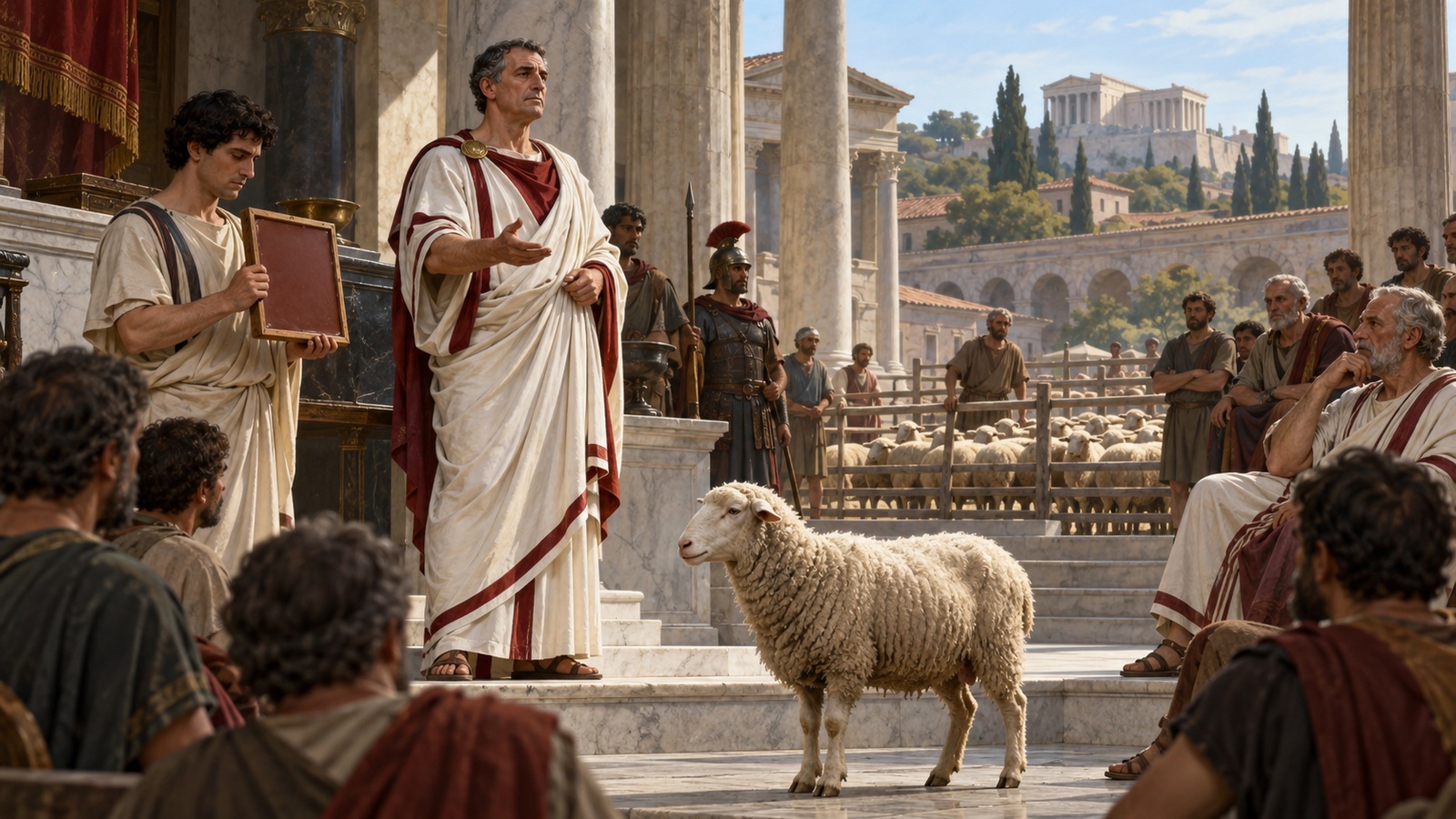
That distinction returns the article to setting. Animals and bronze determined scale, but forum and camp determined the voice of power. Similar losses could belong to different institutions because the official, audience, and legal space were different.
Gellius wrote as an antiquarian, not as a complete handbook to every period of Roman public law. His chapter preserves explanations attributed to earlier authors and a legal vocabulary whose history was already layered. It should be read as evidence for remembered forms and debates, not proof that every magistrate in every century collected an actual line of cattle.
The system’s interest lies in those layers. A pastoral measure survived inside monetary valuation. A statutory rate corrected differences among living animals. A ceiling restrained repeated penalties. A grammatical form marked valid public speech. Thirty oxen were not merely a dramatic fine; they were the visible edge of a mechanism designed to make punishment countable.
Sources
Aulus Gellius, Attic Nights, 11.1.