
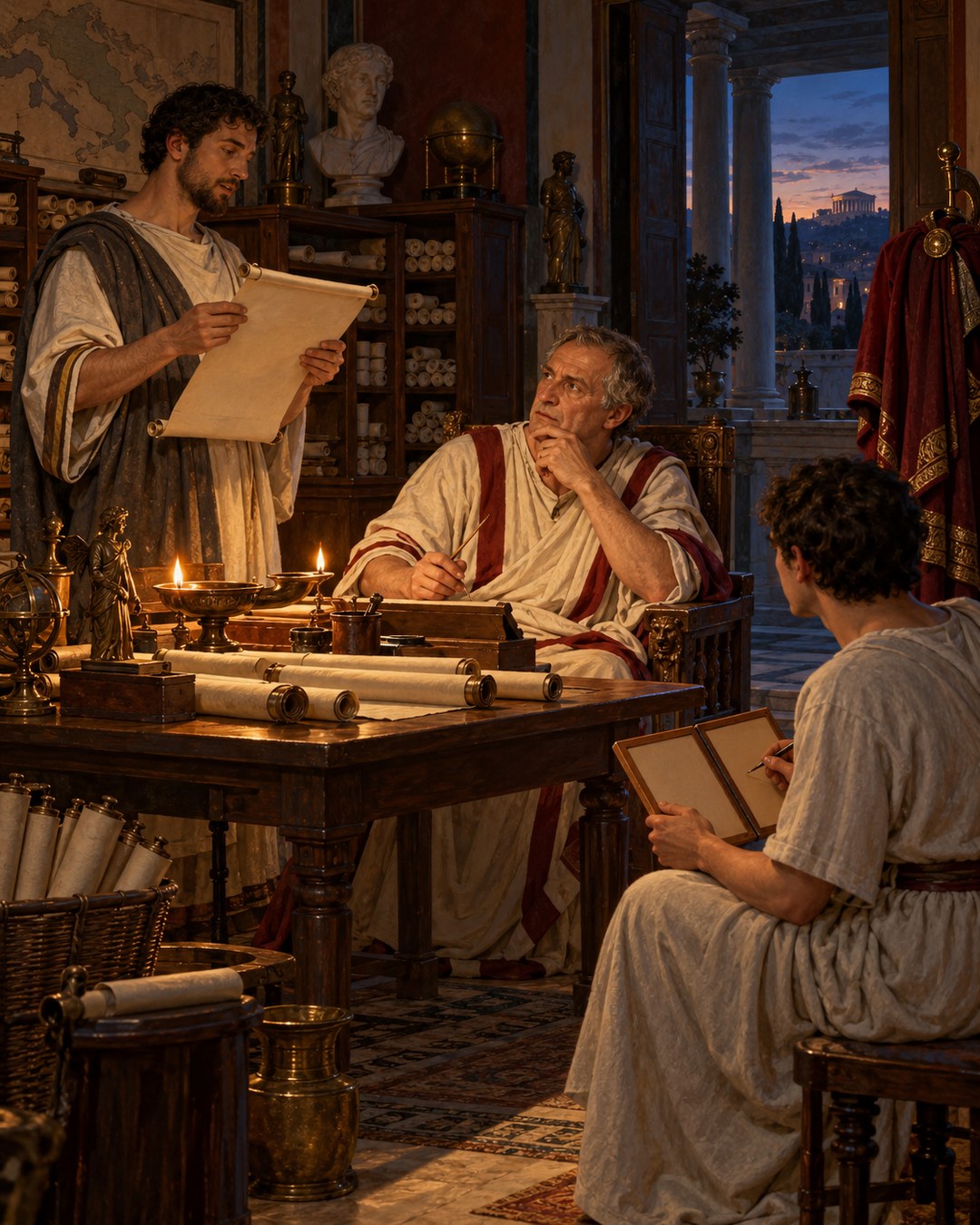
Pliny the Elder did not wait for a silent room. A reader followed meals, a shorthand secretary travelled with books and tablets, and a litter turned movement through Rome into another study session. In winter, the secretary wore gloves so cold fingers would not stop the notes.
His nephew describes this routine while listing an enormous body of work: twenty books on the German wars, thirty-one continuing the history of Aufidius Bassus, and thirty-seven books of Natural History, alongside works on language, oratory, biography, and military skill.
The books grew from a system that treated minutes as raw material. Bathing, dining, official service, travel, and rest each had a place, but almost every boundary between them could carry reading or dictation.
Before sunrise, public duty and private study shared the day
Under Vespasian, Pliny went to the emperor before dawn. He then performed the business assigned to him and returned home to devote whatever remained to scholarship. His literary production did not come from freedom from office; it was fitted around office.
The early audience establishes the pressure on the schedule. Imperial service claimed hours that could not simply be refused. Pliny’s answer was not to imagine a longer day but to make transitions productive.
Summer and winter altered the clock, yet the principle remained. Reading entered periods that many people would treat as recovery. A light meal, sun, cold bath, brief sleep, and renewed work could be arranged as parts of one sequence rather than obstacles to writing.
This discipline was not identical to Spurinna’s measured retirement of walking, carriage exercise, reading, and ball play. Spurinna’s routine balanced an elderly body and cultivated leisure. Pliny’s routine squeezed textual capture around continuing obligations.
The difference helps explain why a biography of labor must include furniture, servants, transport, and climate. “He studied constantly” hides the machinery that made constancy possible.
A meal became a reading room with a strict line count
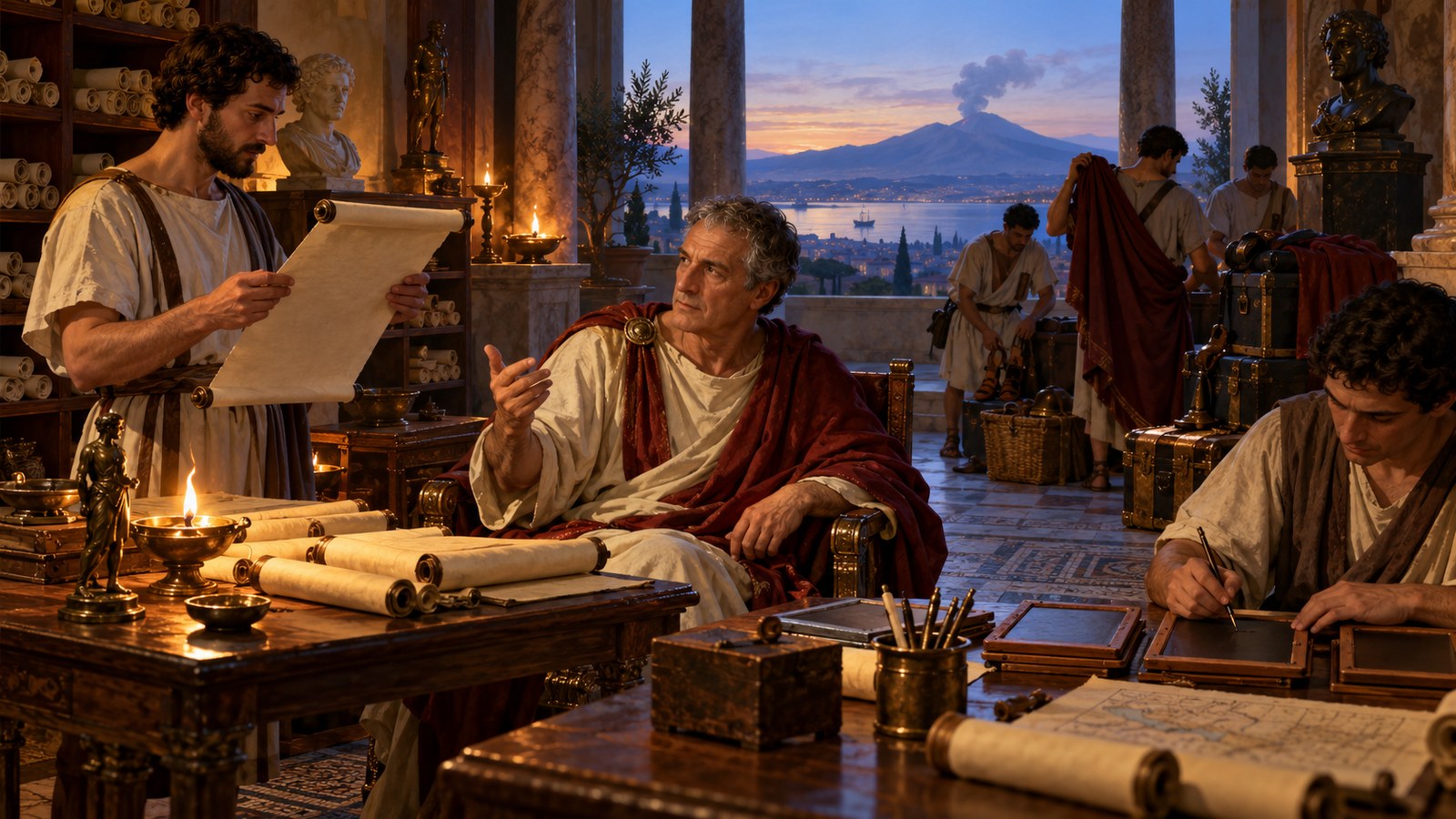
At dinner, a book was read aloud and notes were made. The arrangement let Pliny eat while another voice supplied material and another hand captured the useful passages.
His nephew recalls a guest stopping the reader over a faulty pronunciation and asking for the line to be repeated. Pliny asked whether the meaning had still been understood. When the guest said yes, Pliny complained that the interruption had cost more than ten lines.
The anecdote is funny because the unit of loss is so precise. Polite correction, which might display education at an ordinary table, becomes waste when measured against the flow of the book.
The reader was not background entertainment. Pace mattered because listening belonged to a research pipeline. A repeated sentence delayed the notes that could have followed.
Such work depended on people whose names the letter does not preserve. Readers supplied trained voices; secretaries converted speech into marks; household organization kept the meal running. The famous author’s productivity was collective at the point of capture, even when authorship remained his.
Winter gloves kept the travelling archive in motion
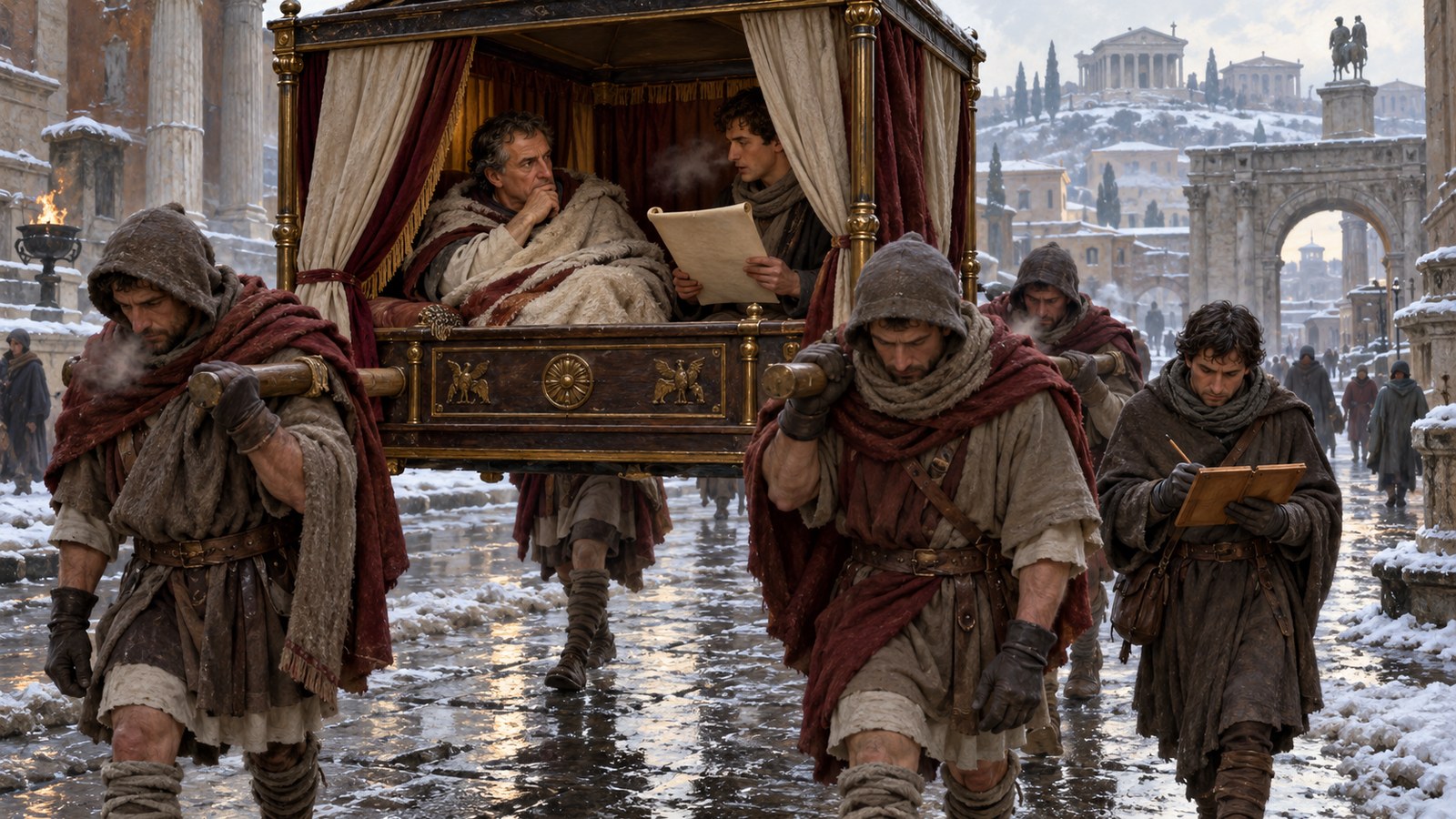
Travel freed Pliny from other concerns, his nephew says, so the journey intensified rather than interrupted study. A shorthand writer sat nearby with a book and tablets.
Cold weather threatened the hand that linked listening to storage. The solution was practical: the secretary wore gloves in winter. That small detail makes the routine physical. Knowledge depended on fingers remaining flexible enough to write.
At Rome, Pliny was carried in a litter instead of walking. He could hear a text or dictate while streets passed outside. The vehicle became a mobile study, separating his attention from the effort and hazards of movement.
He once rebuked his nephew for walking, saying those hours need not have been lost. The criticism shows the cost of the system as well as its output. Walking for its own sake counted as unused capacity.
The contrast with the measured pace imposed on military recruits is revealing. For a recruit, distance on foot proved bodily readiness. For Pliny, the same interval could be judged by how many lines entered the notebook.
One hundred and sixty notebooks preserved the capture system
Pliny left one hundred and sixty notebooks, written in extremely small script on both sides. The physical density matched the temporal density of his routine. Space on a page, like time in a day, was not to be left idle.
The notebooks were not simply finished books in miniature. They were stores of extracts and observations from which larger works could be assembled. Their value lay in making past reading available to future composition.
Larcius Licinus once offered four hundred thousand sesterces for them, according to the letter. Pliny refused, and the collection continued growing. The offer recognized that organized notes were an intellectual asset, not household scraps.
The surviving list of publications shows how those assets spread across genres. Military instruction, biography, German wars, oratorical training, linguistic problems, contemporary history, and the encyclopedic Natural History all demanded different arrangements of evidence.
Quantity alone is not the point. The routine maintained a chain: someone read, Pliny selected or dictated, a secretary recorded, notebooks retained, and later composition reorganized. Break any link and the famous total becomes harder to imagine.
Productivity had a human and moral price
Pliny the Younger admires his uncle’s extraordinary energy, but the details allow a less simple reading. The scholar’s refusal to waste minutes required other people to synchronize their bodies with his plan.
A reader could be hurried; a secretary wrote through winter with gloves; litter bearers transformed walking time into intellectual work. Elite resources made the schedule possible. Discipline and privilege operated together.
The system also narrowed the category of acceptable rest. A bath retained one pause when Pliny was actually in the water, but listening or dictation resumed around it. A walk without a text became loss. Even dinner had a line count.
His nephew’s admiration may encourage readers to imitate the appetite for learning, but the letter is not a neutral timetable. It is also family portraiture. By placing the catalogue of books beside scenes of daily discipline, the younger Pliny explains how his uncle could appear almost superhuman without claiming that the manuscripts wrote themselves.
The list of works gives scale to each small saving. Ten recovered lines at dinner seem trivial until they are multiplied across years of meals. One productive journey seems incidental until a hundred and sixty notebooks stand at the end of the process. The letter makes accumulation, rather than a single flash of genius, its governing image.
Even the tiny handwriting belongs to this logic. Writing on both faces of a page reduced unused surface and made a large archive more portable. Dense pages also demanded orderly retrieval, because compressed abundance is valuable only when a compiler can find the passage needed for a new chapter.
There was risk in such dependence on dictation and extracts. A hurried reader could mispronounce, a secretary could mishear, and a copied note could lose context. Pliny’s impatience with repetition reveals the tension between speed and accuracy that every capture system faces. The workflow optimized continuity, not infallibility.
Yet the letter is valuable because it refuses to leave productivity abstract. It gives us dawn, food, cold water, a carried chair, wax tablets, cramped writing, and protected fingers. Those objects explain more than praise alone.
Pliny’s books did not emerge from a modern office, and his routine should not be turned into a timeless efficiency lesson. It belonged to a Roman household, imperial service, enslaved or dependent labor, manuscript culture, and transport available to an elite man. The striking achievement and its social conditions are inseparable.
The library’s deepest mechanism was capture. Pliny tried to keep experience from passing without leaving a usable trace. His nephew’s letter does the same for him: it catches the reader, the litter, the gloves, and the complaint about ten lost lines, preserving the machinery behind works far larger than any single day.
Sources
Pliny the Younger, Letters, 3.5.