
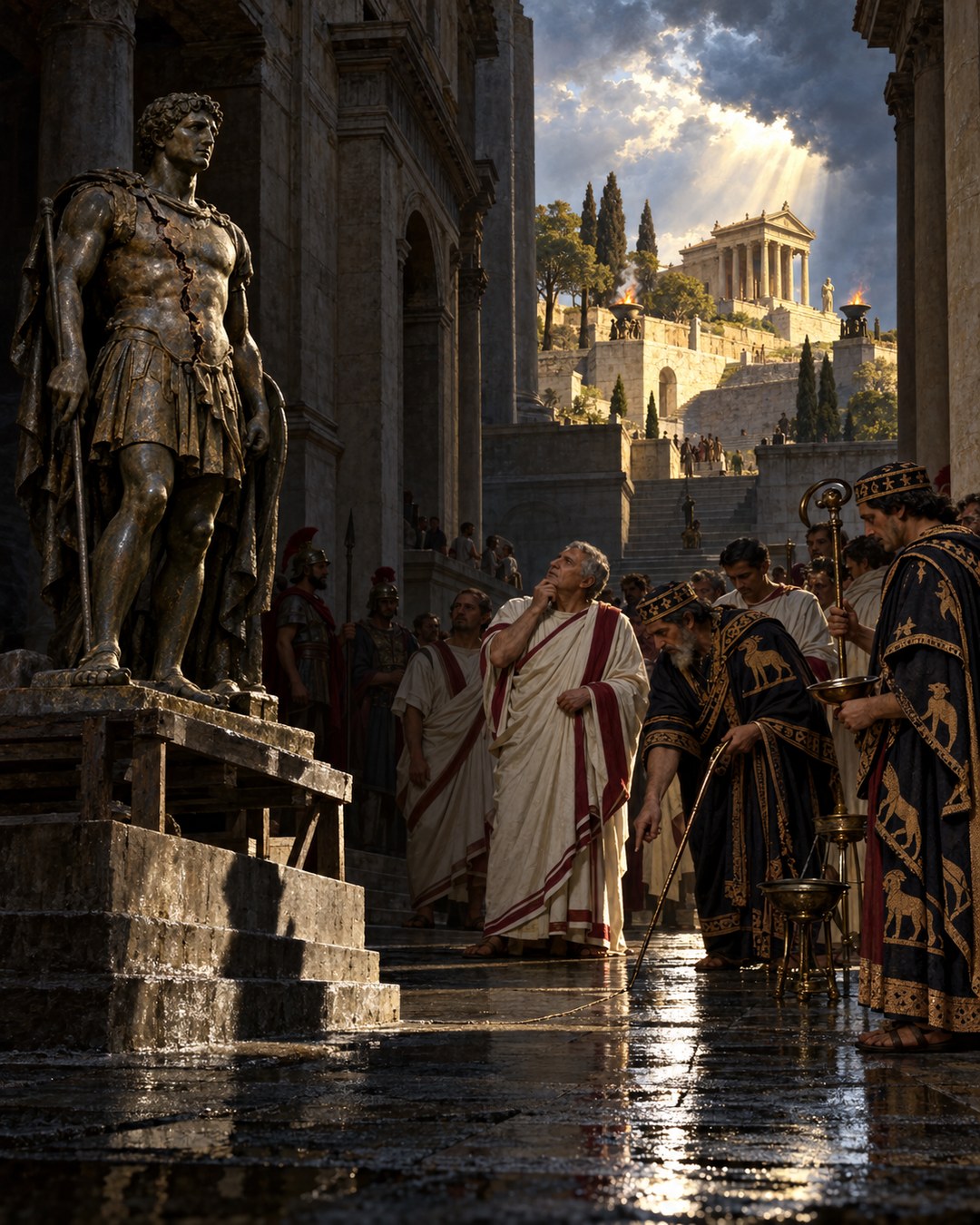
Lightning struck the statue of Horatius Cocles in the Comitium, and Rome summoned Etruscan diviners to explain what should follow. According to Aulus Gellius, the experts did not answer honestly. Hostility led them to recommend a low place shut away from the sun by surrounding buildings.
The Romans obeyed before the deceit surfaced. Once it did, the diviners faced trial before the people and confessed. The statue was moved again, this time upward to a commanding position in the Area of Vulcan, where the correction was said to bring a successful outcome.
The episode did not end with stone and punishment. Boys chanted a compact warning across the city: bad counsel harms its giver most. A contested ritual interpretation became public memory carried by young voices.
Lightning turned a familiar monument into a problem
Horatius Cocles belonged to Rome’s stories of survival. His statue in the Comitium gave that memory a fixed body near a political meeting place. When lightning hit it, damage to bronze or stone was only one issue. The strike demanded interpretation.
Roman prodigy procedure treated unusual events as disruptions requiring a proper response. The question was not simply how to repair the object. Authorities needed to know where it should stand and what expiation would restore an acceptable relation between monument, place, and divine warning.
That need created room for specialists. Etruscan expertise had prestige in interpreting lightning, but the story insists that expertise could carry motive. Gellius says the summoned diviners acted from personal and national hostility toward Rome.
The statue’s proposed destination made the alleged malice visible. A lower site, hemmed in by high buildings and denied sunlight, would reduce a civic hero’s presence without destroying the monument outright.
This concern with sacred location differs from the augural argument attached to Rome’s sacred boundary. Both stories make place consequential, but here the struggle centers on whether expert advice will elevate or obscure an existing memorial.
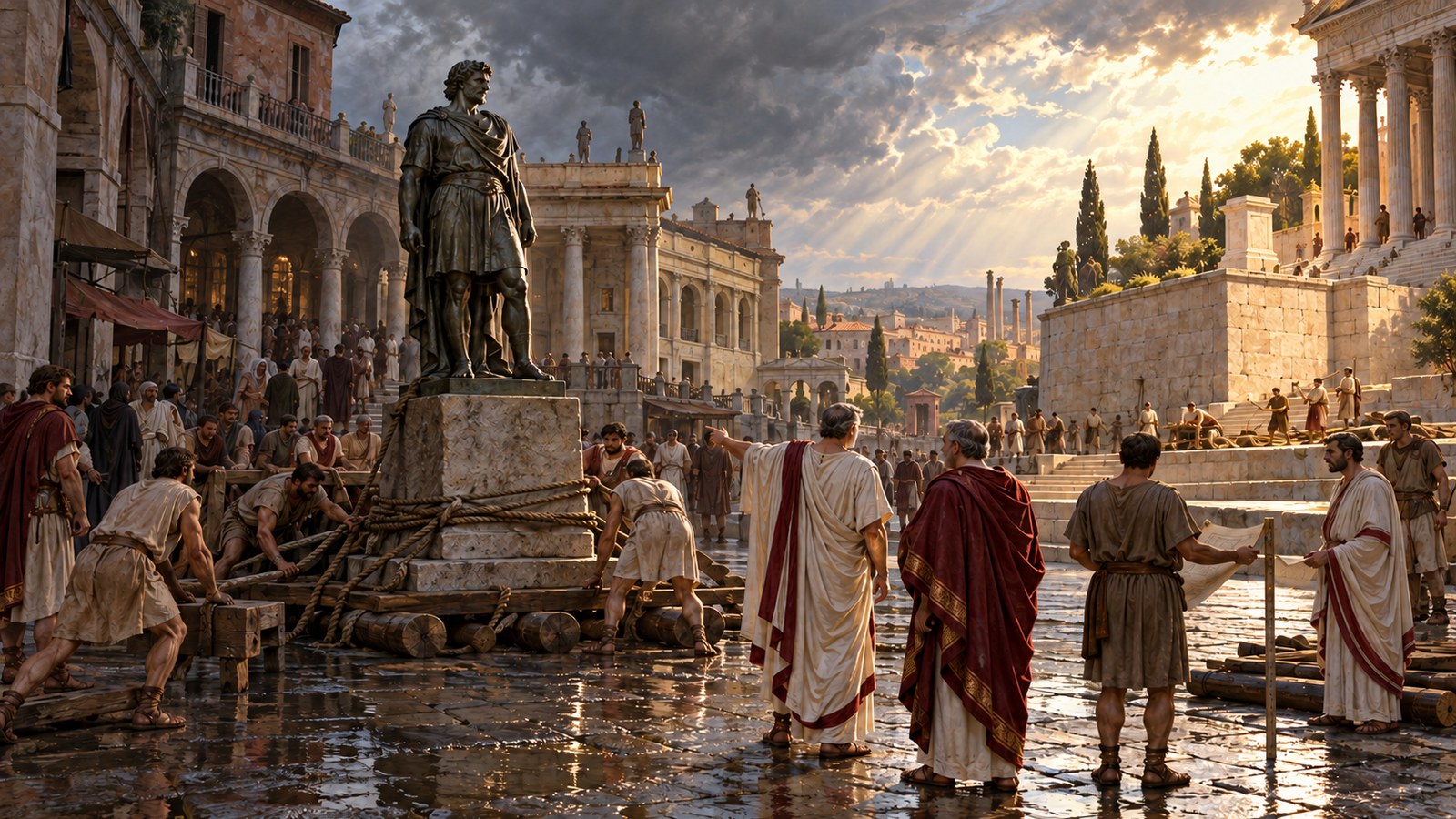
A low, sunless site disguised hostility as ritual care
The diviners did not advise melting the statue or throwing it away. Their recommendation could masquerade as a technical requirement: relocate the object to a particular spot after the prodigy.
Yet the physical consequences were severe. Height affects visibility, and sunlight affects how a monument dominates a public space. Surrounded by tall structures, the statue would lose both prominence and the changing light that made it legible through the day.
The tale therefore uses architecture as evidence of intention. A listener does not need access to a secret prayer to understand what the lower site does. The proposed setting diminishes the figure in measurable ways.
Initial Roman compliance also matters. False advice worked for a time because the speakers occupied a recognized role. Gellius does not present the city as automatically immune to manipulation. Procedure could be exploited from inside.
The incident makes a subtle distinction between consulting outsiders and surrendering judgment. Expertise was necessary, but the result still had to withstand scrutiny against place, consequence, and competing knowledge.
Exposure reversed both the placement and the authority
Once the deception was discovered, the diviners were brought before the people. Their confession shifted the episode from uncertain prodigy to proven duplicity. What had looked like ritual instruction became hostile counsel.
Gellius reports a severe punishment: the men were put to death. The narrative treats false interpretation not as an academic error but as an attack capable of harming Rome through the management of a charged public object.
The proper direction was then identified as the opposite of concealment. The statue belonged in an elevated, commanding position in the Area of Vulcan. Height and visibility became signs that the corrected reading had restored honour.
After the move, the matter was said to turn out well for the Romans. That outcome validates the correction inside the logic of the story, although it does not tell a modern reader what physical event constituted success.
The reversal resembles the layered precautions surrounding Roman agricultural ritual: exact action mattered because an improper sequence could leave a community exposed. Here, however, the danger lies in deliberately corrupted instruction.
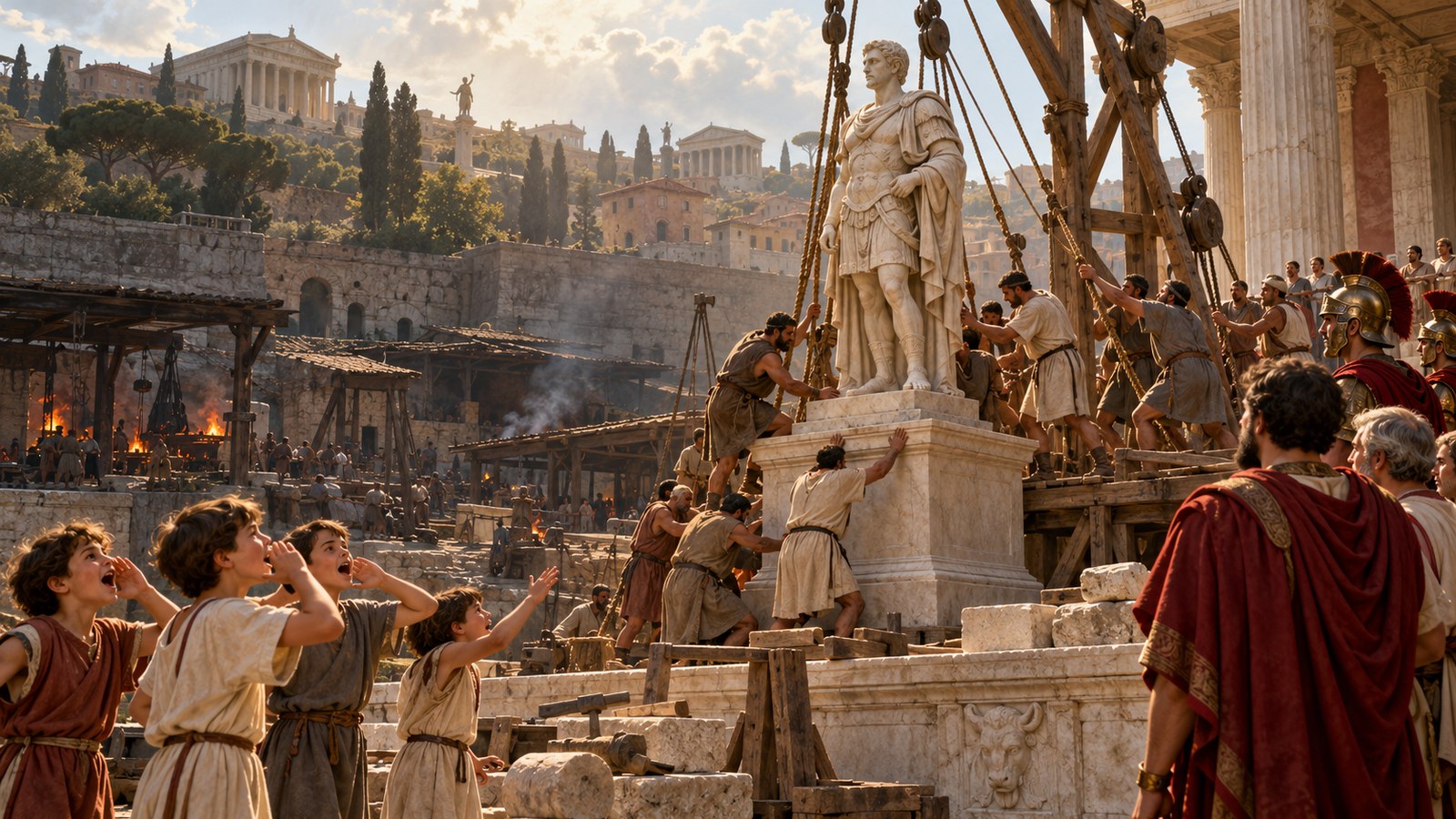
A children’s verse became the final safeguard
Rome could punish the deceptive advisers and move the statue, but neither action by itself guaranteed that the lesson would remain available. The street verse supplied a portable conclusion.
“Bad counsel” is broader than divination. The line applies to any adviser whose scheme returns upon him. Its general form helped the specific story travel beyond officials who knew the ritual file.
Gellius says boys chanted it throughout the city. Children gave the maxim repetition, rhythm, and geographic reach. A judgment entered ordinary sound rather than remaining confined to an archive.
The phrase also flips the original plan. The diviners tried to lower someone else’s monument; their counsel instead destroyed them and raised the statue. The moral feels earned because the plot physically enacts it.
Gellius traces the story to the Annales Maximi and Verrius Flaccus, while observing that the line resembles a familiar verse of Hesiod. That layered transmission matters. Official record, learned compilation, Greek proverb, and children’s chant all converge around the same warning.
The monument itself carried another layer of memory. Horatius Cocles was associated with the defense of the bridge, so lowering his statue could be understood as lowering a model of public courage. The tale does not need to narrate the bridge episode again; the name gives the relocation emotional weight.
Sunlight functions almost like a witness. The false site is described through absence—no sun because buildings close it in—while the corrected site is high and commanding. Moral interpretation becomes a contrast that an ordinary passer-by could see without mastering Etruscan ritual doctrine.
Trial before the people likewise removes the dispute from a closed circle of specialists. The advisers must answer in the civic arena whose memory they attempted to manipulate. Their confession supplies the certainty that prodigy stories often lack: the issue is no longer whether a technical judgment happened to be mistaken, but whether counsel was knowingly bent.
The children’s role prevents the ending from belonging only to magistrates. Their chant is not a formal decree, and that is why it can survive outside the original proceeding. Rhythm makes institutional memory social. Every repetition reenacts the return of harm to the deceptive speaker.
Public repetition could also discipline future advisers. A specialist entering Rome after the episode would confront more than the legal risk of fraud. The city had attached ridicule to the failed scheme. The maxim stripped deceptive counsel of technical grandeur and made its consequence understandable in one breath.
The story’s foreign hostility should be read as part of Roman self-presentation, not an independent description of Etruscan character. Gellius gives the Romans the role of a community briefly misled but ultimately capable of discovery, judgment, and correction. That flattering shape helped the anecdote endure.
The account should not be treated as a neutral court transcript. It is a Roman memory about hostile experts, civic alertness, and justice. Its sharp symmetry is part of its design. Yet that design reveals what made the story useful: it connected a flash in the sky to a visible urban correction and then reduced the lesson to words anyone could repeat. The statue stood higher, while the warning moved at street level.
Sources
Aulus Gellius, Attic Nights, 4.5.