
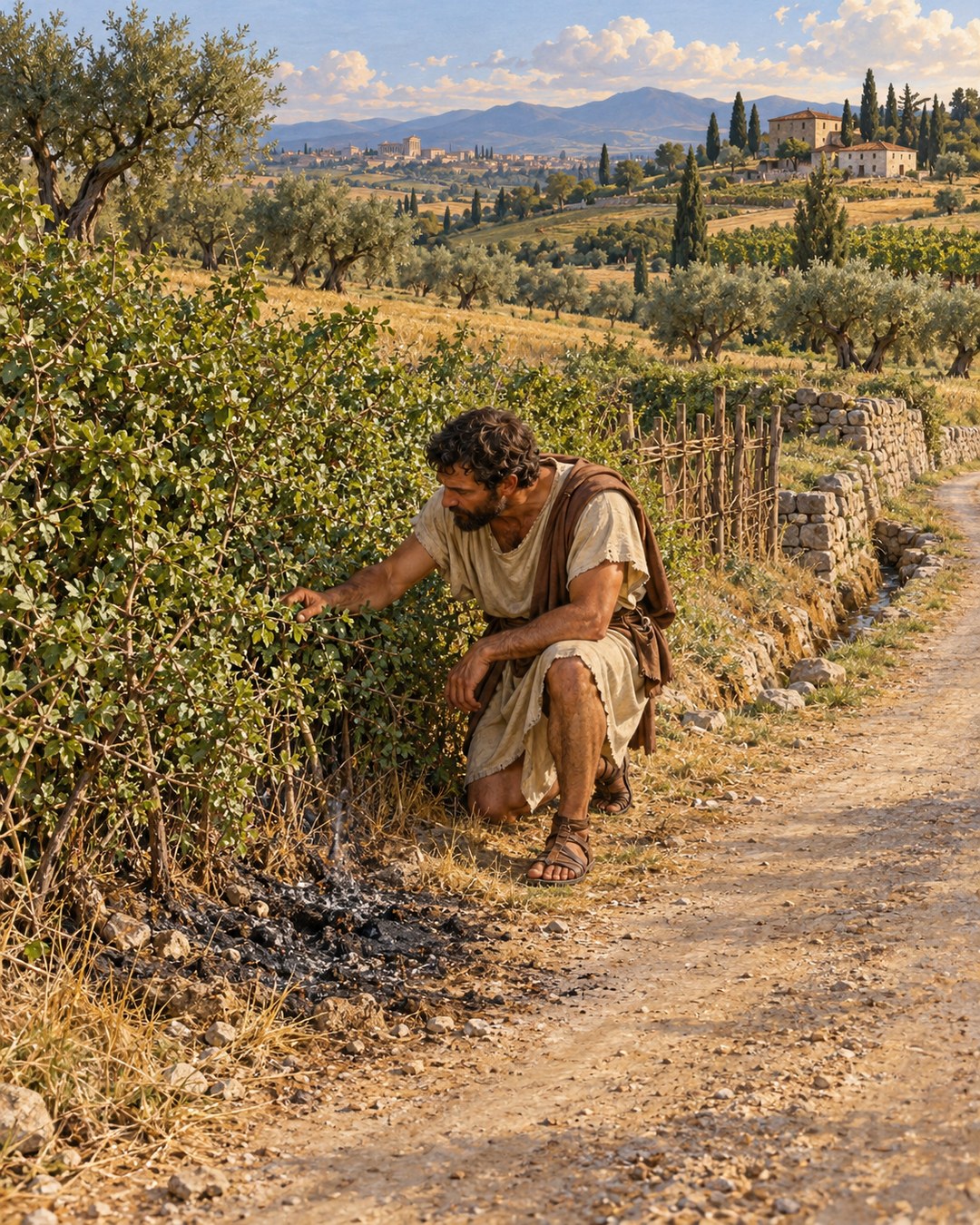
A malicious passerby with a torch was one test of a Roman farm boundary. Varro’s living hedge could survive because its roots remained in the ground. A dry wooden barrier might stop an animal or mark a line, yet the same flame could erase the structure that made the edge visible.
Fire was only one hazard. Water gathered in trenches, climbers faced banks, timber decayed, and neighboring workers could quarrel when a boundary lacked continuity. Varro therefore lists four families of enclosure: natural, rustic, military, and masonry.
The classification turns property into a material problem. An edge was not secure merely because an owner asserted it. Plants, posts, ditches, banks, stone, brick, or compacted earth had to keep the line present under local pressure.
A rooted hedge answered fire by staying alive
The natural enclosure was planted brush or thorn. Its defense came from density and living continuity. Branches obstructed passage while roots renewed growth after cutting or scorching.
Varro singles out the flaming torch of a mischievous passerby. The scene is brief but precise: a person moving along the edge can damage a dry fence without entering the estate. A living hedge denies that easy transformation of barrier into fuel.
Living did not mean maintenance-free. Gaps had to be replanted, vigorous shoots managed, and the hedge kept dense near ground level. A line that grew upward while opening beneath would appear healthy and fail as an enclosure.
The hedge also occupied space. Roots drew water and nutrients, shade reached nearby crops, and thorny cuttings complicated movement during repair. Its resilience against fire traded one set of costs for another.
That balance distinguishes the enclosure from a boundary stone honored by neighbors on both sides. A stone concentrated agreement at a point. A hedge extended obstruction across the distance between points and demanded repeated care.
Because growth made the line visible season after season, the hedge carried memory. New workers could follow it without reproducing every legal description. Physical continuity reduced the number of places where one side could claim uncertainty.
Three wooden systems traded speed against durability
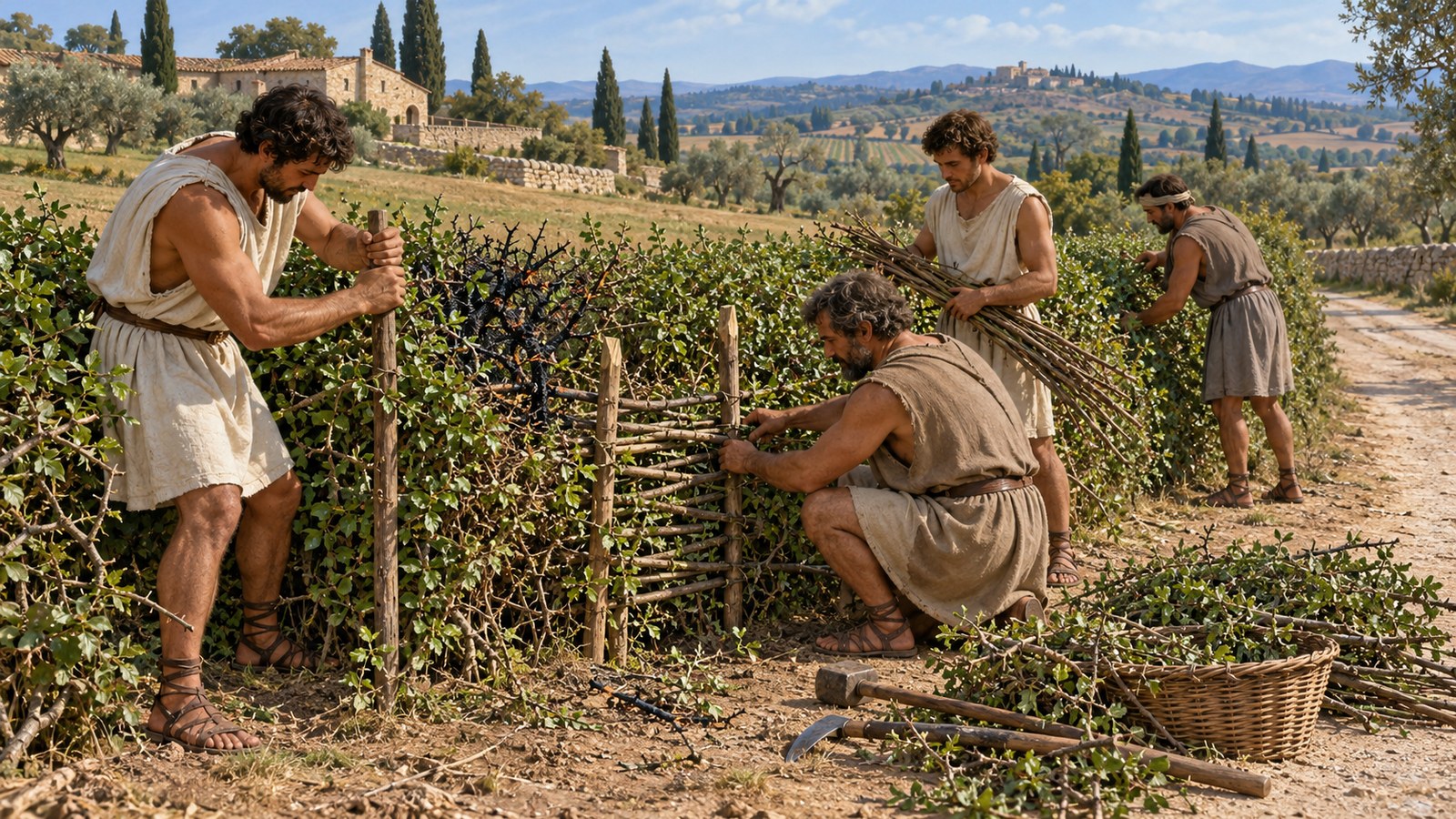
Varro’s rustic category was dead wood arranged in several ways. Close stakes could be interwoven with brush. Thick posts could be bored so that two or three rails passed through each panel. Trimmed trees could be laid end to end with branches driven into the earth.
Each method distributed effort differently. Wattle demanded many slender pieces and weaving labor but could use brush close at hand. Post-and-rail work required heavier timber and accurately placed holes, yet damaged rails might be replaced one at a time.
Whole trimmed trees reduced joinery. Their branches acted like rough stakes when forced into the ground, creating an immediate obstacle from material that might otherwise require further processing.
These were not four stages in a universal evolution from primitive hedge to advanced wall. They were choices conditioned by timber, labor, tools, animals, terrain, and the duration for which an enclosure had to serve.
A wooden fence could be erected faster than masonry and altered when a field division changed. It could also burn, rot at soil level, loosen around rails, or be dismantled for fuel. Repair was part of its original economics.
The named variants reveal that “fence” is too broad to explain performance. A woven barrier resisted differently from a rigid panel. Thick posts transferred loads through rails; brush spread many small contacts; a line of trees used mass and awkward branching.
The ditch had to decide what happened to rain
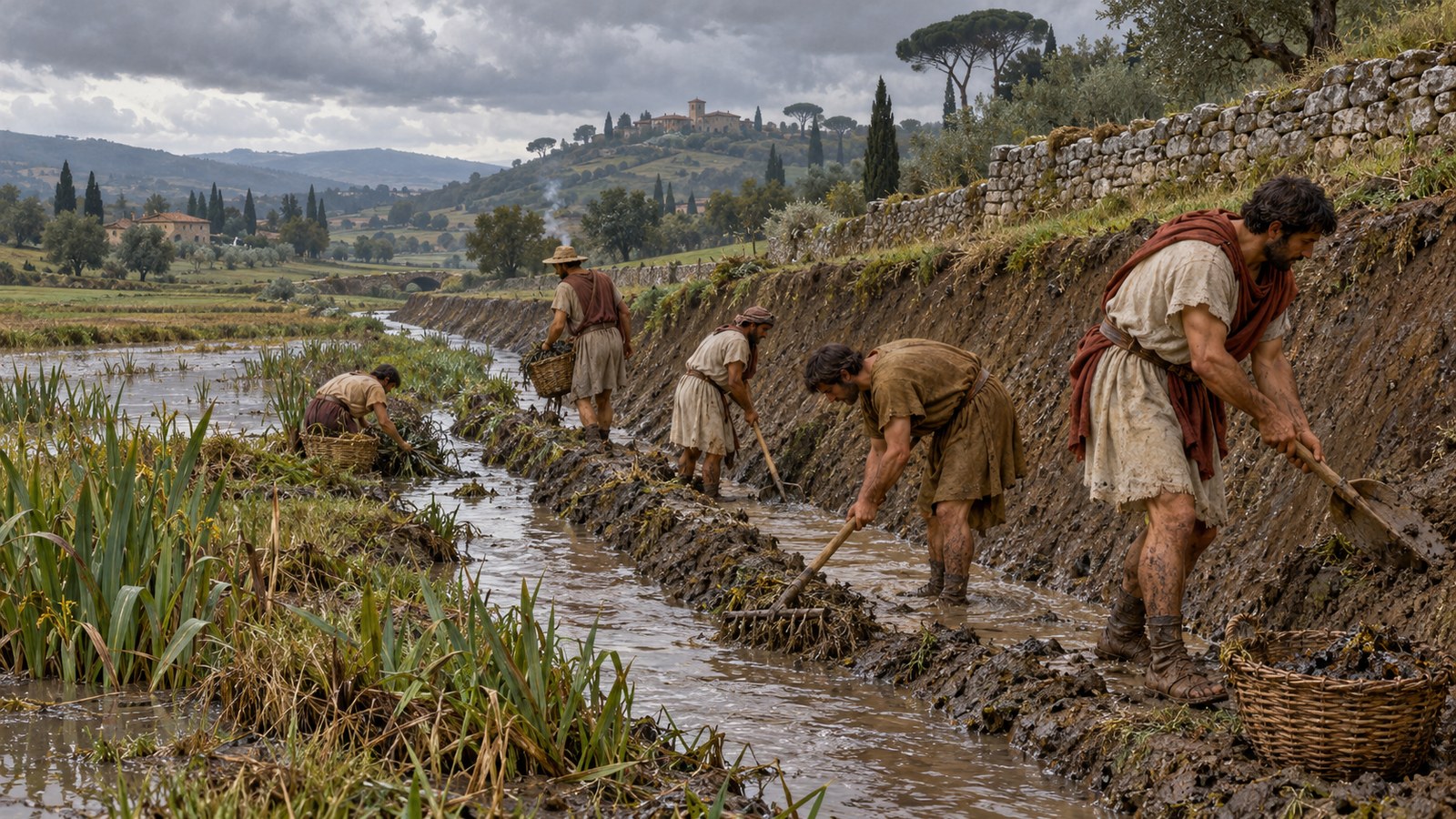
The military type paired a ditch with an inner bank. The name drew on fortification, but Varro applies it to agricultural edges, particularly along roads and streams.
A trench was adequate only if it could hold the rainwater entering it or had enough slope to carry that water away. Digging a depression without deciding between retention and drainage could turn protection into saturation.
The bank had its own geometry. It should stand close inside the ditch or rise steeply enough that climbing remained difficult. Distance between the two would create a convenient landing; a shallow bank would convert excavated soil into little more than a ridge.
Varro points to the Via Salaria near Crustumeria, where banks combined with trenches kept a river from injuring fields. The boundary therefore faced in two directions. It regulated people and animals crossing laterally while also managing water moving across the landscape.
This hydrological role recalls the contracts used to clear river obstructions, but at a different scale. River administration protected navigation through public work; the farm ditch protected a particular field by giving runoff and overflow a controlled path.
Maintenance decided whether the design remained real. Silt reduced capacity, collapsed sides softened the bank, vegetation blocked flow, and burrowing animals opened leaks. A well-conceived earthwork still failed if no one cleared it after storms.
Walls and tree lines made local materials declare the edge
Varro’s masonry family included stone around Tusculum, fired brick in the Ager Gallicus, sun-dried brick in the Sabine country, and mounded earth mixed with gravel in Spain and near Tarentum. The list makes regional availability part of boundary design.
Stone resisted weather but demanded quarrying, transport, and skilled fitting. Fired brick consumed prepared clay and fuel. Sun-dried brick reduced firing costs while requiring protection from persistent moisture. Rammed or mounded earth and gravel depended on suitable soil and enough thickness.
Calling all four “walls” does not make their maintenance identical. Caps, foundations, drainage, and surface repair had to suit the material. A prestigious stone solution imported to the wrong place could cost more and perform worse than a local earthwork.
Where no enclosing barrier existed, planted trees could secure the boundary. Varro says they prevented servants from quarreling with neighbors and reduced the need to settle the line through lawsuits. His wife used pines on Sabine farms; he used cypresses near Vesuvius; people near Crustumeria planted elms.
The examples combine biography and prescription. They do not prove one tree was legally mandatory. They show owners selecting species that kept an edge visible under different conditions.
Elms were especially productive on suitable plains. They supported baskets of grapes, offered foliage to sheep and cattle, and supplied rails and fuel. A boundary tree thus earned space several times over.
The species also changed how the line was read at a distance. A repeated row of trunks remained legible above seasonal crops, while pruning and harvesting brought workers back to the same edge. The boundary was renewed through ordinary tasks rather than visited only when a conflict began.
That productivity could strengthen permanence. People had reasons to maintain a line that yielded fodder, vine support, wood, and fuel. The legal edge became less likely to vanish through neglect because it participated in the farm’s annual economy.
Varro’s fourfold catalogue is not a modern property code, and it does not tell us which enclosure surrounded every Roman estate. It is evidence for the questions a manager was expected to ask: what threatens this edge, where will water go, what materials exist here, how will repairs happen, and can the line produce something while it separates?
The torch in the opening matters because it compresses those questions into one instant. A line on a document cannot burn, but the farm boundary on the ground can. Roman property remained secure only when law, memory, labor, and material construction continued to overlap.
Sources
Marcus Terentius Varro, On Agriculture, 1.14–15.