
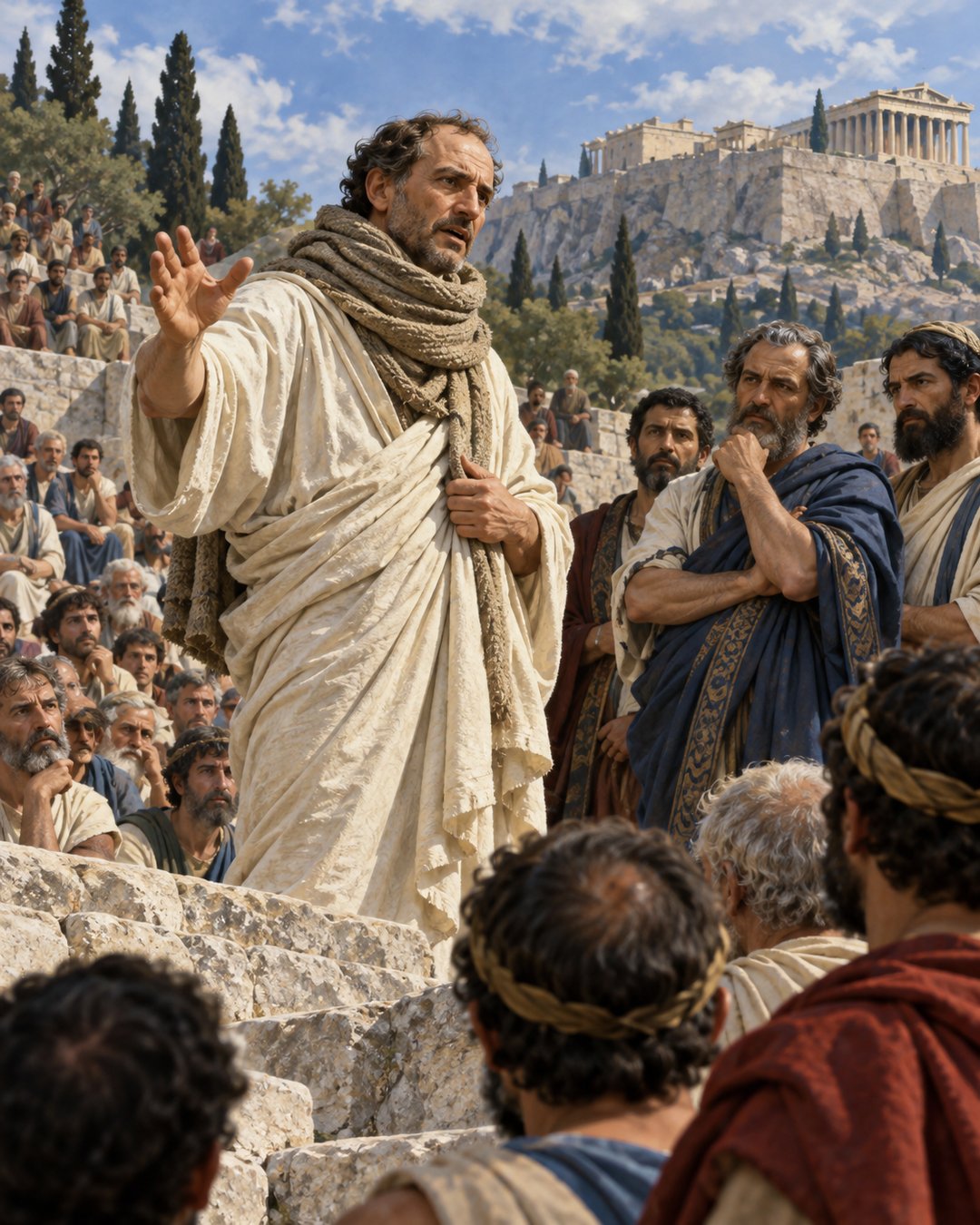
Demosthenes had already told the Athenian people why they should refuse the Milesians. Their request for aid, he argued, deserved rejection and did not serve the city’s interest. The debate was postponed until the next day, leaving the foreign envoys with one night to change what the assembly would hear.
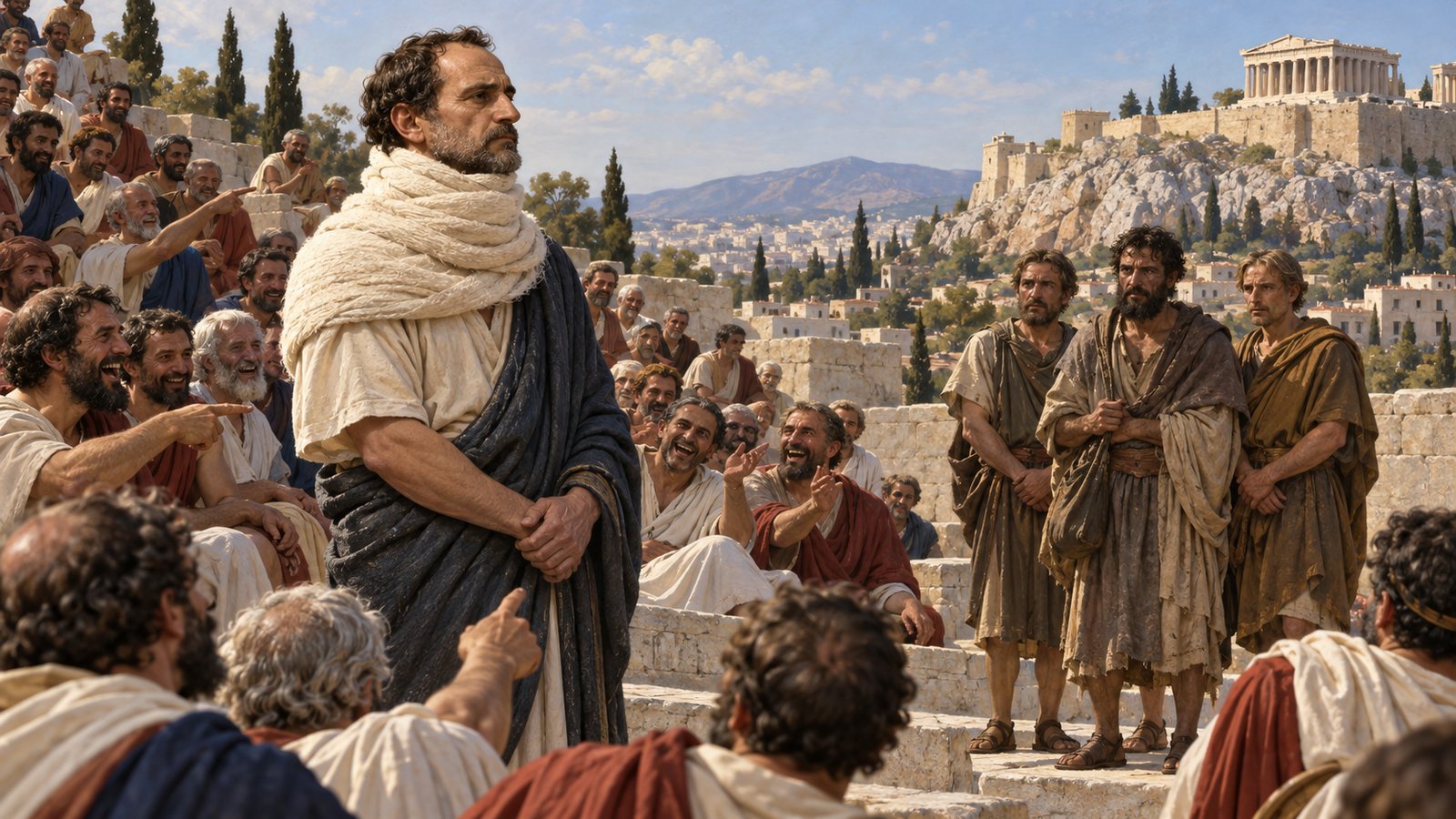
They did not hire a better answer. According to the story Aulus Gellius read in Critolaus, they paid the opposing speaker himself. Demosthenes returned with his neck and shoulders wrapped in thick wool, announced that quinsy had taken his voice, and declined to repeat the argument.
The disguise failed without being removed. Someone in the crowd renamed the sickness as “silverinsy.” The joke identified the payment through the very body meant to hide it. Corruption appeared not as a false vote or a flattering speech, but as a conspicuous silence where a public argument had stood the day before.
A postponed decision created a market for one missing voice
Gellius introduces the episode as a story from Critolaus. He does not provide a date, treaty text, vote total, or the exact aid Miletus sought. He even marks the purpose of the embassy as probable. Those limits matter: the surviving chapter is an anecdote about persuasion and reputation, not a complete record of Athenian foreign policy.
Its sequence is nevertheless exact. Envoys from Miletus came to Athens on public business. They selected advocates, and those speakers addressed the people according to the embassy’s instructions. The arrangement placed a foreign request inside the city’s own deliberative machinery.
Demosthenes took the opposite side. Gellius gives his case two parts. The Milesians did not deserve aid, and aid would not benefit the state. One argument judged the applicants; the other judged Athens’s interest. Together they offered the assembly both a moral and a practical reason to refuse.
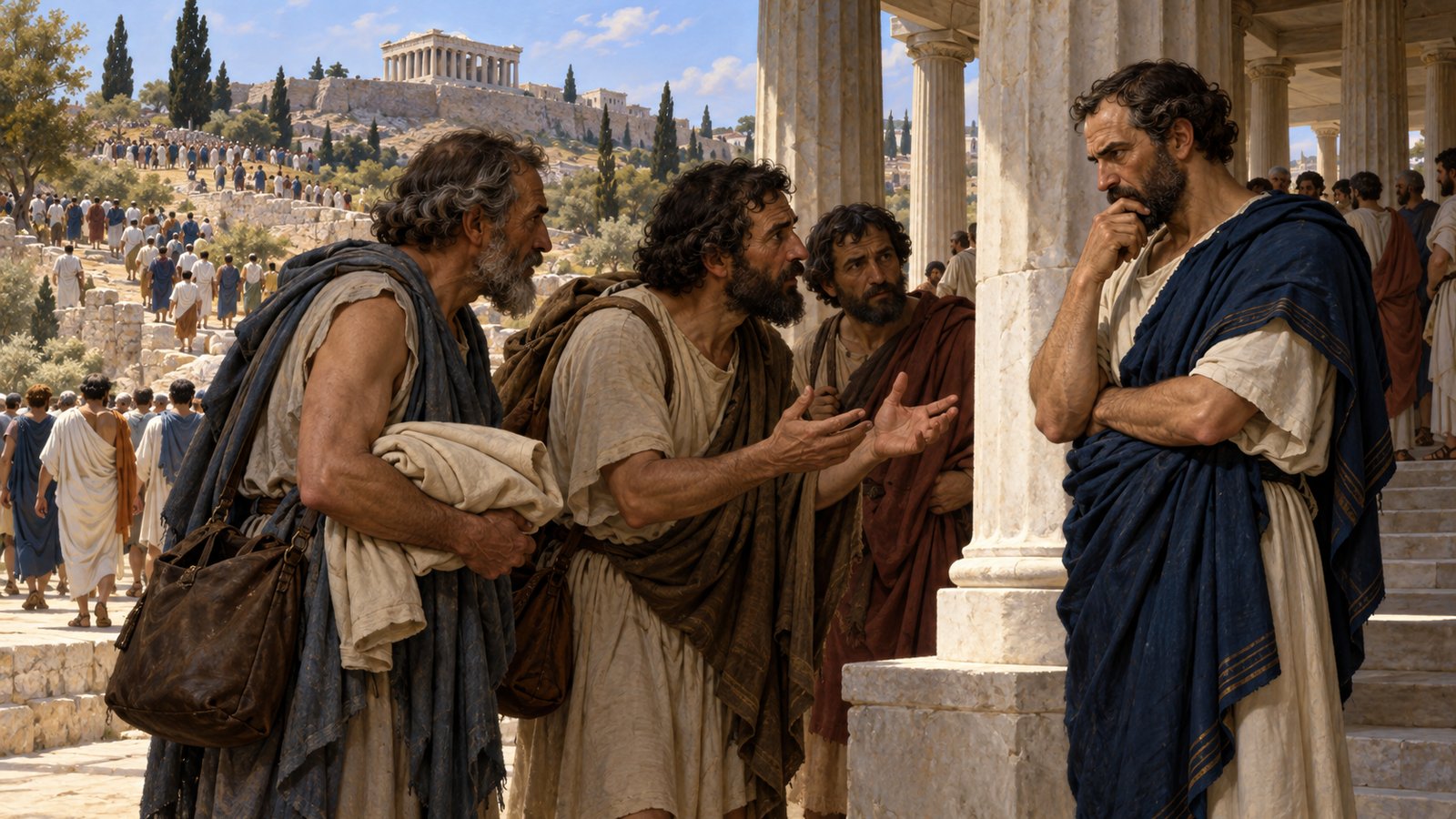
No decision closed the matter that day. Postponement changed the contest. A completed speech could now be remembered, answered, softened, or prevented from returning. The envoys approached the man who had made refusal persuasive and begged him not to oppose them again.
The request reveals what they believed mattered. They did not merely fear a position in the abstract. They feared its effective public carrier. Demosthenes’s argument had enough force that removing his next performance seemed worth a payment.
That mechanism differs from the discipline in the story of Demosthenes using half a haircut to keep himself in training. There, an altered appearance made retreat from study embarrassing. Here, wool made retreat from a public position look medical. In both anecdotes, the speaker’s body became part of how speech was controlled.
Thick wool turned purchased silence into a public performance
Demosthenes demanded money and received the sum he named. The next day he did not simply remain home. He came before the people wrapped around the neck and shoulders and supplied a reason they could see before he spoke: quinsy had disabled the orator.
The choice made absence theatrical. His body was present, but the expected voice was not. The wool translated that contradiction into illness. It offered a visible bridge between yesterday’s vigorous opposition and today’s inability to continue.
That was useful because pure disappearance could invite questions of cowardice or betrayal. A sick speaker might preserve his political position while avoiding the work it required. He need not endorse the Milesians. He only needed to be unavailable at the moment when opposition mattered.
Gellius does not report a medical examination, a confession before the assembly, or the final outcome of the request. We should not turn the crowd’s suspicion into a modern evidentiary file. The point of the anecdote is how quickly appearance, timing, and prior conduct made the excuse legible.
The bandage therefore concealed and advertised at once. Thick wool could plausibly signal a damaged throat, but it also drew attention to the organ whose service had allegedly failed. Every layer around the neck framed the missing speech.
The payment purchased restraint rather than advocacy. That distinction is the story’s sharpest political detail. Buying praise can fill public space with a new claim. Buying silence removes a tested objection and leaves listeners to decide without hearing it renewed.
Silence is difficult to count because it leaves no speech to quote. The visible wrapping solved that narrative problem for Critolaus and Gellius. It gave the absent argument an object, a posture, and a moment before the assembly.
One pun converted a private payment into a civic accusation
A person in the crowd answered the claim of quinsy with a verbal substitution: Demosthenes suffered from silver. The precise English pun belongs to translation, but the surviving scene depends on the same move. The audience replaces the orator’s diagnosis with a financial one.
The interruption was efficient because it did not need to reconstruct the negotiation. It joined three public observations: Demosthenes had opposed the request, a night had passed, and he now appeared unable to repeat himself. Money supplied the hidden cause that made the change intelligible.
Humor also redistributed authority. The famous orator had controlled the previous day’s argument. On the second day, an unnamed listener supplied the line that survived. A voice from the audience interpreted the professional speaker’s silence for everyone else.
The episode resembles the Roman alarm over Carneades demonstrating opposing arguments only at a distance. Carneades displayed how rhetoric could move between positions. Demosthenes did not publicly reverse his case in Gellius’s story. The accusation was that money made a powerful position disappear from the second hearing.
That difference protects the anecdote from becoming a vague complaint that eloquence is manipulative. The mechanism is concrete. There is a first speech, a postponement, an approach by interested envoys, a payment, wool around the throat, a medical excuse, and a crowd’s answer.
The joke did not physically force Demosthenes to speak. Its sanction was reputational. It denied him control over the meaning of his silence. The bandage said illness; the assembly’s pun said purchase.
The later boast made silence a commodity with a price
Critolaus’s version did not end at the assembly. Gellius says Demosthenes later made no effort to hide the affair and even boasted about it. The comparison he used turned political silence into a professional fee.
Demosthenes asked the actor Aristodemus what he had received for acting. Aristodemus answered: one talent. Demosthenes replied that he had received more for holding his tongue.
The exchange pairs two kinds of performance. The actor was paid to appear and speak or act. The orator claimed a larger reward for withholding what audiences normally valued in him. His reputation made nonperformance expensive because listeners expected his voice to alter the decision.
Gellius gives no exact amount for the payment to Demosthenes, only the comparison that it exceeded a talent. Precision would be tempting but false. The source’s emphasis is relational: silence earned more than the actor named for performance.
The boast also changes the moral temperature of the episode. A reluctant concession could be explained as fear or need. Pride in the fee presents the transaction as evidence of market value. The greater the payment, the more important the withheld speech appears.
That self-presentation may be part of why the story traveled. It contains an accusation, a visual prop, a crowd’s pun, and a final line polished enough to repeat. Each stage converts political procedure into memorable speech about speech.
Yet the anecdote’s neatness should keep us cautious. Gellius transmits Critolaus, and Critolaus presents a famous orator through a compact moral story. We are seeing Demosthenes as later readers discussed him, not listening to an untouched transcript of the assembly.
The transmission is itself Roman evidence. Gellius placed the episode in a miscellany for readers interested in language, conduct, memory, and public life. A Greek assembly story became material through which Roman readers could consider what eloquence cost, how an excuse could be read, and why a joke might preserve an accusation better than a decree.
The story does not need a favorable speech to expose the transaction. Its whole design rests on subtraction. Yesterday’s argument establishes the voice; postponement creates another opportunity; money removes the voice; wool explains the removal; laughter contests the explanation; and the later boast assigns the silence a price.
By the end, the most consequential act is something Demosthenes does not do. He stands before the people and withholds the argument they already know he can make. The bandage cannot keep that absence neutral. In a public debate, silence after payment still communicates—and the crowd proved ready to translate it.
Sources
Aulus Gellius, Attic Nights, 11.9; Critolaus, account quoted by Gellius.