
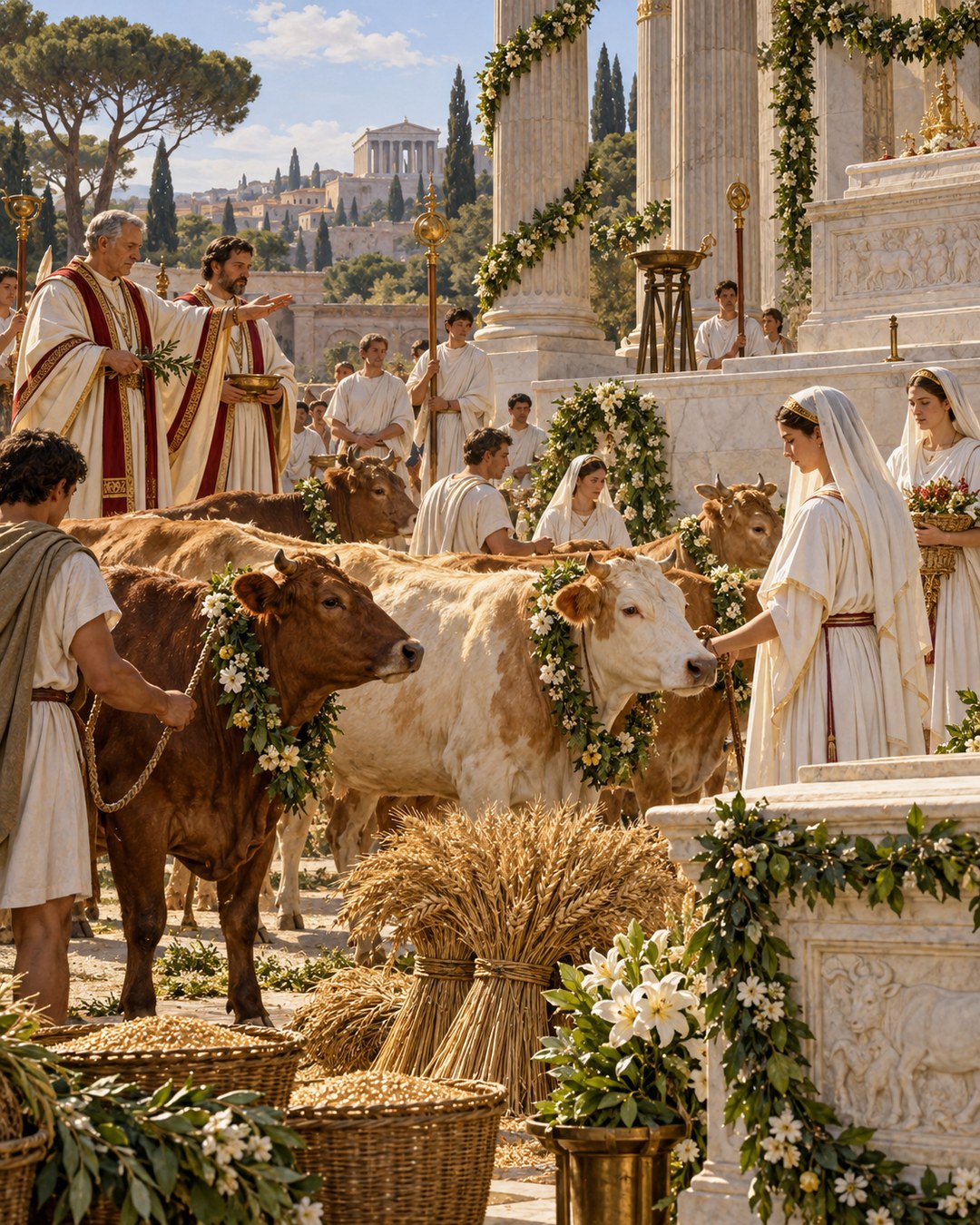
On April 15, Rome did not finish with the sacrifice it began. Ovid says pregnant cattle were offered, the unborn calves were removed, and the eldest Vestal burned them. Their ashes were kept for another festival six days later.
The delay is the key to the Fordicidia. A rite addressed to a seed-filled earth produced material for the Parilia, when the Roman people and their pastoral world underwent purification. One sacred date prepared the substance used by the next.
Ovid explains this public sequence through an older crisis story about Numa, failed harvests, miscarrying animals, a night in a grove, and a riddle from Faunus. Poetry, civic organization, and stored ash all meet in one account, but they do different jobs.
April’s seeded ground received a pregnant victim
Ovid dates the offering by the calendar: the third day after the Ides of April, or April 15. Pontiffs are told to sacrifice a forda, which he explains as a cow carrying a calf.
His explanation plays with the language of bearing. The animal is full of young while the ground is full of seed. A “teeming Earth,” in the translation, receives a teeming victim.
The analogy is direct but not casual. Mid-April crops are committed to the soil but not yet safely harvested. Herds also carry young whose survival matters to the coming year. Pregnancy gathers agricultural hope and risk into a visible body.
Ovid is writing a poetic calendar, not an administrative handbook. He gives vivid ritual actions and an origin tale, but not a complete priestly schedule, budget, or map of every procession. The account must be used for what it actually preserves.
The scene also needs to remain distinct from the later Parilia purification. The Fordicidia creates the calf ashes; the Parilia deploys them. Combining the two dates into one ceremony hides the logistical link.
That link is unusually material. Words and victims disappear in the moment, but ash can be gathered, guarded, transported, and measured out. Burning changes the offering without ending its ritual usefulness.
Thirty curiae spread one rite across the civic body
Some cattle were sacrificed on the citadel of Jupiter, Ovid says, while the curiae received “thrice ten” cows. The line gives the rite a distributed civic structure rather than confining it to a single altar.
Rome’s thirty curiae were old citizen divisions whose political importance changed over time. Here their number remains legible through ritual allotment. Each group participates in a common action without erasing its own place in the arrangement.
Distribution poses practical questions that Ovid does not answer. Animals had to be assembled and controlled; officiants had to know where each belonged; fires and attendants had to be ready; remains had to be handled according to the rite.
The scale turns agricultural metaphor into urban coordination. “Earth” may be one divine recipient, but Rome approaches her through multiple civic units and a central citadel.
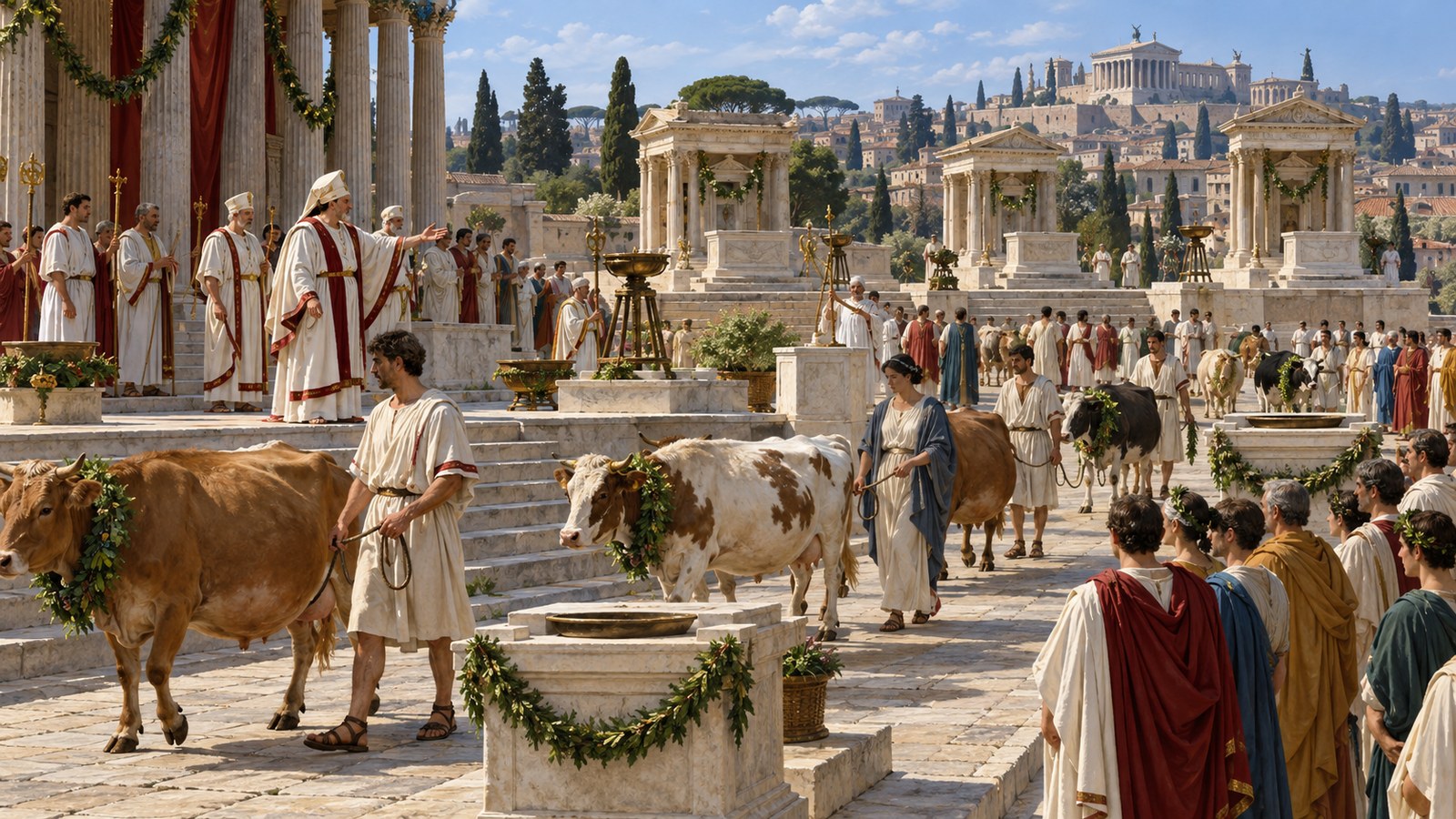
Ovid’s language is graphic about the removal of the calves and the burning that follows. A responsible modern image need not reproduce the violence to explain the mechanism. The significant sequence is victim, separated calf, Vestal fire, preserved ash.
This civic reach resembles the Robigalia’s attempt to protect grain from mildew, yet the organization differs. The Robigalia follows a priest and victims to a grove; the Fordicidia connects citadel, curiae, Vestal custody, and a later festival.
The eldest Vestal converted sacrifice into stored ritual material
After attendants removed the unborn calves, the eldest Vestal burned them. Her role stands between the killing of the cattle and the future purification of the people.
Fire reduces bodies to portable residue. The ashes no longer resemble the pregnant victims, but they retain a named origin and an assigned destination. Transformation allows one rite to cross time.
Ovid explicitly says the ashes are for the day of Pales. That is the Parilia on April 21, a festival associated with pastoral purification and, in Roman memory, the city’s birthday. The Fordicidia therefore anticipates a larger calendrical moment.
Storage is easy to overlook because it falls between dramatic scenes. Someone had to keep the material identifiable and uncontaminated for nearly a week. Ritual continuity depended on custody as much as spectacle.
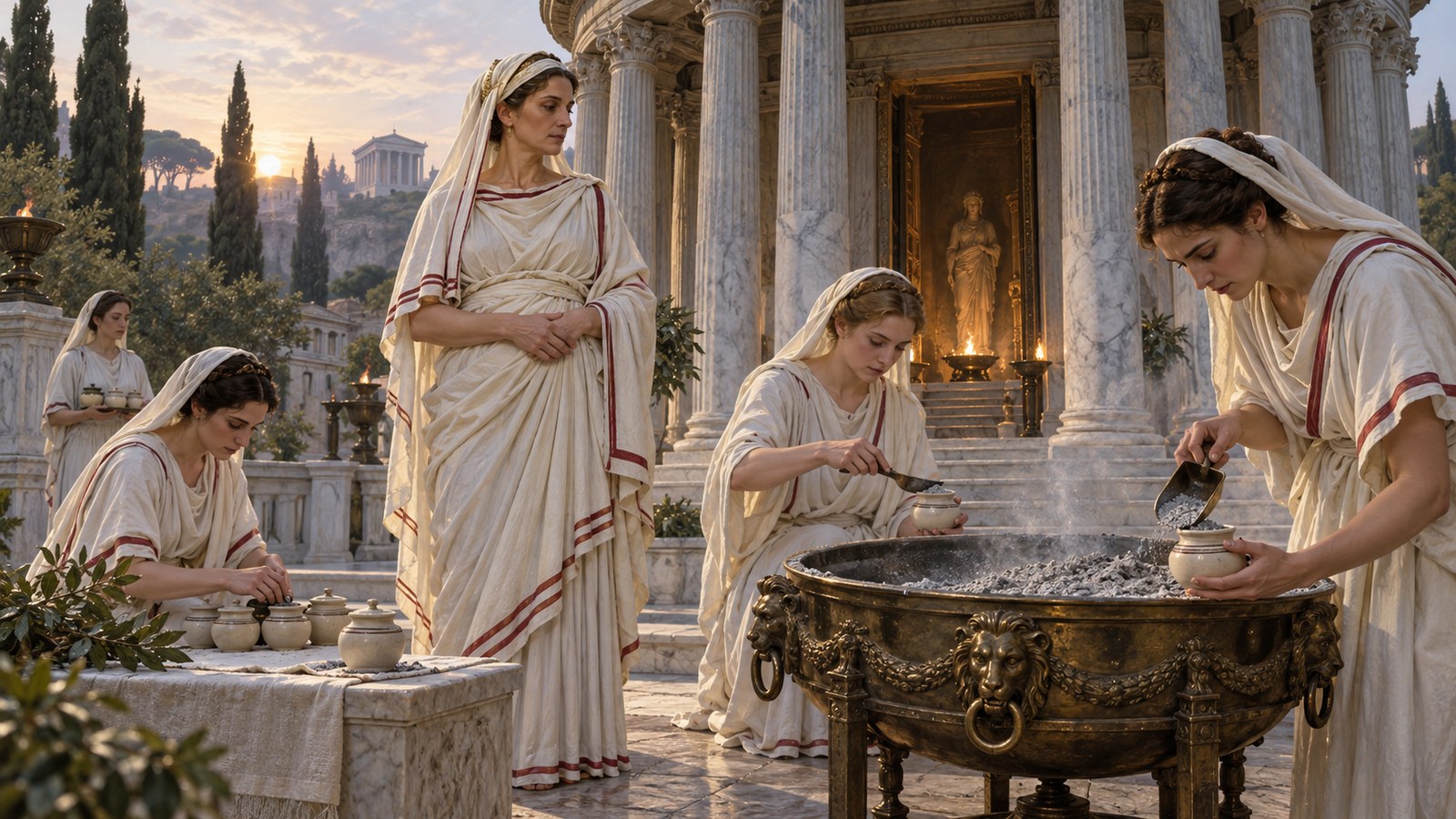
The passage does not say exactly where every portion was stored or how it was divided at the Parilia. Those details cannot be invented from silence. What it does say is enough to establish intentional reuse.
This makes the rite a small supply chain of sacred matter. Civic groups provide victims; attendants perform a difficult separation; a Vestal burns the calves; ash survives; another festival consumes its meaning.
Numa’s dream explained why one body carried two lives
Ovid closes the account by moving backward to King Numa. Harvests fail despite labour and prayer. Weather swings between cold dryness and ceaseless rain, young crops disappoint, weeds choke the soil, and animals lose their young.
Numa seeks an answer in an ancient grove. He sacrifices two sheep, one to Faunus and one to Sleep, spreads their fleeces on the ground, washes his head twice, crowns himself with beech leaves, removes his ring, avoids meat and sex, and lies down in rough clothing.
The preparation makes sleep a formal consultation rather than an accidental dream. Faunus arrives and gives a deliberately difficult command: Earth must be appeased through two cows, yet one heifer must yield two lives.
Egeria solves the riddle. A pregnant cow contains the two lives that one body can provide. Ovid says the offering followed and the year became more fruitful in field and herd.
This origin story should not be mistaken for a dated archive of Numa’s reign. It explains ritual form through exemplary kingship and divine interpretation. The calendar rite is historical evidence for Roman religious imagination; the dream is part of that imagination.
Ovid’s catalogue of the crisis gives the riddle weight. Dry weather and cold north winds can damage one season; relentless rain can damage another. Crops fail at sprouting, oats crowd the field, and livestock lose young before term. The solution has to answer both soil and herd because the poem has made both vulnerable.
Numa’s restrictions before sleep mirror that seriousness. Water, leaves, abstinence, an unadorned hand, rough clothing, and fresh fleeces remove ordinary royal comfort. The king does not command an answer from a throne. He prepares his body to receive one on the ground.
Egeria’s interpretation is also essential. A divine message arrives in language that cannot be enacted literally until human intelligence resolves it. The rite is therefore not presented as obedience without thought; it depends on translating “two lives” into the condition of one animal.
Once repeated publicly, the private dream becomes civic infrastructure. Pontiffs, curiae, attendants, and Vestals take over functions that the origin story concentrates around Numa. The annual rite no longer needs a new riddle, because institutions preserve the answer.
Together, the public instructions and the tale explain different dimensions. The analogy of pregnancy tells why the victim suits seeded earth. The thirty curiae show how Rome distributes participation. The Vestal’s ash explains how April 15 reaches April 21. Numa’s riddle gives the whole action a memorable first solution.
The most revealing object is what remains after the fire. Ash carries no visible calf or field, yet its controlled passage preserves both associations. Rome’s next purification begins with material prepared six days before.