
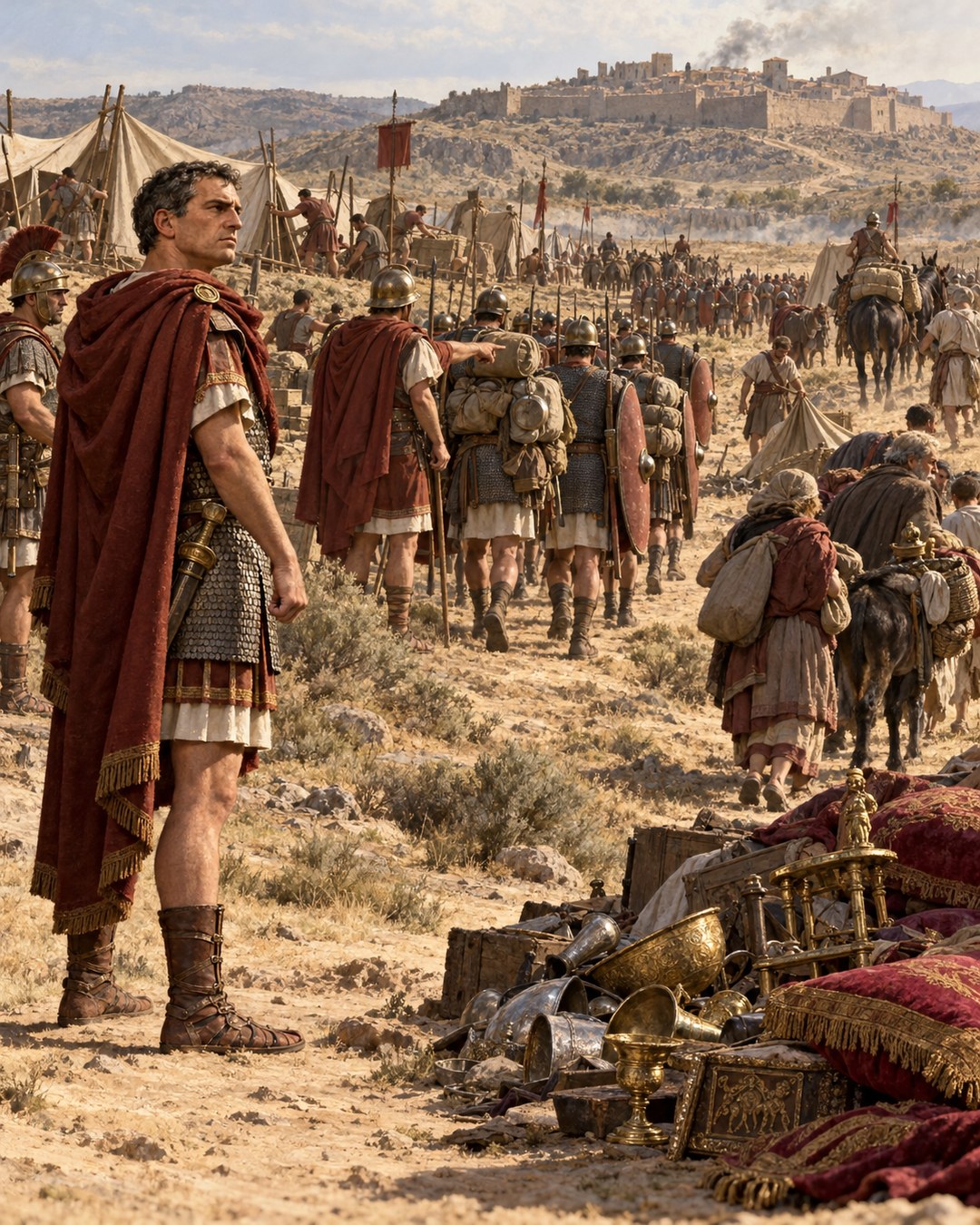
Before Scipio could defeat Numantia, Frontinus says, he had to confront the Roman army sent to do it. The force was demoralized after slack command. Its camp carried too many followers, its soldiers expected comforts unsuited to campaigning, and its habits no longer matched the danger ahead.
Scipio’s answer was not one inspirational address. He dismissed a large noncombatant population, imposed a regular daily routine, ordered frequent loaded marches, and made soldiers cross streams in cold and rain. He also broke utensils that existed only for self-indulgence.
Frontinus compresses a complicated reform into an example of discipline. In his version, the unit of change is the repeated day. An army becomes credible by carrying, moving, and enduring differently before it ever forms a battle line.
The first inspection counted people as part of the baggage
Frontinus begins with diagnosis. The army before Numantia had become demoralized, and previous commanders had allowed the condition to develop. The failure was institutional rather than a momentary panic in battle.
Scipio dismissed an enormous number of camp followers. Ancient armies needed traders, servants, animal handlers, craftspeople, and other noncombatants, but a swollen following could consume food, slow movement, multiply vehicles, and blur responsibility.
The action did not claim that every supporting person was useless. Frontinus’s point is scale. Scipio treated the camp population as a military variable that commanders could control rather than an inevitable crowd surrounding the legions.
A smaller train changed the army’s geometry on the road. Fewer dependants and fewer comforts meant less distance between the front and rear, fewer delays at crossings, and fewer people competing for protected space. Frontinus does not give an exact headcount, so the effect should be understood without inventing one.
His emphasis differs from the forked poles that let Marius’s soldiers carry organized bundles. Marius’s device redistributed equipment onto individual shoulders. Scipio’s reform first removed people and objects he judged unnecessary, then tested what remained.
Dismissal also made authority visible. A commander arriving after lax predecessors had to show that old permissions were not permanent. The first reform therefore altered the camp before it altered tactics.
Several days of food turned a march into an audit
Scipio ordered frequent marches and required the men to carry rations for several days. The burden made each exercise an audit of preparation. Food had to be packed, distributed, carried, and protected rather than assumed to appear at the evening halt.
A loaded march exposed weaknesses that drill on level ground could hide. Footwear failed, straps cut, containers leaked, and badly arranged loads exhausted their carriers. Repetition gave soldiers opportunities to correct such problems before an enemy could exploit them.
“Frequent” is essential. One hard day can be survived through adrenaline or luck. A routine forces the body and the unit to develop sustainable methods. Men learn pace, spacing, rest, and the difference between necessary weight and possessions that merely feel familiar.
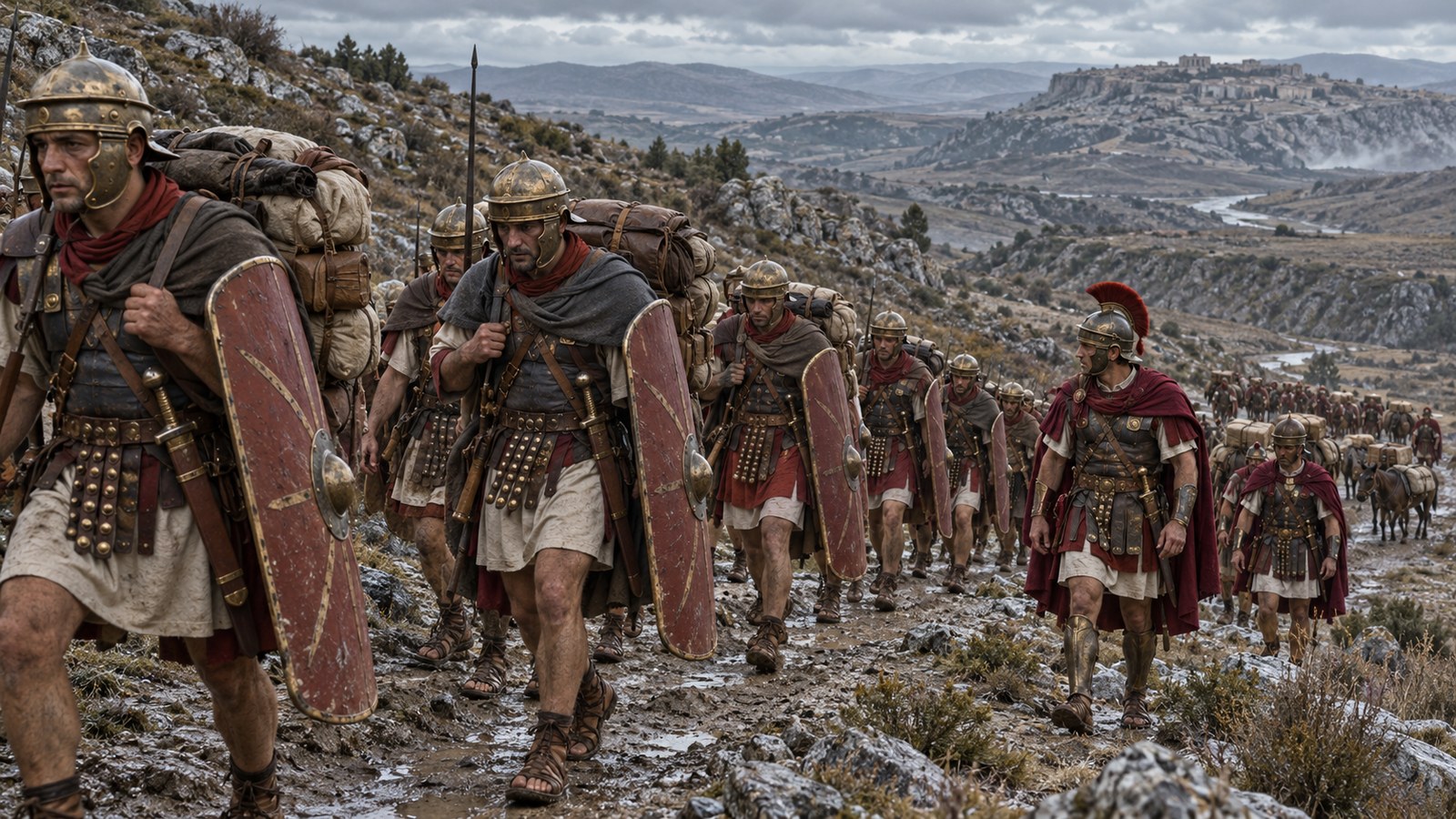
The rations also linked discipline to future independence. A unit able to carry several days of food could move without a dense market following close behind. It could cross ground where carts struggled and tolerate disruptions in the supply route.
Frontinus does not specify the food, total weight, route length, or marching speed in this example. Those details cannot be borrowed from other armies and presented as his. What he records is the relationship between duration and burden: several days’ subsistence stayed with the soldiers during exercise.
This distinguishes the reform from a punishment parade. The load had operational meaning. Scipio was training the army to remain a functioning army after leaving the conveniences of its camp.
Cold, rain, and streams removed the training ground’s shelter
The marches accustomed soldiers to cold and rain. Scipio did not wait for ideal weather, because war would not preserve a dry road or moderate temperature for Roman convenience.
Exposure tests more than toughness. Rain changes footing, adds weight to cloth and leather, spoils careless packing, obscures visibility, and raises the cost of every pause. Cold makes hands clumsy and turns a small equipment problem into a serious delay.
Stream crossings added another transition. A marching column had to enter water, keep order where the bottom could not be seen, protect its loads, climb the far bank, and reform without leaving men or equipment scattered behind.
Frontinus groups these experiences under discipline because weather and water reveal whether orders survive discomfort. A unit may look orderly on a dry parade ground and become a crowd at the first difficult bank.
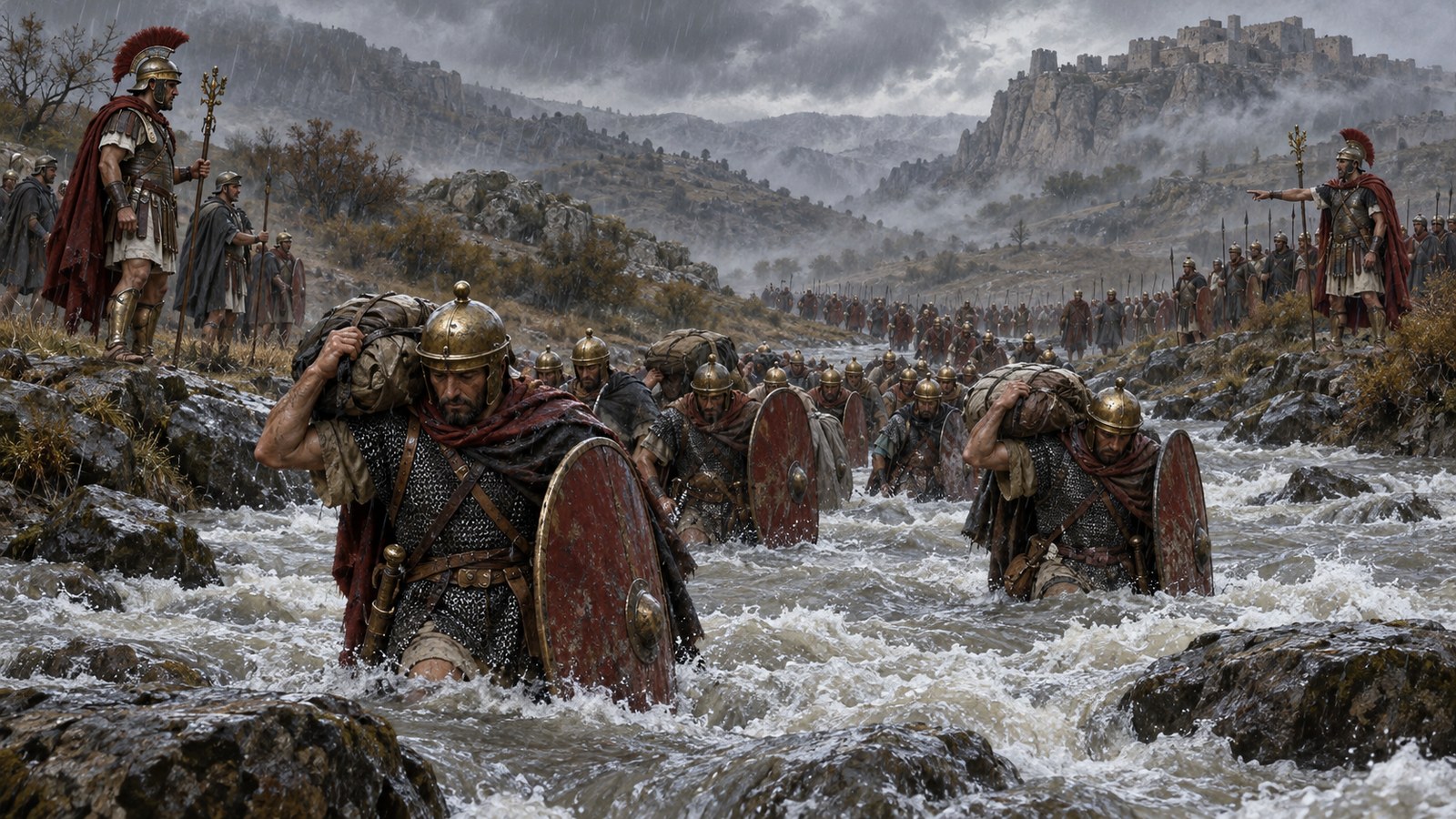
The exercise belongs beside, but not inside, battlefield formation. The infantry placed among Roman horsemen solved a tactical problem through arrangement. Scipio’s marches addressed whether soldiers could reach a fight with their cohesion intact.
Repeated crossings also made leadership observable. Officers could see which units bunched at the entrance, which failed to secure loads, and which recovered formation quickly. The landscape became an examiner.
Frontinus does not say that suffering was valuable by itself. Cold, rain, and water mattered because they reproduced predictable campaign difficulties. Endurance served movement.
Broken luxuries drew a boundary around the necessary
Scipio reproached timidity and indolence, but Frontinus pairs words with objects. The commander broke utensils that served self-indulgence and had no necessary campaign function.
A utensil occupies little space when considered alone. Multiplied across a legion and accompanied by servants, animals, or containers, optional possessions become a transport system. Scipio’s violence against them made accumulated excess visible.
The distinction between necessary and luxurious could also discipline rank. Frontinus singles out the tribune Gaius Memmius. Scipio reportedly told him that he would be worthless to Scipio only for a certain period, but worthless to himself and the state forever.
The insult reaches beyond temporary command. Memmius’s habits are presented as damage to his own character and public usefulness, not merely an inconvenience to one general. Frontinus uses the exchange as an exemplum, sharpened for readers who were expected to remember the line.
We should not treat every reported sentence as a transcript. Frontinus wrote a collection of military examples, and memorable speech helps an example travel. Yet the placement of the quote still tells us how he interpreted the reform: material austerity and moral responsibility belonged to the same lesson.
The broken vessels also prevented private comfort from defeating collective speed. A soldier could not insist that an object was harmless when thousands of similar exceptions slowed the column. The commander established a shared threshold.
That threshold completed the cycle begun with the camp followers. Scipio reduced the outer crowd, reduced the inner baggage, and filled the resulting space with routine. Removal alone might produce resentment; repeated practice demonstrated what the leaner force could do.
Frontinus places the episode under discipline, not under a clever battlefield trick. The classification is revealing. Scipio’s stratagem was not to deceive Numantia but to make Roman soldiers stop deceiving themselves about readiness.
By the time a battle decision arrived, the army had already been measured in miles, meals, rain, cold, stream crossings, and discarded comforts. Frontinus’s short account makes victory’s precondition mundane: the force first had to become able to leave camp.
The reform also made failure harder to hide inside the mass. On a repeated march, a badly packed ration bundle, a unit delayed at a ford, or an officer preserving unnecessary baggage appeared again and again. Routine converted vague complaints about morale into visible performances that could be corrected. Scipio did not need to wait for an enemy attack to discover whether the column could obey under pressure; he could create smaller tests every day and compare the result.
Sources
Frontinus, Stratagems 4.1.1.