
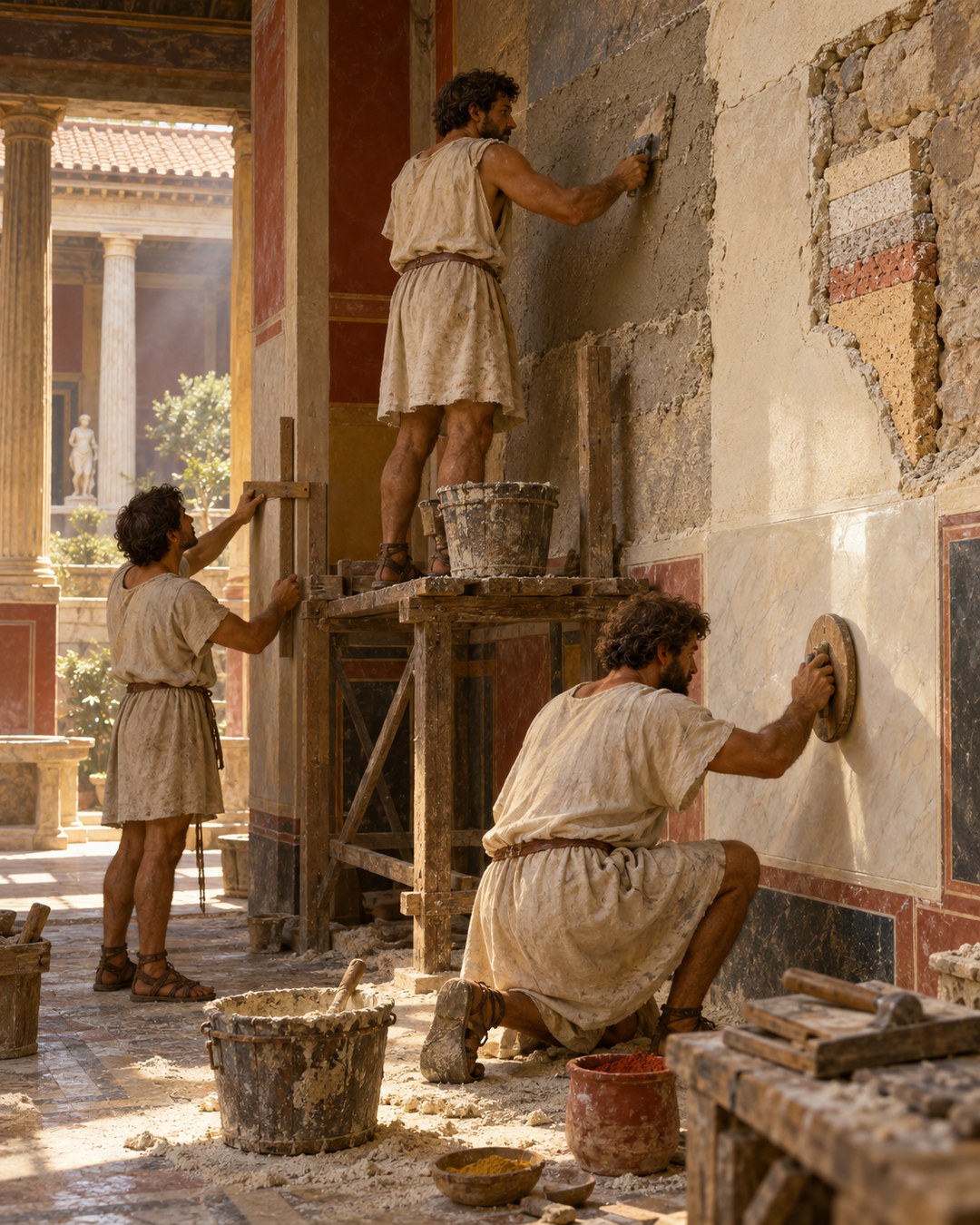
The polished surface was the last thing made and the first thing seen. Vitruvius asks his reader to begin somewhere less glamorous: with a rough wall, a drying interval, and mortar that must be ruled straight before any fine marble touches it.
In Book 7 of On Architecture, the finish grows through seven applications: an initial rough rendering, three coats of sand mortar, and three coats made with progressively finer marble. Each layer corrects, supports, or refines the previous one. The shine at the end is stored work.
This sequence explains why a Roman wall painting cannot be reduced to pigment on plaster. The visible image depended on thickness, timing, geometry, and the controlled movement of moisture through materials hidden beneath it.
The rough coat preserved a grip for everything above it
Vitruvius places the wall process after preparations for the vaulting. That order matters because overhead work could drip, strike, or load a finished surface below. The building operation had to proceed in a sequence that protected later labour.
The wall first received a rough rendering. Its job was not to look complete. Uneven texture created purchase for the sand mortar that followed, while the first coat began the transition between masonry and finish.
Vitruvius waits for this rendering to begin drying before the next application. A layer that is too wet can move under new weight; one that is too dry may fail to bond as intended. His wording records a practical window rather than a clock time.
The first sand coat was ruled in length and height. The craftsperson did not trust the eye alone. A straightedge translated the desired plane into the soft mortar, cutting high points and revealing hollows.
Right angles were tested at this stage as well. Corners that wander cannot be rescued cleanly by a final film. Geometry belongs near the base of the system, when enough material remains to correct it.
This emphasis on readiness differs from the test in which sticky lime warned a plasterer about incomplete slaking. Lime quality determines whether the material is safe to use; the seven-coat sequence determines how sound material becomes a straight finished wall.
Three sand coats built a plane that could survive drying
A second sand coat followed the first, and then a third. Vitruvius treats repetition as strength. The foundation of the stucco becomes more durable as the sand-mortar body grows solid.
Multiple coats do not mean applying the same thick mass in one gesture. Separate layers allow settlement and drying to be observed. A defect can be corrected before it is buried beneath finer, more expensive material.
Sand gives the body a granular skeleton. Lime binds it, but aggregate controls shrinkage and gives thickness something more stable than pure paste. Vitruvius does not offer a universal modern ratio in this passage, so the mechanism should not be turned into a recipe he did not state.
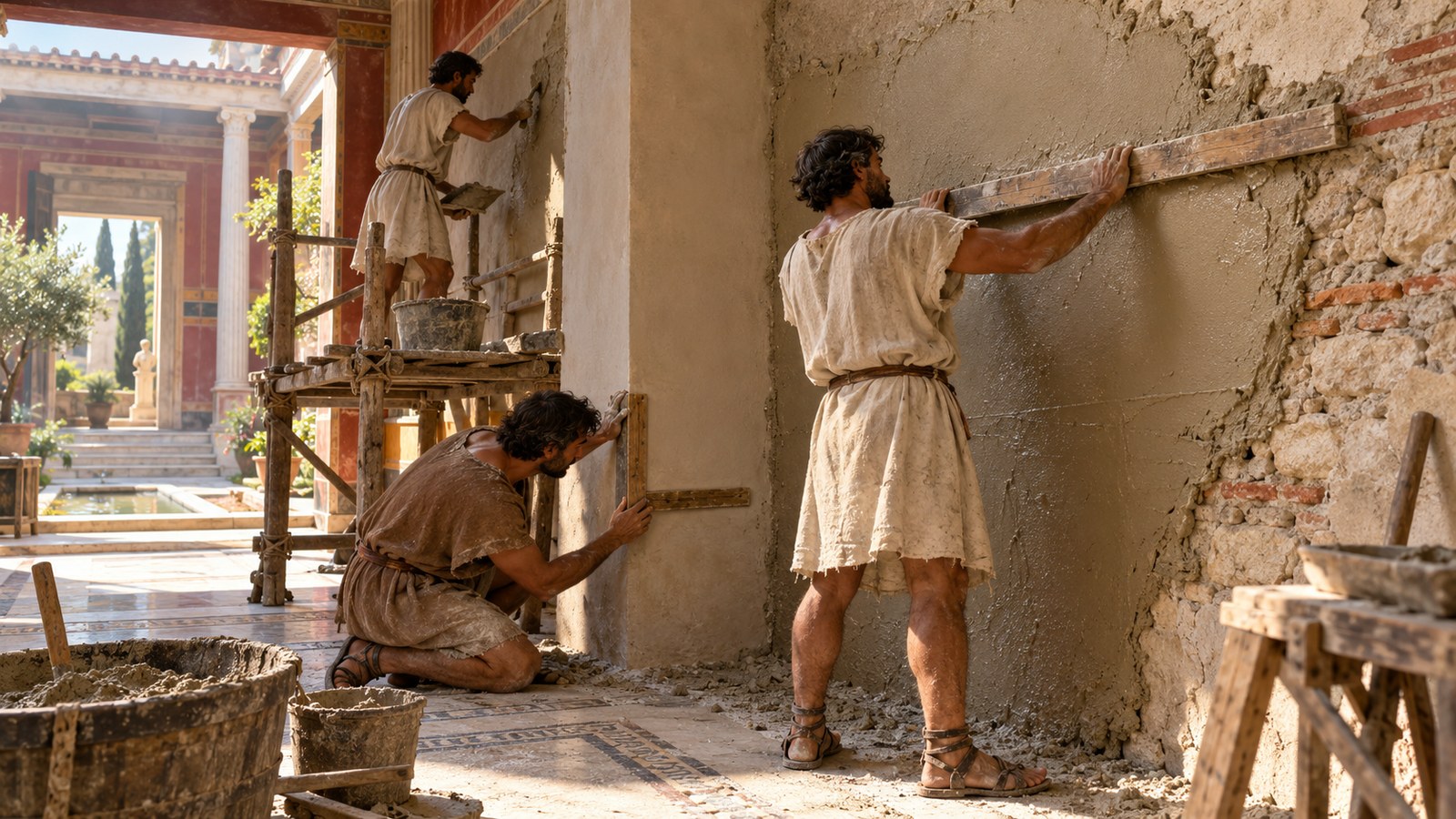
The three sand coats were allowed to dry before the first marble coat arrived. That boundary separates structural preparation from visible refinement. Moisture had to leave the deep body before denser finishing work sealed the face.
The waiting time was active quality control. Workers could watch for cracking, movement, or a line that no longer held true. The wall announced whether its hidden layers were ready to carry the next stage.
A thick base also spread local irregularities. Masonry joints, stone faces, and previous tool marks would otherwise telegraph through a thin finish. Repeated mortar created a new continuous plane over a discontinuous substrate.
Vitruvius’s criticism of cheap work confirms the point. One sand coat beneath one marble coat may look finished briefly, but it lacks the body needed to manage stress. The surface inherits every weakness below it.
Marble moved from grain to polish in three finer steps
The first marble coat did not use the finest possible powder. Vitruvius begins with grains that could still unite with the dry sand-mortar ground and establish a transition between coarse structure and fine face.
After that coat began to set, a second marble layer was applied. It too was ruled and polished. Straightness therefore remained a concern even while the texture became finer. Polishing did not replace geometry; it refined a plane already established.
The third marble coat used still finer material. Particle size changed as the worker approached the surface. Coarser grains provided body, while finer grains filled smaller voids and accepted a tighter polish.
Counting the rough rendering, the wall now held seven applications. Vitruvius specifically praises three sand coats and three marble coats above that first key. The number is not decorative symbolism in his explanation. It is accumulated material discipline.
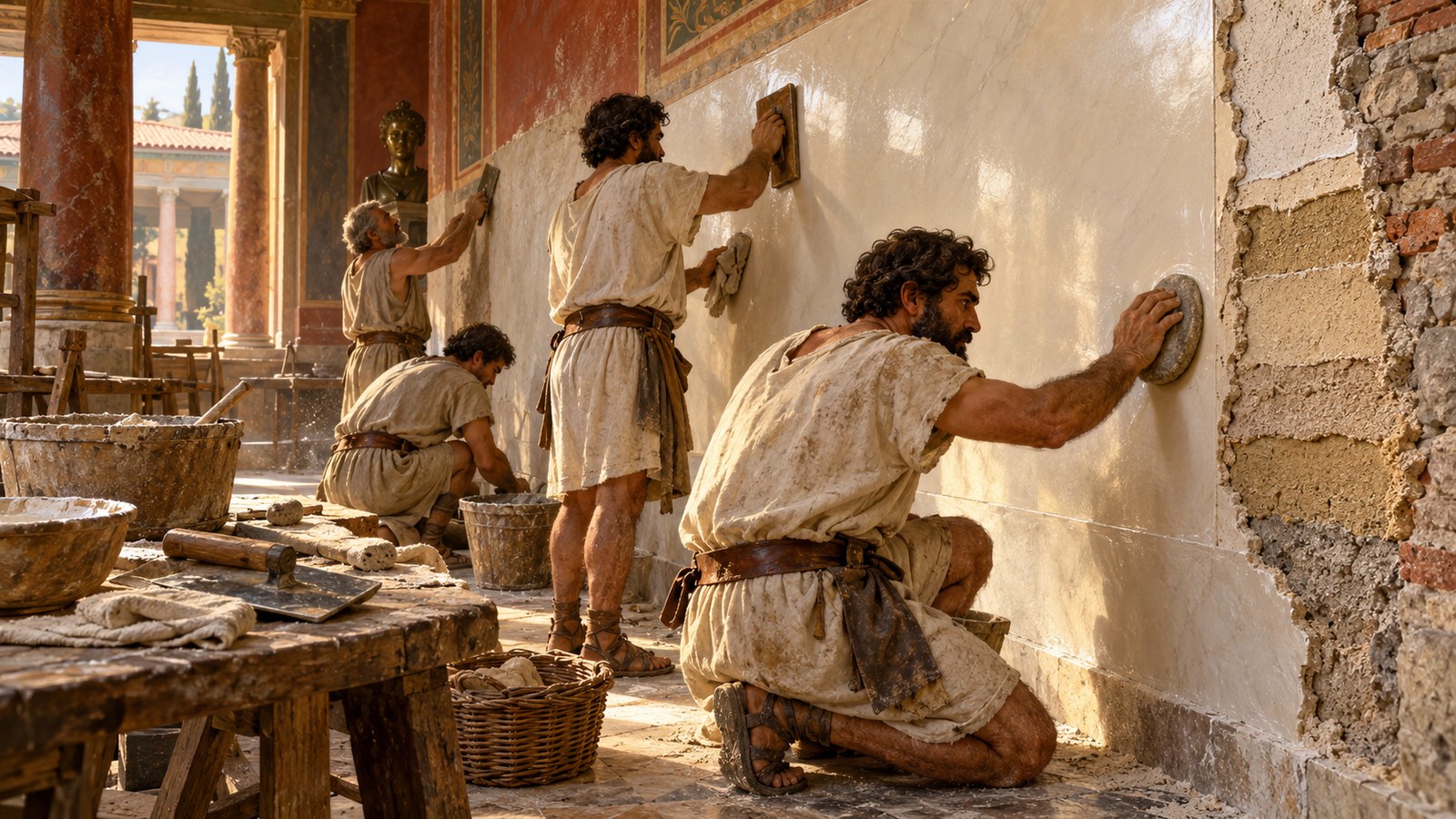
Polishing compressed and hardened the final material. A dense face reflects light more evenly than an open, torn surface, producing the brilliance Vitruvius associates with good work.
The process helps explain why the visible wall could feel unlike ordinary mortar. Marble was not merely painted as a colour. Its particles became the finishing matrix itself, worked until the surface acquired both hardness and sheen.
This finish later supported treatments such as the heated wax protection described for vermilion. Yet wax could not compensate for a weak wall. Surface protection works only when the coats beneath have already controlled cracking and moisture.
Moist lime carried colour into the finishing coat
Vitruvius links durability in painting to applying colours while the finishing coat remains moist. As water leaves lime, he says, pores open and take in the colours. His explanation belongs to ancient material theory, but the operational observation is clear: timing joined pigment to plaster.
Colour applied at the right moment did not sit as a completely separate skin. It became associated with the curing face, which made the painted surface more resistant to casual separation.
The sequence therefore coordinated two clocks. Deep coats needed enough drying to carry the next load, while the final coat needed enough moisture to receive colour. “Dry” and “wet” were not simple opposites; each stage required a different condition.
Vitruvius says the full build resists cracks and other defects. That is not a promise that every surviving wall was flawless or that seven is a magical guarantee. It is a construction argument: thickness distributed strain, repeated ruling corrected shape, graded particles reduced abrupt transitions, and polishing strengthened the face.
Thin work abandoned those safeguards. With only one sand coat and one marble coat, the wall readily cracked and could not acquire the same durable polish. Speed saved material and labour at the moment of construction, then transferred risk into the finished room.
The hidden coats also changed how we should look at Roman painting. A surviving patch is not just an image fragment. Its broken edge is a record of scheduling: rough key, structural mortar, drying intervals, marble refinement, colour, and polish.
The craft’s achievement was to make that complexity disappear. A successful wall presented one continuous luminous plane. Vitruvius restores the buried sequence, revealing that smoothness was not the absence of structure but the result of structure repeated carefully.
The sequence also organized labour and material cost. Coarse aggregate did the deep levelling before marble entered the work, so fine material was reserved for the thinner stages where its grain and polish mattered. Straightedges and squares checked the plane while correction was still possible; polishing came only after those decisions had been built into depth. If a corner was false or the sand body unstable, another bright pass at the face could conceal the error only briefly. The finished room therefore preserved a chain of inspections even when viewers saw none of them.
Sources
Vitruvius, On Architecture 7.3.