
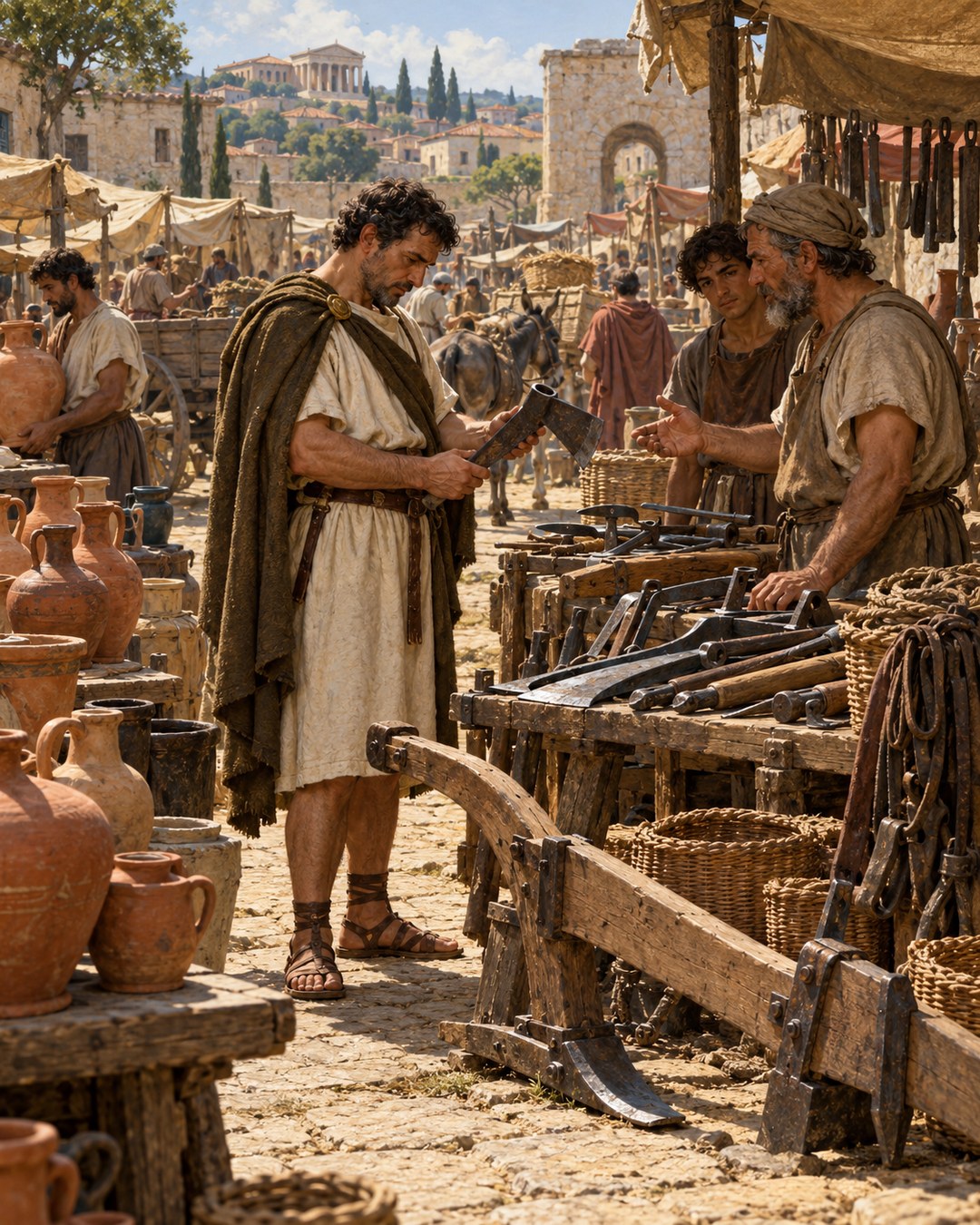
A Roman farm could grow olives, grapes, and grain without making every object it used. Cato the Elder’s procurement list sends the estate buyer out across Italy: clothes from Rome, iron tools from Cales and Minturnae, carts from Suessa and Lucania, oil mills from Pompeii or a particular yard at Nola, and rope from named specialists.
The list in On Agriculture 135 is easy to mistake for a heap of place names. It is better read as an operating map. Different soils called for different ploughs, different towns carried reputations for different wares, and a failed press rope could threaten the value of an entire harvest. Knowing where to buy was therefore part of knowing how to farm.
Cato does not describe a modern integrated market. He preserves a practical network assembled from roads, workshops, local materials, remembered reputations, and buyers capable of matching an object to its job.
Clothing and iron began the route at established markets
Rome heads the list for tunics, togas, blankets, smocks, and shoes. These were recurring needs rather than monumental purchases. Work wore out cloth and leather, and an estate needed replacement garments as surely as it needed seed.
For caps and a long range of iron equipment, Cato points instead to Cales and Minturnae. His group includes scythes, spades, mattocks, axes, harness fittings, ornaments, and small chains. The grouping suggests buyers could arrive with several needs and use a market already known for metal and farm gear.
Venafrum receives an even narrower recommendation for spades. Cato offers no explanation for its advantage. The value of the note lies in selectivity: he was willing to distinguish one town’s version of an ordinary tool from the wider iron market.
Procurement continued beyond hand tools. Carts and sledges should come from Suessa and Lucania; jars and pots from Alba and Rome; tiles from Venafrum. Heavy, fragile, and bulky goods appear beside clothing and iron. The estate had to calculate transport as well as quality, even though Cato does not preserve freight prices.
This is not the same question as the inventory that counted tools for a hundred-iugera vineyard. An inventory says what should be present. Chapter 135 asks where the buyer should look when those things must be acquired.
The route also guarded against an illusion of self-sufficiency. A productive villa could command land and labour while remaining dependent on distant furnaces, potteries, tanneries, rope makers, and vehicle builders.
Soil decided which plough belonged in the cart
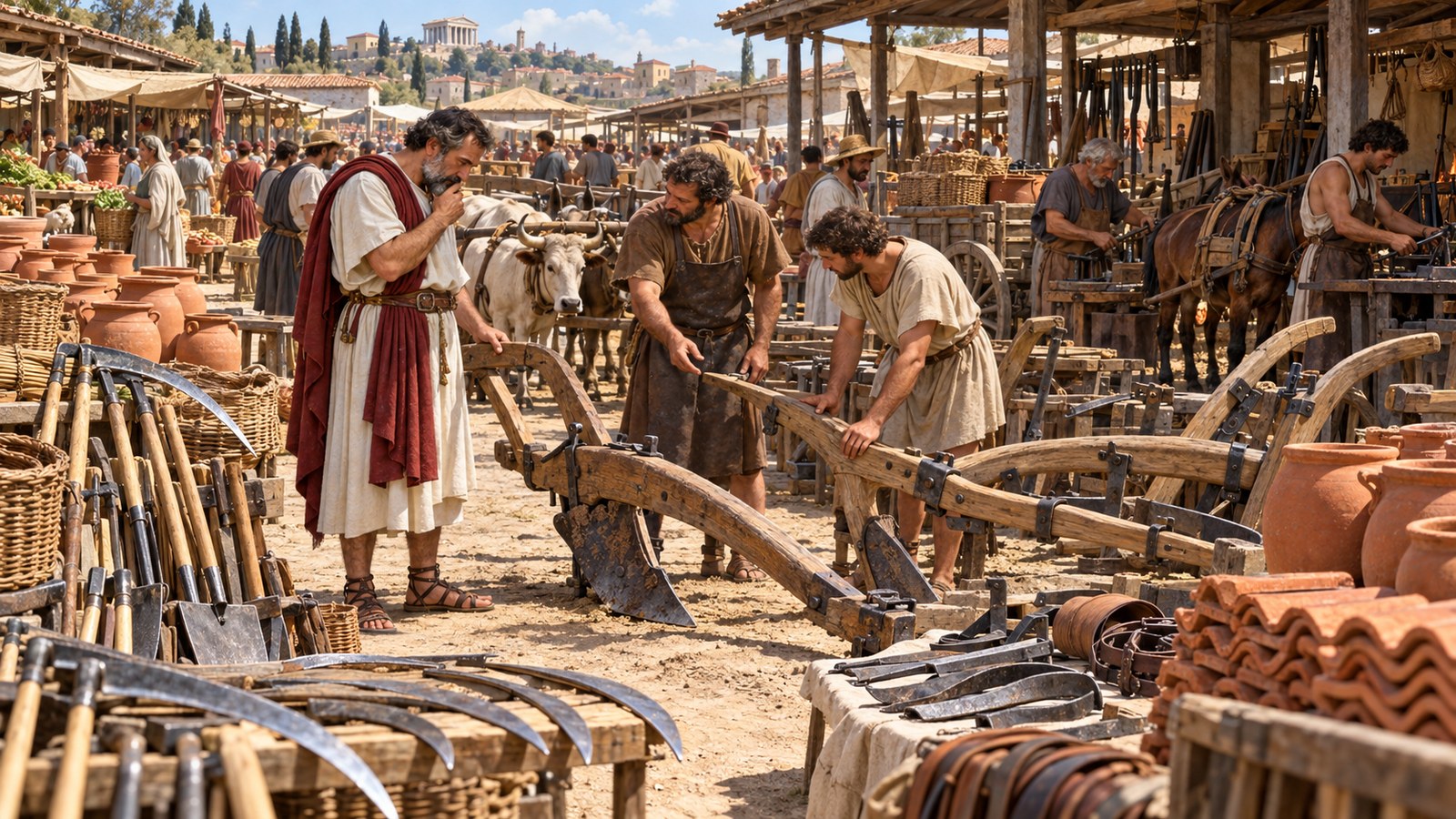
Cato does not treat a plough as a generic object. He recommends Roman ploughs for heavy soil and Campanian ploughs for black loam. The purchase had to begin with the field’s resistance, not with the prestige of the place name.
That small distinction reveals why specialist knowledge mattered. A tool could be well made and still be wrong for the ground. The buyer needed enough agricultural judgement to choose between regional forms rather than simply accept whatever a merchant offered.
Cato calls Roman yokes the best and favours detachable ploughshares. A detachable cutting part could be removed from the wooden assembly for replacement, repair, or sharpening. Modularity reduced the cost of failure because the entire implement did not have to be discarded when the working edge suffered.
The advice implies communication between field and market. Someone had to know which soil was being worked, what had broken, and which dimensions or fittings the replacement needed. Procurement was not detached from production; it translated field experience into an order.
Cato’s terse sentences omit the negotiations. He does not say whether the owner, overseer, tenant, or specialist agent travelled. He gives no season for the trip and no warranty. Those silences should remain. What survives is the decision structure: identify the task, select the regional form, then seek the market associated with it.
Even a familiar object therefore carried geographical information. “Roman” and “Campanian” did not merely advertise origin. In this passage they marked designs expected to behave differently when pulled through different earth.
Pompeii, Nola, and Capua supplied the harvest’s machinery
For oil mills, Cato names Pompeii and the yard of Rufrius at Nola. The second recommendation narrows trust from a town to a workshop. A buyer was not only following a regional reputation but a maker’s name.
Oil processing concentrated value and risk. Fruit could not wait indefinitely after harvest, and an ill-fitting or weak machine could slow the work when the crop demanded speed. Cato’s advice about where to buy a mill belongs to the same practical world as his one-finger clearance for olive millstones: small technical choices protected both machinery and produce.
Rome supplied nails and bars, while Capua and Nola supplied copper vessels. Cato names pails, oil urns, water pitchers, and wine urns among them. A farm processed liquids in quantity, and its metal containers had to survive carrying, heating, pouring, and repeated cleaning.
Capua also supplied Campanian baskets and cordage. Suessa and Casinum supplied baskets identified as Roman. Basketry rarely survives archaeologically as well as pottery or metal, yet the text places it firmly inside long-distance purchasing. Harvest and storage depended on woven containers that were light enough to move and cheap enough to use widely.
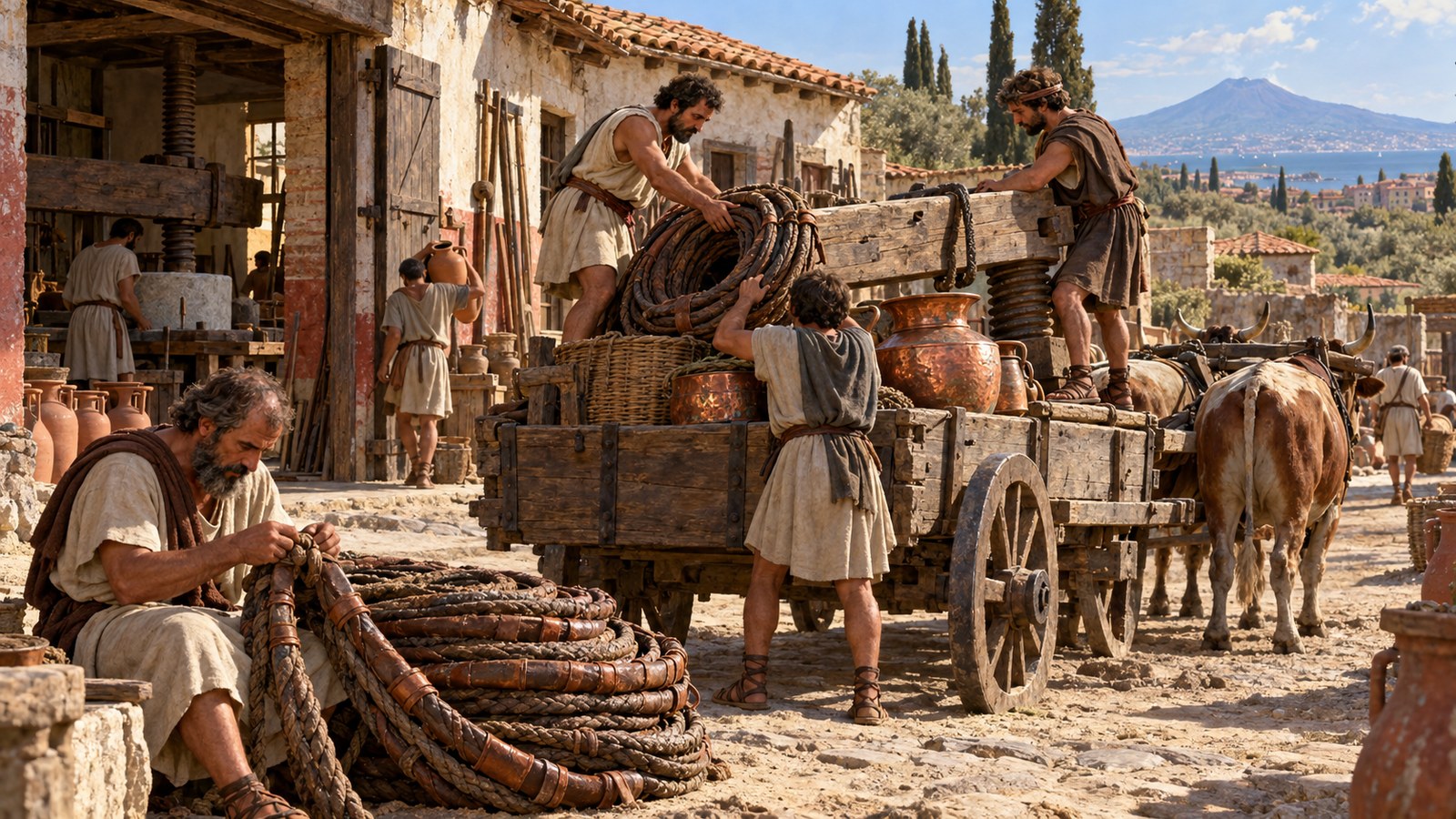
The list forms a chain rather than a single marketplace. One town might provide a cart, another the copper vessel it carried, and another the cordage used to secure the load. The estate assembled its equipment by combining products whose reputations had developed in different places.
Cato’s confidence also depended on repeated experience. A named yard becomes useful advice only if buyers can find it and if its output remains recognizable. Reputation substituted for inspecting every stage of manufacture.
A press rope carried its maker’s name and its own specification
The most detailed item is the press rope. Cato names Lucius Tunnius of Casinum and Gaius Mennius of Venafrum as makers of the best examples. Their personal names interrupt the geographical catalogue because this component demanded more than a town’s general reputation.
He specifies eight good native hides, freshly tanned and only lightly salted. They were to be rubbed with fat and dried. Each instruction concerns the behaviour of leather under tension: preservation mattered, but excessive salt, poor tanning, or neglected conditioning could compromise the material.
The rope was first laid out seventy-two feet long. It required three splices, and each splice used nine leather thongs two fingers wide. After twisting, the finished length became forty-nine feet. Three feet disappeared in fastening, leaving forty-six feet to work.
Those numbers turn reputation into verification. A buyer could know not only whom Cato trusted but what construction the delivered rope ought to embody. Length lost during twisting and fastening was expected rather than treated as evidence of fraud.
A press converted stored energy and leverage into pressure. Its rope could not be an approximate household cord. Failure during pressing would interrupt work, damage equipment, and endanger people close to the mechanism. The elaborate specification answers that concentration of force.
This final item clarifies the entire shopping list. Cato was not celebrating famous towns. He was reducing uncertainty. Regional specialization told a buyer where to start; named makers and measurements gave stronger checks where the consequences of failure were greatest.
The farm at the end of the route was therefore a composite achievement. Its fields were local, but its working capacity arrived piece by piece from Rome, Campania, Latium, and beyond. Agriculture depended on a map remembered in tools.
Sources
Cato, On Agriculture 135.