
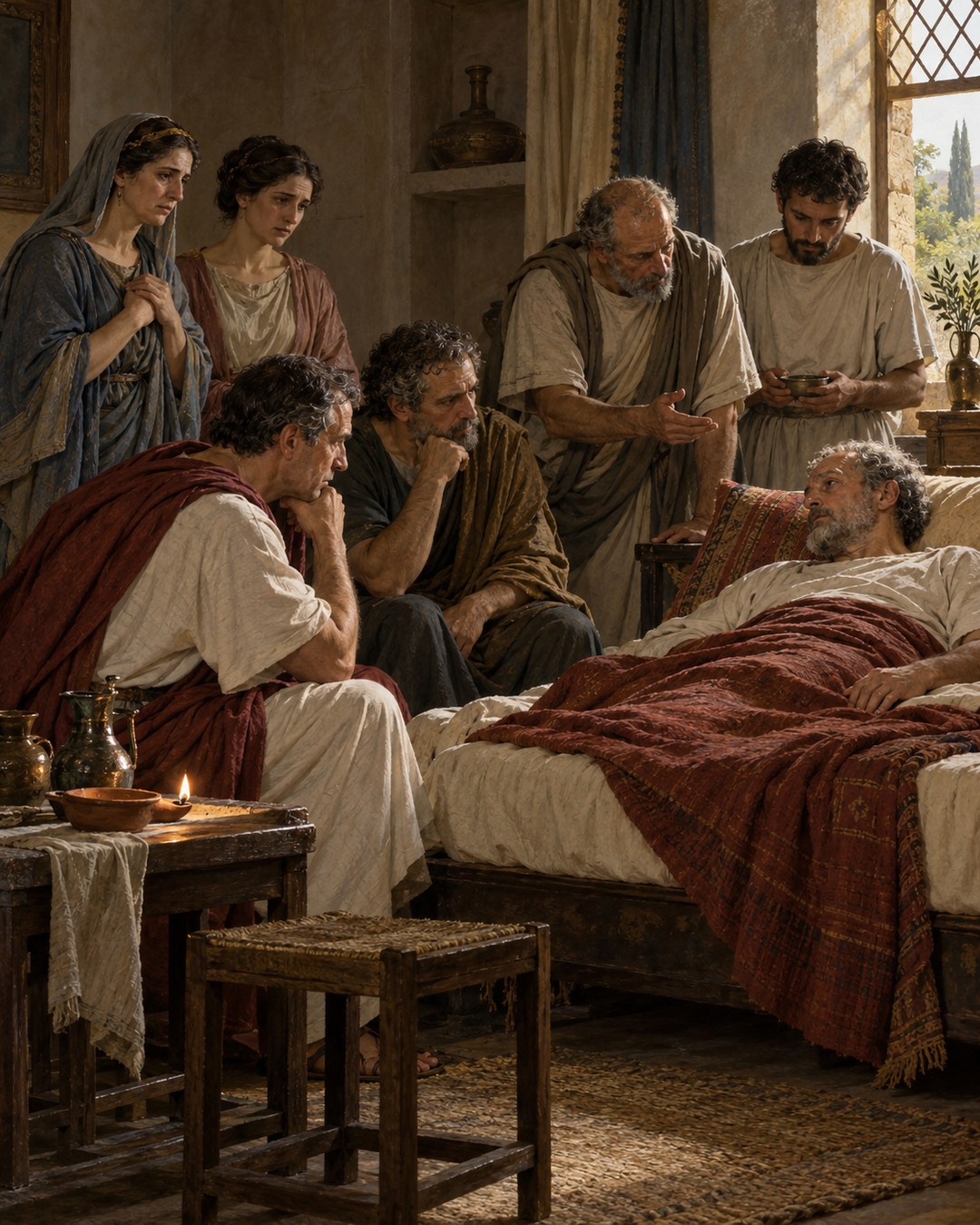
Pliny entered Titius Aristo’s room already knowing how his friend reached difficult decisions. Aristo understood a disputed point quickly, he says, but refused to answer quickly. He sifted opposing reasons, traced their consequences, and waited until judgment deserved confidence.
Illness turned that legal habit inward. Fever, thirst, and pain had confined the jurist to a couch. He called Pliny and a few friends close, then asked them to consult the physicians. If recovery was impossible, one course remained open; if hope survived, however difficult the road, his wife, daughter, and friends gave him reasons to endure it.
The letter is biography compressed into a sickroom. Pliny does not list triumphs. He shows a mind working under pressure, and he lets Aristo’s procedure connect scholarship, public usefulness, friendship, and the value of continued life.
Pliny trusted a mind that delayed its own certainty
Aristo appears first as a storehouse of difficult knowledge. Pliny praises his command of political and civil law, then adds history and antiquity. When a question became obscure, this was the person he sought.
Knowledge alone does not explain the admiration. Aristo grasped arguments rapidly but decided slowly. He tested each opposing reason and followed it outward toward consequences that a hasty answer could miss.
That combination made caution a strength rather than hesitation. A weak adviser delays because he cannot understand; Pliny’s Aristo delays because understanding increases the number of consequences that must be weighed.
The portrait also describes conversation. Aristo’s manner held sincerity and dignity without theatrical certainty. The point was not to win a debate at once but to leave a question more carefully judged than it had arrived.
This offers a different angle from the governor’s letter that turned trials into an imperial procedure. There Pliny sends uncertainty upward to Trajan. Here he remembers a jurist whose authority came from keeping uncertainty in view long enough to examine it.
Pliny makes method inseparable from character. Temperance in judgment prepares the reader to recognize temperance in food, clothing, and pain. The sickroom is not a sudden test imposed on an otherwise unknown man; it is the severe extension of a lifelong pattern.
Plain clothes placed a jurist inside active Roman life
Aristo ate frugally and dressed plainly. When Pliny saw him reclining in his room, the scene suggested ancient simplicity. Yet the praise avoids turning simplicity into withdrawal.
Aristo did not spend his life performing philosophy in gymnasia or porticoes, nor did he fill leisure with endless controversy. Pliny places him in civil and active life. He helped many through influence and more through advice.
The distinction matters because plainness can be staged. A rough garment may become another way to demand attention. Pliny insists that Aristo did not locate happiness in display or seek a noisy public reward for virtue.
His room therefore carried no dramatic philosophical scenery. A couch, plain clothing, and a sick body were enough. The force came from the record of decisions made for others and the quiet standards by which he measured himself.
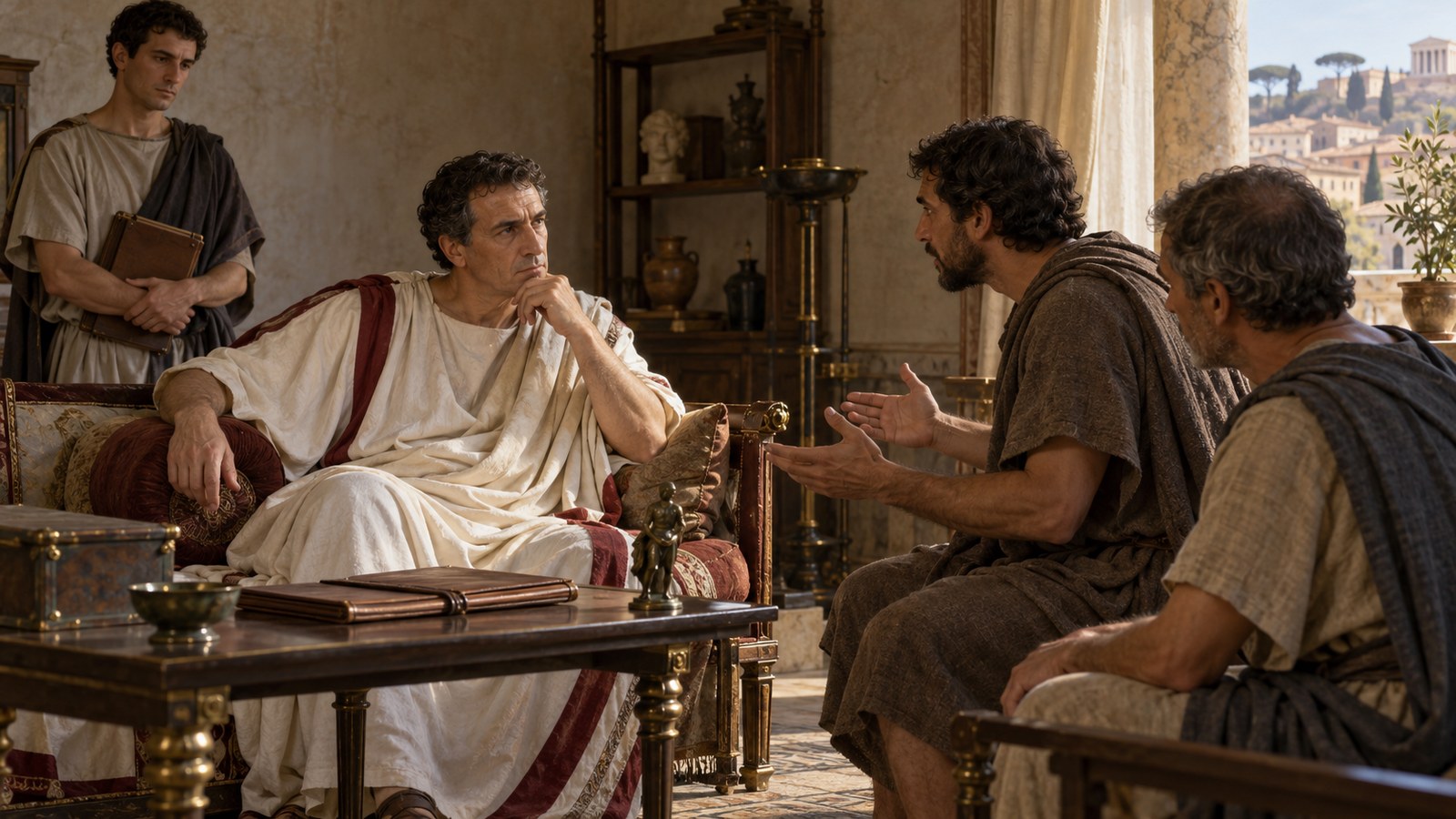
Advice also made Aristo useful beyond any single office. A legal mind could travel through the questions carried into the room: property, obligation, procedure, family, and public duty. Pliny does not inventory specific cases in this letter, so their details should not be invented. He records reach instead—many assisted by standing, still more by counsel.
The active-life contrast keeps the portrait Roman. Philosophy is tested not by isolation from civic pressure but by conduct inside it. Justice, courage, restraint, and piety become habits visible in service.
When illness removes Aristo from that network, Pliny feels more than private fear. A concentration of knowledge and judgment is in danger. The possible loss belongs to friends, petitioners, and the civic world that had relied on his measured answers.
The physicians supplied evidence for an irreversible choice
Aristo’s illness brought sustained pain, thirst, fever, and heavy coverings intended to make him perspire. Pliny admires his patience, but endurance by itself does not settle what should happen next.
The jurist called Pliny and a few close friends to his bedside. Their task was concrete: ask the physicians what course they expected the disease to take. Aristo wanted a prognosis before choosing.
He divided the future in two. If the illness was incurable, he contemplated voluntarily ending his life. If recovery remained possible, no matter how long or difficult, he would wait.
The line did not run between pain and comfort. He was already in pain. It ran between hopelessness and a remaining prospect of recovery. Medical judgment would establish which side of that boundary the illness occupied.
Family and friendship entered the balance. His wife and daughter had pleaded with him, and his friends joined them. Aristo thought he owed them persistence while their hope was not entirely desperate.
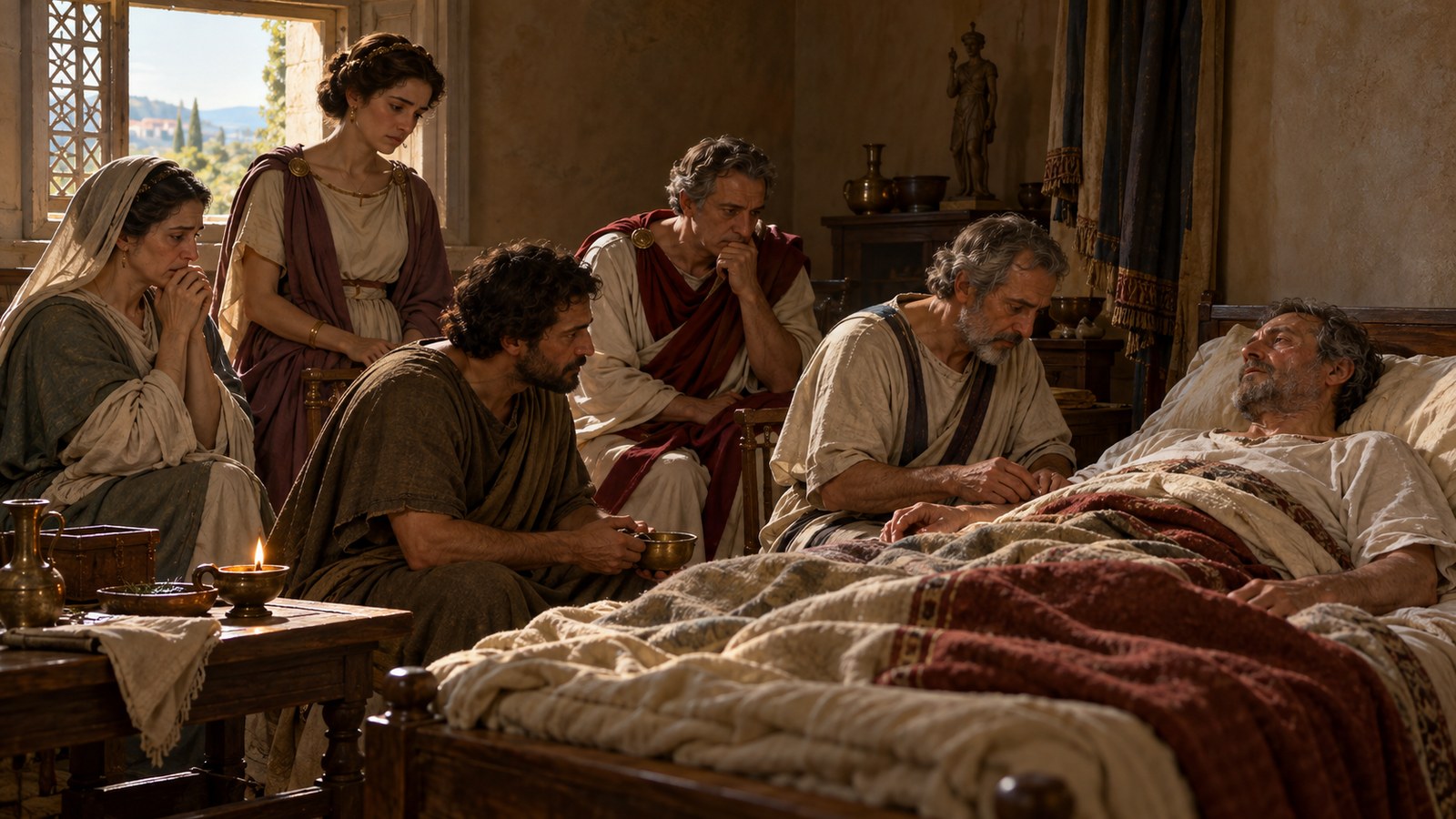
This is why Pliny calls the resolution heroic. A sudden rush toward death could be impulse. To weigh reasons for life and death, then let the stronger side determine conduct, required the same discipline he admired in legal judgment.
The letter should not be flattened into a general Roman rule. It records one educated man’s deliberation as represented by an anxious friend. Its specificity is the point: physicians, a wife, a daughter, close companions, and a prognosis all shape the choice.
Pliny’s interrupted routine reveals the cost of waiting
The physicians eventually offered a favourable opinion. Pliny clung to it and hoped events would confirm their promise. The answer did not instantly restore Aristo, but it changed the moral situation by leaving recovery possible.
Waiting had already reorganized Pliny’s own days. Attendance on his friend and anxiety about him consumed both time and thought. He lacked not only leisure for reading and writing but the inclination to attempt them.
That admission gives the polished portrait an unfinished edge. Pliny normally constructed work from disciplined intervals; even the noise of Roman racing could become a setting for chosen books. Aristo’s fever broke that capacity to turn circumstance into study.
Pliny imagined returning to Laurentum, his papers, and his books once his mind became easy. The plan belongs to the future because friendship has suspended his ordinary control of time.
The letter thus contains two kinds of deliberation. Aristo weighs whether the evidence justifies continued endurance. Pliny weighs nothing successfully; fear has occupied the space where work usually happens.
That asymmetry keeps the tribute human. Aristo looks composed because the person describing him is not. The patient submits his decision to evidence, while the visitor asks his correspondent to write back in a happier strain and lend him another mind’s calm.
A conventional biography might have arranged offices, ancestry, and honours. Pliny arranges law, plain clothing, civic advice, fever, physicians, and family. The sequence makes character visible as a method used repeatedly when no answer is cheap.
Aristo’s sickbed becomes a final court only in the limited sense that reasons must be heard there. No crowd applauds, and no decree is carved. The judgment remains provisional while medicine leaves room for hope. For a man praised as slow to decide, that waiting is not weakness. It is consistency.
Pliny’s praise is interested in restraint at every scale. Aristo restrains the urge to answer a case too soon, the urge to turn plain habits into display, and the urge to make pain alone decide an irreversible question. The same discipline appears in counsel, clothing, civic service, and endurance.
Sources
Pliny the Younger, Letters 1.22.