
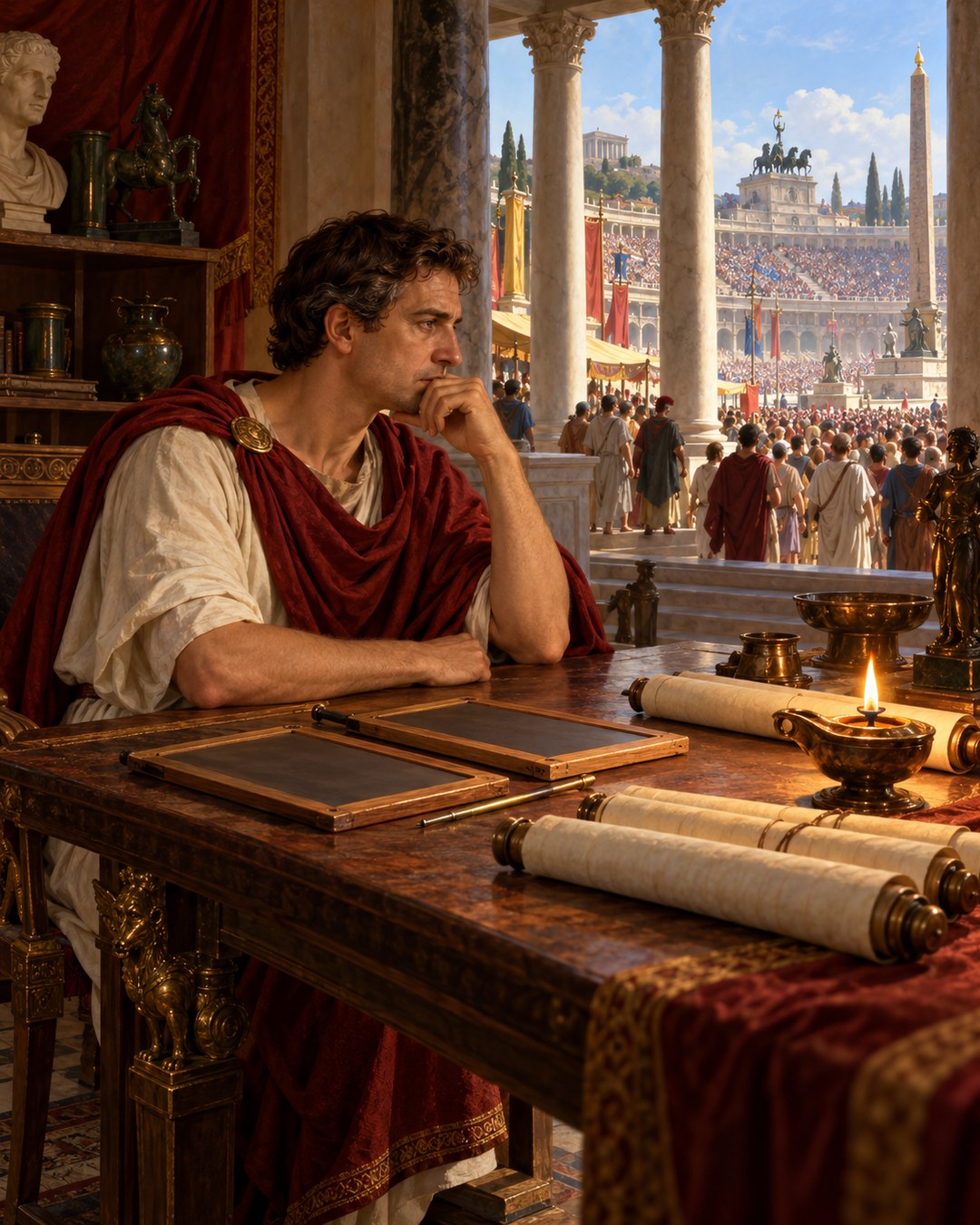
Rome had filled the Circus, but Pliny the Younger was pleased to be elsewhere. In a letter to Calvisius, he placed himself among tablets and books while the Circensian games occupied many thousands. The contrast was not accidental scenery. It was the point of the letter.
Pliny did not merely say that racing bored him. He proposed a test of the spectators’ loyalty. Change the racing colours in the middle of the course, he claimed, and the crowd would transfer its partisanship even while familiar horses ran and named charioteers bent over their cars. Whether the experiment could ever have happened was irrelevant. As an argument, it let him reduce a vast spectacle to a strip of dyed cloth—and elevate his own quiet reading above it.
Quiet entered through a noisy calendar
The letter begins with an apparent contradiction. How could Pliny be spending uninterrupted time with his books in Rome? His answer was that the games were on. The event that drew others out created privacy for him. Public excitement cleared the space around private study.
This framing makes the race meeting useful before Pliny has described a single lap. He converts the crowd’s absence into literary leisure. Rome has not become quiet, but his corner of it has. The city’s schedule divides people according to appetite: thousands move toward horses and drivers; one senator represents himself staying with texts.
The recipient, Calvisius, is made to ask the opening question. Pliny thereby stages his explanation as a reply rather than a boast delivered without invitation. Yet the self-portrait is carefully arranged. He can work because he does not share the attraction that interrupts other lives.
That distinction should not be mistaken for a full picture of the Circus. We hear no spectator explain why a race mattered. Every enthusiasm reaches us through a writer committed to disliking it. The letter is excellent evidence for Pliny’s elite rhetoric and his perception of faction loyalty. It is not an opinion poll.
Repetition was the point he refused
Pliny’s first objection was sameness. He found no novelty, no variety and nothing that anyone should wish to see twice. Horses ran repeatedly; charioteers repeatedly leaned over their cars. He saw recurrence where spectators presumably saw a new contest.
The disagreement concerns attention. A person uninterested in racing can collapse many starts, turns and finishes into one repeated motion. A committed follower distinguishes competitors, positions, risks and outcomes. Pliny knew that spectators recognized drivers from afar and shouted their names, so he could not honestly portray them as seeing nothing. Instead he argued that what they saw did not explain what they loved.
An inscriptional career gives a very different view in the record of Diocles and his 1,462 victories. There, categories of victory and tactical choices make races legible as work and achievement. Pliny strips those distinctions away because his target is less a driver than the appetite that keeps bringing the audience back.
His comparison of grown men with children sharpens the insult. Repetition becomes not expertise but immaturity. The language tells us how he wanted Calvisius to value the scene, not what every observer necessarily experienced.
Faction colour displaced driver and horse
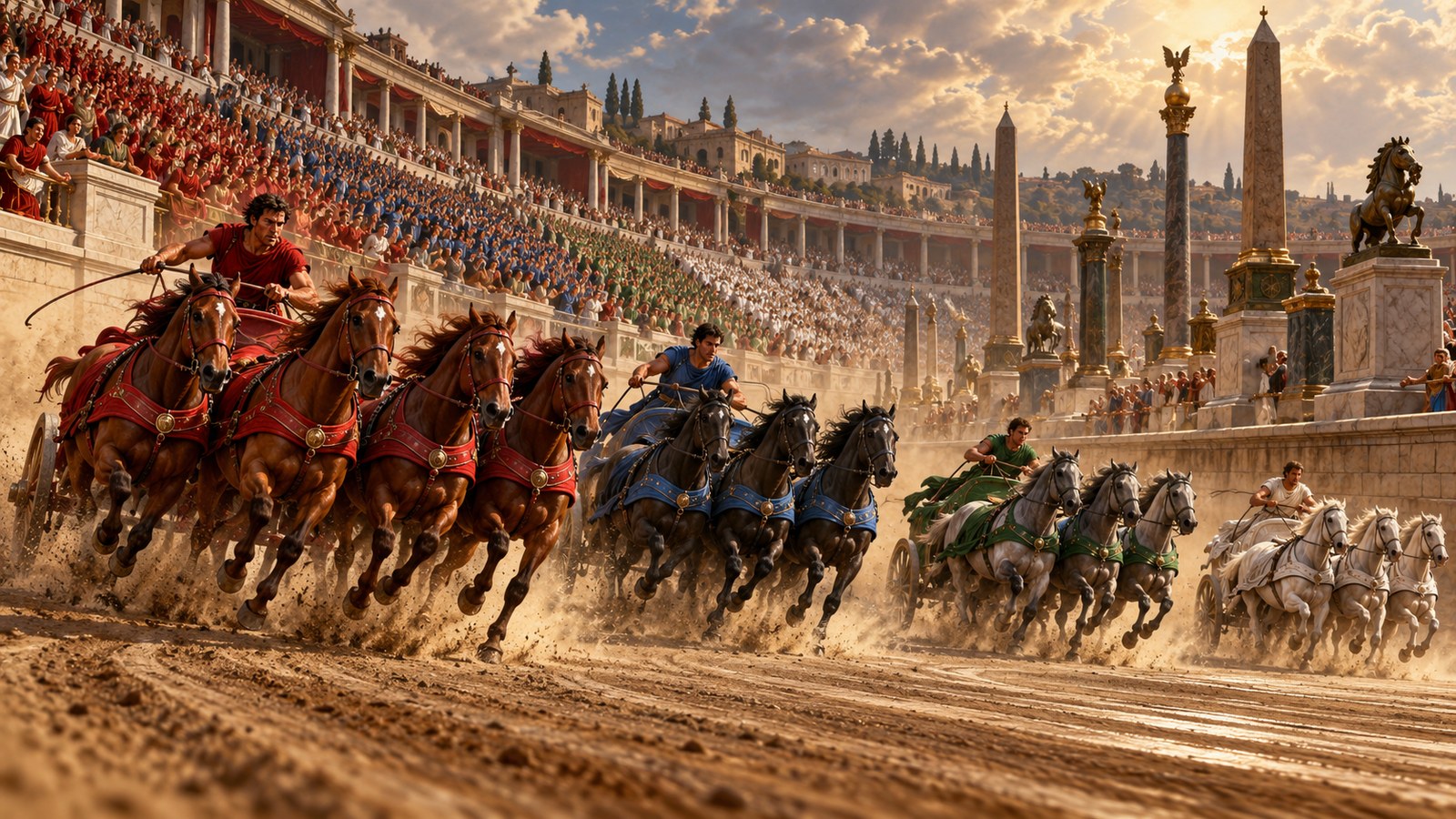
Pliny conceded that speed or driving skill could provide a reason for enthusiasm. The concession gives him a standard of merit before he denies that merit governs the crowd. In his account, racing colours command affection. The visible faction marker organizes loyalty more powerfully than the individual qualities of animal or driver.
His imagined mid-race exchange is the letter’s decisive device. Let the colours switch while the contest is underway. He predicts that partisanship will switch too. Spectators who can recognize charioteers at a distance and shout their names would immediately desert both drivers and horses.
No actual colour exchange is recorded in the letter. This is a thought experiment, and it should be read as one. It isolates the variable Pliny wants to blame. The drivers remain; the horses remain; only the tunic changes. If allegiance follows the cloth, then personal recognition has been subordinated to faction identity.
The argument works because colour is small and conspicuous. A tunic can be called cheap as material while functioning as a powerful public signal. Pliny marvels at its influence and authority. His contempt therefore contains an admission: an inexpensive visible marker could organize feeling across an enormous audience.
Elite boredom became a social judgment
Pliny first mocks the common crowd, then refuses to leave the criticism there. Men of position were also caught by the colours. Status did not protect them from long hours of partisanship. That extension lets the writer present taste as a better distinction than rank.
The move is important for his own persona. If only the poor or socially marginal attended, staying home would prove little. By including prominent men, Pliny makes his indifference into a chosen quality. He is not merely unable to enter elite company at the Circus; he declines a pleasure that reaches his peers.
His vocabulary grows deliberately severe. The sport is fruitless, cheerless and tedious. Spectators can sit for a long time without tiring, while the same duration looks to him like wasted life. Endurance becomes evidence against them because it shows how completely the attraction holds.
Roman spectacle could also transform urban routines far beyond racing. The foxes released in the Circus for Ceres belonged to a different ritual story, but that episode likewise reminds us that a Circus event could carry meanings invisible if every gathering is flattened into generic entertainment. Pliny intentionally performs that flattening here. It serves the moral contrast he wants.
The race meeting gave him a private victory
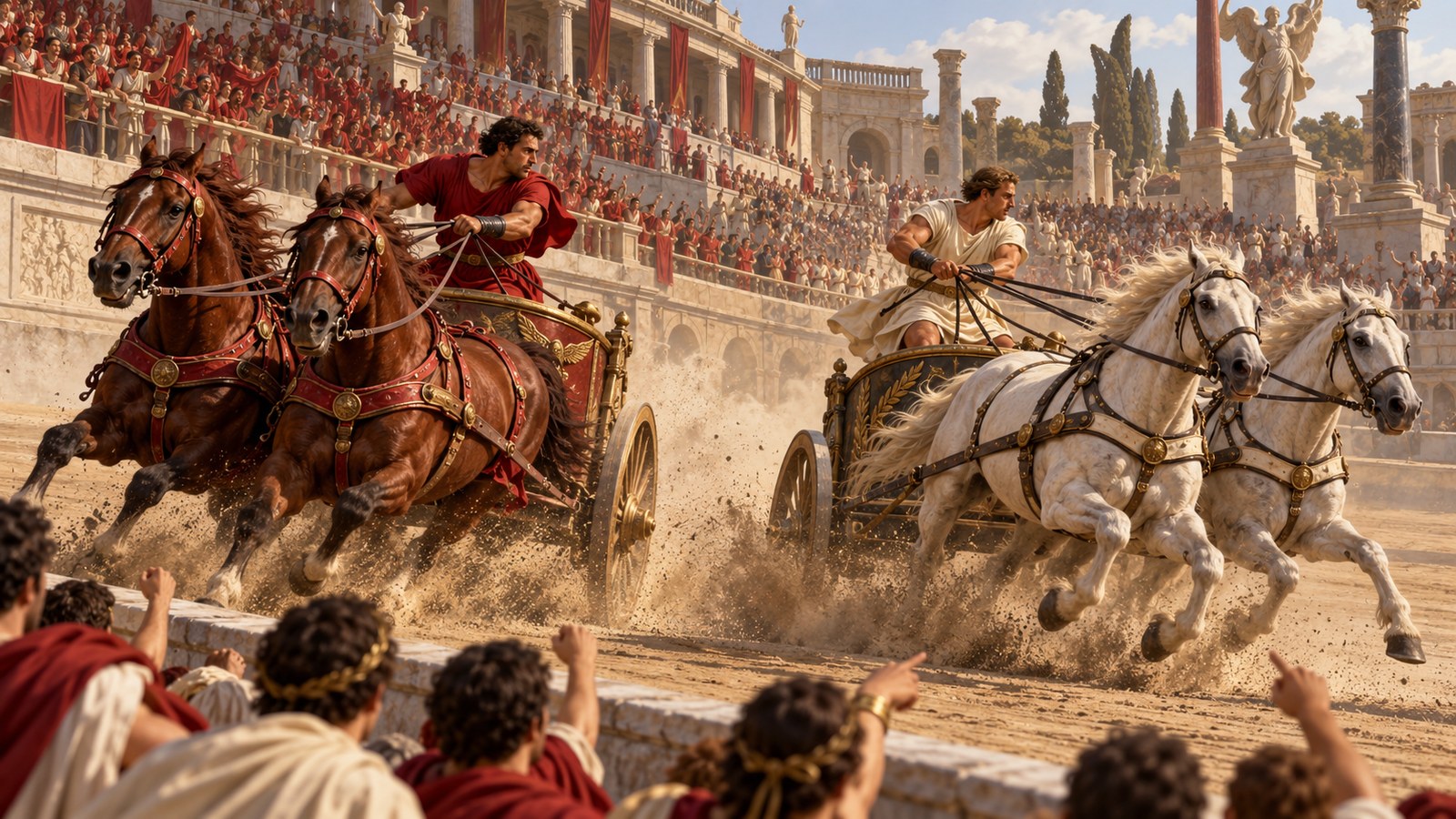
The letter closes where it began, among books. Pliny takes pleasure in the fact that the crowd’s delight has no charm for him. Their days at the meeting become the condition for his productive leisure. He claims the better use of time and the better object of attachment in one movement.
There is more social competition in that serenity than the quiet surface admits. Pliny needs the spectators as a foil. Their noise, duration and transferable loyalties make his reading look stable, selective and free. The books do not simply occupy him; they certify the identity he prefers to display to Calvisius.
His thought experiment also reveals why faction could survive individual careers. If colour remained the primary object of loyalty, a driver could be replaced without dissolving the community that cheered. Pliny offers that continuity as proof of irrationality. From another angle, it describes the organizational strength of a symbol that outlasted particular performers.
The letter cannot tell us whether every fan would really have switched allegiance with a tunic. It can show that an elite observer found the possibility plausible enough to carry his argument. He noticed names being shouted and colours being loved at the same time, then arranged those observations into a hierarchy: skill would be reasonable, colour was not, books were better.
That hierarchy is the real finish line. No race result appears. No victor is named. Pliny wins the comparison because he controls the page, giving the crowd repetition and himself reflection. The Circensian games remain outside his room, yet they supply the very material with which he defines what happens inside it.
Sources
Pliny the Younger, Letters, 9.6.