
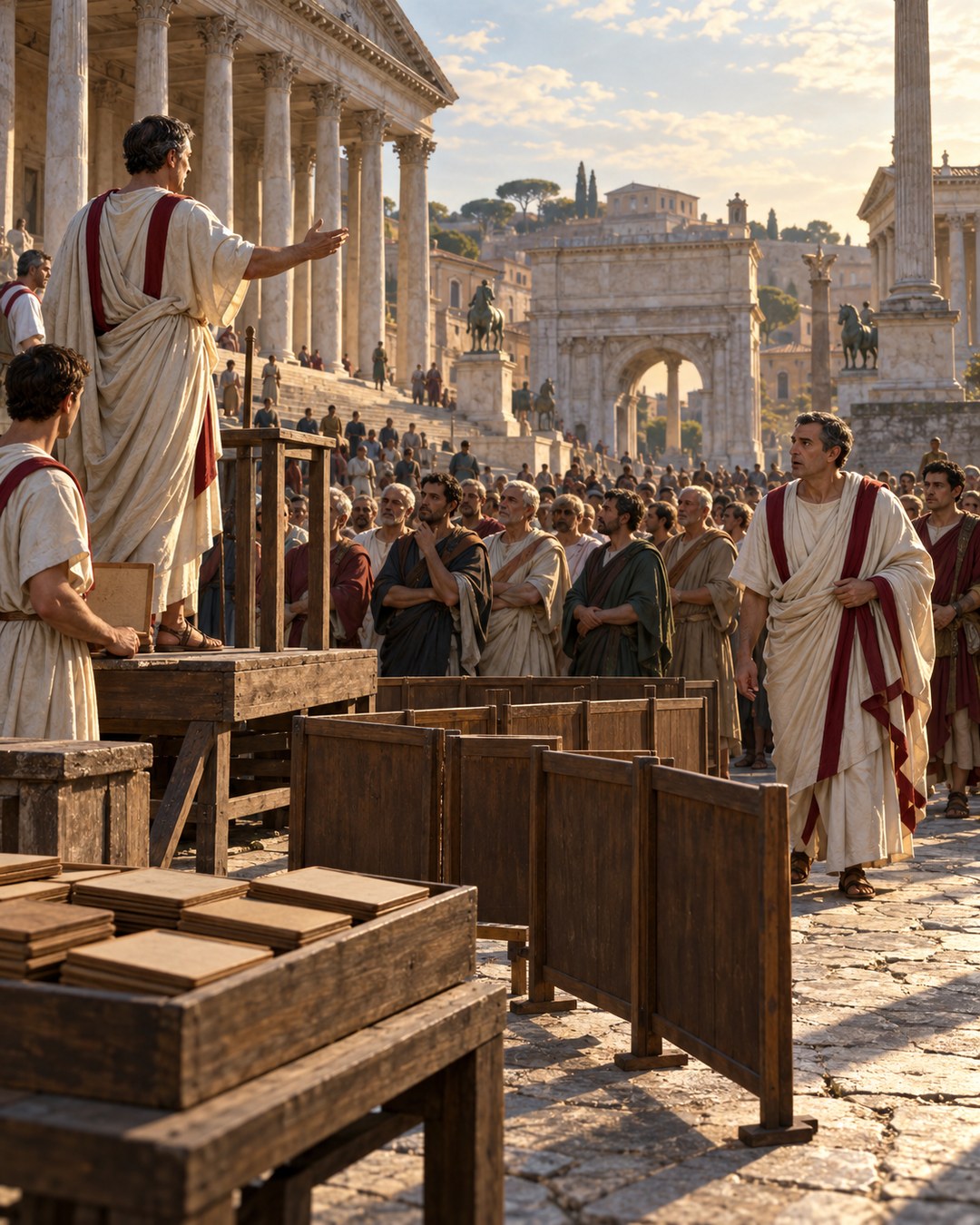
A Roman crowd could listen to several magistrates at once, but it could not be asked to make the same civic decision twice. Aulus Gellius preserved the distinction through two phrases that look similar in translation: addressing the people and treating with the people.
The difference was a vote. Speech without a measure could coexist with other speech. Once a magistrate asked citizens to order or forbid something, stricter rules of rank, priority, and interruption applied.
Messala’s procedural note reveals a city trying to manage overlapping authority before overlap became contradiction. The event was defined not merely by who gathered, but by what the gathering was empowered to do.
A consul could break into any magistrate’s meeting
Messala begins with hierarchy. A consul could call the people away from any magistrate, whether they had assembled for an election or for another public purpose. The consul’s authority to interrupt stood at the top of the arrangement described.
A praetor possessed a broad but subordinate version. He could call the people away from an election or another assembly, but not from a consul. Rank therefore shaped whose business could displace whose.
Lesser magistrates had no comparable power to call the people away. Their meetings were protected from each other not because every minor office was supreme, but because equal-level competition needed a priority rule.
Messala’s language treats public attention as a finite civic resource. A crowd capable of voting cannot simultaneously complete incompatible formal acts under rival presiding officers.
This differs from the old division between a tribune’s power to arrest and the missing power to summon. That problem separates legal tools attached to an office. Messala’s problem coordinates several officeholders trying to use the same electorate.
The hierarchy did not mean every public speech required exclusive control. The decisive question was whether the magistrate had moved from speaking to asking for an authoritative answer.
First summons protected the lesser magistrate
When lesser magistrates competed, the one who first summoned the people to an election had the law on his side. Timing supplied the order that rank could not.
The rule prevented one minor magistrate from calling the assembly away from another. It also served the broader principle Messala states: the same action could not lawfully be taken twice with the people.
Priority here is procedural, not a declaration that the first proposal must win. It decides who may validly put the matter before the citizens. The electorate still supplies the order or prohibition through voting.
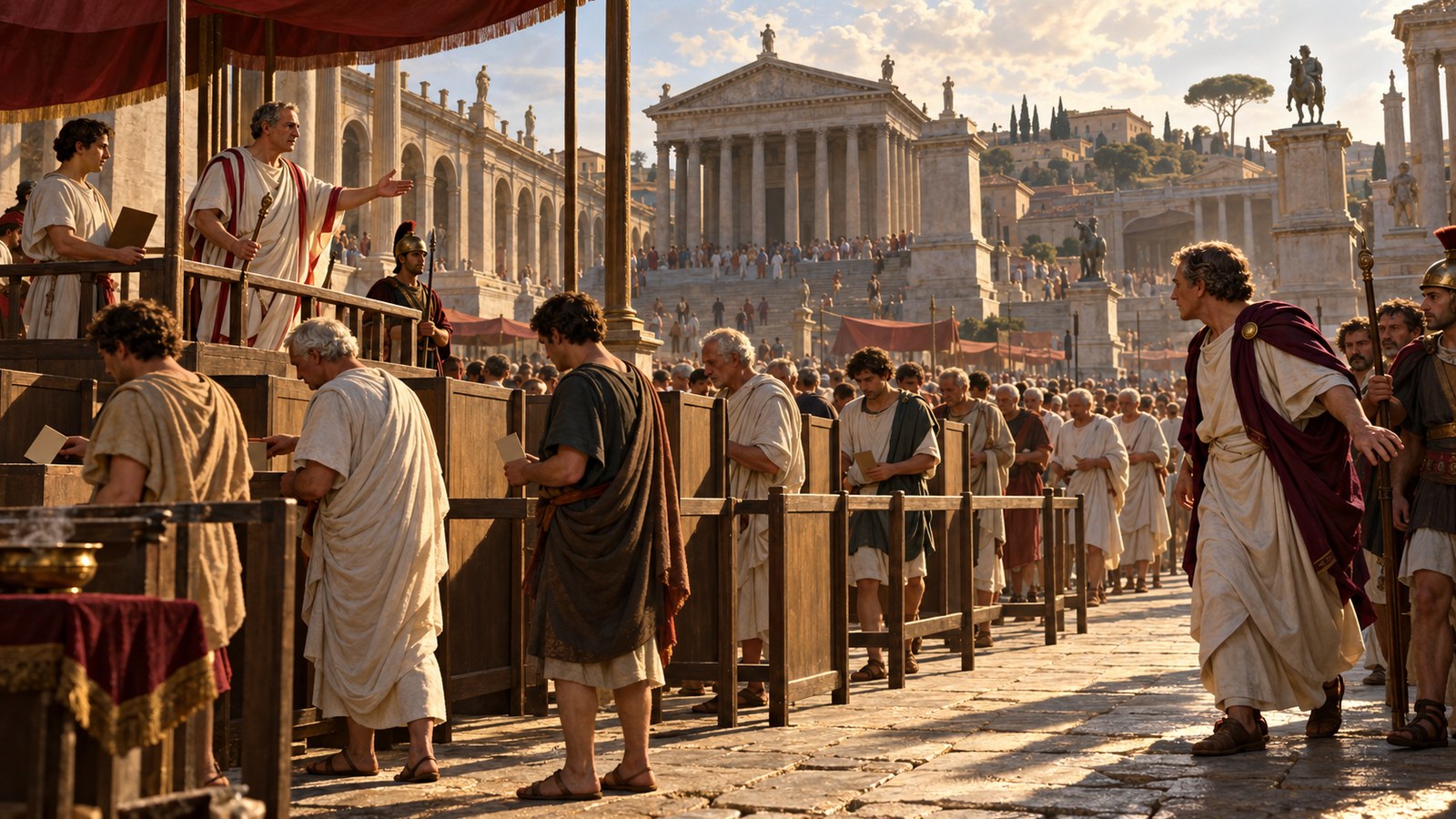
The rule also reduces ambiguity after the event. If two equal magistrates could conduct the same action at once, rival groups might later claim that each result represented the people.
Messala does not give Gellius a narrative of a disputed election in this chapter. He gives him a classification capable of preventing one. That makes the prose dry, but the mechanism consequential.
Roman public life often depended on visible sequence: who called, who presided, what question was put, and whether the citizens were merely hearing words or giving a binding response.
A speech left room for simultaneous crowds
The restriction relaxed when no measure was laid before the people. Any number of magistrates could hold meetings at the same time if they were only addressing citizens.
Gellius extracts the definition. To treat with the people meant asking something that they would order or forbid by votes. To address the people meant speaking without placing a measure before them.
The same physical elements could appear in both scenes: a magistrate, citizens, a public place, and political argument. Legal character came from the requested act.
A speech could persuade, accuse, warn, or prepare opinion. It might change what citizens later did. Yet without a formal question for decision, it did not trigger the same exclusivity rule.
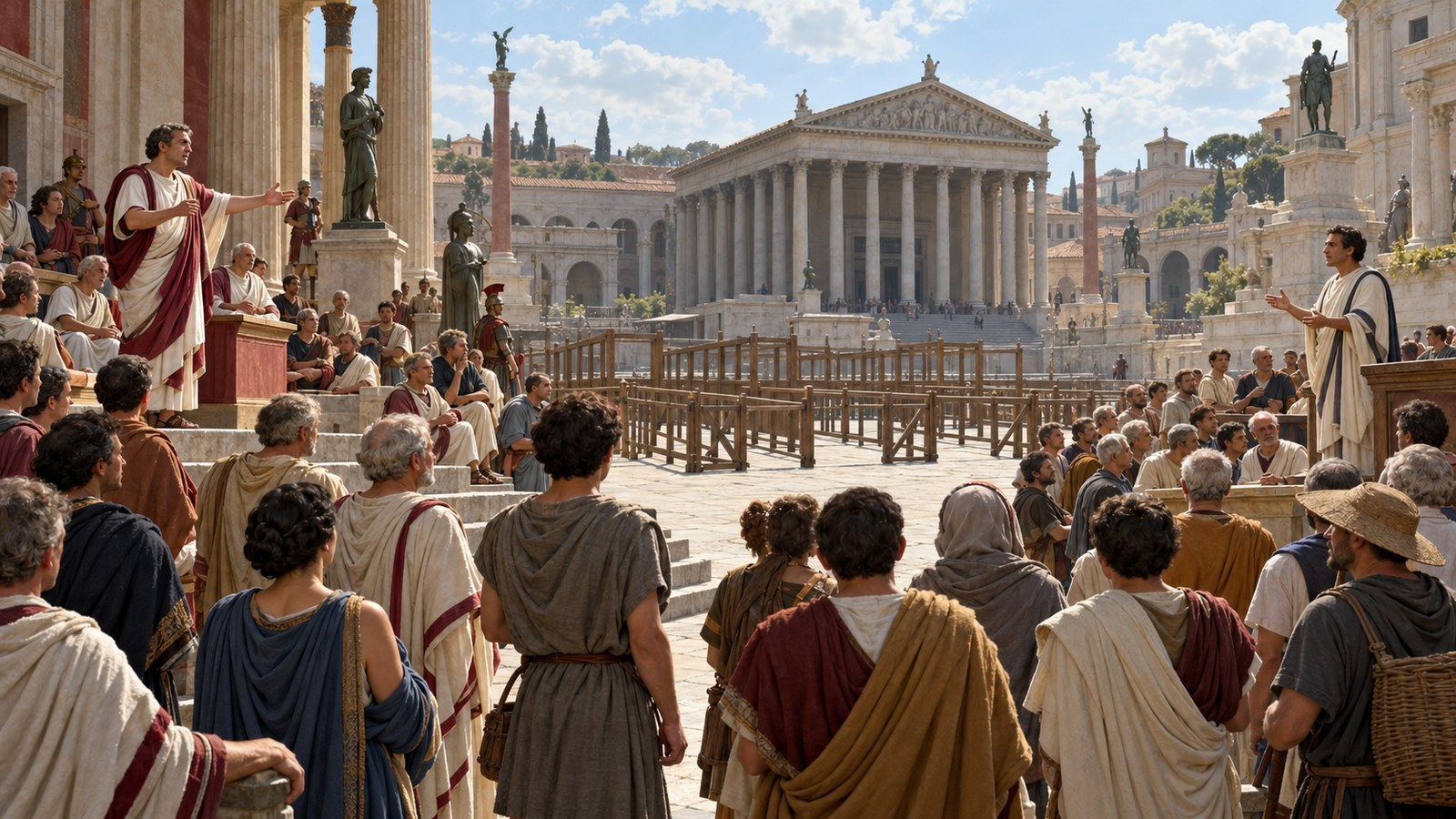
This distinction helps explain why a city full of political speaking did not treat every cluster of listeners as one competing assembly. Procedure marked the threshold between influence and decision.
It also prevents modern vocabulary from flattening the event. “Assembly” can describe the people gathered, but Messala asks what operation is occurring inside the gathering.
The nearest comparison is the later dispute over written ballots and the behaviour they encouraged. Ballot design concerns how a decision is expressed. Messala first asks when a speech has become an occasion for decision at all.
The electorate was an institution, not only an audience
Messala’s definitions make citizens appear in two capacities. As an audience, they may hear several magistrates. As the voting people, they order or forbid and must be approached through a controlled procedure.
The difference protects more than administrative tidiness. A binding act needs an identifiable question, presiding authority, and sequence. Without those, political energy could be mistaken for a lawful decision.
Rank and priority solve different conflicts. Consular and praetorian authority establish hierarchy between unlike offices. First summons settles competition where lesser magistrates cannot outrank one another.
The principle against doing the same action twice then guards the output. Rome could tolerate simultaneous persuasion more easily than duplicate claims to have obtained the people’s command.
Gellius’s chapter contains no praise of crowds and no complaint about noise. His interest is linguistic precision because the two Latin expressions preserve different constitutional operations.
That precision matters whenever translation uses a broad verb such as “address,” “deal with,” or “assemble.” A reader can miss the vote and therefore miss why interruption becomes legally significant.
Messala’s rulebook also shows that power was not simply possession of a title. It was a bundle of relations: who could interrupt whom, who arrived first, whether a measure was pending, and what response the people were being asked to give.
A consul could redirect an assembly that a lesser magistrate could not. A praetor could redirect many assemblies but not a consul’s. Two minor magistrates depended on priority. Many speakers could coexist if none demanded a vote.
The arrangement made public action legible. Citizens might encounter competing voices throughout the city, but the legal system attempted to identify one valid channel when their voices became an order.
That channel also imposed a sequence on political ambition. A magistrate who wanted more than attention had to move from commentary to a defined request. Once he did, his relationship to other magistrates changed. A superior could displace him, an equal could not duplicate his action after a prior summons, and the assembled citizens ceased to be merely available listeners.
The rule therefore distinguishes congestion from conflict. Several speeches may compete for ears without producing two legal commands. Two voting proceedings aimed at the same action would create a deeper collision because each claimed to convert popular response into public authority.
Messala’s hierarchy offers no picture of equal access among officeholders. Consuls and praetors possess interruption powers that lesser magistrates lack. Yet the priority rule gives those lesser officials a limited security: once the lawful sequence has begun, another magistrate of the same level cannot simply seize the electorate.
The definitions also discipline retrospective claims. A speaker cannot point to an enthusiastic crowd and treat applause as an order. The people act in the constitutional sense described here only when a measure is put to them and their votes order or forbid.
That is the quiet force of Gellius’s distinction. Democracy and hierarchy meet inside a verb. Magistrates control the procedural doorway; citizens cross it when they vote.
A speech can be politically powerful without being the people’s act. A vote can be only one moment, yet transform the gathering’s status. Messala preserves the boundary so that persuasion is not confused with authorization.
Sources
Aulus Gellius, Attic Nights 13.16, quoting Messala on magistrates, assemblies, and voting procedure.