
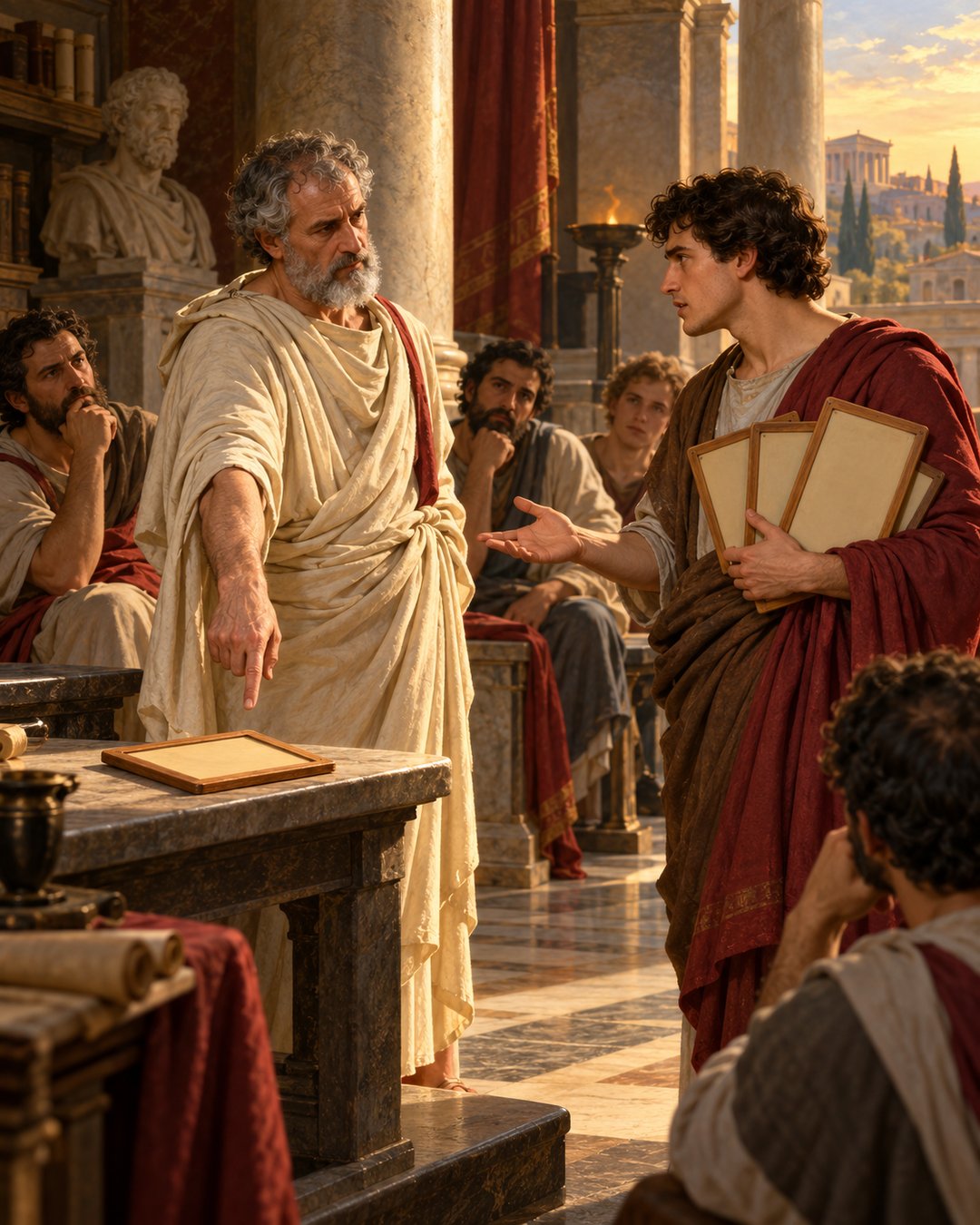
A student stood before the philosopher Taurus with a defence that sounded practical. He had done what other people commonly did. There were examples. There was custom. Surely a familiar mistake was less serious than an eccentric one.
Taurus did not accept the bargain. In Aulus Gellius’s account, the philosopher became more irritated by the excuse than by the original choice. The student had moved from rhetoric and eloquence into philosophy under circumstances Taurus judged dishonourable, then tried to turn repetition into permission. Taurus answered with a remembered sentence from Demosthenes: do not say that something has often been done; ask whether it ought to be done.
The scene is small, but its mechanism is exact. A teacher separates evidence about behaviour from evidence about standards. Frequency can explain an action. It cannot absolve it. That distinction made the classroom a place where precedent was tested rather than merely inherited.
The Student Admitted the Act but Disputed Its Weight
Gellius does not describe a student caught in a factual lie. The young man did not deny Taurus’s allegation. He accepted the basic account and shifted the argument to context: people did this often, and earlier examples appeared to make his own conduct ordinary.
That move matters because it changes the question. Instead of asking whether his choice was sound, the student asked whether it was unusual. Instead of defending the act on its merits, he tried to distribute responsibility across a crowd of predecessors. If enough people had taken the same route, the individual decision might seem too conventional to deserve sharp judgment.
The defence also borrowed prestige without naming a genuine authority. A predecessor can be cited because that person supplied a reason worth considering, or merely because the person went first. The student offered the second kind. His unnamed examples established sequence and frequency, but Gellius gives no indication that they established wisdom. Taurus’s anger focused on this attempt to make accumulated conduct impersonate considered advice.
Taurus saw the substitution. Gellius says the philosopher was angered by “the very nature” of the defence. The problem was no longer only that the student had made a questionable transition from one course of study to another. He had also adopted a rule that could protect any repeated fault. A common act would become self-authorizing simply because earlier people had supplied examples.
This was the kind of intellectual pressure associated with Taurus elsewhere in the archive, including the dinner conversation in Taurus Charged His Dinner Guests One Question Each. Questions were not ornaments around learning. They exposed whether a claim could bear weight.
Demosthenes Turned Precedent into a Warning
Taurus answered the student in the language of the discipline he had left. He recalled Demosthenes, whose polished phrasing, he suggested, ought to have remained fixed in the memory of someone trained in rhetoric. The rebuke therefore worked twice. It supplied a principle, and it made the student’s earlier education testify against his present excuse.
The quoted passage begins by refusing the student’s preferred measure. “Often done” is not the same as “ought to be done.” The first phrase reports a pattern. The second makes a judgment. Moving from one to the other without argument is precisely the shortcut Taurus wanted the student to see.
Demosthenes’s formulation then reverses the force of precedent. If someone copied an act that had previously escaped punishment, that history did not make the copy innocent. It could make punishment more important, because a fresh consequence might prevent the next person from proposing the same excuse. The chain of imitation was not evidence for mercy by itself. It was evidence that an uncorrected example could reproduce itself.
The result is more demanding than a simple command to obey. Taurus did not say that old practice was always bad or that novelty was always good. He required the student to identify the standard by which a practice should be judged. Custom remained relevant as history, but it could not perform the work of moral reasoning.
Demosthenes’s logic also distinguishes explanation from exoneration. A widespread habit may explain why an individual found a course attractive or easy to imagine. It may reveal weak teaching or a permissive institution. None of that settles the judgment of the act itself. Taurus could acknowledge the social path that brought the student to his choice without allowing the path to dictate the destination.
Rhetoric Became Part of the Correction
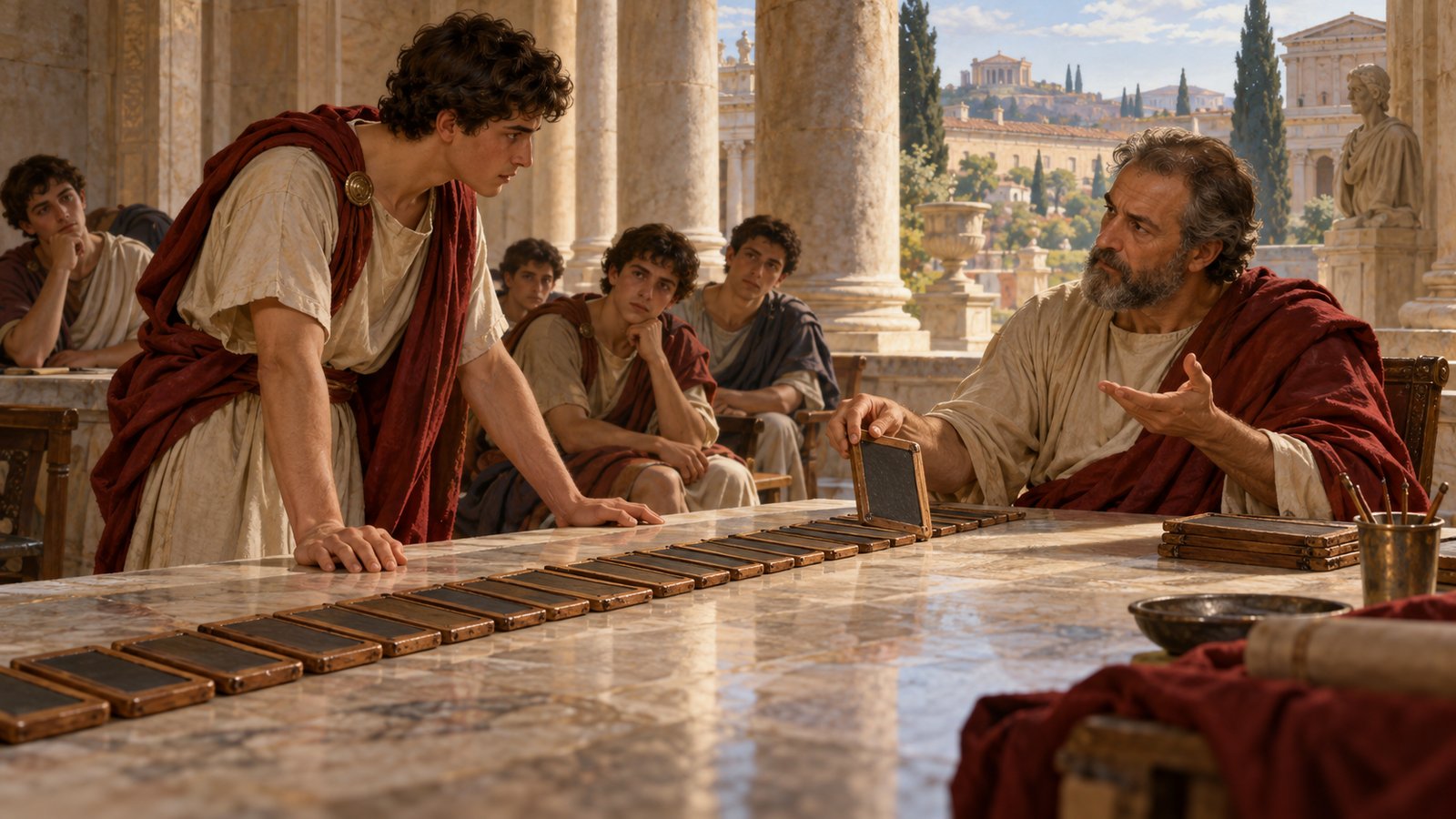
There is a pointed irony in Taurus’s choice of authority. The young man had turned away from rhetoricians and the study of eloquence. Taurus reached back into that abandoned training and selected a line memorable enough to function as what Gellius calls a rhetorical catch. The philosopher did not oppose eloquence to seriousness. He used memorable form to make serious judgment harder to evade.
That technique resembles the journey described in Twenty Miles in Disguise Bought Euclides a Night with Socrates: philosophical commitment appears not as a label but as conduct that survives inconvenience. Here the test is verbal rather than physical. Can a student resist the convenient sentence that everyone does it?
It is significant that Taurus did not discard rhetoric after the student changed disciplines. He treated eloquence as a store of compact arguments that philosophy could inspect and use. The memorable line from Demosthenes carried the structure of the correction: first separate occurrence from obligation, then consider how present judgment shapes future examples. Form helped the student retain the sequence.
Taurus’s answer also guards against a familiar abuse of examples. An example can illuminate a principle, but a pile of examples cannot create one. The student treated repetition as if it were an argument. Taurus forced him back to the missing premise: why should the copied act be considered right?
Punishment Interrupted the Copying Chain
The Demosthenic passage does not present punishment only as payment for the past. It looks forward. If an earlier offender had been punished, the present student might not have proposed the example. If the present offender now faced a consequence, a later imitator might hesitate. Judgment changes the archive from which future people choose their precedents.
That makes public response part of the moral environment. Silence after a fault can be misread as approval. Repetition then gives the mistake an appearance of stability. Taurus’s severe correction was designed to stop that conversion. He wanted the classroom to produce better examples, not merely better explanations for weak ones.
Gellius closes by saying that Taurus used every kind of persuasion and admonition to incline his disciples toward a virtuous and blameless life. Severity was one instrument among several. The goal was formation: teaching students to examine the rule inside their own defence before they tried to use it.

A Common Practice Still Needed a Reason
The lasting force of the episode lies in its refusal to confuse description with justification. “People do this” may be accurate. “Therefore I may do it” remains unfinished. Between those sentences stands the question Taurus borrowed from Demosthenes: ought it to be done?
The student arrived with a crowd behind him. Taurus made him answer alone. Earlier conduct could supply context, temptation, and even a warning. It could not take responsibility for his choice. By turning the excuse back into a question, the philosopher made precedent useful again—not as shelter, but as evidence to examine.
Gellius’s anecdote therefore records more than a severe teacher or a borrowed quotation. It shows education correcting the way evidence is classified. The student brought Taurus a fact about prevalence and presented it as a verdict about permission. Taurus restored the missing categories. What happened before, what happens often, what the rules allow, and what a person ought to do are related questions, but they are not interchangeable answers.
Sources
Aulus Gellius, Attic Nights, Book 10.19.
Demosthenes, passage quoted by Aulus Gellius in Attic Nights 10.19.