
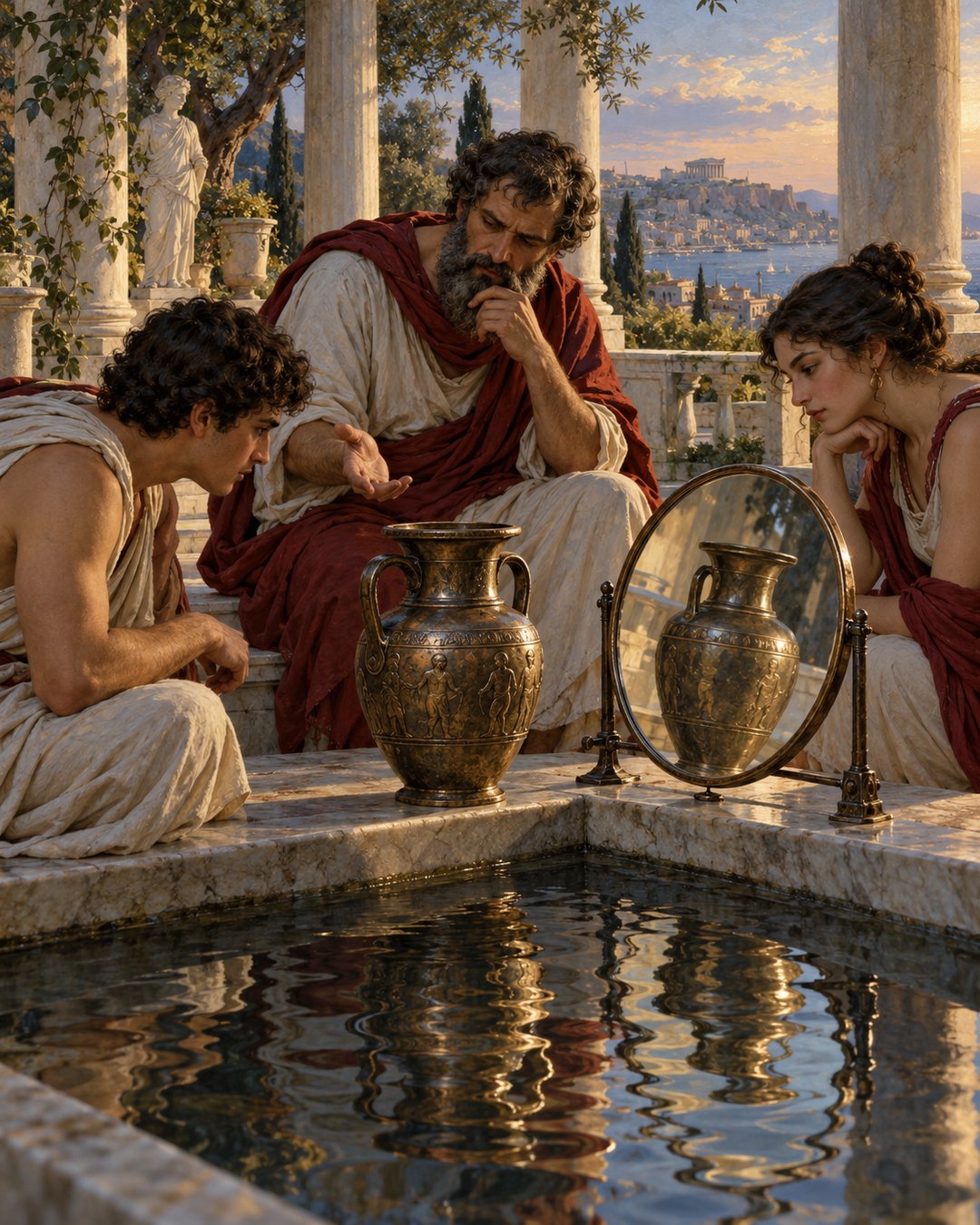
The Pyrrhonists did not stop at doubting the world. They doubted whether their doubt had earned the right to become a conclusion.
Aulus Gellius describes a long-running argument over the difference between Pyrrhonian and Academic philosophers. Both were called skeptics, inquirers, and doubters. Both challenged the confidence with which people claimed to know things. Yet one distinction remained sharp enough to matter: the Academics were thought to grasp that nothing could be grasped, while the Pyrrhonists refused certainty even to that sentence.
This was not indecision by accident. It was a method designed to prevent inquiry from quietly hardening into another dogma.
Skeptic First Meant an Investigator
Gellius begins with the Greek label attached to the Pyrrhonians. He explains “skeptics” through words meaning inquirers and investigators. The name points toward activity rather than paralysis. These philosophers did not define themselves by having no questions left. They remained occupied with asking what, if anything, nature allowed a person to determine.
In Gellius’s formulation, they decided nothing and determined nothing. Read alone, that can sound like refusal. Placed beside the explanation of their name, it looks more like disciplined delay. They kept examining because the evidence had not justified the finality that ordinary assertion demanded.
Their characteristic posture was therefore not “nothing matters.” It was “the claim has not reached the point at which inquiry may honestly stop.” That distinction separates skepticism from mere contrariness. A contrarian needs another person’s certainty in order to oppose it. An investigator needs a question that remains open.
The repeated verbs in Gellius’s summary—inquiring, considering, deliberating—give the school a tempo. A conclusion is not rejected because conclusions are forbidden. It is postponed because the route from appearance to settled nature remains under examination. The skeptic’s work happens in that interval, where competing accounts can still be compared without one being prematurely crowned.
Other schools also trained the gap between first response and considered judgment. In The Storm Turned a Stoic’s Face White Before Reason Returned, an involuntary reaction does not automatically become a reasoned belief. Gellius’s skeptics apply a related caution to perception itself.
Seeing Was an Experience, Not Yet a Verdict
Gellius says the Pyrrhonians did not deny that something happened when they saw or heard. They experienced something like seeing and hearing. Their uncertainty concerned the nature and character of the things responsible for those experiences.
This is a precise restraint. The appearance is present; the final account of its cause is not. A person may report how something seems without claiming direct possession of what it is in itself. The senses supply an encounter, but the encounter arrives through a body and mind with their own condition.
Gellius says both Pyrrhonians and Academics treated appearances as relative to the state of those receiving them. Objects did not simply stamp an identical result onto every observer. What appeared was shaped in relation to the senses through which it arrived.
That claim did not make appearances useless. It made them situated. The skeptic could say that honey tastes sweet now, that a sound seems distant, or that an argument appears persuasive, while withholding the leap from present appearance to universal nature.
Gellius’s phrasing protects ordinary experience while limiting metaphysical ambition. The person does not need to deny the sight before the eyes or the sound in the ears. What must be resisted is the unnoticed promotion of an experience into a complete description of the object that produced it. The report stays honest by marking where the observer stands inside it.
Truth and Falsehood Arrived with Mixed Signs
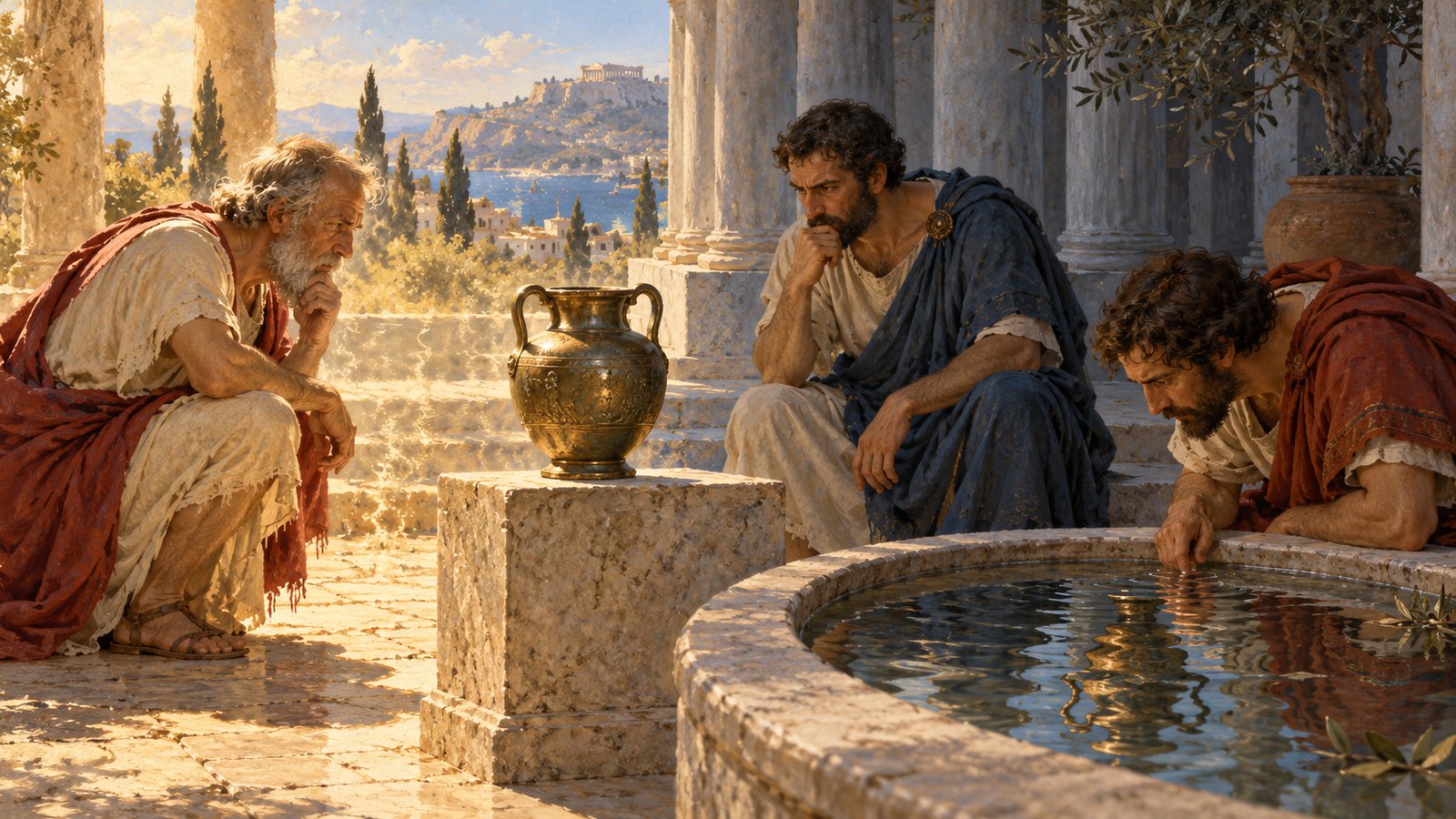
The difficulty, as Gellius reports it, was that signs of truth and falsehood were mingled and confused. Assurance looked beyond reach because the marks by which people tried to separate reality from error did not always arrive already sorted.
The response attributed to Pyrrho captures that pressure: does the matter stand this way rather than that way, or is it neither? The formula keeps more than one possibility alive. It does not replace one confident answer with its opposite. It also leaves room for the categories themselves to have been poorly drawn.
Favorinus, a major presence in Gellius’s intellectual world, wrote ten books called the Pyrronian Principles. That scale matters. The posture was not a single clever paradox. It supported sustained analysis of proofs, qualities, perception, and the language with which a person should describe uncertain things.
A ten-book treatment also suggests how many routes certainty could take back into an argument. It could enter through a sensory report, a proof, a definition, or a claim about what all humans perceive. A skeptical method had to examine not just the final sentence but the warrants accumulated along the way. Otherwise a cautious conclusion might rest on premises asserted with the very confidence it rejected.
The same culture could turn philosophy into a test of conduct, as when A Slave Quoted Plutarch’s Own Book Against the Lash. Here the test falls on assertion: will a thinker claim more than the available appearance can support?
The Academics Stopped One Sentence Earlier
Gellius admits that the two skeptical traditions sounded very much alike. Both were said to affirm nothing and to believe that nothing was understood. The old debate concerned whether they differed at all and, if they did, where the difference lay.
His clearest distinction is almost a trap. The Academics, he says, “comprehend” the fact that nothing can be comprehended. Their skepticism reaches a negative conclusion and holds it. Knowledge fails, and that failure is itself known.
The Pyrrhonists detect one more possible act of confidence. If nothing can be established as true, how did the sentence “nothing can be established as true” escape the rule? They therefore refuse to treat even the failure of knowledge as a secured possession.
This final hesitation is not a contest to see who can deny more. The Pyrrhonist does not replace the Academic conclusion with “the Academics are certainly wrong.” That would reproduce the problem. The distinction concerns how tightly the thinker holds a negative result and whether that result remains available for the same examination applied to every positive claim.
This does not produce a louder denial. It produces a quieter grammar. Instead of declaring reality unknowable as a settled fact, the Pyrrhonist describes how the question presently appears and continues the investigation.
Doubt Avoided Becoming Its Own Doctrine
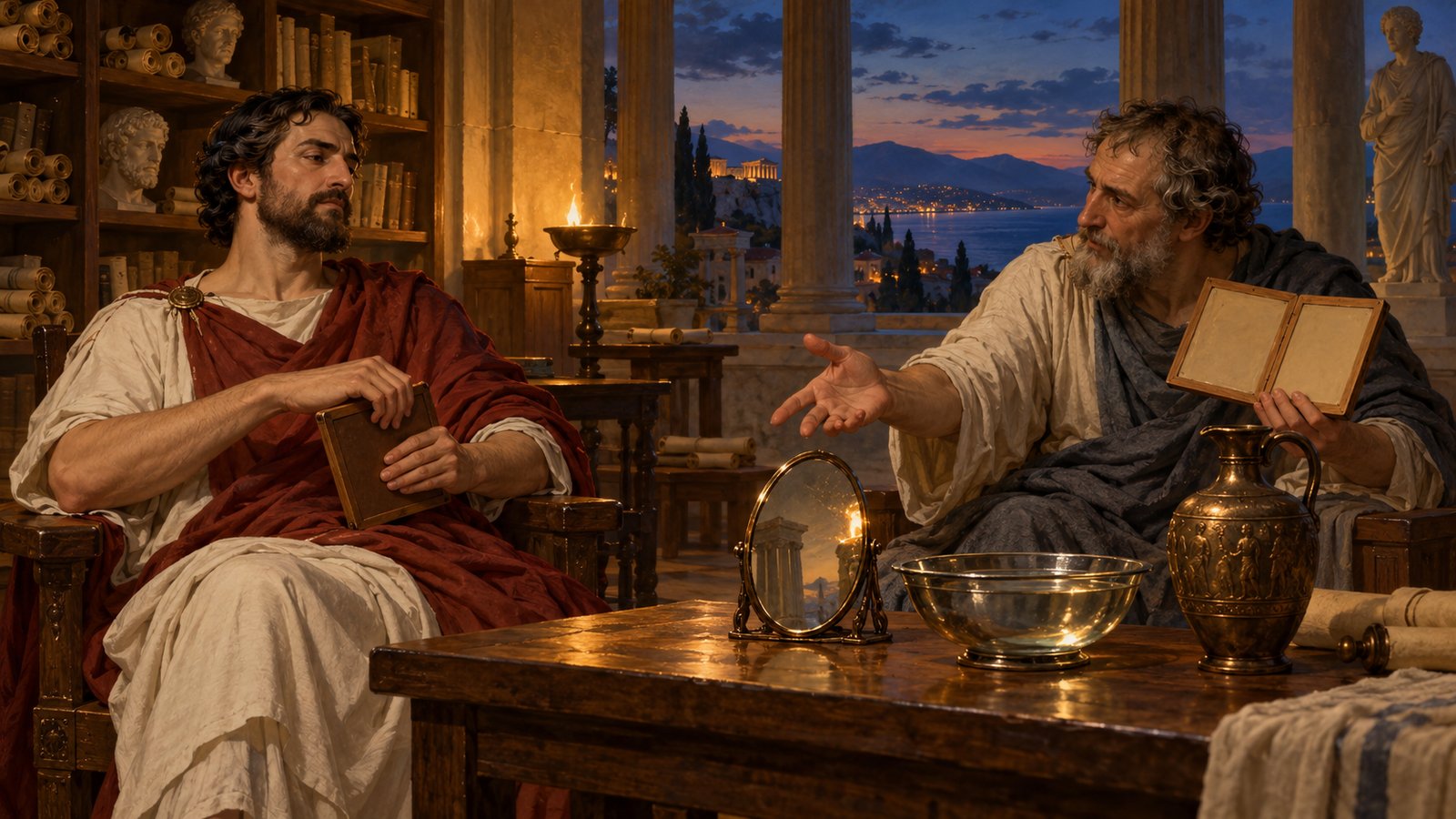
The difference Gellius preserves is small enough to disappear in summary and large enough to change the whole practice. Academic skepticism can end in a proposition about the limits of knowledge. Pyrrhonian skepticism keeps testing whether that proposition has claimed too much.
Its discipline is recursive. Every tool used against certainty must also be used on the skeptic’s own conclusion. Every statement about appearances is itself another appearance presented to a particular mind under particular conditions.
That recursion explains why the Pyrrhonists could remain investigators without promising a final discovery. Inquiry was valuable not because it guaranteed a doctrine at the end, but because it guarded the boundary between what appeared and what had actually been established.
Gellius’s sharpest line is therefore the last turn of the screw. The Academics knew that knowledge failed. The Pyrrhonists asked whether anyone could know even that.
That question does not close the inquiry with a triumphant paradox. It reopens it. The skeptic can continue observing, comparing, and speaking, but each statement carries an account of its limits. For Gellius, the distinction between the schools rests in that final measure of restraint: one tradition secures a negative result, while the other still asks how securely any result can be held.
Sources
Aulus Gellius, Attic Nights, Book 11.5.
Favorinus, Pyrronian Principles, as described by Aulus Gellius.