
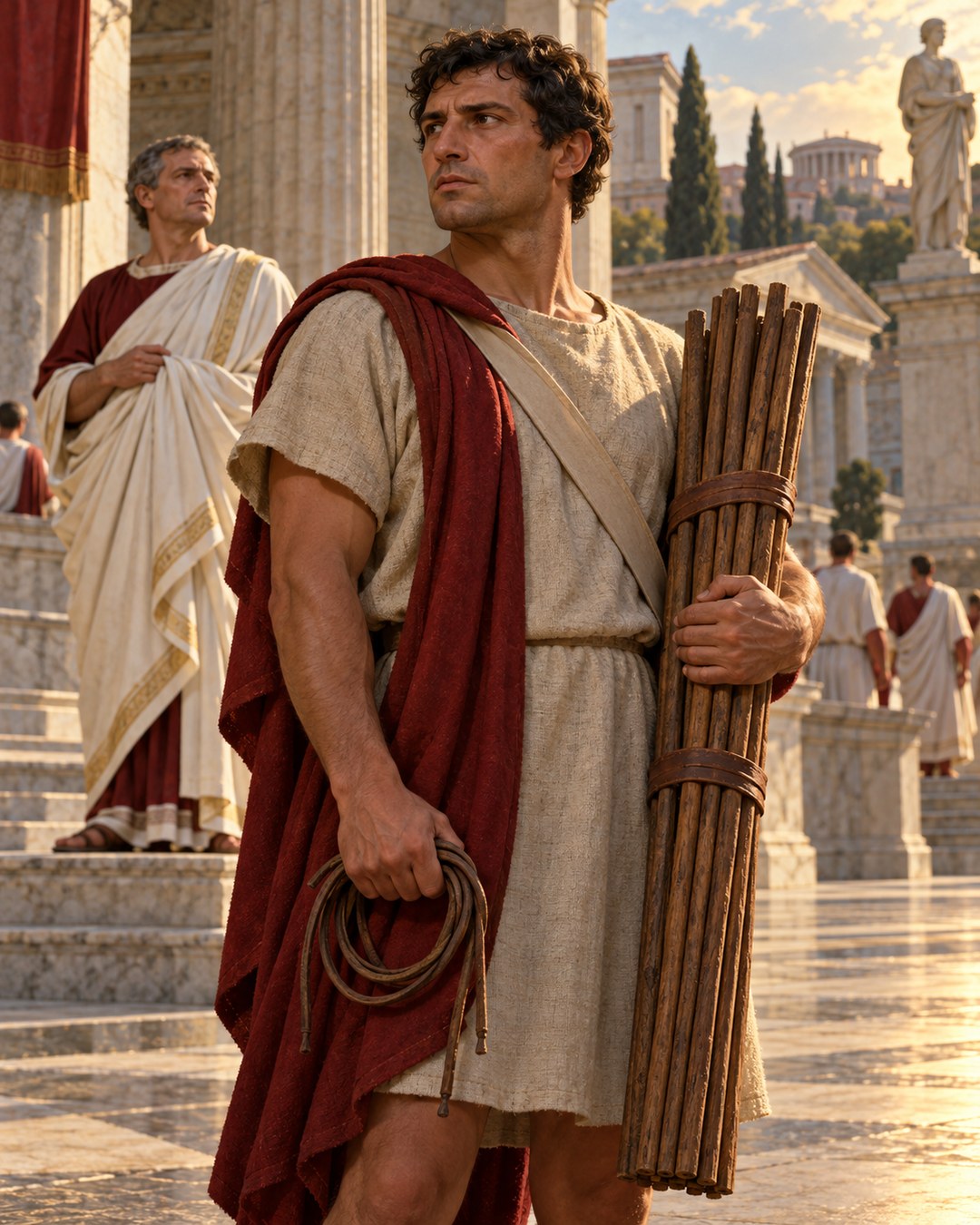
A Roman lictor was designed to be seen. He walked before a magistrate, carried the rods and axe of office, cleared a path, and turned public rank into movement through the street. Yet Aulus Gellius preserves a much smaller dispute about this conspicuous attendant: where did the word lictor itself come from? Two learned Romans looked at the same office and chose different details. Valgius Rufus heard the language of binding a condemned person. Tullius Tiro saw the band or girdle worn across an attendant’s body. Their disagreement makes the name more useful than a tidy dictionary answer. It shows how Romans tried to recover an institution’s history from its duties, clothing, quotations, and even the length of a vowel.
Valgius began with the command to bind
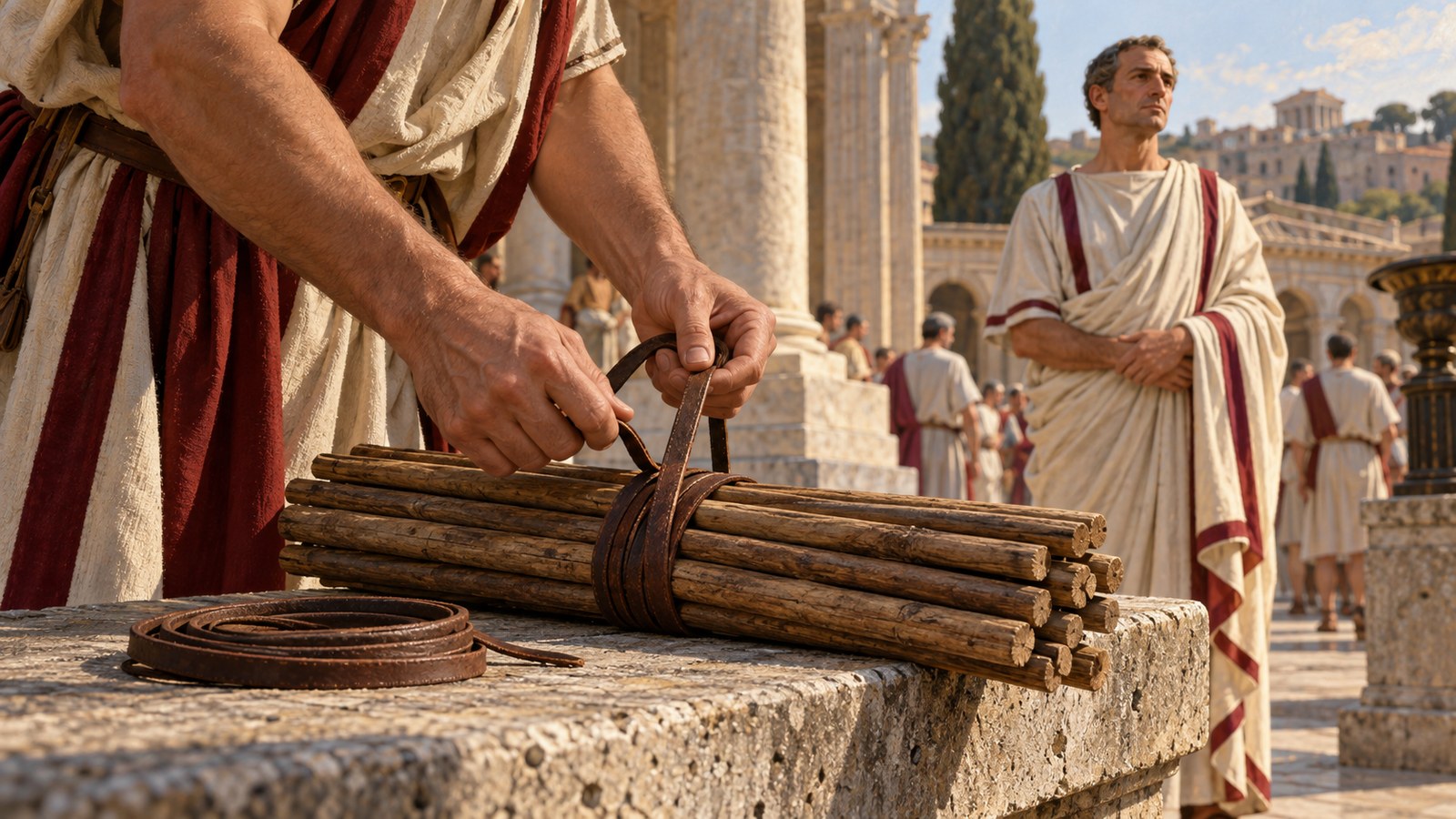
Gellius introduces the first explanation through Valgius Rufus, who set it out in the second book of a work called On Matters Investigated by Letter. Valgius connected lictor with ligare, “to bind.” His reasoning began not with ceremony but with punishment. When a Roman magistrate ordered someone beaten with rods, an attendant fastened the person’s arms and legs. On this account, the member of the attendant corps responsible for binding became the lictor.
Valgius did not leave the derivation as an unsupported resemblance between two words. He supplied a line from Cicero’s speech for Gaius Rabirius: “Lictor, bind his hands.” The quotation gives the theory a compact scene. A magistrate has power, a verbal command turns that power into action, and the attendant physically restrains the body on which punishment may fall. The origin story therefore places the lictor at the harshest end of his work.
This is not the whole history of the office. Lictors also preceded officials, organized public space, and displayed the fasces. A separate Lost Eagles article follows how lictors made Roman power walk through the street. Valgius’s etymology does something narrower. It selects one duty as the duty powerful enough to explain the name.
Tiro looked at the attendant’s clothing instead
Tullius Tiro offered Gellius a competing route. Tiro had been Cicero’s freedman and was remembered as a careful scholar. He did not derive the word from binding. He connected it with limus or licium, terms associated with a band or girdle. In his account, attendants of magistrates wore a distinctive band across the body, and the visible item of dress supplied the name.
The rival explanations begin from the same public figure but frame him differently. Valgius reconstructs an action: an attendant closes cords around arms and legs. Tiro reconstructs an appearance: a band crosses an attendant’s clothing while he stands near the magistrate. One origin lives in an order and its violent consequence; the other lives on the surface of an official body.
That contrast matters because Roman office was communicated through both action and costume. A lictor did not carry a written job description. People recognized him by position, equipment, clothing, and conduct. Tiro’s explanation treats dress as institutional evidence. It resembles the way other Roman garments and insignia made status legible before anyone spoke. The argument is not merely decorative. It asks which visible or practical feature became stable enough to name the man.
A long vowel seemed to favour Tiro
Gellius then confronts a technical objection. The first syllable of lictor was long, as it was in licium, while the corresponding vowel in ligare was short. To a reader trained to hear vowel quantity, Tiro’s derivation could therefore appear more convincing. The sound of the word seemed to preserve the band rather than the act of binding.
Gellius nevertheless sided with Valgius. He argued that the difference in vowel length did not decide the case, because Latin could lengthen a vowel when it formed an agent noun. He placed lictor beside examples such as lector, a reader, from legere; vitor, a binder or plaiter, from viere; tutor, a protector, from tueri; and structor, a builder, from struere. A short vowel in the underlying verb did not have to remain short in the resulting occupational noun.
This is the hinge of the chapter. Gellius does not choose Valgius because binding feels more dramatic. He answers a phonetic argument with a pattern from word formation. The lictor’s name becomes a small test case in how evidence should be weighed: resemblance is useful, but morphology can explain why a form no longer sounds exactly like its proposed source.

The office could be read through different kinds of evidence
The debate also reveals the working habits of Roman antiquarians. Valgius used an institutional duty and a quotation from an oration. Tiro used an item of costume and a phonetic likeness. Gellius used comparative grammar. None possessed the modern historical linguist’s toolkit, but none simply guessed from sound alone. Each tried to connect language with a recoverable feature of Roman life.
Their methods overlap with Roman legal reasoning. The meaning of a title could affect how an office was imagined, just as the powers attached to an office could be separated with surprising precision. The archive preserves many such boundaries. For example, the Roman tribune’s ability to arrest did not automatically include every other form of command; one tribune could arrest a man he could not summon. Institutions were bundles of specific acts, not vague clouds of authority.
Valgius’s answer consequently emphasizes coercion without claiming that coercion exhausted the office. The rods, procession, and clearing of space remain real. The derivation instead proposes that the binding duty left the deepest mark on the title. Tiro’s alternative proposes that public recognition fixed on apparel. Both are attempts to identify the memorable core of a complex role.
Gellius preserved the disagreement rather than flattening it
A modern summary could report only that Gellius preferred derivation from ligare. That would miss the texture of his note. He first names the scholars, states both explanations, preserves the Ciceronian command, presents the vowel objection, and answers it with several parallel nouns. The sequence lets readers watch an argument being assembled rather than receive an isolated verdict.
It also keeps the lictor from becoming a generic emblem. The title leads back to hands tied for punishment, a band worn across the body, and a listener attentive enough to distinguish long and short vowels. Public power appears in three registers at once: physical, visual, and verbal. A magistrate’s authority needed attendants who could embody all three.
The most valuable result is not certainty about a remote etymology. It is the map of Roman attention created by the disagreement. Valgius noticed what the attendant did when an order reached a human body. Tiro noticed what marked the attendant when he stood in public. Gellius noticed what Latin did when it turned actions into the names of agents. The lictor’s name survived because each observer could read a different part of the same office.
The argument also resists the temptation to treat an official title as a transparent label. By Gellius’s day, the lictor was already an old institution surrounded by remembered practice. Explaining his name required scholars to move backward from surviving evidence. A line of Cicero preserved a spoken order. Clothing preserved a visual distinction. Pronunciation preserved a pattern that might either support or mislead an etymologist. Gellius’s comparisons then tested whether the apparent obstacle was actually unusual. That layered inquiry is why the note remains valuable even if its preferred derivation cannot be proved. It records Romans investigating their own public vocabulary with the sources they trusted: literature, institutional memory, trained hearing, and analogy.
Sources
Aulus Gellius, Attic Nights, 12.3; Cicero, In Defence of Gaius Rabirius.