
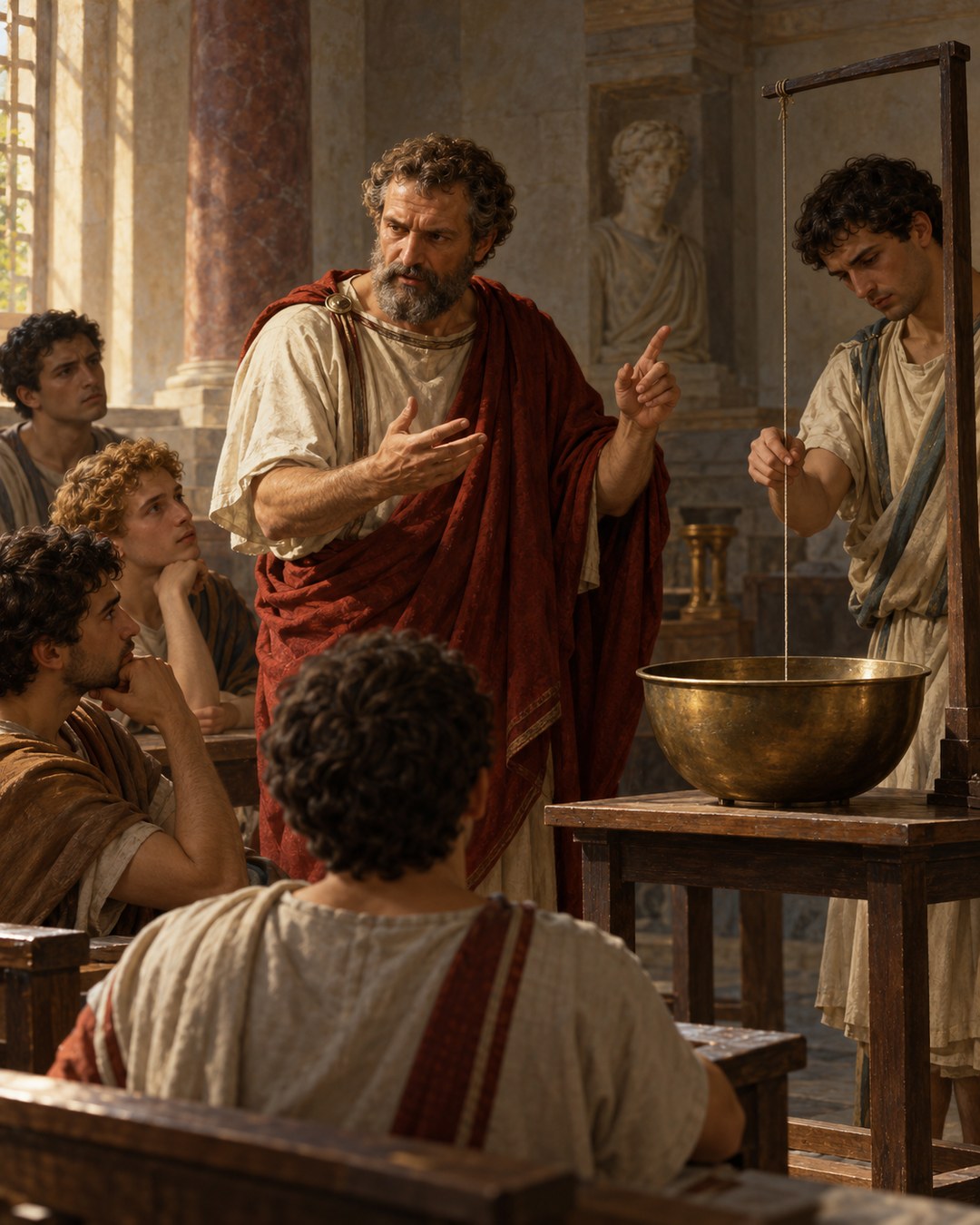
A voice crossed a Roman room, reached an ear, and immediately became a problem of matter. Had a body moved? Had air been struck? Was the voice the blow rather than the air, or a stream of particles too small to see?
Aulus Gellius did not invent those alternatives. He gathered rival answers from Stoics, Plato, Democritus, and Epicurus, then ended the chapter by questioning what the argument did for ordinary conduct. The surprise is not that ancient thinkers disagreed. It is that they disagreed about which part of a familiar event deserved to be called the voice.
The chapter therefore has two thresholds. The first lies between body and incorporeal action. The second lies between inquiry worth pursuing and subtlety that has ceased to repay attention.
The first dispute concerned what a body can do
Gellius begins with a question he says had been argued continuously by famous philosophers: is voice corporeal or incorporeal? Even the Latin vocabulary shows the pressure of the problem. He notes that some writers coined incorporeus to correspond to a Greek term for what lacks body.
Before the schools can classify voice, they must define body. One definition makes action central. A body is something that acts or is acted upon. Gellius gives the Greek formula and pairs it with a line from Lucretius: nothing except a body can touch or be touched.
That test makes voice troublesome. Sound plainly produces effects. It reaches listeners, interrupts thought, startles a crowd, and can be answered. Yet an effect does not by itself reveal whether the agent is a body, a movement in a body, or the perception created when movement arrives.
A second Greek definition uses extension: a body has three dimensions. This gives the argument another axis. Voice occurs through space, but does it possess length, breadth, and depth in the same sense as the speaker, a wall, or the air between them?
Gellius does not reconcile the definitions. He places them before the competing theories so the reader can see that a disagreement about voice already contains a disagreement about body.
This is unlike the architectural problem of returning an actor’s voice through bronze resonators. There the question is how sound behaves inside a theatre. Here the more basic dispute is what kind of thing behaves at all.
The Stoics put the voice into struck air
The Stoic answer gives the moving medium a material identity. Voice is bodily because it is air that has been struck. A speaker does not send an immaterial label into the room; a physical disturbance begins in air and travels through it.
That account fits the active-or-passive definition neatly. Air receives a blow and becomes capable of acting upon what lies beyond it. The voice can then be described through contact and consequence rather than through metaphor alone.
It also fixes the boundary of the event. The struck air is not merely a carrier used by a separate voice. It is the voice under a particular condition. Remove the affected air and the object named by the Stoics disappears.
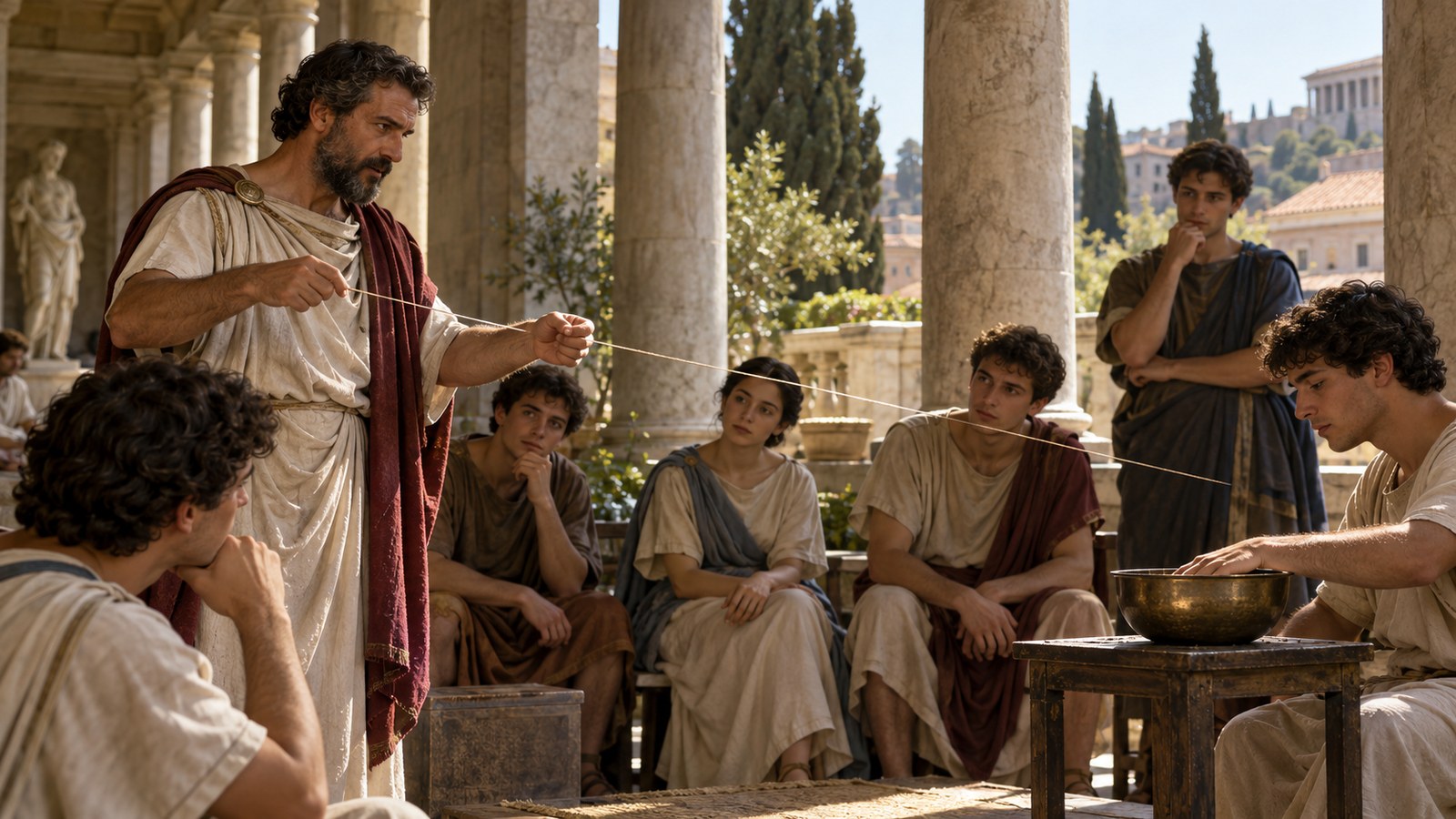
Gellius supplies no experiment involving cords, bowls, or enclosed rooms, so the chapter should not be turned into a modern acoustics lesson. Its evidence is conceptual. The Stoics choose the medium itself as the bearer of voice because it can be struck, moved, and made to act.
The choice would matter whenever a philosopher asked what survives between speaker and listener. It keeps the explanation in the world of bodies without requiring an invisible second substance travelling alongside the air.
Yet the simplicity is deceptive. Calling struck air “voice” still leaves open where the voice begins and ends. Air is everywhere around the speaker. The blow spreads. The listener hears a bounded utterance. The definition identifies the material process, but Gellius’s compressed report does not map every boundary of the perceived sound.
Plato moved the name from the medium to the event
The Platonic answer preserved by Gellius separates the voice from the air. The air is struck, but voice is the stroke and blow themselves. The material that receives the action is not identical with the action.
This is a small grammatical shift with a large consequence. The Stoics point to a changed body. Plato points to what happens to it. If a bronze door is struck, the door remains a body and the striking remains an event; the event does not become bronze merely because bronze receives it.
Applied to sound, that distinction makes voice incorporeal without denying a bodily setting. Air can still be necessary. A speaker and listener can still occupy space. The classification turns on whether the name “voice” belongs to the medium or to the impact transmitted through it.
The chapter gives no winner. Instead it reveals how two accounts can observe the same sequence and disagree because they assign the noun to different moments.
That assignment is not verbal decoration. Definitions determine what counts as explanation. If voice is struck air, tracing the affected medium answers the question. If voice is the stroke, one must describe an action that depends on matter without simply becoming the matter it affects.
The contrast also clarifies why a performer’s damaged voice could force theatre to divide song from gesture. Performance treats voice as an ability with visible consequences, while Gellius’s philosophers dismantle that ability into medium and event.
Atomists replaced the single blow with a moving stream
Democritus and Epicurus offer a third construction. Voice consists of individual particles, described as a stream of atoms. The explanation is material, but it is not simply the Stoic formula repeated in smaller pieces.
A stream emphasizes succession and movement. What reaches the listener is composed of units flowing from the source. The account gives voice a particulate body while explaining travel through emission rather than naming all struck air as the utterance.
Gellius says Epicurus followed Democritus here. That intellectual sequence matters because he is not listing random possibilities. He is locating a shared atomist answer beside Stoic and Platonic alternatives.
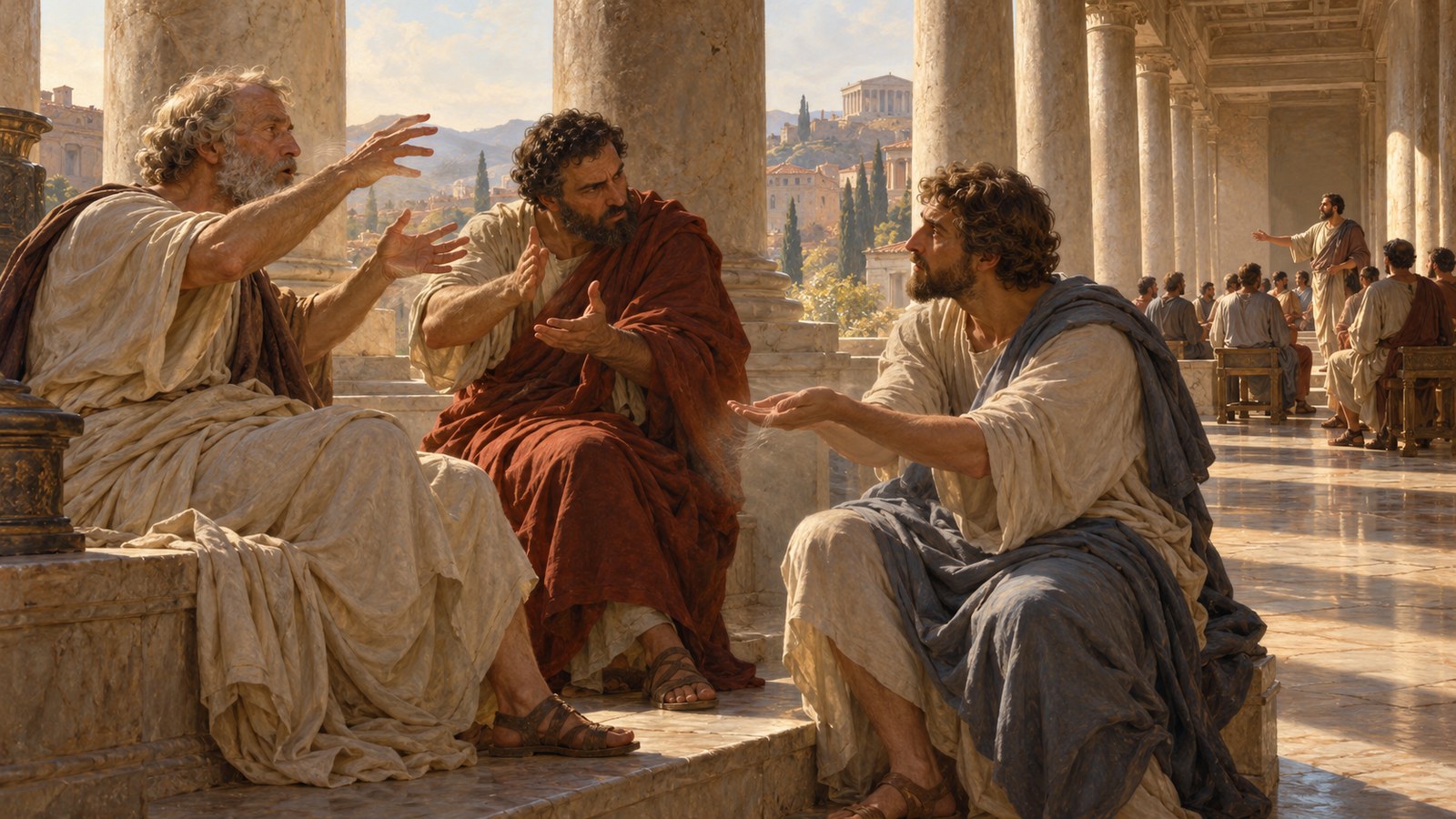
The phrase “stream of atoms” has vivid explanatory force. It turns an invisible occurrence into something that can be imagined as transmission. But the image also risks feeling complete before the details have been supplied. Which particles, in what arrangement, and how they preserve an utterance are not questions this short chapter answers.
That incompleteness helps explain the structure of Gellius’s ending. Three positions can be stated compactly while each opens further disputes. A body may be defined by action or dimensions. Struck air may be distinguished from a blow. A stream may be divided into particles without revealing why one pattern becomes a word.
Gellius changed the standard from truth to usefulness
After preserving the theories, Gellius steps away from them. He calls such subtleties the product of self-satisfied cleverness joined to idleness. He sees no advantage for the conduct of life and no natural endpoint to the inquiry.
That response does not refute the Stoics, Plato, Democritus, or Epicurus. It changes the criterion. The question is no longer merely which definition is coherent, but how long a reader should remain inside a disagreement that offers no clear practical return.
Gellius closes with Ennius’s Neoptolemus: philosophizing must exist, but within limits. The quotation is not an instruction to abandon thought. Gellius has just spent a chapter distinguishing theories carefully. His limit falls after comparison, when continued refinement threatens to become its own occupation.
The editorial act is therefore part of the argument. He records enough to show why the question persists, then refuses to let persistence prove importance. A dispute can be intellectually real and still receive only a bounded share of attention.
That is a sharper position than simple mockery. The chapter depends on the very learning it criticizes. Gellius knows the Greek terms, definitions, school positions, and poetic line. His skepticism concerns proportion: how much labor a question deserves relative to what it changes.
The familiar voice makes the test unusually effective. Every reader knows the event from experience. The schools divide it into body, blow, and particles; Gellius then asks whether those divisions make a person live differently. The answer he implies is not enough to sustain endless inquiry.
Still, the preserved disagreement has value of another kind. It teaches readers to notice where an explanation places identity. One account calls the medium the thing. Another calls the action the thing. A third calls a stream of components the thing. Much argument begins before evidence is compared, at the moment a noun is attached to one layer of an event.
Gellius’s final limit does not erase that lesson. It prevents the lesson from becoming an infinite corridor. Voice travels, definitions multiply, and the editor decides where to close the notebook.
Sources
Aulus Gellius, Attic Nights 5.15, on whether voice is corporeal or incorporeal.