
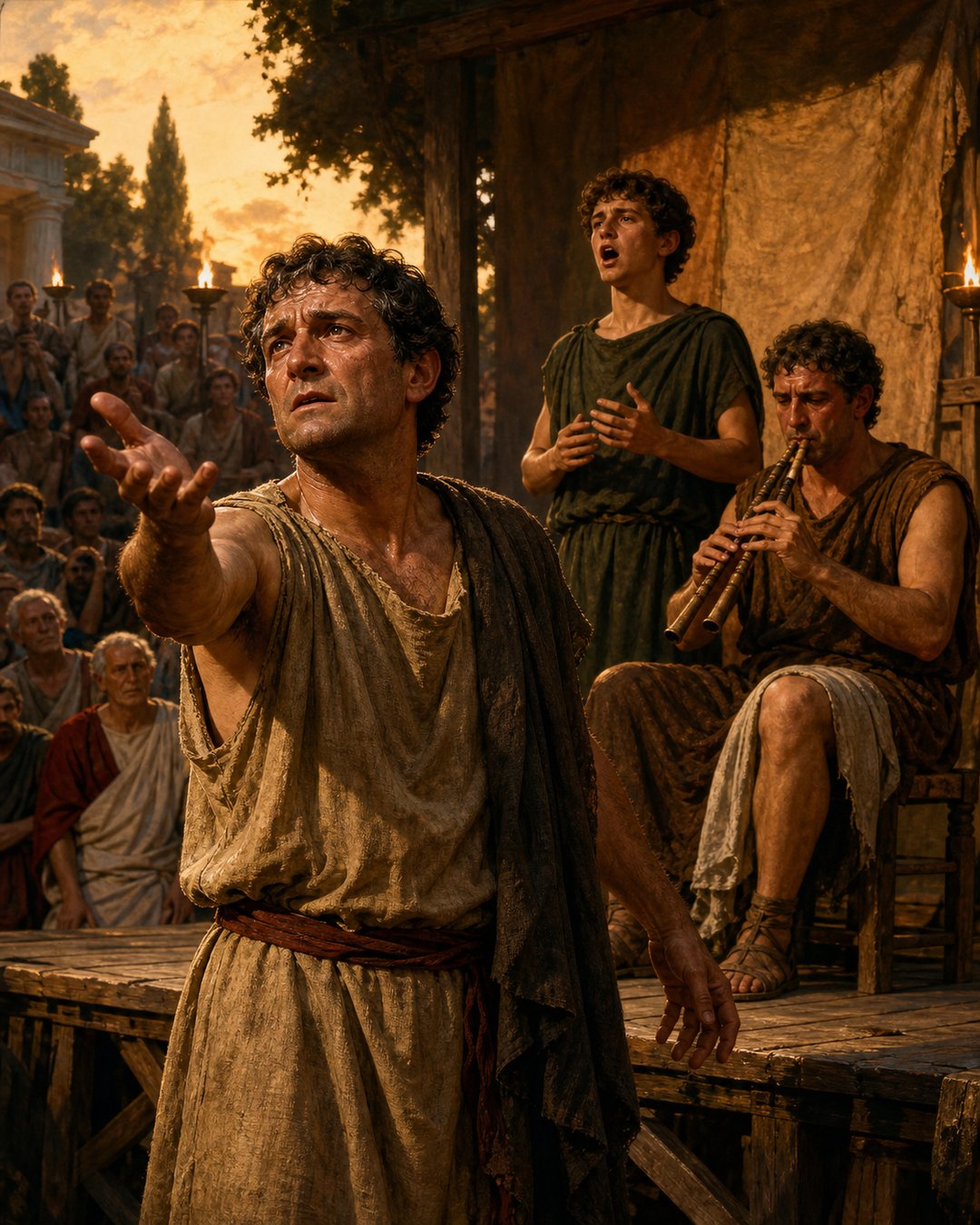
The actor had reached the point where applause became a physical problem. Livius Andronicus performed in plays he had written, and the audience repeatedly called him back. According to Livy, the strain broke his voice. The performance still had to continue, but its author could no longer carry every part of it.
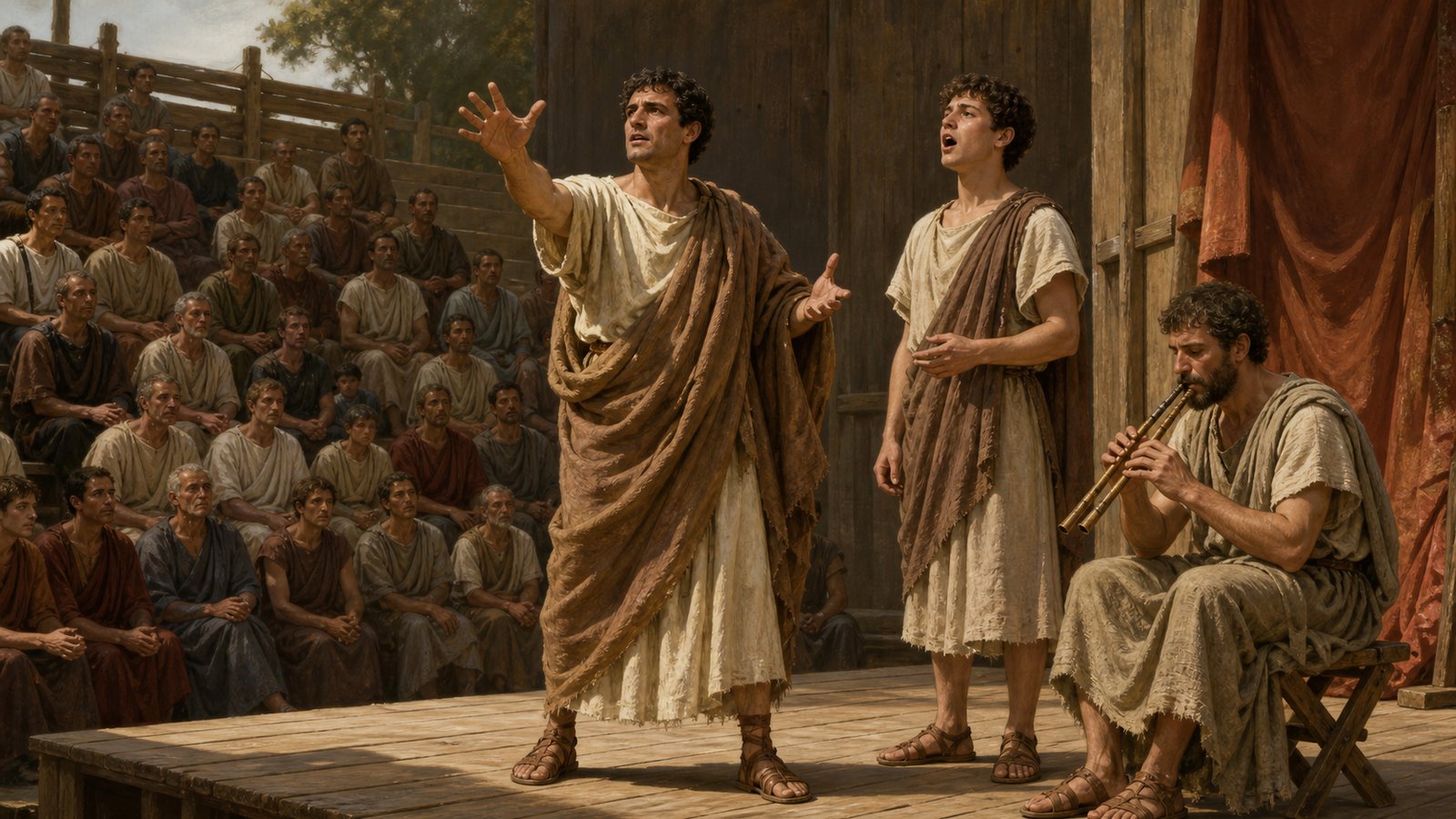
The solution was practical. With permission, Livius placed a boy beside the musician to sing while he remained before the crowd and performed the gestures. Freed from supplying the sung voice, the actor could move with greater range. Spoken dialogue stayed with the performers; song could now come from another body.
Livy presented this as a turning point in Roman scenic practice. Whether every detail preserves a precise institutional beginning is harder to prove than his confident sequence suggests. Yet the story identifies something real about performance: theatre changes when a task that one exhausted person cannot sustain is divided among specialists.
Plague Brought a New Kind of Performance to Rome
Livy began far from Livius’s damaged voice. A pestilence continued through successive years, and efforts to calm it had failed. Rome had already held a lectisternium, a ritual banquet laid out for the gods, for the third time since the city’s foundation. Neither human remedies nor divine observance had brought relief.
Scenic plays entered the narrative as another act of expiation. Livy stressed their novelty. Rome was, in his formulation, a warlike people accustomed to circus shows rather than staged drama. The first performances were not introduced as a leisurely artistic reform. They were one more response from a frightened community searching for a form the gods might accept.
That origin makes the theatre’s later growth striking. A measure taken under religious pressure became an entertainment, then an art with trained performers and organized roles. The shift resembles the way Duilius’s flute and wax torch preserved a public honor through repeated performance. Sound and movement could begin in a specific civic obligation and outlast the event that had demanded them.
Livy did not claim the plays cured the epidemic. In the next stage of his account, the overflowing Tiber interrupted the performance and intensified Roman fear that the gods rejected the effort. The significance of the plays lies elsewhere. Once assembled, musicians, performers and spectators created a practice that could continue for human reasons even when its religious objective remained uncertain.
This beginning also prevents a tidy story in which Roman drama simply arrived as a finished literary import. The earliest layer in Livy’s sequence had no plot, script or spoken poetry. Rome first encountered coordinated bodies and music. Words, roles and narrative were added through later experiments.
Etruscan Movement Met Roman Improvisation
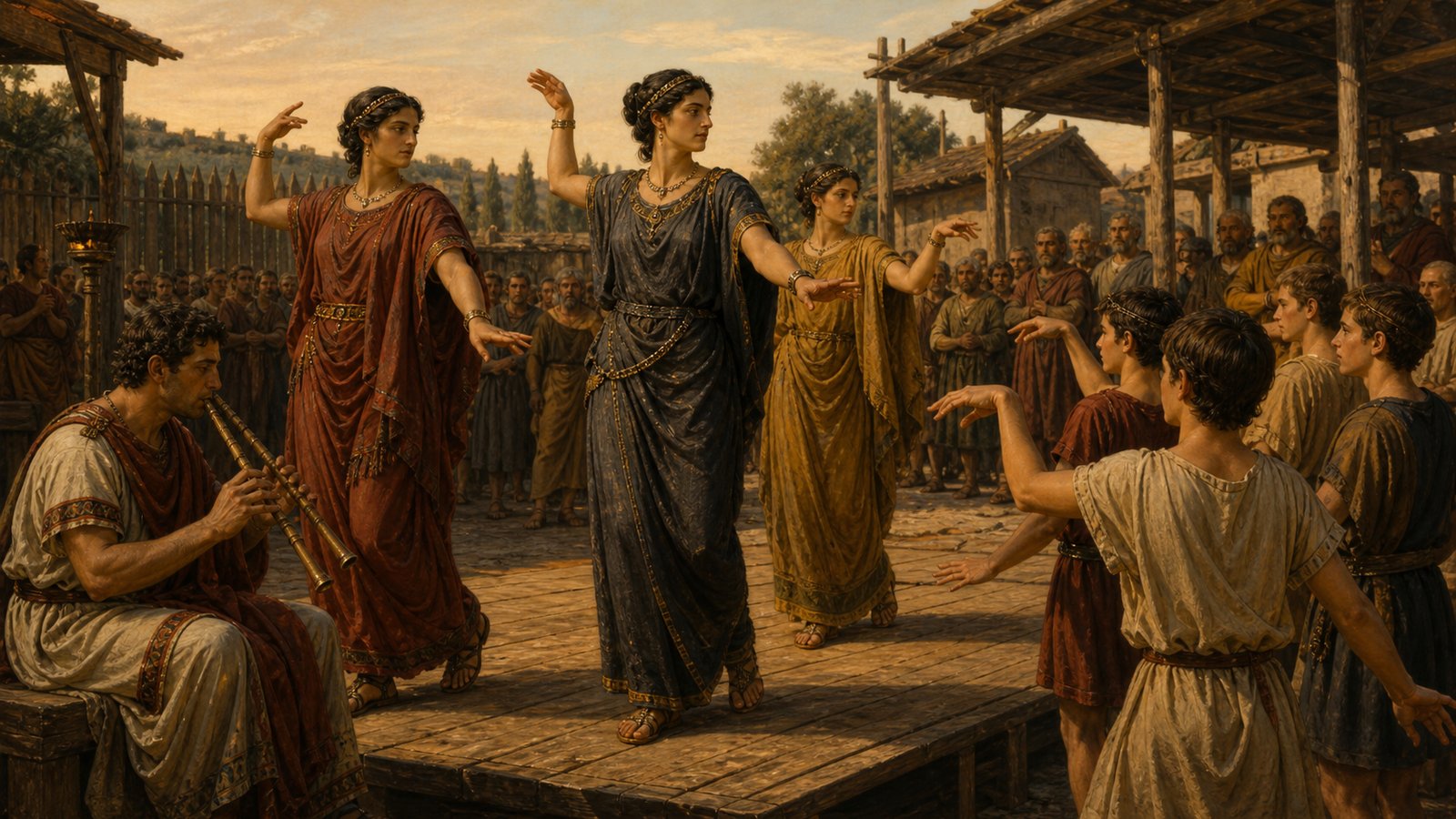
The first specialists came from Etruria. Livy described them dancing to the measures of a musician in the Etruscan fashion. They did not deliver poetry, nor did their gestures imitate a poetic text. The attraction was controlled motion itself: patterned steps linked to sound before a Roman crowd.
Roman youths began to imitate what they saw. Their version added joking exchanges in rough verse, and their gestures answered their language. Borrowing therefore produced alteration almost immediately. The imported performers supplied rhythm and movement; local amateurs brought verbal competition and mockery.
Livy connected the professional name histriones with hister, which he gave as the Etruscan word for an actor. The etymology mattered to his story because the vocabulary carried a memory of transmission. Even after Roman performance changed, the name marked the foreign craftsmen who had stood near the beginning.
Repeated use refined the mixture. Random joking verses developed into medleys with meter, music adjusted to the musician and gestures fitted to the words. No single invention completed this process. Coordination accumulated: a line needed a rhythm, movement needed to meet the line, and performers needed to repeat the arrangement reliably.
This was not yet the plotted play associated with Livius Andronicus. It was an intermediate form, more organized than improvised teasing but still built from joined pieces. Livy’s account is valuable because it notices such awkward middle stages. Cultural forms rarely move directly from absence to maturity. They grow through imitation, adjustment and habits that become difficult to separate once they work.
A Hoarse Playwright Turned One Role into Three
Livius Andronicus supplied a different kind of order. Livy credited him with leaving medleys behind and shaping a story with a regular plot. The playwright was also an actor in his own work, so composition and delivery met in the same person. That concentration made his voice essential—and made its failure consequential.
The repeated recalls that exhausted him suggest an audience with power over the performer’s body. An encore extended more than fame. It demanded another passage, another projection across the performance space and another cycle of song and gesture. Success could wear out the instrument that produced it.
Placing a boy before the musician redistributed the work. The musician maintained the measured accompaniment. The boy carried the sung passage. Livius embodied the action. Livy specifically observed that the actor’s gestures became freer when vocal effort no longer impeded him. Division did not merely rescue a damaged performance; it expanded what the visible performer could do.
The arrangement recalls the intense fusion of body and story in Polus carrying his son’s ashes while acting Electra, but its mechanism runs in the opposite direction. Polus made personal grief and theatrical action converge in one body. Livius’s workaround separated functions so several bodies could construct one role together.
Livy said a convention followed: actors received the sung portions in coordination with their hand gestures, while dialogue alone remained to their own voices. A character onstage could thus be visually continuous yet vocally composite. The audience accepted that the person they watched and the person they heard singing did not need to be identical.
The Workaround Changed Who Counted as an Actor
Once song and gesture could be assigned separately, theatre became less dependent on an all-purpose performer. It could reward different capacities: vocal endurance, musical timing, expressive movement and spoken delivery. The production survived individual limitation by making cooperation part of the form.
Livy linked this technical change to a broader social sorting of entertainment. As formal plays moved away from loose laughter and became an art for regular actors, Roman youths kept the old joking tradition in afterpieces associated with Atellan farce. They did not surrender every kind of performance to professionals.
Status followed the distinction. Livy said performers of Atellan farces were not removed from their tribes and could serve in the army, as though their activity had no connection with the professional stage. Rome could enjoy several kinds of acting while drawing legal and social boundaries around the people who performed them.
The chapter ends by contrasting small beginnings with the costly magnificence of later spectacles. Livy saw the early sequence retrospectively, from a world in which theatre had grown large enough to burden wealthy kingdoms. That perspective can make every primitive step look like an origin designed to explain the future. His details should therefore be read as an ancient account of development, not a rehearsal log preserved without interpretation.
Still, the broken voice remains a compelling mechanism. A singer failed, a boy stepped beside the musician, and the actor discovered that silence could make his body more articulate. Roman theatre did not advance because weakness disappeared. In Livy’s story, it advanced because performance reorganized itself around weakness and turned an emergency repair into a repeatable craft.
Sources
Livy, History of Rome 7.2.