
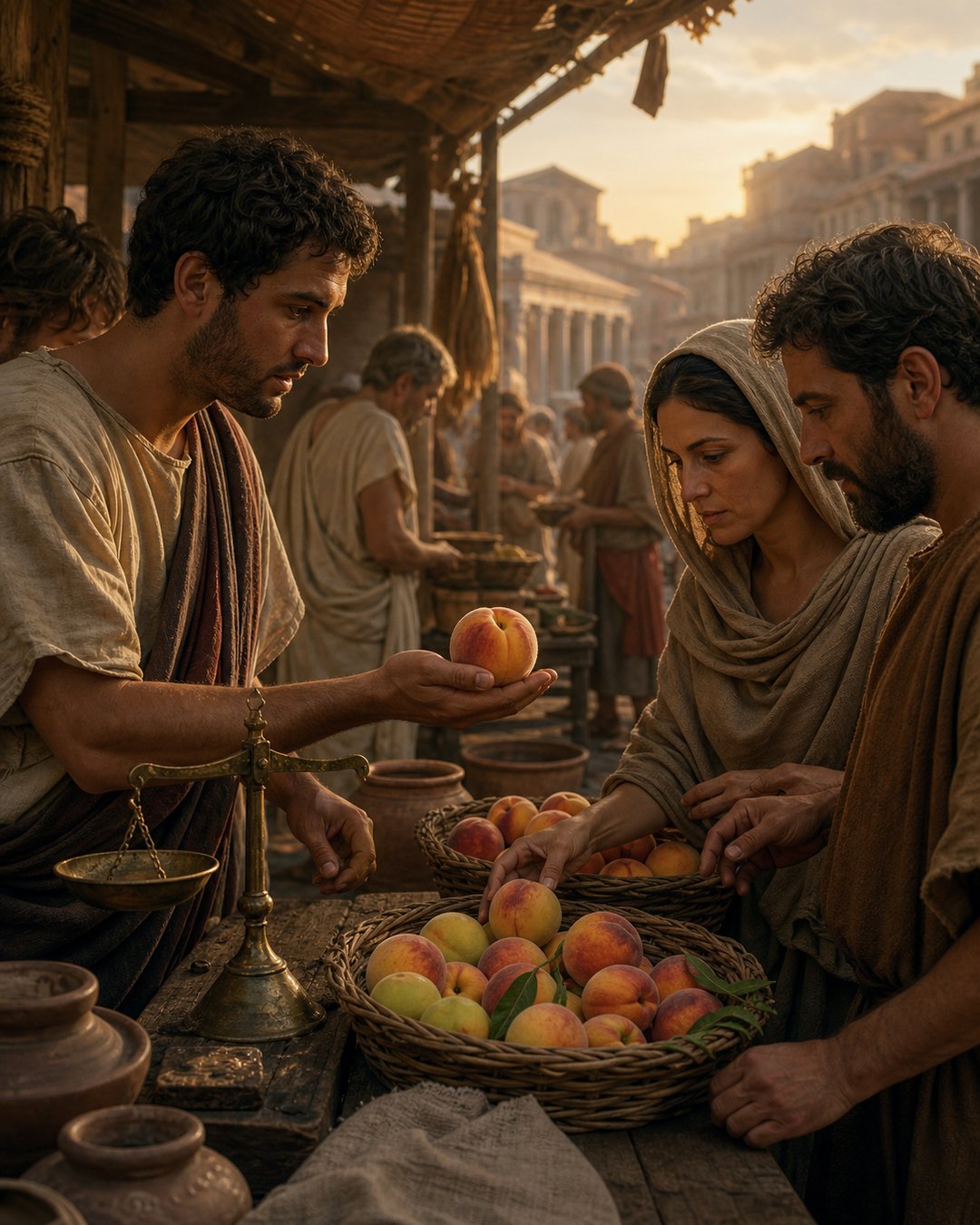
A ripe peach arrived at a Roman stall with a clock already running. Pliny the Elder gave it no more than about two days after picking. It could not wait through a long warehouse delay, improve during storage or be held until a seller liked the price. Once the branch released it, the fruit had to move.
That fragility makes Pliny’s highest figure startling. An individual peach, he wrote, had sold for as much as thirty sesterces, a price no other fruit had exceeded in his account. Early varieties had begun at a denarius each when they were introduced. The numbers turn a familiar piece of fruit into a tightly timed luxury.
The useful question is not whether every peach cost thirty sesterces. Pliny did not say that. His exceptional price sits inside a catalogue of varieties, seasons, origins and physical differences. Rome’s expensive peach was the product of classification and speed: buyers had to recognize what had arrived, and sellers had almost no time to find the buyer who wanted it.
A Price Could Ripen Faster Than the Fruit
Pliny’s two-day limit defines the transaction. A durable commodity can be accumulated, compared and released gradually. A soft peach does not offer that freedom. Harvest, packing, transport and sale become one connected operation, because a delay at any point consumes part of the fruit’s useful life.
The merchant therefore faced two opposite pressures. Scarcity and novelty could raise the asking price, but decay could destroy the sale. A peach worth a great deal in the morning might be bruised, split or overripe before another market day. The famous thirty-sesterce specimen was valuable precisely because the seller had placed an exceptionally desirable fruit in front of the right customer before time erased the distinction.
This differs from the slower movement described in the transport of young trees with their native earth. A living tree could be protected for relocation and expected to produce later. A picked peach carried no such future. Its commercial journey ended at eating, and every hour narrowed the distance it could travel safely.
Pliny’s earlier price of one denarius for newly introduced early peaches suggests another source of value: being first in the season. An early fruit reached buyers before the ordinary calendar supplied abundance. The premium attached not merely to sweetness but to timing. A grower who advanced ripening and a trader who shortened the trip could sell a piece of summer ahead of its competitors.
None of this requires treating the maximum as a standard market rate. Ancient writers liked memorable extremes, and Pliny’s wording marks an exceptional sale. Yet the exception still reveals what Romans noticed. They could measure prestige through a single flawless fruit, and they understood that perishability made such perfection temporary.
Rome Knew Peaches by Place, Texture, and Season
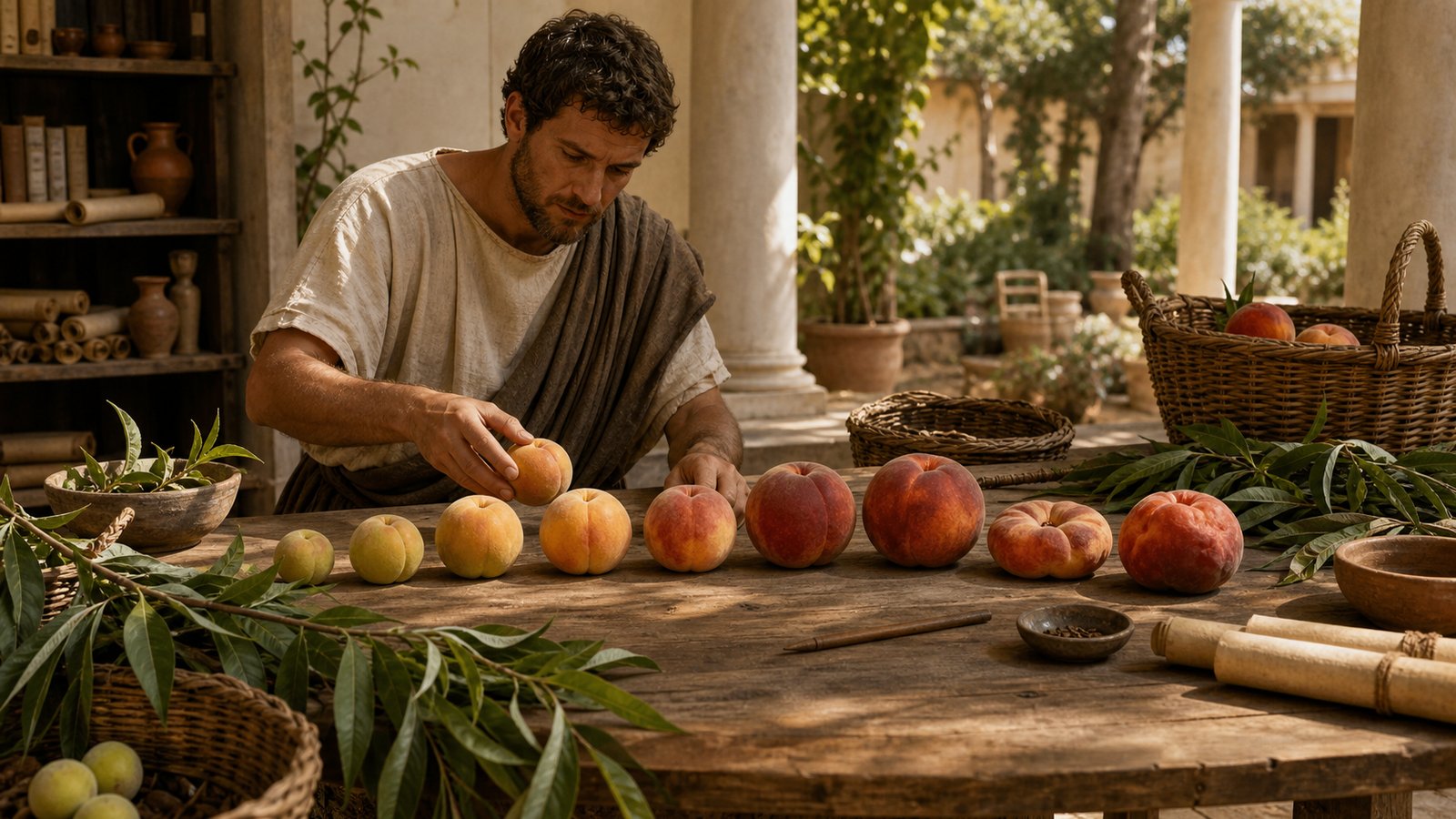
Pliny did not describe one undifferentiated peach. He counted six varieties and ranked the duracinus first. Its name pointed to firmness, a quality that mattered both in the mouth and on the road. Firmer flesh could distinguish a type at the table while also giving it a practical advantage against handling.
Other names organized fruit through geography. Gallic and Asiatic peaches were associated with their countries and ripened toward the end of autumn. The supernatia came from Sabine territory. The popularia, by contrast, grew everywhere. A Roman buyer could hear a fruit’s proposed origin, season or abundance before touching it.
Such names were not modern botanical genetics. They were working categories made from cultivation, commerce and observation. A place-name might identify where a type had become famous rather than reconstruct every stage of its ancestry. A texture name told the buyer what to expect. A seasonal label put the fruit on the market calendar.
The same practical need for recognizable measures appears in Roman market weights that made trust visible. Peaches could not be standardized like metal masses, but the problem was related. A sale between strangers required shared signs. Variety, firmness, origin and ripeness gave language to differences that otherwise vanished into a basket.
Pliny also called the peach harmless and especially suitable for invalids. That observation placed it within another classification: not just luxury, but tolerated food. A costly fruit could carry pleasure, medical reputation and social distinction at once. Those meanings increased the number of reasons a buyer might prize a particular specimen.
The Persian Name Carried a Travel Story
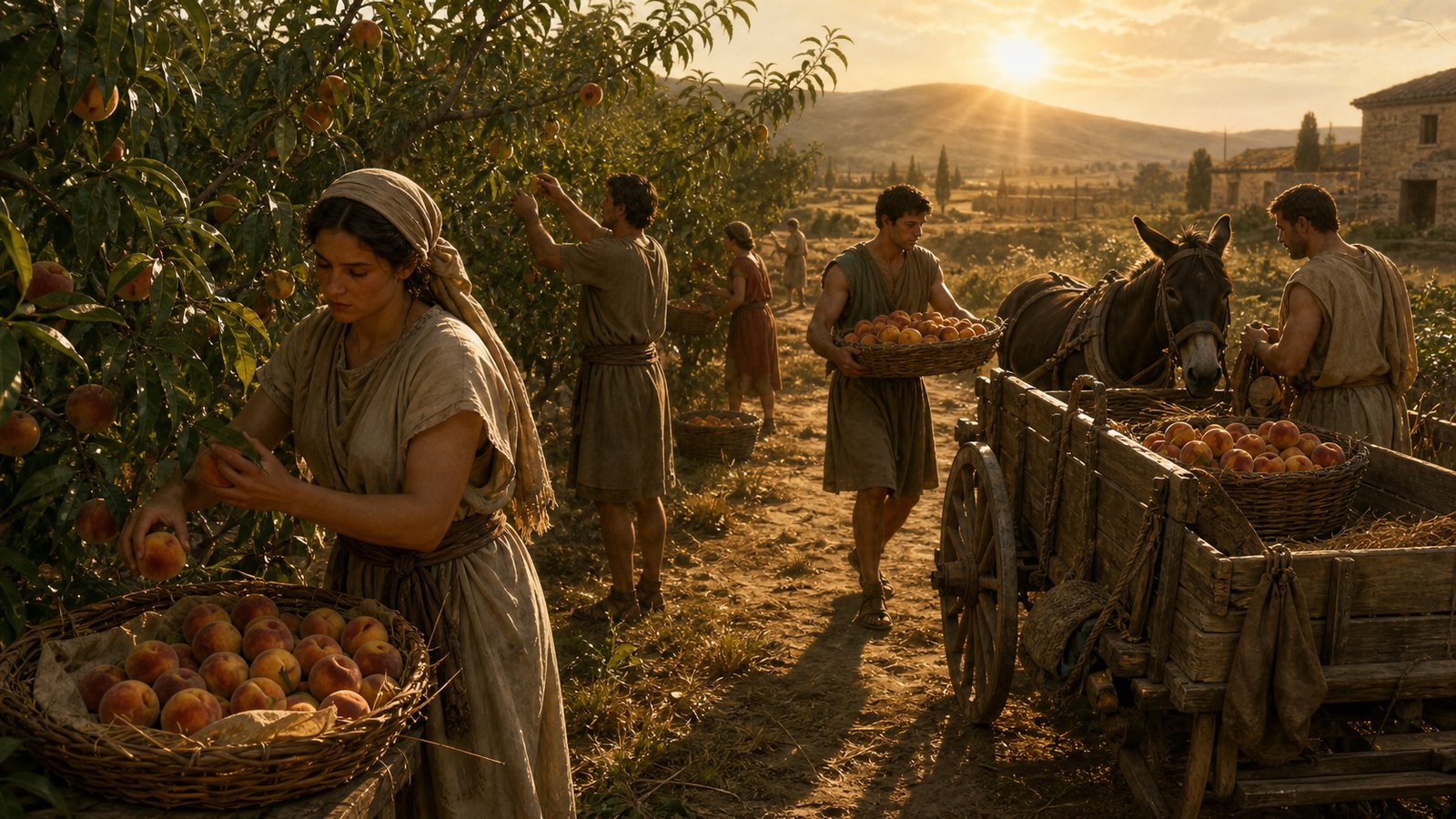
Romans could call the peach Persica, the Persian apple. Pliny treated the name as proof that the fruit was foreign to Greece and Asia Minor and had first come from Persis. The label turned every peach into a small statement about distance, even after orchards much closer to Rome began producing it.
“Apple” in this language was a broad family resemblance, not the narrow English category. Pliny explicitly compared structures: a pomegranate enclosed many seeds, while a peach held one stone. Classification began with visible anatomy but remained flexible enough to group very different fruits under a familiar term.
His travel route is less secure than his confidence makes it sound. Pliny said peach trees came by way of Egypt and found a first stopping place on Rhodes, where he claimed they were barren. That picture conveys difficulty: a desirable tree could cross regions without immediately becoming productive in each new soil.
The claim should be read as Pliny’s ancient account, not as a modern reconstruction of peach domestication. Its value lies in what it shows about Roman explanation. Names preserved supposed origins. Failed cultivation explained why a fruit remained unusual. Successful varieties then acquired newer local identities—Gallic, Asiatic, Sabine—without losing the old Persian name.
One fruit could therefore hold several maps at once. “Persian” supplied a deep origin story; Rhodes and Egypt marked stages of travel; Gallic and Sabine names described varieties known in Pliny’s world. Roman agriculture did not erase foreignness when cultivation moved west. It could turn foreignness into part of the product.
Pliny Separated the Peach from a Poison Legend
Distance also attracted stories. Pliny rejected a tale that Persian kings had transplanted poisonous peaches into Egypt as an act of revenge, after which Egyptian soil supposedly removed their harmful nature. The drama joined exotic rulers, dangerous fruit and transforming land in a neat explanation.
His correction was taxonomic. The poison tradition, he argued, concerned the persea, a different eastern tree whose fruit resembled the red myxa. Peach and persea had been pulled together because names, geography and unfamiliar plants could slide across one another. Separating them required comparing the trees rather than repeating the tale.
This is the sharpest part of the catalogue. Pliny is often remembered for preserving marvels, but here he acted as a critic of one. He did not reject every claim around the fruit: he still accepted a difficult route through Egypt and a barren stop on Rhodes. He selected among stories, using plant identity to decide which narrative belonged where.
The correction also changes the thirty-sesterce peach. Its danger was not poison but time. The real threat to value began after picking, when two days of useful life started to disappear. Kings and revenge made a better legend; bruising, transport and rapid sale made the market.
Seen this way, Pliny’s peach is more than an example of extravagant appetite. It is a compact history of how Romans handled novelty. They named varieties, ranked textures, tracked seasons, attached origins, repeated and corrected travel stories, and noticed the extreme price created by a fruit that refused to wait. Thirty sesterces purchased not permanence, but a perfect moment before softness won.
Sources
Pliny the Elder, Natural History 15.11 and 15.13.