
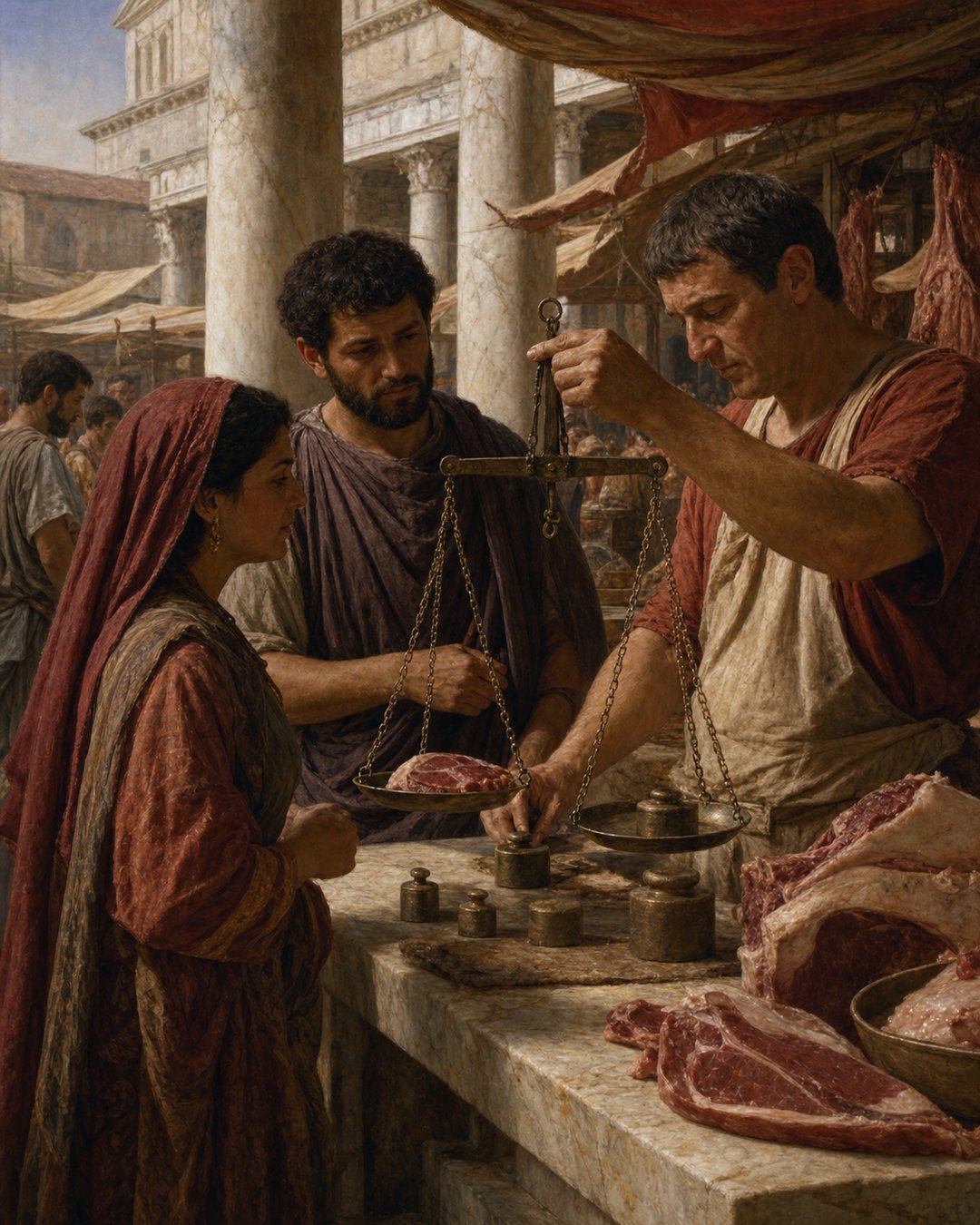
A Roman market did not need silence to create trust. It needed a counter, a balance, a set of weights, and enough witnesses to make a bad measure risky. The buyer could look, the seller could answer, and the object between them could speak louder than either.
Roman market weights made trust public because exchange in a busy city had to survive strangers. The pound, the ounce, the stall, and the macellum turned fairness into something visible enough to challenge.
The counter needed more than a promise
In a household exchange, reputation might do most of the work. In a market, reputation had to share the job with instruments. Bronze, lead, stone, or glass weights put a claim into a form that could sit on the counter while two people disagreed.
The Smith Dictionary entry on pondera is dry in the best possible way: it reminds us that weights were things. They had material, shape, and presence. A customer did not have to accept a seller’s voice as the only evidence.
The libra gave trade a shared arithmetic
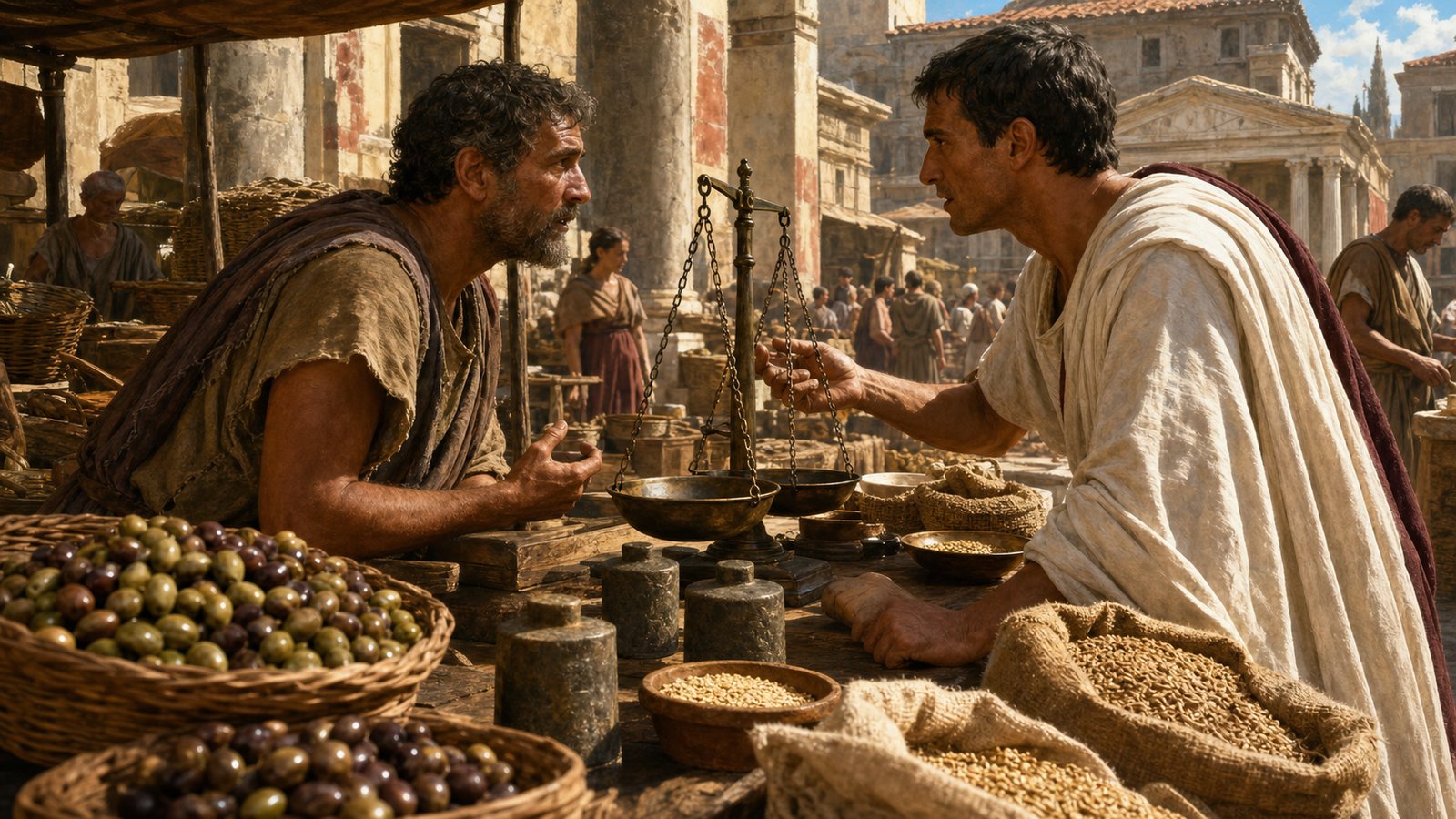
The Roman libra divided the pound into twelve unciae. That sounds small until you imagine bargaining without a common scale. A shared unit let meat, oil, grain, metal, and money enter the same mental world of comparison.
Numbers did not remove cheating. They made cheating more definite. A short measure could be named, repeated, remembered, and resented because the arithmetic was supposed to be common.
The macellum made measurement visible
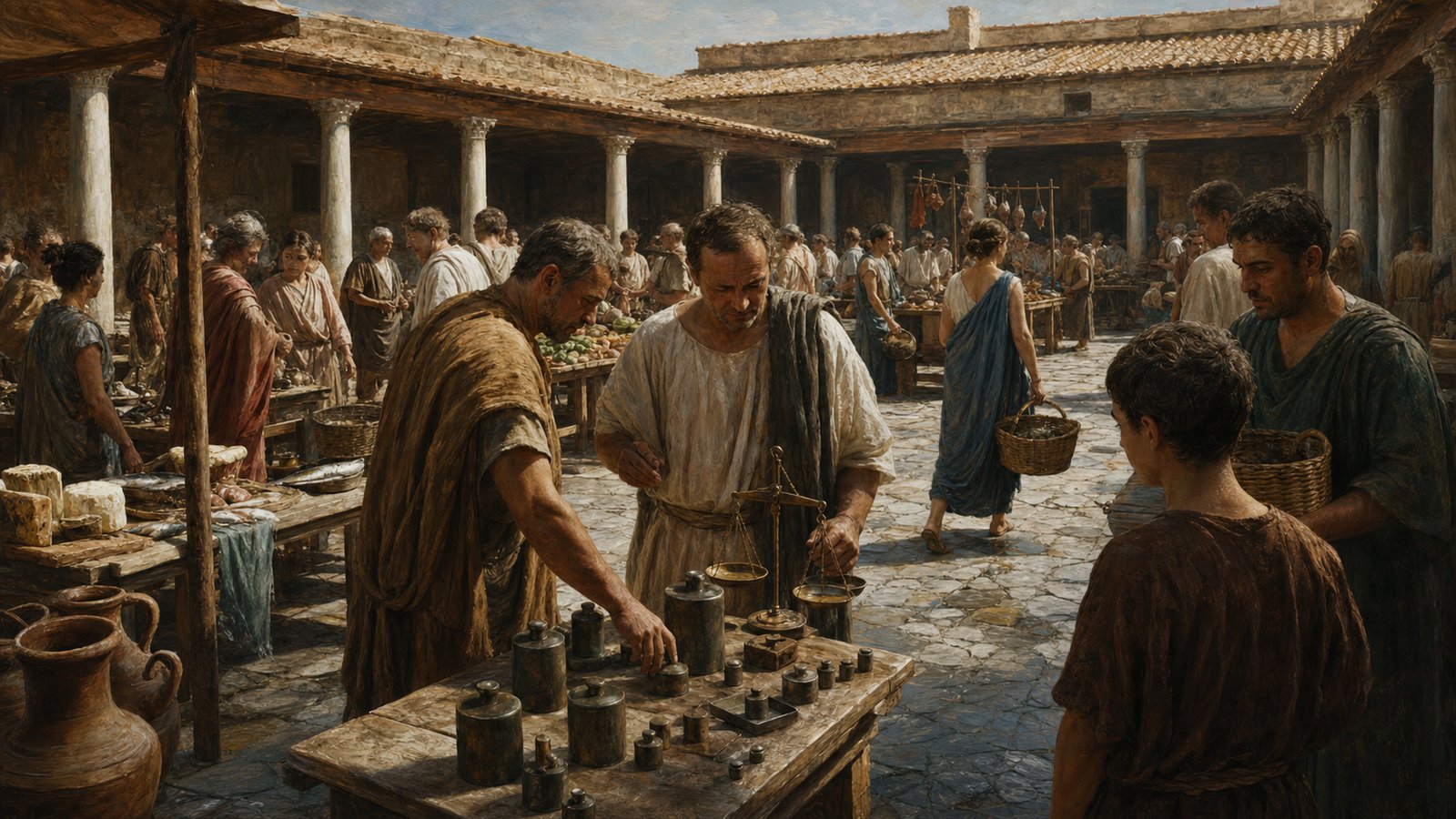
A macellum concentrated food trade in a public building. Stalls, counters, columns, customers, and movement turned buying into a social scene. The buyer who watched a scale was rarely alone with the seller.
That mattered. In a crowded market, the weight was not only a tool. It was a small public performance: put the goods down, balance the measure, let people see the result, then ask for payment.
Shops carried public life into ordinary need
Roman tabernae opened work and trade onto the street. The line between civic life and daily appetite was thinner than modern categories suggest. A person buying provisions was also moving through a city of eyes, voices, status, and memory.
The forum and market belonged to the same Roman habit of public business. Law, trade, politics, food, and gossip shared spaces. A fair weight could not make the city honest, but it gave ordinary people a visible ground for complaint.
Trust became an object you could point at
The strongest part of the system was not that Rome had perfect measures. It was that trust became less private. A buyer could point to the scale. A neighbor could remember the stall. A magistrate, witness, or rival seller could hear a complaint.
Market weights made Roman commerce feel governed at the smallest scale. They turned a handful of grain or olives into a civic question: what counts, who checks it, and what happens when the count is wrong?
The scene is easy to underestimate because it lacks drama. No army marches, no emperor speaks, no mob storms a palace. Yet this was the everyday machinery of confidence: a pound divided into parts, a counter open to the street, and a city willing to make measurement visible.
The surviving vocabulary matters because it shows how ordinary this machinery was. A libra, its unciae, a set of pondera, a stall in a macellum: none of these needed a heroic explanation. They belonged to the daily habits by which a city turned appetite into exchange and exchange into repeatable conduct.
A false weight was not only a private trick. In a dense market it threatened the shared assumption that the next counter, the next measure, and the next purchase could be approached with the same expectations. Public measurement was a small defense against the exhaustion of constant suspicion.
The objects also gave memory a handle. A customer might not reconstruct every word of a quarrel, but he could remember the weight, the balance, the stall, and the people present. Roman trust was often anchored in visible routines that neighbors could retell.
This does not mean the system was fair to everyone. Poor buyers had less room to walk away, and sellers could still exploit urgency or ignorance. The point is sharper: because unfairness remained possible, the city needed objects and places that made unfairness easier to name.
A macellum full of noise therefore carried a quiet political lesson. Measurement turned need into a public standard. The person buying food for dinner stepped briefly into a Roman argument about order, authority, and what could be checked in common.
At this scale, Roman government was not an abstract empire. It was the expectation that a pound was a pound, a counter could be watched, and a bargain could be measured before it disappeared into somebody else’s purse.
A buyer who saw the balance settle also saw the city’s promise in miniature. Rome could not make every vendor honest, yet it could provide a language for honesty: weight, part, counter, witness, and public place. Those words turned a transaction into something more durable than appetite.
This helps explain why small commercial tools deserve the same attention as roads and aqueducts. Roads moved goods across distance; weights made those goods negotiable when they arrived. The infrastructure of empire did not end at the city gate. It continued on the table where a seller measured out dinner.
The market also trained people to think comparatively. A pound here could be weighed against a pound there. A customer who learned the feel of one transaction carried that expectation to the next stall, the next street, and the next complaint. Repetition made the standard social.
In a city full of strangers, that repetition mattered. Family trust could not govern every purchase. Friendship could not verify every handful of grain. The market needed simple objects that allowed people who did not know each other to act as if a common measure stood between them.
The balance scale therefore did cultural work. It taught Romans that fairness could be staged in public, that value could be made visible, and that a citizen or resident did not have to accept every claim as private authority. A little weight could pull a whole argument down to earth.
The most revealing part is how modest the device was. A set of weights could not feed Rome, patrol the streets, or settle every quarrel, yet it could give a hungry buyer one concrete thing to inspect. In that limited, repeatable gesture, Roman commercial life found a way to make trust less dependent on personality and more dependent on public form.
The result was not modern consumer protection, and it should not be romanticized as equality. It was something older and rougher: a shared object that made a claim testable in front of other people. In a world of noise, bargaining, hunger, and unequal power, that was already a meaningful civic technology for seller, buyer, and onlookers together daily.
Sources & Further Reading
- Smith Dictionary, Pondera
- Smith Dictionary, Libra
- Smith Dictionary, Macellum
- Smith Dictionary, Taberna
- Smith Dictionary, Forum