
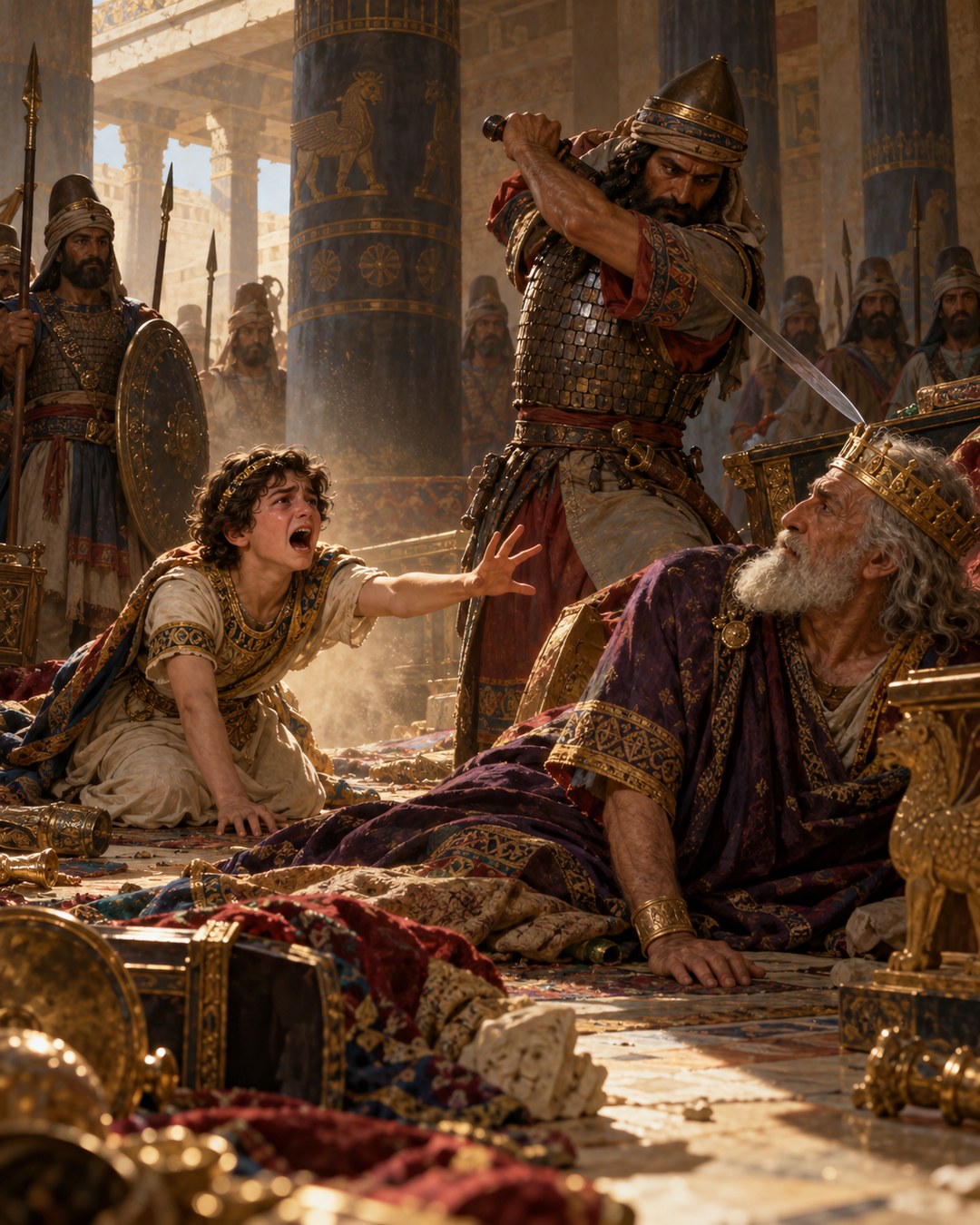
The soldier saw a defeated man, not a king. His sword was already drawn when a young man who had never been able to speak forced out the name that changed the scene: Croesus.
Aulus Gellius tells the story through Herodotus, but his chapter is interested in more than a marvellous cure. The son’s first words identify someone the attacker has failed to recognize. Voice arrives as intervention. Before it becomes conversation, it stands between a weapon and a life.
Gellius then pairs that royal crisis with a sacred contest on Samos. Another previously speechless witness finds his voice when he sees a false lot being slipped into a draw. The scale changes from a captured city to procedural cheating, but the verbal mechanism remains exact: someone who could not speak names what must be stopped.
Defeat stripped Croesus of the sign that might have saved him
Gellius begins with a long condition rather than a sudden miracle. Croesus’s son had reached the age for speech, grown into youth, and still could not utter a word. People regarded him as mute and tongue-tied.
That duration matters. The crisis does not merely silence an ordinarily fluent witness. It confronts a witness who has no established voice on which anyone can rely.
The political setting intensifies the problem. Croesus has been defeated in a great war, and the city where he lives has been taken. Rank has ceased to protect him. An enemy soldier runs toward him with a sword while unaware that the man before him is the king.
Recognition is now the missing defense. A guard, emblem, or ceremony might have announced Croesus’s identity in another setting. Capture has erased those buffers. The attacker sees only a target within a conquered place.
The son possesses the crucial fact but lacks the ordinary means to transmit it. The story’s tension rests on that imbalance: perfect knowledge inside one observer, fatal ignorance inside another, and almost no time between them.
This differs from the strange case in which a blow removed one learned system while leaving other memory intact. Croesus’s son has not lost a specific vocabulary in the narrative. He has lived without usable speech and must create an utterance at the moment identity becomes a matter of survival.
The first sentence did one job and no more
Gellius describes effort and breath. The young man opens his mouth to cry out; force breaks the impediment or bond upon his tongue. He then speaks plainly and clearly.
The words preserved from Herodotus are direct: “Man, do not kill Croesus.” They contain an address, a prohibition, and a name. Nothing is ornamental. The sentence does exactly the work demanded by the crisis.
The name is indispensable. “Do not kill him” might express fear without correcting the soldier’s mistake. “Croesus” restores the identity that defeat has hidden. The attacker is made to see a king where he had seen an anonymous enemy.
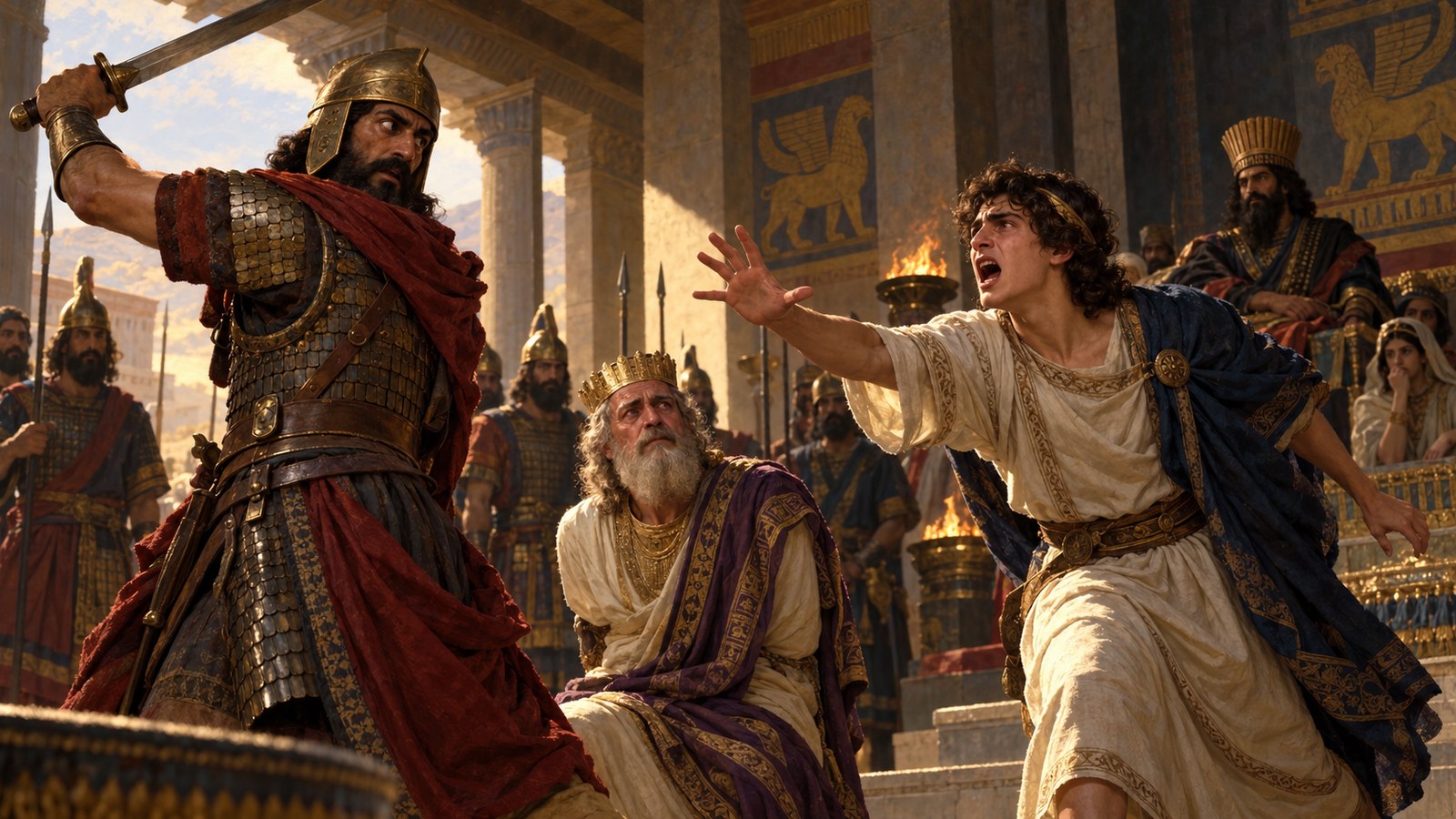
The soldier withholds the sword. Croesus lives. Gellius then says the son continued to speak from that time onward. The first utterance is therefore both a completed rescue and the beginning of an enduring ability.
It would be easy to let the later ability swallow the immediate achievement. Yet Gellius orders the details around action. The voice does not first prove itself by reciting, greeting, or answering a question. It proves itself by changing what another person is about to do.
The scene also separates visibility from knowledge. Croesus is directly before the attacker, but his identity is invisible in practical terms. The son’s words do not introduce a distant object; they reinterpret the person already in sight.
Herodotus supplied the sentence; Gellius supplied the pairing
Gellius explicitly names Herodotus as the chronicler and quotes the first words attributed to the son. His Roman notebook therefore preserves not only the outline, but the formula that makes the rescue intelligible.
That attribution limits what can safely be claimed. Gellius does not offer a medical diagnosis. He does not explain the son’s earlier condition through anatomy, shock, or divine intervention. He describes an impediment broken by effort and breath because that is how the received story accounts for the change.
The chapter’s craft lies in selecting what follows. Gellius does not move to another king or another battlefield. He chooses Echeklous, an athlete from Samos who had also been speechless.
Pairing invites comparison without declaring the incidents identical. One story concerns a royal father under a sword after military defeat. The other concerns fairness in the casting of lots at a sacred contest. Their institutions and stakes differ sharply.
What binds them is the moment at which silence becomes impossible to maintain. Each witness sees a wrong trajectory already in motion: a soldier misidentifies a captive; an official slips a false name into a draw.
Gellius’s method resembles the way a seemingly powerless witness could make hidden guilt suddenly public. The evidentiary force lies not in a long argument but in an interruption that changes everyone’s understanding of the scene.
Echeklous spoke when a sacred draw bent
Echeklous is identified as an athlete of Samos. Gellius says that he had previously been speechless. During a sacred contest, he saw that the drawing of lots between the Samians and their opponents was not being conducted fairly.
The deception is concrete: a lot bearing a false name was being slipped in. Echeklous sees both the object and the act. His sudden shout tells the man responsible that the fraud has been observed.
Here the first speech does not save a body from a sword. It protects a procedure from substitution. The false lot would make a rigged outcome look like chance. By speaking, Echeklous prevents concealment from surviving long enough to become an accepted result.
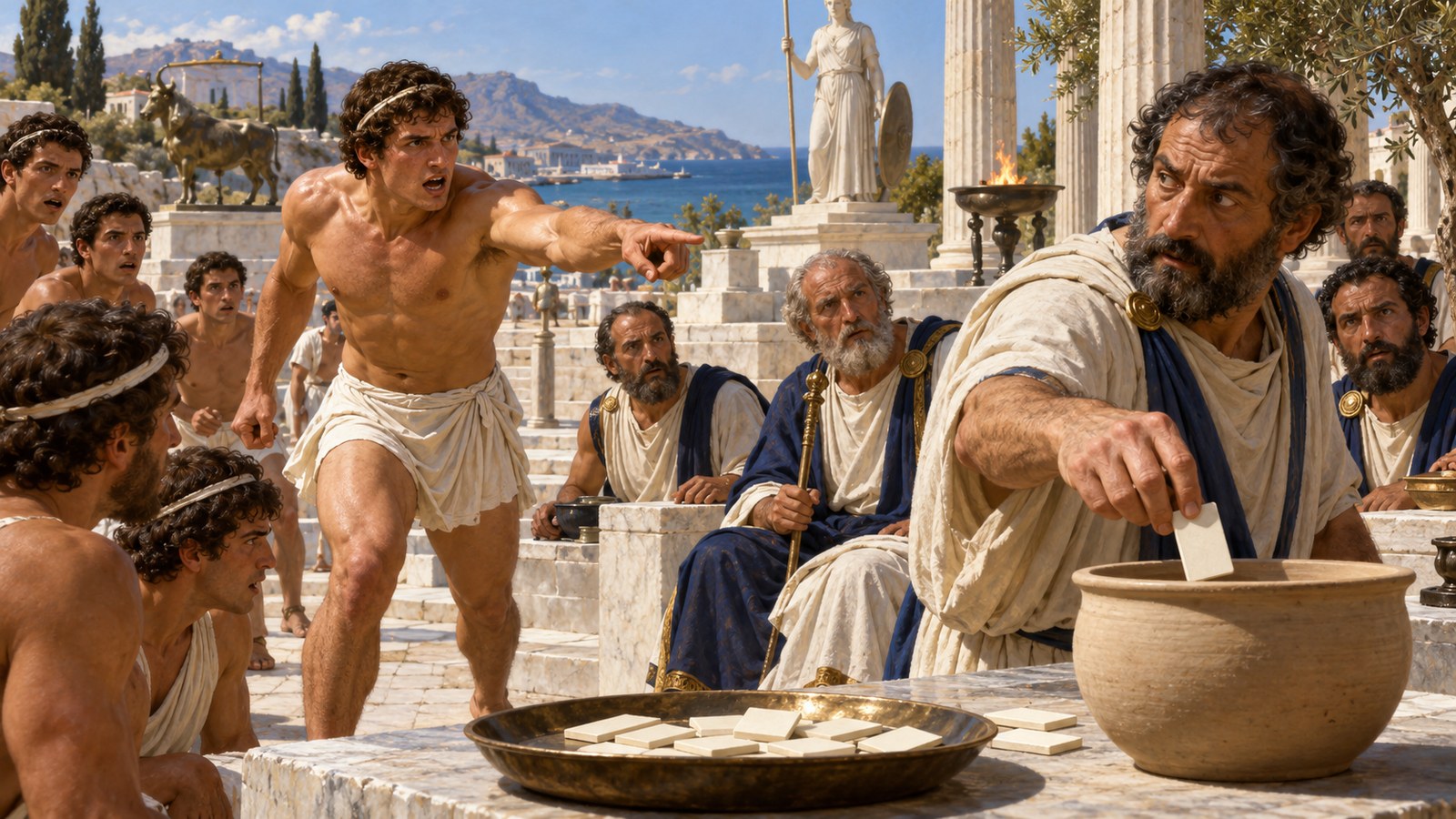
The sentence is not preserved in the same exact form as the warning to Croesus’s attacker, but its function is clear. Echeklous announces that he sees what the official is doing. Observation becomes accusation.
Gellius says he too was freed from the check upon his speech and thereafter spoke without stammering or lack of clarity. As in the Croesus story, the new ability continues. Yet again the chapter introduces it through a socially urgent use.
The two witnesses do not speak because an audience invites a performance. They speak because delay would allow an act to harden into consequence. The timing gives their first words authority before either has a history as a speaker.
A voice entered public life by stopping an act
Placed together, the stories produce a narrow theory of speech. Voice matters first as a capacity to alter another person’s next movement. The soldier lowers a sword. The dishonest draw is exposed. In both cases, words arrive before the action is complete.
The content is also relational. Croesus’s son names his father and addresses the attacker. Echeklous addresses the person manipulating the lots and makes the observer’s presence known. Neither voice exists as sound alone; each establishes who knows what about whom.
Gellius offers no general rule that crisis cures muteness. He reports two stories and notes their similarity. Treating them as clinical evidence would demand more than the chapter supplies.
The safer insight concerns narrative structure. Ancient compilers recognized that a first utterance becomes memorable when it performs a task no one else can perform in time. The miracle is tied to consequence.
Croesus’s own lost status sharpens that pattern. Kingship cannot announce itself after defeat. The son’s sentence briefly restores the protective force of the name. The conqueror’s soldier does not spare an anonymous captive and later discover the truth; he changes course at the instant the truth is spoken.
Echeklous’s scene reverses the direction of authority. A contest official controls the draw, but a speechless athlete controls the fact of observation. The shout does not need office because it makes concealment impossible.
Both stories therefore turn vulnerability into a precise form of agency. The young man cannot command an army, and the athlete does not control the sacred contest. Each can insert one fact into the moment before power acts.
Afterward, both continue speaking. That conclusion gives the tales their marvellous arc, but it is not their only payoff. Even if the chapter ended with the first sentence, each voice would already have justified its arrival.
Gellius’s pairing keeps that achievement visible. Speech is not introduced through eloquence. It appears as the shortest adequate bridge between knowledge and intervention: a name before a sword falls, an accusation before a false lot is accepted.
Sources
Aulus Gellius, Attic Nights 5.9, retelling Herodotus on Croesus’s son and adding the parallel of Echeklous.