
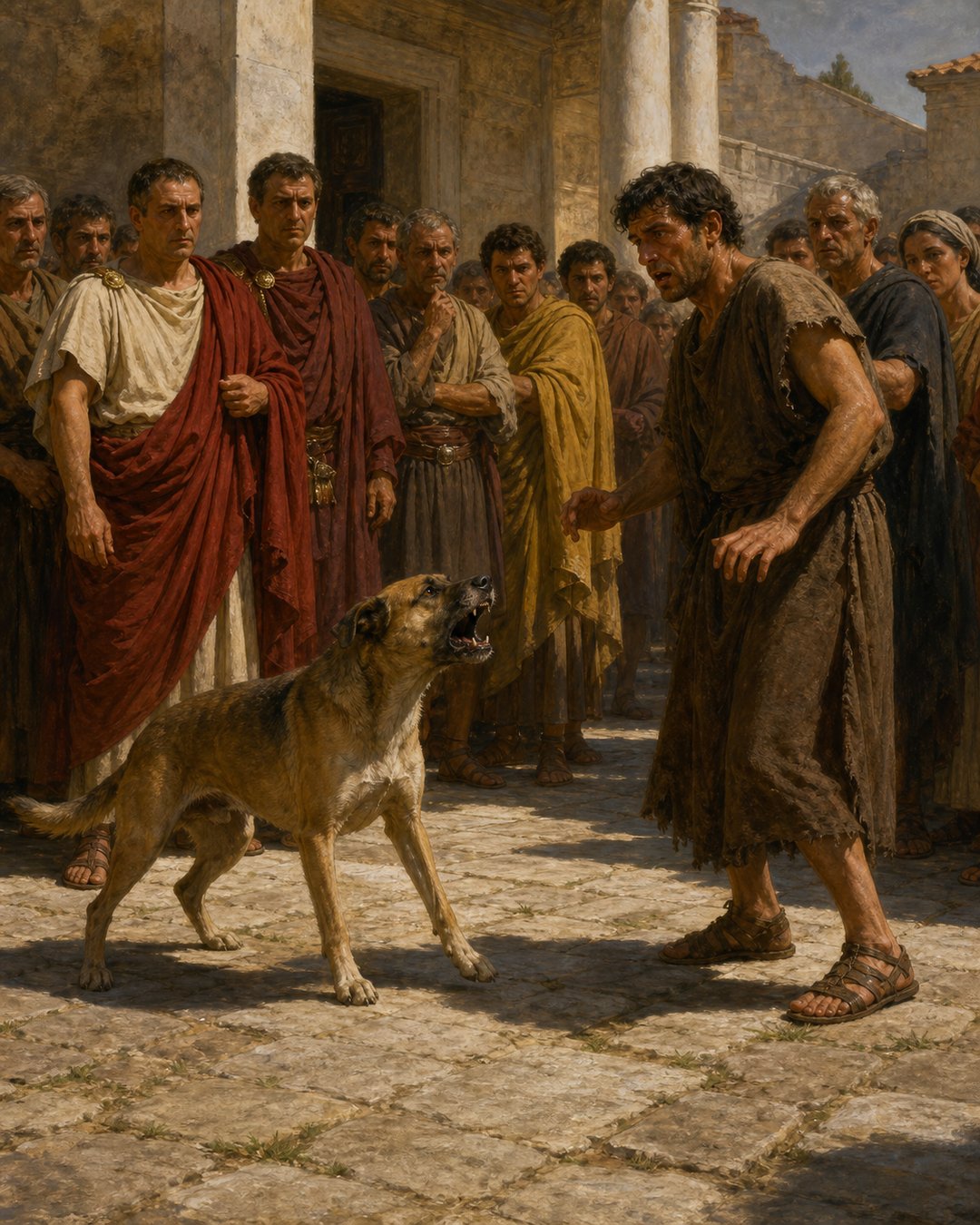
The dog did not search a road or lead anyone to a hidden body. Its decisive act happened in a gathering in Epirus, where the suspected killer stood among other people. Pliny the Elder says the animal recognized the man who had murdered its master. It barked, snapped and kept the accusation fixed on him until he confessed.
The scene is brief enough to sound like a courtroom fable. Yet Pliny does not actually make the dog a judge, nor does he claim that barking by itself proved guilt. The animal creates a public crisis of recognition. The confession still comes from a human voice, but it comes only after the dog singles one person out before witnesses.
Pliny places this encounter inside a long passage on canine fidelity, memory, scent and social attachment. That setting changes its meaning. The Epirote dog is not introduced as a supernatural oracle. It appears beside dogs that remember voices and routes, track footprints, guard bodies and react to the loss of a familiar person.
A Gathering Turned Recognition into Accusation
Pliny gives neither the murdered master’s name nor the killer’s. He supplies only the location, Epirus, and the mechanism of exposure. A dog recognized its master’s murderer in a group, then used snapping and barking to make the recognition impossible to ignore. The unnamed people around them matter because private memory becomes a shared event.
An ancient reader did not need to imagine the animal answering questions. The dog’s contribution was behavioral and directional: this person, not the others. Repetition held the target in place. The accused man’s confession then translated the animal’s insistence into the kind of statement human authorities could understand.
That sequence separates the story from a trial by omen. In the account of a young judge refusing to pretend unclear evidence was clear, uncertainty stops a human verdict. Here an animal’s certainty does not itself become a verdict; it removes the suspect’s ability to remain comfortably anonymous inside the crowd.
Pliny calls dogs the domestic animals most faithful to human beings before he tells the story. That opening announces the value he wants the examples to display. Fidelity is not an abstract virtue in the catalogue. It takes physical forms: staying, returning, refusing food, following scent and directing attention toward a threat.
A Wounded Guardian Kept the Body from Disappearing
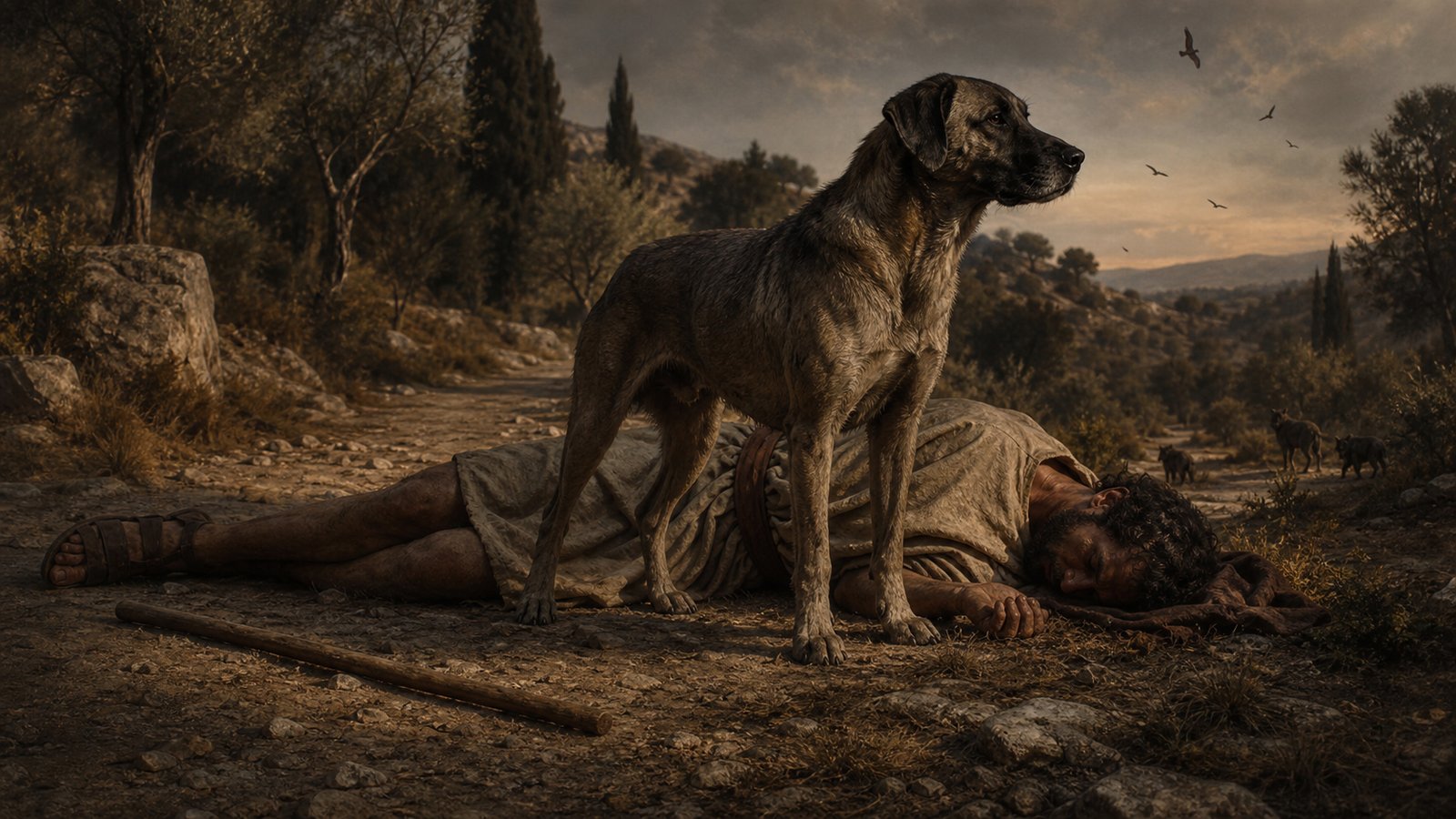
The Epirote scene follows another story with a darker landscape. Brigands attacked a master, and his dog fought in his defence. Covered with wounds, the animal remained beside the corpse. It drove away birds and beasts of prey rather than abandoning the dead once resistance could no longer save him.
This first dog does not solve the murder. It preserves the relationship after the master can no longer command, reward or recognize it. Guarding also preserves the body as a social fact. Scavengers would physically break apart the evidence of a life and death; the wounded dog keeps that final point of attachment intact.
Pliny’s pairing is carefully progressive. One animal refuses to leave a body. The next carries recognition from the victim to the murderer. Protection becomes identification. The first example measures loyalty by endurance at a fixed place, while the second measures it by selecting a person out of many.
The emphasis on public reaction resembles the Forum raven whose daily greetings became collective memory. Both accounts ask what happens when repeated animal behavior enters human civic space. The raven’s death produced a funeral; the Epirote dog’s accusation produced a confession. Familiarity made each animal socially legible before the decisive moment arrived.
Names, Voices and Roads Made the Story Plausible
After the exemplary tales, Pliny turns to capacities he presents as ordinary observations. Dogs know their masters and distinguish a sudden arrival as a stranger. They respond to their own names and recognize the voice of a member of the household. They can remember the route to places far away.
These claims create the practical floor beneath the Epirote story. Recognition depends on maintaining distinctions: master and stranger, household voice and unfamiliar sound, known route and open country. Pliny’s dog identifies a murderer because his catalogue has already made durable social memory the defining canine ability.
He also records a simple bodily way to cool aggression: a person could sit down on the ground. Whether that always worked is not the point of the murder story, but it shows Pliny collecting repeatable-looking actions beside dramatic examples. Posture, sound, scent and movement all become evidence in his portrait of a species unusually attentive to humans.
The catalogue therefore moves between different standards of credibility. A household can observe whether a dog answers its name. A hunter can see whether a leash pulls toward a track. A reader must trust a transmitted story about a confession in Epirus. Pliny uses the familiar behaviors to make the exceptional scene feel continuous rather than magical.
A Leash Converted Scent into Human Direction
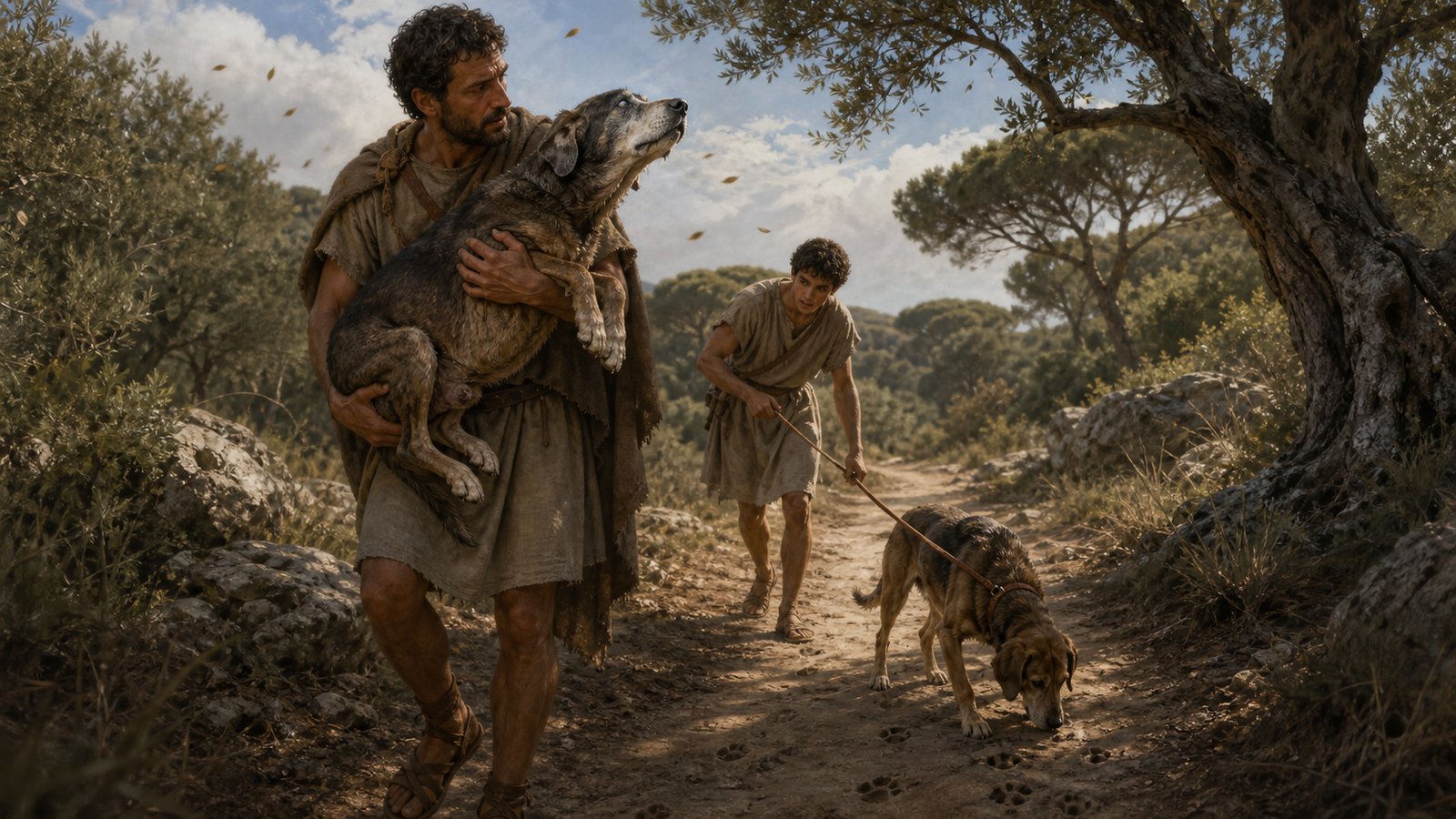
Hunting gives Pliny his clearest description of canine information becoming visible. A hound follows footprints and drags the accompanying tracker toward the quarry. The leash connects two different kinds of knowledge: scent available to the animal and direction available to the person holding it.
Once the quarry comes into view, the dog’s signals change. Pliny describes a silent sequence, first in the tail and then in the muzzle. The hunter reads posture where no spoken report exists. This is close to the Epirote gathering at the level of mechanism: an animal focuses human attention through repeated, interpretable movement.
Even age and blindness do not erase that role. Pliny says old, weak hounds could be carried in human arms so they might sniff the breeze and point their muzzles. The image reverses the usual partnership. Human strength transports the body; canine senses still choose the direction.
The story is not a technical manual for forensic tracking. It is a catalogue of interfaces between animal perception and human action. A leash tightens. A tail changes. A muzzle points. Barking fixes on one man. Pliny repeatedly turns invisible memory or scent into a gesture that another creature can follow.
Loyalty Expanded from the Household to the Battlefield
Pliny does not keep fidelity small. He says two hundred dogs escorted an exiled king of the Garamantes back to power and fought those who resisted. Colophon and Castabulum supposedly put canine troops in the front rank. After Cimbrians were killed, their hounds defended the wagon-houses left behind.
These are reports of varied reliability, not a single documented military institution. Their scale nevertheless shows what Pliny is doing with loyalty. The same quality that holds one dog beside one body can be enlarged into a line of battle, a returning king’s escort or the defence of a mobile settlement.
Other examples turn loyalty inward. Jason of Lycia’s dog refused food after Jason was murdered and starved. Duris supplied the name Hyrcanus for a dog said to have thrown itself into King Lysimachus’s funeral fire. Pliny stacks these deaths to portray attachment as stronger than self-preservation.
The account of Hippo’s dolphin and the crowds drawn by its bond with a boy also survives through a writer openly negotiating marvelous animal behavior. Pliny the Younger flags that tale as resembling a fable. The Elder arranges his dog stories as cumulative natural history. Neither method removes uncertainty, but each reveals how credibility was built.
The Epirote confession sits near the center of that construction. It requires no talking animal and no divine intervention. A dog remembers a relationship, recognizes a threat and behaves so forcefully that a gathering cannot ignore the choice. The hidden crime becomes visible because the animal’s loyalty is public.
For Pliny, this was evidence of canine fidelity. For a careful reader, it is also a lesson in how an ancient anecdote makes proof. Familiar observations support extraordinary reports; gestures become readable; a crowd supplies witnesses; and the final human confession closes a chain that began with barking.
Sources
Pliny the Elder, Natural History 8.61.