
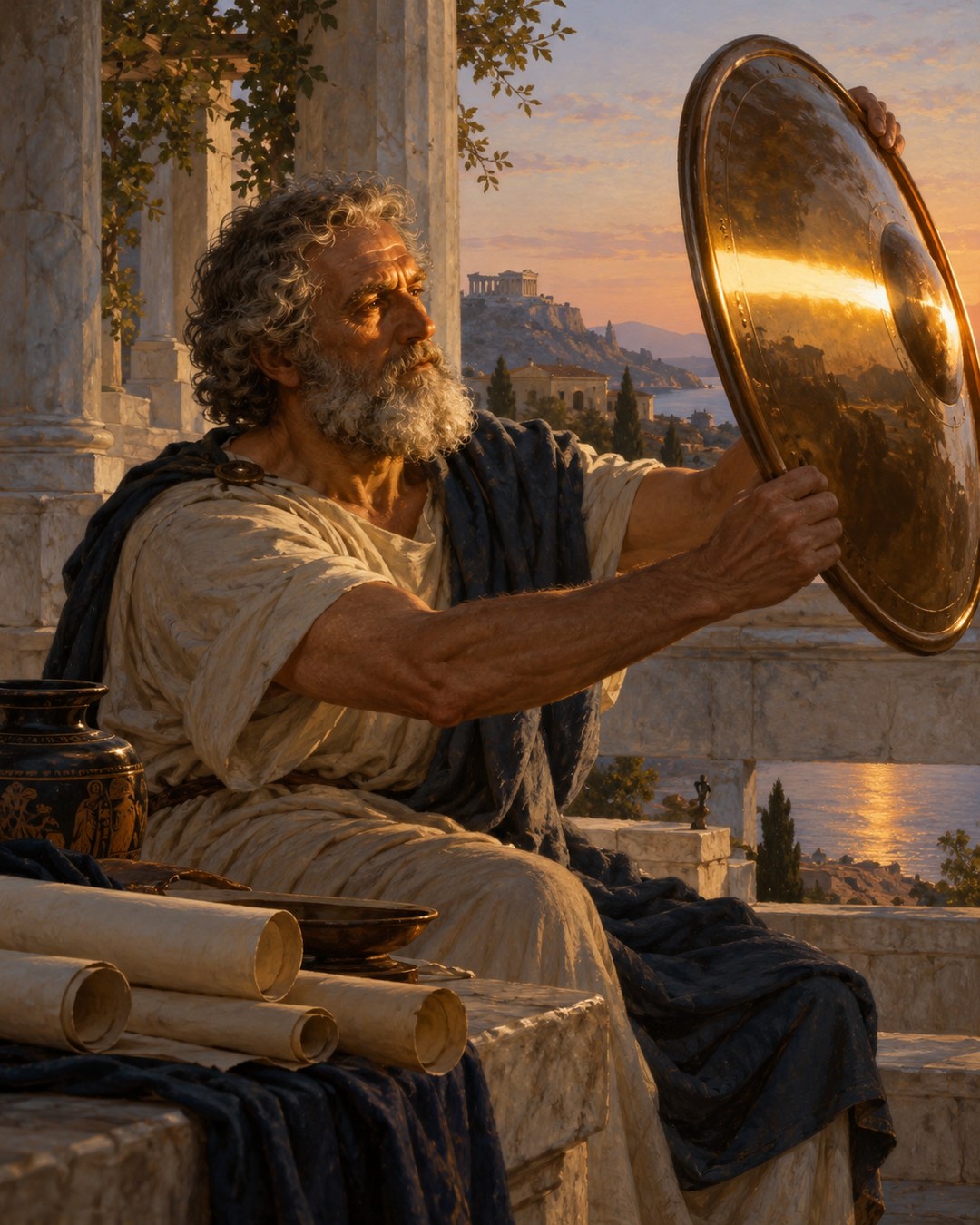
Democritus faced a polished shield toward sunrise. In the story preserved by Aulus Gellius, the blaze reflected from brass destroyed the philosopher’s sight. He wanted fewer distractions while examining nature.
Then the Roman playwright Laberius took the device away from philosophy and placed it in the mouth of a rich miser. The miser did not want clearer thought. He wanted to avoid seeing his spendthrift son enjoy good fortune.
The physical action remains spectacular in both versions. Its moral direction reverses. Gellius’s short chapter shows how adaptation can preserve an image while replacing the reason that made the image admirable.
The inherited story made blindness an instrument of attention
Gellius introduces Democritus through Greek records and treats him with unusual respect. He calls the philosopher worthy of reverence and a figure of the highest authority.
According to that received account, Democritus deprived himself of sight voluntarily. The motive was intellectual concentration. Thoughts and meditations directed toward the laws of nature would become more vivid and exact if the eyes no longer offered allurements and distractions.
The reasoning gives vision two values at once. Sight is a powerful source of access to the world, yet its immediate attractions can compete with sustained examination. The anecdote resolves that tension with an irreversible act.
Gellius does not verify that Democritus truly blinded himself, and the article should not turn the report into established biography. What matters inside the chapter is the way Greek story represented philosophical commitment: the thinker removes an entire class of interruption to intensify inward work.
The claim is deliberately extreme. Ordinary discipline might involve leaving a crowded room or lowering one’s eyes. Voluntary blindness converts concentration into sacrifice and makes the pursuit of natural law visible through the destruction of vision.
That paradox belongs beside the story of Socrates remaining fixed in thought from one dawn to the next. Both anecdotes turn invisible concentration into a physical scene, but only the Democritus tradition makes the body permanently bear the cost.
A shield and sunrise gave the story theatrical machinery
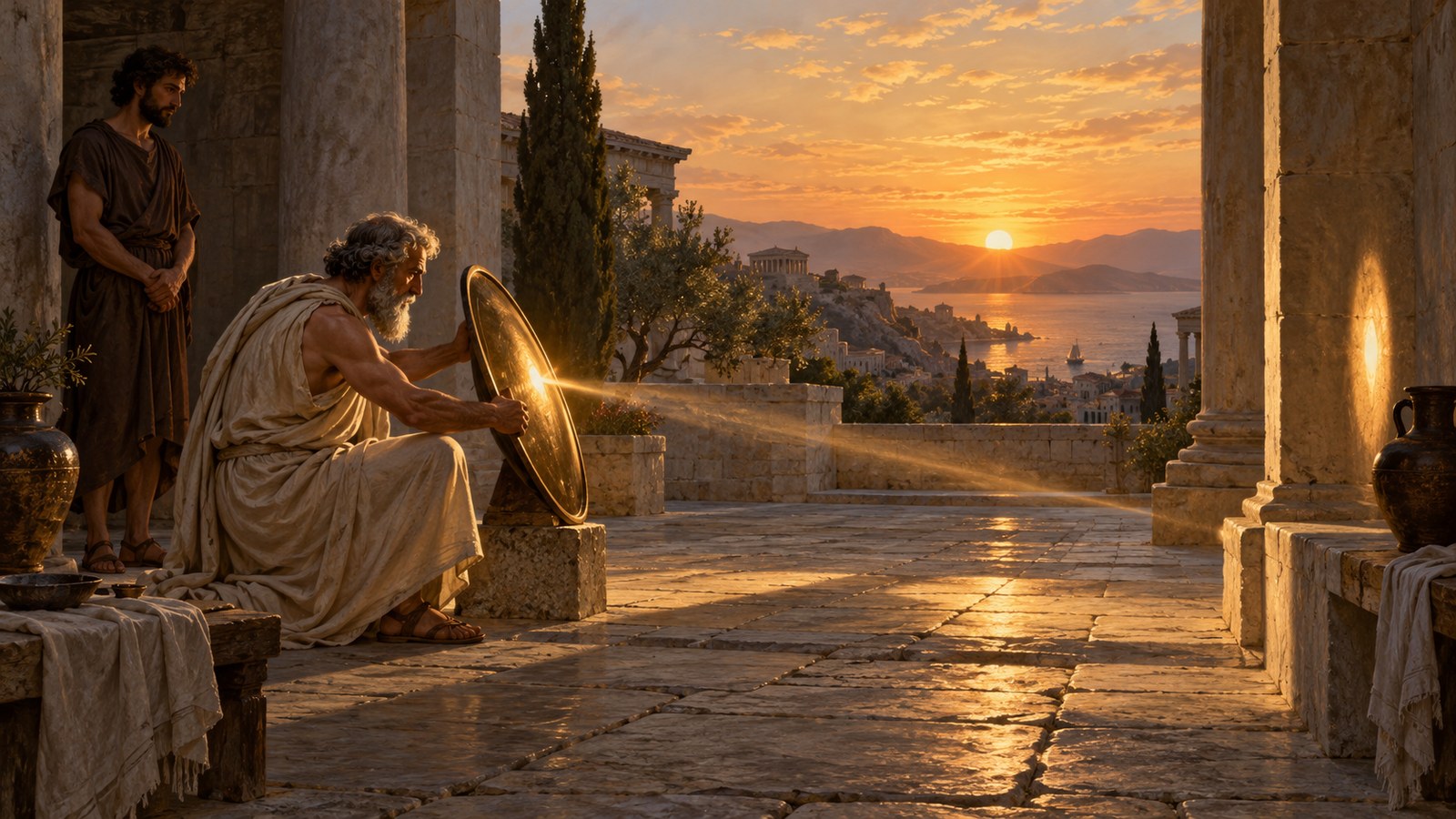
Gellius says Laberius described both the act and the ingenious manner in which it was done. The verses stage Democritus at Abdera setting a shield toward the rising Hyperion, a poetic name for the sun.
The brass turns ordinary sunrise into a focused blaze. Democritus does not attack his eyes directly in the quoted scene; he arranges objects so reflected light performs the injury.
That device is made for theatre because it can be pictured quickly. A shield, an eastern sky, and a man holding his gaze establish preparation, suspense, and consequence. The audience does not need a lecture on optics to understand concentrated brightness.
Gellius calls the verses elegant and finished. His admiration matters because the adaptation is not presented as careless distortion. Laberius knows how to compress a philosophical legend into a strong stage image.
The shield also carries associations that the chapter leaves unstated, so restraint is necessary. Gellius identifies it as the reflective device; he does not develop a symbolism of warfare, protection, or civic duty. The visual power comes from use: an object made of bright brass redirects the sun.
The mechanism lets the later speaker imagine a parallel. Once blindness can be caused by reflected splendour, the miser can replace brass with gold and philosophical withdrawal with domestic resentment.
The Ropemaker changed who wanted not to see
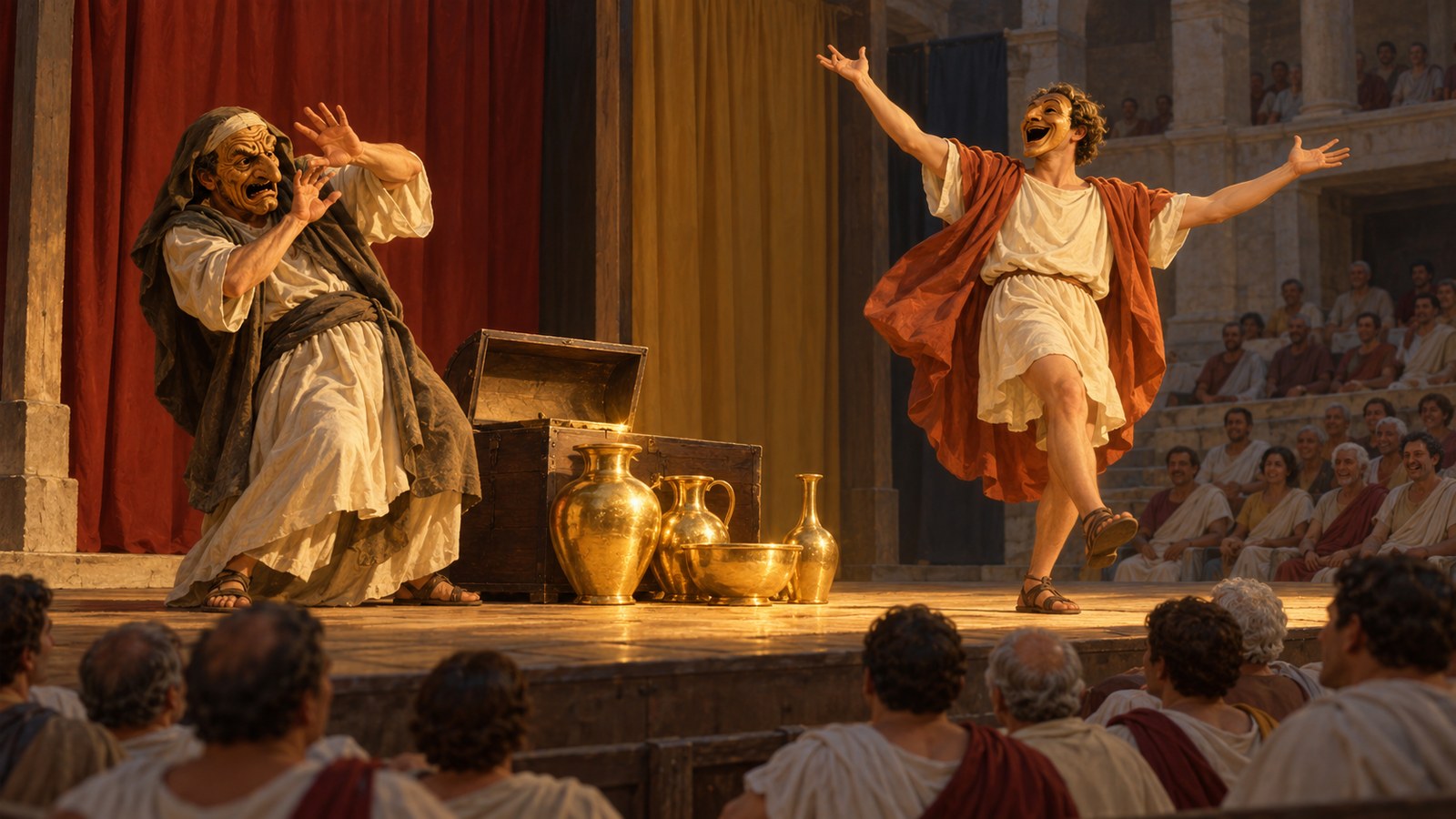
Laberius placed the verses in a farce called The Ropemaker. The speaker is a wealthy, stingy miser complaining vigorously about the extravagance and dissipation of his young son.
This character borrows Democritus’s action but cannot inherit his motive. The philosopher wishes to examine nature’s laws without visual distraction. The miser wishes to escape the sight of another person’s good fortune.
That difference changes self-denial into possessiveness. The miser does not renounce wealth. His imagined instrument is the blaze and splendour of his own gold. Property remains central even in the fantasy of withdrawing from sight.
Laberius’s Democritus says he avoided seeing bad citizens prosper. The miser adapts the complaint to his spendthrift son. Public moral disgust contracts into a household conflict over money, authority, and succession.
The son’s “good luck” is intolerable because it implies enjoyment outside the father’s control. Blindness would not reform the son or recover the spending. It would merely protect the miser from witnessing an outcome he resents.
This is where genre does its work. A philosophical sacrifice can be retold as comic excess because the new speaker exposes his own warped priorities while trying to sound elevated.
The same image carried opposite moral weight
Adaptation often preserves plot while changing language. Laberius does something more compact: he preserves the physical device and substitutes a motive.
The philosopher’s account moves from eyes to mind. Remove allurements, and meditation becomes exact. The miser’s account moves from gold to envy. Use splendour to remove the view, and the son’s enjoyment no longer wounds the father.
The action therefore cannot be judged by appearance alone. Two people might describe the same self-blinding device. One narrative frames it as concentration on nature; the other as flight from resentment. Motive reorganizes the image.
Gellius’s chapter trains the reader to keep versions separate. He first reports what Greek records said, then marks Laberius’s reason as imagined and suited to the playwright’s own subject. The comic version is not smuggled into Democritus’s biography.
That attribution discipline differs from the attempt to explain Archytas’s flying wooden dove through weights and enclosed air. There, the notebook preserves a proposed mechanism for an extraordinary object. Here, it preserves the mechanism of literary reuse.
The distinction also protects the joke. If Laberius’s miser were mistaken for historical evidence about Democritus, the character’s self-exposure would disappear. Comedy depends on the audience hearing the borrowed grandeur and recognizing the reduced motive beneath it.
Gellius preserved the seam instead of smoothing it away
A compiler could have quoted the verses as a colourful confirmation of the philosophical tradition. Gellius instead points directly at the change. Laberius imagined another reason and applied it neatly to his subject.
That editorial sentence is the chapter’s hinge. It tells readers where inheritance ends and invention begins. The shield and reflected sun belong to the adapted story; the miser’s resentment belongs to the farce.
The seam reveals what Roman literary culture valued in an anecdote. A memorable action could travel between history, philosophy, and comedy because it was detachable enough to serve new characters. Responsible reading required tracking the attachment point.
Democritus’s authority gives the comic speaker a borrowed altitude. For a moment, a household miser can compare his frustration to a revered philosopher’s renunciation. The comparison collapses under its own motive.
The miser also turns gold into an anti-knowledge device. Philosophical blindness is supposed to remove distraction so thought can become exact. Comic blindness removes evidence the father does not wish to face. One withdrawal seeks a clearer object; the other seeks no object at all.
This reversal makes the son important even though Gellius supplies almost nothing about him beyond youth, extravagance, and dissipation. The father’s fantasy tells the audience more about possession than about the son’s behavior. He would rather lose sight than revise his relation to wealth and inheritance.
Gellius does not ask the reader to choose whether the original anecdote was wise. He preserves its stated rationale and then admires the craftsmanship of its comic reuse. Philosophy and farce remain distinguishable without one cancelling the other.
The result is a lesson in reading transmitted stories. Repetition does not guarantee stable meaning. A shield can face the same sunrise; the reflected blaze can destroy the same sense; the moral action can still become its opposite when a new speaker explains why.
Laberius understood that the most durable part of the tale was its image. Gellius understood that the most revealing part of the adaptation was its motive. By recording both, he lets the reader see not only Democritus before the shield, but a playwright at work behind him.
Sources
Aulus Gellius, Attic Nights 10.17, on the tradition of Democritus’s blindness and Laberius’s adaptation in The Ropemaker.