
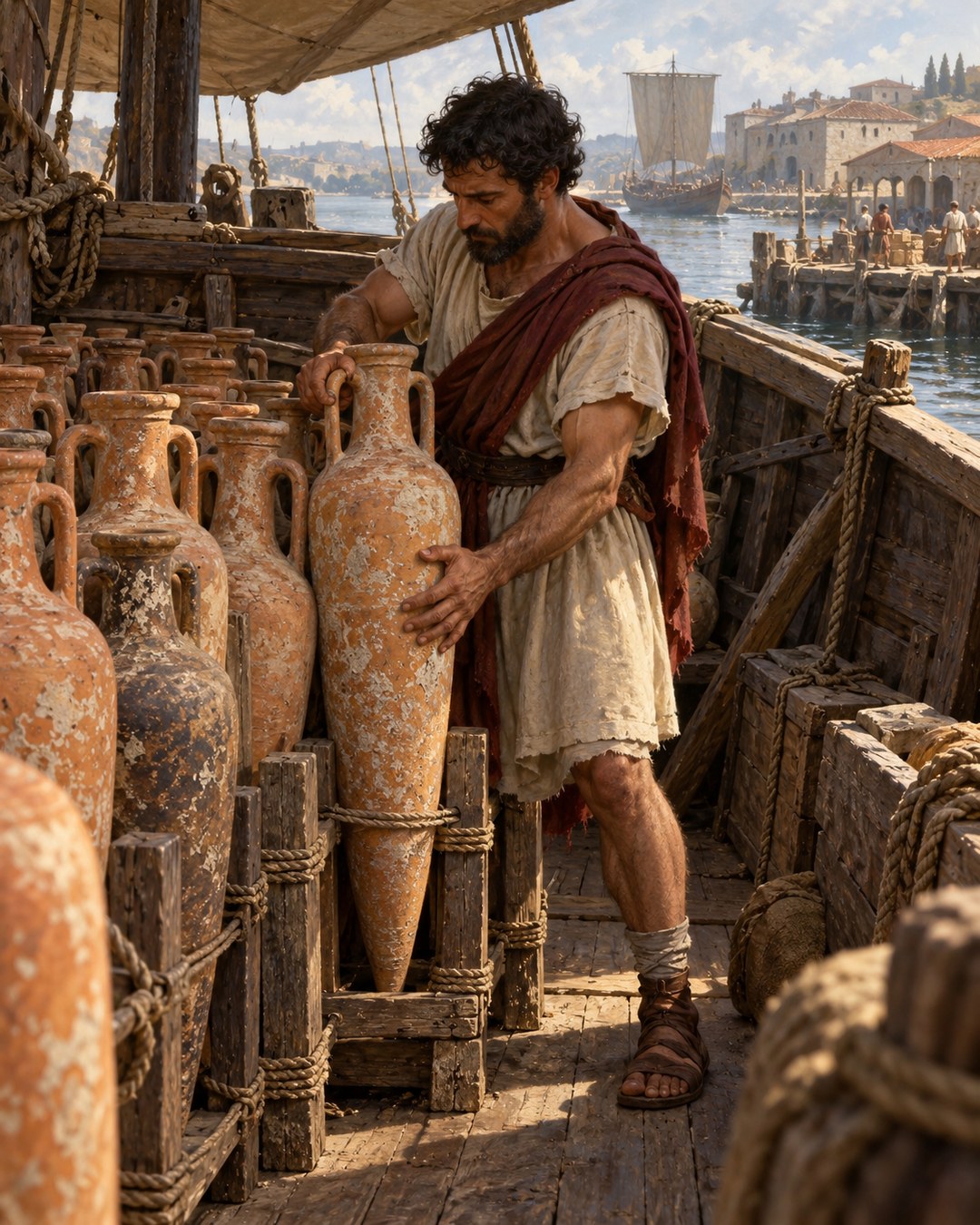
A container that ends in a point appears to have surrendered the simplest advantage of a pot: a flat base. The carrot amphora found in Southwark did the opposite. Its narrow pointed body allowed it to be stored upright, and evidence from shipwrecks shows that the same shape helped keep such vessels stable when they travelled by sea or river.
The jar was 410 millimetres high, 155 millimetres wide and 125 millimetres deep across its handles. Empty, it weighed 5,000 grams. Those dimensions describe a dense, narrow package rather than a broad household storage pot. The museum believes carrot amphorae carried dried fruit from the eastern Mediterranean. Shape, closure and cargo worked as one transport system.
The missing flat base was part of the design
The vessel’s name is modern and visual: “carrot amphora.” Its body narrows downward to a point. That profile distinguishes it from containers expected to stand independently on a room’s flat floor. Yet the museum specifically notes that the shape allowed carrot amphorae to be stored upright. The point therefore belongs to a support arrangement, not to instability.
A pointed jar can enter a rack, soft packing, ground or another holding structure in a way a broad foot cannot. The record does not specify the exact Southwark support, so it would be wrong to invent one. What it does establish is the outcome: the distinctive form supported upright storage. The apparent defect becomes an interface with the vessel’s surroundings.
The handles complete that logic. The recorded width and depth include them, placing the gripping points within a compact cross-section. A height of 410 millimetres gives the vessel vertical capacity, while the 155-by-125-millimetre spread keeps its body narrow. Its 5-kilogram mass before any stated cargo made secure placement more than a matter of neatness.
Those measurements also reveal how emphatically vertical the jar was. Its height was more than two and a half times its recorded width. Seen in a row, such vessels would present repeated narrow bodies rather than broad bellies. The pointed base continued that line downward into whatever support kept the amphora upright.
The Southwark find preserves only one container, but the type explains repetition. A shipper could not rely on each 5-kilogram empty jar balancing by itself. Stability emerged from many pointed bodies placed within a prepared cargo arrangement. The individual vessel and the surrounding pack were therefore parts of one design.
Shipwrecks preserved the answer
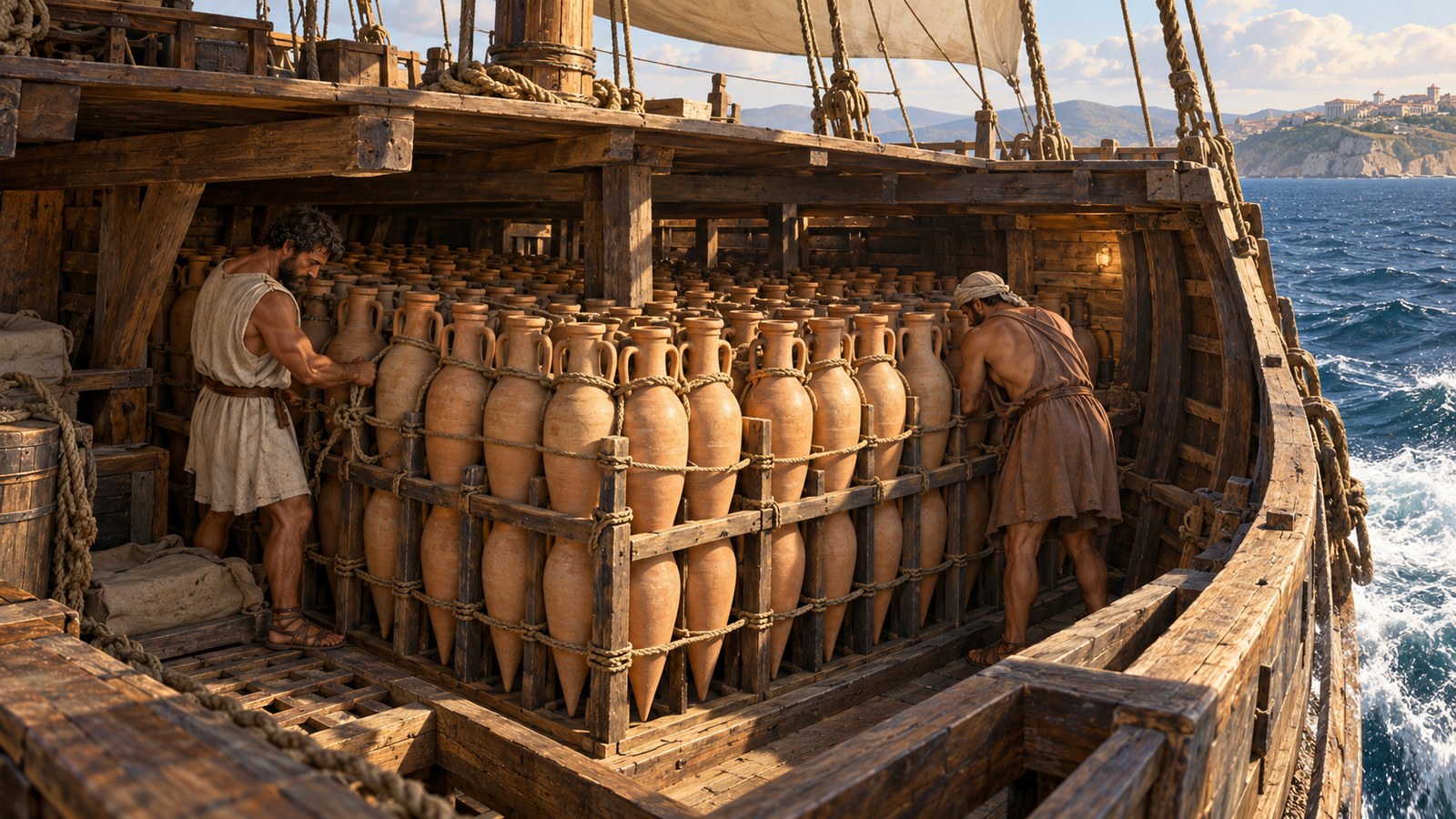
The argument for transport stability does not rest only on the silhouette of one museum object. The London Museum points to excavated shipwrecks. Their cargo arrangements show that the pointed shape helped keep these amphorae stable during movement by sea or river.
That evidence joins design to environment. On land, “upright” might mean simply resisting gravity. Aboard a vessel, it also means resisting repeated motion. A jar carrying food cannot be useful if each roll turns it into a loose ceramic weight. Stability had to come from the relationship between pointed containers and the way they were packed.
Roman commerce produced many such relationships. The route discussed in the long carriage of cinnamon to an Arabian market depended on time and successive movement. The carrot amphora reveals a smaller mechanical problem inside that larger world: how one package could remain controlled while the platform beneath it shifted.
The river matters as much as the sea in the museum’s description. The design was not limited to an ocean crossing. A vessel from the eastern Mediterranean could move through several transport environments before arriving in Britain. The same pointed profile remained useful wherever cargo had to be packed tightly and kept from wandering.
Shipwreck evidence is unusually direct for this question because a wreck can preserve containers in relation to one another. A museum shelf isolates the jar and makes its missing foot look inconvenient. A cargo context restores the neighbours and supports that made the point useful. The archaeological setting changes what counts as an intelligible base.
A seal turned pottery into a food package
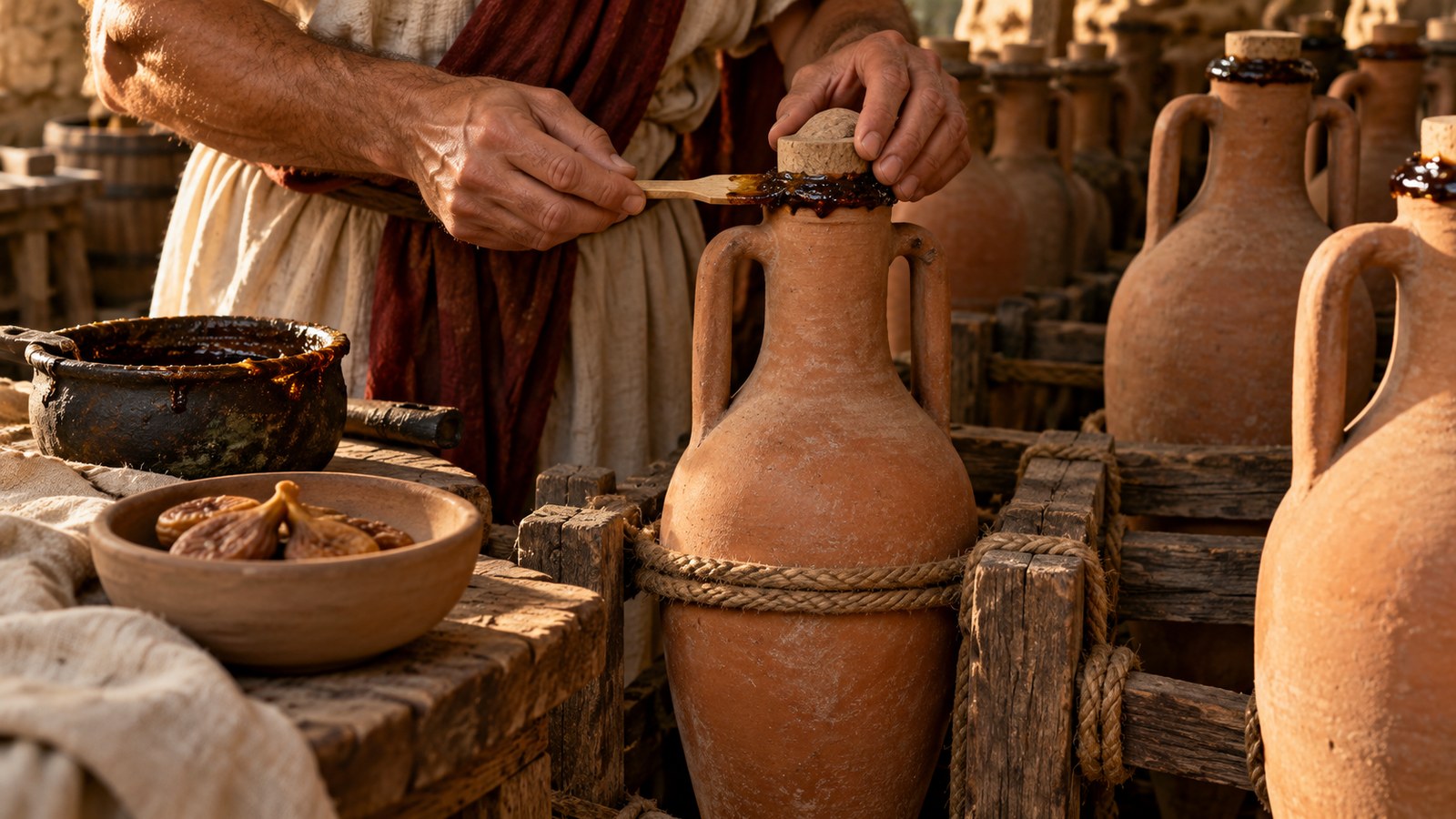
Amphorae carried foodstuffs around the Roman Empire, but ceramic walls were only part of the package. The opening could be closed with clay, cork or a wooden stopper. Wax or resin often covered that closure. The sequence combined a rigid container, a fitted plug and a sealing layer.
Each component answered a different vulnerability. The ceramic body held the bulk of the cargo. The stopper occupied the neck. Wax or resin covered the meeting point where stopper and vessel could otherwise remain exposed. The museum does not state which exact closure survived with this Southwark jar, so the article cannot assign one. The range of known methods still shows that transport packaging extended above the clay body.
That concern with closures has a close parallel in the way wax and cord made interference visible on a Roman box. The purposes were not identical: one system closed a food container, while the other exposed tampering. Both depended on small materials at a join. A package succeeded or failed at the place where it had to open later.
The range of stopper materials suggests adaptation within a stable concept. Clay, cork and wood differ in hardness and compressibility, but each could occupy the mouth of an amphora. Wax or resin then added a covering layer. The museum’s phrasing prevents us from choosing one exact recipe for this jar, while still allowing the closure system to be reconstructed in stages.
Dried fruit suited the narrow traveller
The museum says archaeologists think carrot amphorae were used to transport dried fruit. That identification is appropriately cautious. The Southwark vessel survives as ceramic; the record does not claim that its original contents remain inside. The likely cargo comes from the type rather than from a named residue in this particular jar.
Dried fruit gives the design a concrete commercial purpose without requiring a liquid-tight fantasy. The jar’s narrow body could gather many small pieces into one countable, movable load. The point helped it stand within a transport arrangement. The stopper and sealing layer closed the neck. Handles made the 5-kilogram container manageable before and after filling.
Its origin and findspot map the ends of a journey. The amphora was made in the eastern Mediterranean and found in Southwark. It dates broadly from the first century BC to the first century AD and is classified as late Iron Age–Roman. Those facts do not reveal every port, boat or owner between manufacture and deposition. They do demonstrate that a distinctive eastern container reached the Thames-side settlement.
The date range crosses the conventional boundary between the first century BC and the first century AD. That breadth does not weaken the transport evidence; it limits the precision of the chronology. The vessel can testify to an eastern Mediterranean container tradition reaching Southwark without being forced into a single voyage year.
Likewise, “probably dried fruit” is stronger than a guess but narrower than certainty. The type is associated with that cargo, while this record reports no surviving contents. Keeping type evidence separate from object-specific residue lets the amphora remain informative without making the absent fruit reappear as a fact.
Southwark kept the package after the cargo vanished
The food is gone, but the packaging still makes the transport decision visible. A flat-bottomed pot would explain itself at a glance on a shelf. The carrot amphora requires a second look because its point only makes sense in relation to support, packing and motion. That need for context is what makes the object valuable.
At 410 millimetres high and 5 kilograms empty, it was not a token of trade. It was trade infrastructure in ceramic form. Its body concentrated cargo vertically. Its pointed end worked with the storage environment. Its handles offered control. Its neck accepted a stopper, and wax or resin could reinforce the closure.
The journey from the eastern Mediterranean to Southwark is therefore preserved less as a narrative than as a bundle of solved problems. Keep the jar upright. Keep it stable on water. Keep the food inside. Keep the opening closed until arrival. The carrot amphora turned those requirements into one recognisable shape.
Sources
London Museum, “Carrot amphora” collection record.