
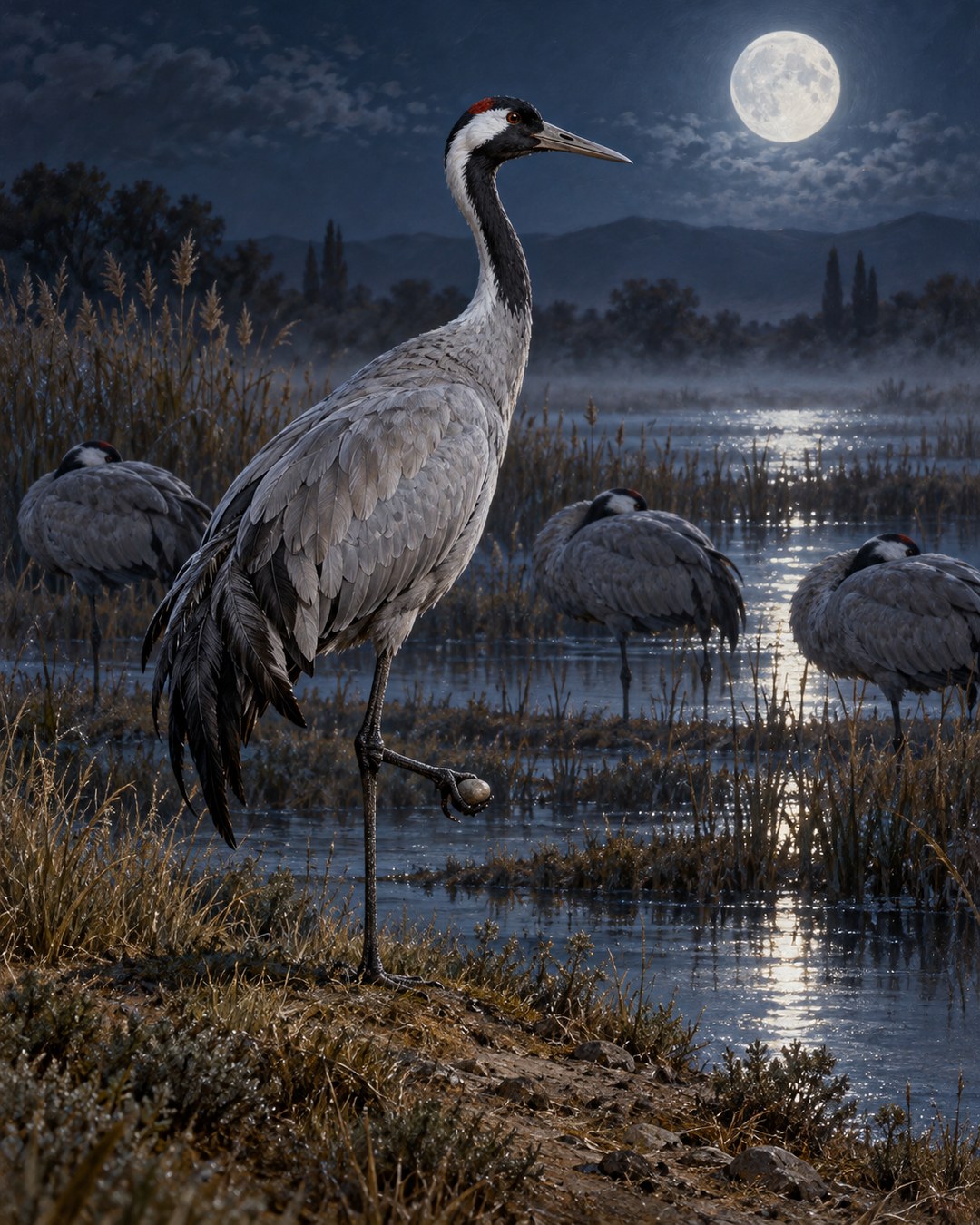
A crane standing night watch held a small stone in its raised foot. If sleep loosened the grip, the stone fell and exposed the lapse. Pliny the Elder placed that memorable device inside a larger account of migration, leadership, formation, calls, fatigue, and guarded rest.
The stone did not keep the whole flock awake. It let most birds sleep because one watcher accepted a test that could not be silently failed. Vigilance became audible.
Pliny’s cranes are not a modern field study. His chapter collects ancient observation and interpretation, sometimes confidently assigning purpose. Read carefully, however, it reveals how Romans could imagine collective animal behaviour as an organised distribution of work.
A wedge made the flock larger than any single wing
Pliny begins with seasonal movement. As winter approaches, cranes leave for warmer regions. Their journey links weather, geography, and bodily endurance.
They travel high, in his description, and arrange themselves in a wedge. The shape gives the flock a point and two receding sides rather than a loose crowd.
Pliny explains the wedge as a way to divide the air. The leader meets resistance first; the birds behind occupy ordered positions created by the moving formation.
Whether every aerodynamic detail matches modern measurement is not the main historical question. The significant point is that Pliny looked for mechanism. Shape was not decoration seen from the ground; it was an answer to the material problem of air.
Calls accompany the flight. He treats sound as a means of maintaining order when distance and height could pull the group apart.
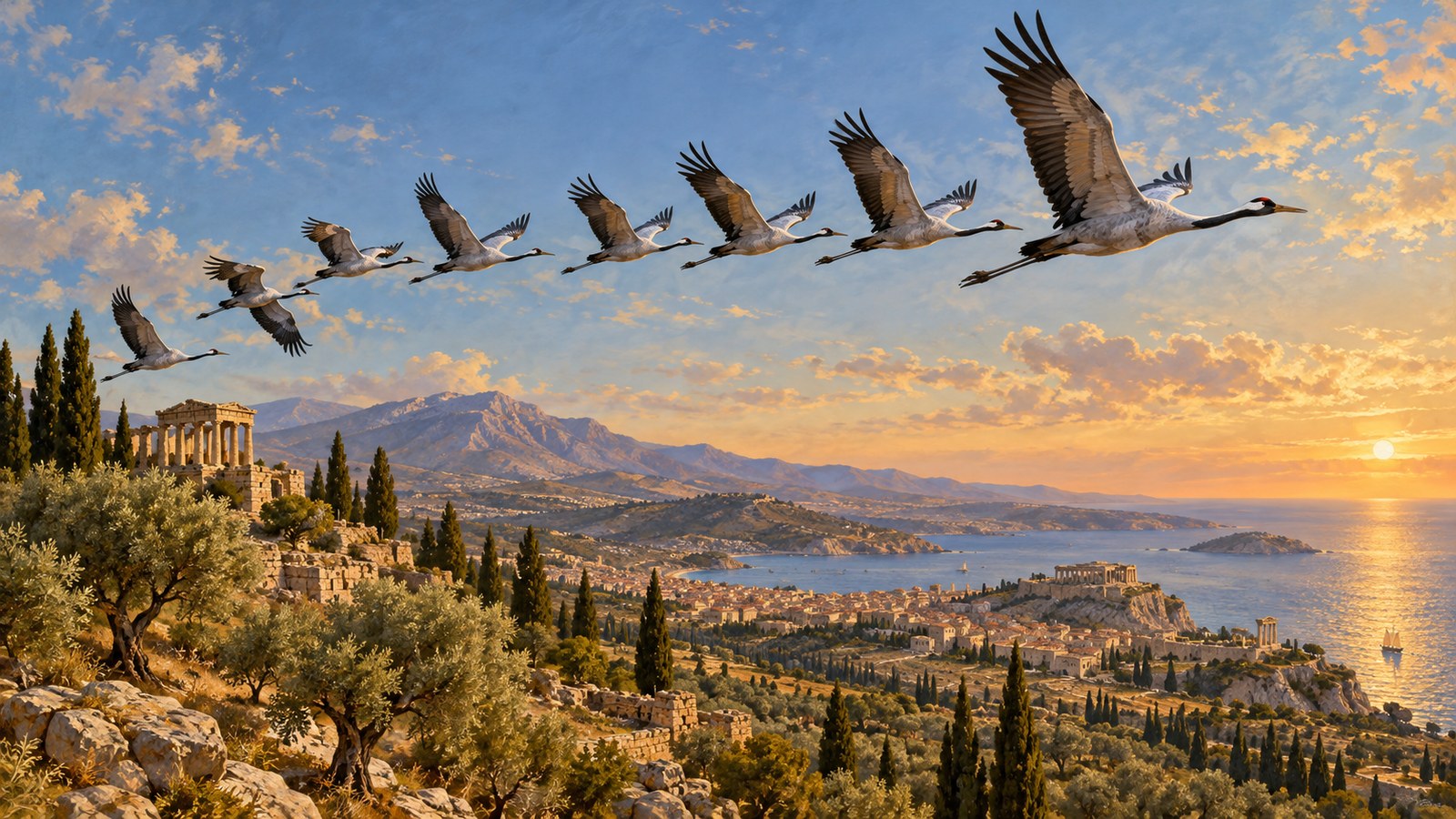
A flock therefore had two structures at once. The wedge organised bodies in space, while repeated calls organised attention. Position could be seen; alignment could also be heard.
This differs from the pipes that steadied a Spartan battle line. Human musicians imposed rhythm on armed ranks. Pliny’s cranes produced their own travelling signal while every caller remained part of the formation.
It also differs from the bronze vessels that redistributed voices in a theatre. There, architecture managed sound for a seated audience. In the sky, sound helped moving bodies preserve a common path.
Leadership moved backward when fatigue arrived
The point of the wedge seems to give one bird permanent command, but Pliny says leadership changes. When the bird in front tires, it falls back and another takes the exposed position.
Rotation prevents prestige from becoming a fatal burden. The leading place is important because it is difficult, and temporary because it is difficult.
Pliny does not describe an election, signal, or dispute. His concise account turns replacement into a smooth natural procedure. The reader sees continuity where individual strength has a limit.
The change also protects the route from the body of one leader. Direction may remain stable even as the animal holding the point changes. A traveller watching from below could see one formation and miss the substitutions occurring within it.
That hidden exchange is structurally similar to the hidden work of the sentinel. In both cases, the flock survives because one role can be transferred or tested before individual fatigue becomes collective failure.
Pliny gives no count of rotations or distance between them. The mechanism remains qualitative, but it is precise enough to distinguish leadership from ownership of the front.
The mechanism depends on a reserve of capable birds. A formation with only one possible leader would fail when that bird tired. Shared competence makes the wedge resilient.
Moving backward is not represented as defeat. It is part of the job. The flock preserves direction by allowing the most strained member to enter a less exposed position.
That pattern made animal travel available for moral comparison. Human communities also had to decide whether office meant permanent honour or exhausting service. Pliny does not write a political allegory here, but his language invited readers to recognise organised succession.
Calls remain important during the exchange. A new leader changes the front without dissolving the two lines behind it. Communication and geometry absorb the transition.
The flock’s order therefore does not reside in one bird. It survives movement of the bird at the point. Leadership is a role carried by the formation, not a possession carried for life.
Night watch converted private sleep into a public risk
After flight comes rest. Pliny says cranes establish watches, which means sleep is staggered rather than universal.
Most birds tuck their heads beneath a wing. The posture conserves warmth and closes attention. It is safe only if another animal remains open to the surroundings.
The watcher stands on one leg while holding a stone in the raised foot. The arrangement makes wakefulness physically demanding and physically testable.
If the bird begins to sleep, muscle control relaxes. The stone drops. Its impact creates the evidence that a quiet failure would otherwise hide.
The ingenuity lies in consequence, not prevention. The stone does not make fatigue disappear. It changes what fatigue does. Sleep can no longer arrive without producing an alarm.
Pliny’s account makes accountability mechanical. No second crane must stare continuously at the watcher. Gravity performs the inspection.
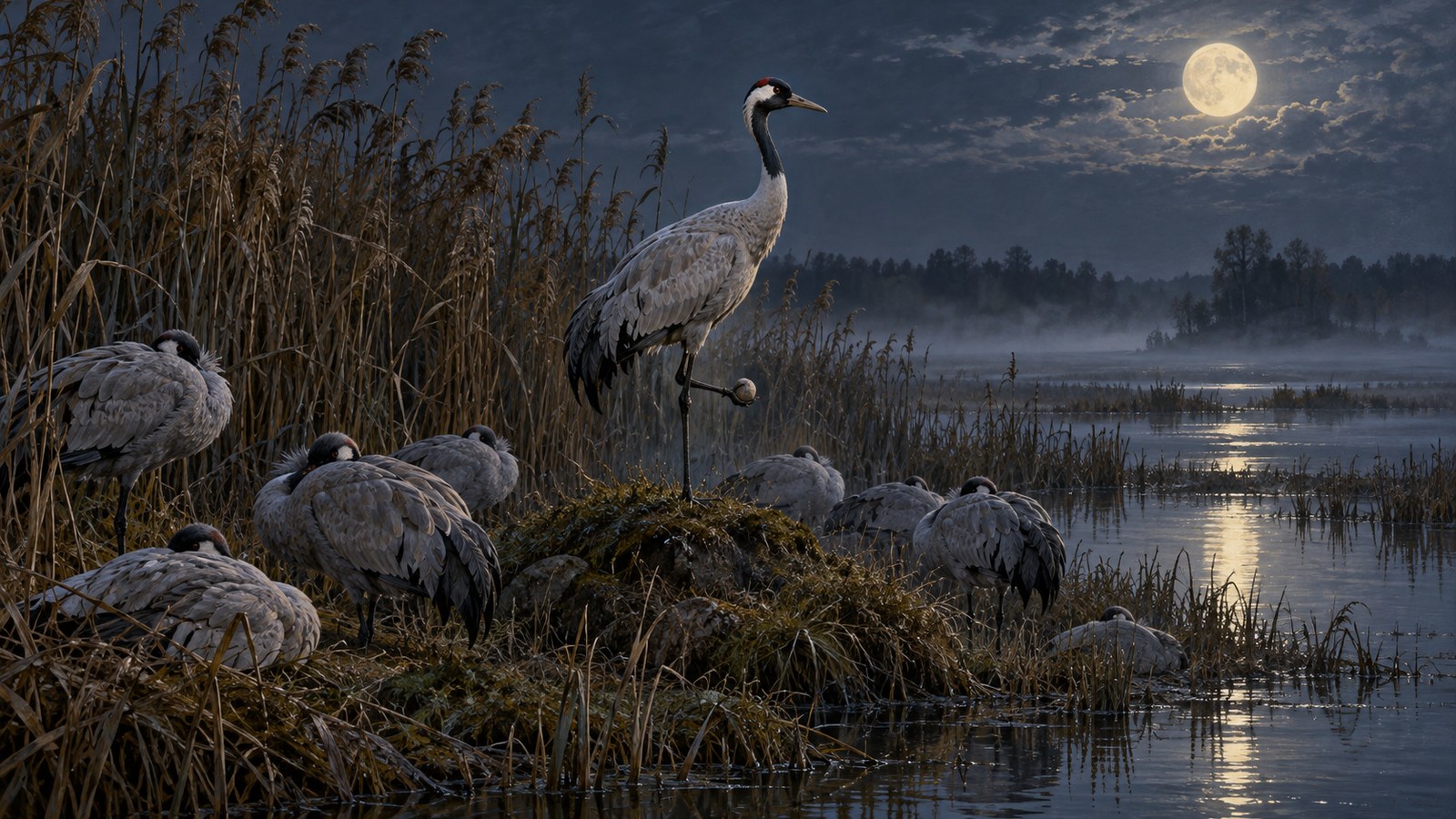
The device also creates trust. The sleeping flock can lower its guard because the sentinel’s body is linked to a sound. Rest becomes a collective achievement rather than the opposite of organisation.
We should not embellish the stone into a shaped tool, metal bell, or formal platform. Pliny specifies a small natural object and a bodily posture. The simplicity gives the anecdote its force.
The same flock distributed effort, information, and risk
Wedge, calls, rotating leader, watch, and stone are often retold separately. Read together, they form one system.
The wedge distributes the work of entering the air. Rotation distributes the hardest position through time. Calls distribute information across distance. Watches distribute vigilance across sleeping hours. The stone converts the watcher’s hidden state into a shared signal.
No single crane performs all these functions continuously. Collective order appears because roles change while the flock persists.
Seasonal travel magnifies the value of that arrangement. A short local movement can pause when one animal tires; migration across unfamiliar ground and weather cannot depend on endless alertness from the same body. Pliny’s sequence answers endurance with substitution, communication, and monitored sleep rather than with an imaginary bird that never reaches a limit.
Pliny’s explanation is purpose-rich. Birds do things “so that” another result follows. Ancient natural history often moved quickly from observed pattern to intention, and readers should preserve that distinction.
The stone story in particular may tell us as much about human admiration as about cranes. It resembles a deliberately designed alarm, which makes the bird seem prudent in a recognisably human way.
Yet the chapter’s lasting appeal does not depend on treating every inference as verified. It shows an ancient writer trying to understand migration through concrete operations rather than pure wonder.
Height, formation, voice, fatigue, sleep, and gravity become connected variables. The crane is not remarkable merely because it crosses a long distance. The flock is remarkable because it continues to function while individuals tire and sleep.
The dropped stone closes the system at its most vulnerable moment. Flight can be watched from below, but sleep takes place in darkness and stillness. Pliny gives that hidden interval a noise.
One small object turns private failure into public information. In the logic of the chapter, that is what makes rest compatible with a journey larger than any one bird’s endurance.
Sources
Pliny the Elder, Natural History, Book 10, chapter 30.