
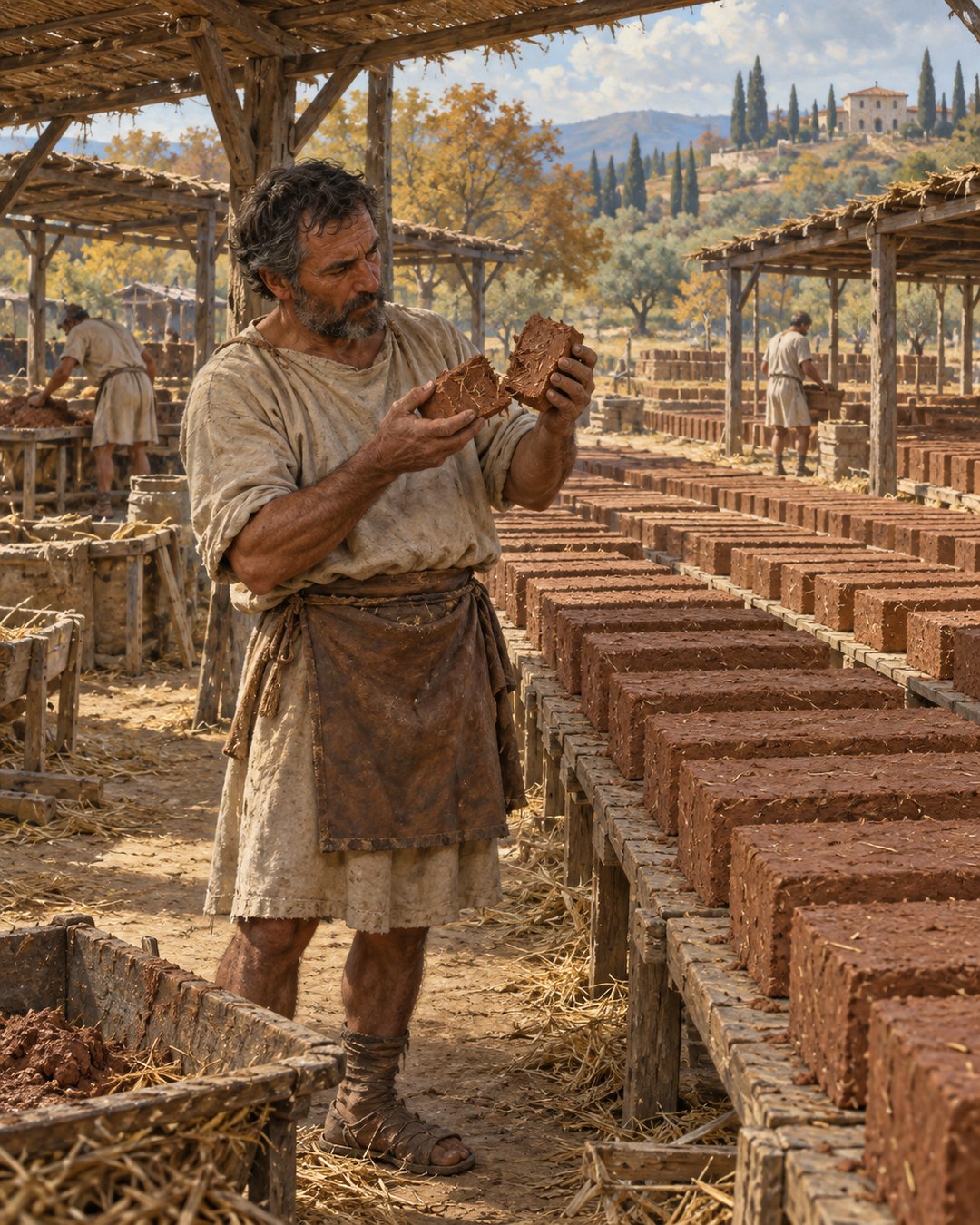
A Roman brick could look finished while remaining wet at its centre. Vitruvius made that hidden moisture the central danger in his instructions: a hard-looking surface was not proof that an unfired brick was ready for a wall.
His remedy was not a clever mould or a hotter kiln. These were sun-dried units, and the essential intervention was delay. Make them in mild seasons, let the water leave evenly, and wait at least two years before building. At Utica, he says, the rule was stricter: five years and approval by a magistrate.
The chapter turns brickmaking into management of changes too slow to watch. Clay contracts. Straw must hold. Plaster hardens at a different rate. A builder who mistakes appearance for readiness transfers an unfinished process into the building itself.
The wrong earth failed before the wall had a chance
Vitruvius begins underfoot, with the earth selected for the mould. He rejects gravelly, pebbly, and sandy clay. The problem was not one vague category called “bad soil.” Each unwanted inclusion interfered with weight, cohesion, or exposure to rain.
Bricks made from rough material became ponderous. Carrying units upward was already repeated labour; unnecessary weight multiplied the burden across every course. A material choice at the clay pit therefore shaped movement on the building site.
Rain created a second test. Vitruvius says walls made from unsuitable earth would moulder and decompose. An earthen unit could bear pressure when dry yet lose its integrity when water repeatedly reached it. Selection had to anticipate weather after completion, not merely handling on the day of construction.
Straw supplied internal binding, but Vitruvius did not treat it as a cure for any mixture. In rough earth it could not hold the mass together adequately. Fibres only worked when the surrounding clay could grip them.
He preferred red or white chalky earth, or earth of a strong sandy character. His important terms are ductility and cohesion. The material had to accept shaping, remain united, and avoid excessive weight.
This is a different construction problem from the geometry that made round towers resist attack. Tower shape managed force after a wall existed. Brick earth determined whether the individual unit could survive long enough to become part of one.
Selection also narrowed later uncertainty. A cohesive mix would not remove the need for drying, but it made the behaviour of the brick more predictable. Vitruvius’s sequence is cumulative: proper earth, proper season, sufficient age, then proper bonding.
Summer made a convincing surface and an unfinished centre
Spring and autumn were the preferred seasons because bricks dried more evenly. Mild conditions allowed moisture inside the unit and moisture near its face to leave without a violent difference in pace.
The summer solstice created a deceptive result. Strong sun quickly made the exterior appear dry while the interior remained in another state. To a hurried builder, the brick offered exactly the evidence he wanted: a firm surface and the colour of finished earth.
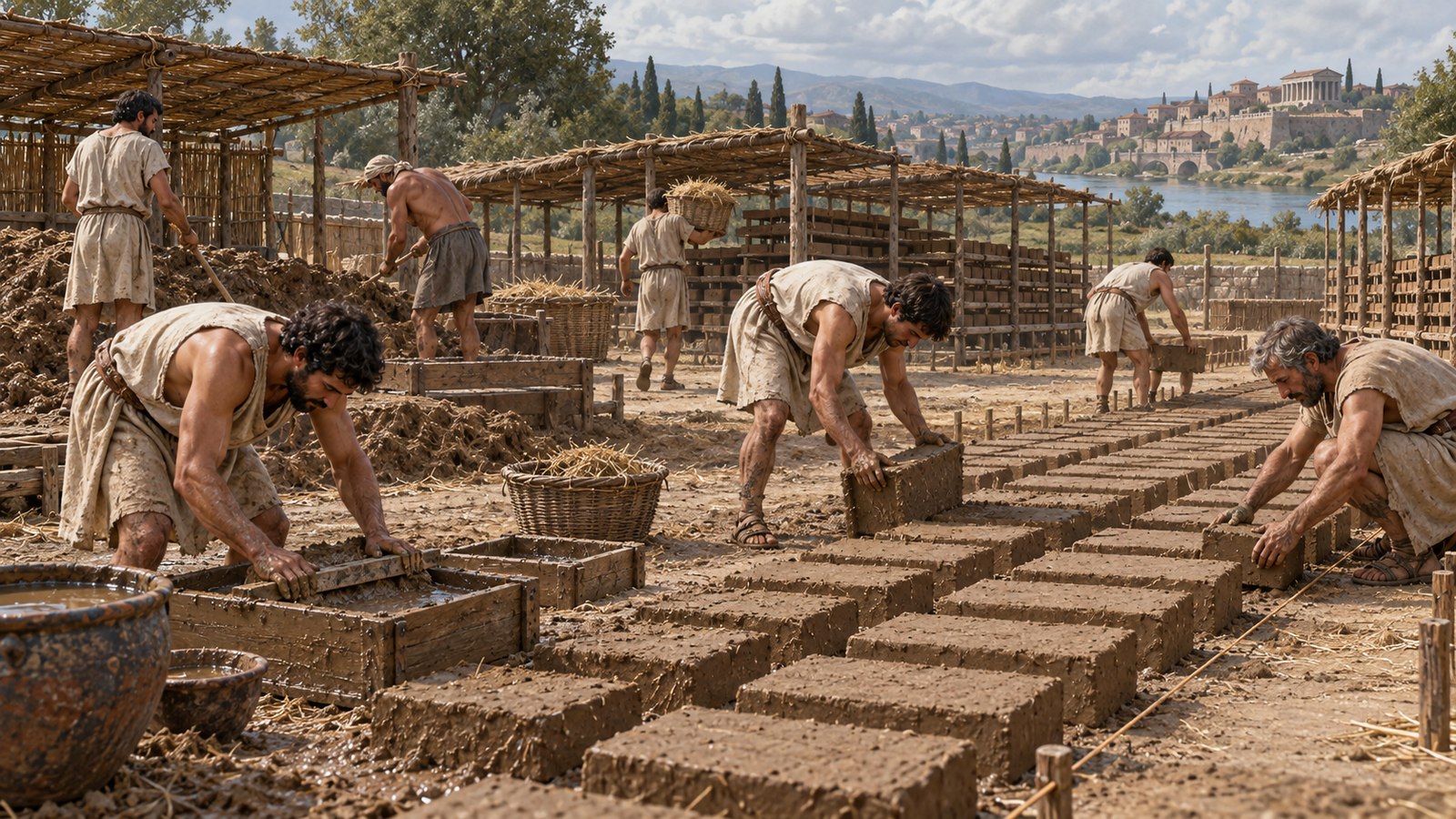
Later drying exposed the mistake. As the moist interior contracted, it pulled against the shell that had already set. The first-dried parts broke, and the unit lost strength before any obvious overload was applied.
Vitruvius’s explanation is mechanical rather than moral. The summer brick does not fail because a worker lacked discipline in the abstract. It fails because different regions of one object move at different times.
That distinction matters for quality control. Surface inspection immediately after moulding could not reveal readiness. A brick had to be judged through its history: which earth, which season, and how long in storage.
The rows of drying units were therefore part of the building process, although they stood outside the future wall. Space had to be available for them. Inventory had to remain identifiable. Production for a later project had to begin well before masons needed material.
Weather could not be commanded, but timing could reduce its most abrupt effects. Spring and autumn transformed climate from an accident into a production variable.
Two years kept shrinkage outside the finished room
Vitruvius calls bricks made at least two years earlier the best, because less time did not ensure thorough drying. The recommendation is remarkable for the patience it demands. A contractor could not begin by making tomorrow’s units.
The danger becomes clearest when plaster enters the account. Plaster could set hard over a brick that still contained moisture. The wall then joined materials whose visible surfaces looked complete but whose dimensional changes were not synchronized.
As the brick continued to dry, it shrank and occupied less space. The plaster did not follow it inward. Instead, the thin finish was left standing without the support on which it had hardened.
A brittle skin cannot carry itself for long. Vitruvius says it breaks into pieces and may involve parts of the wall in its failure. What begins as retained water in one brick can become a visible finish defect and then a structural concern.
The two-year interval was thus a way to make shrinkage happen harmlessly in storage. Time did not strengthen a brick through ceremony; it moved a predictable change to a place where the change could do less damage.
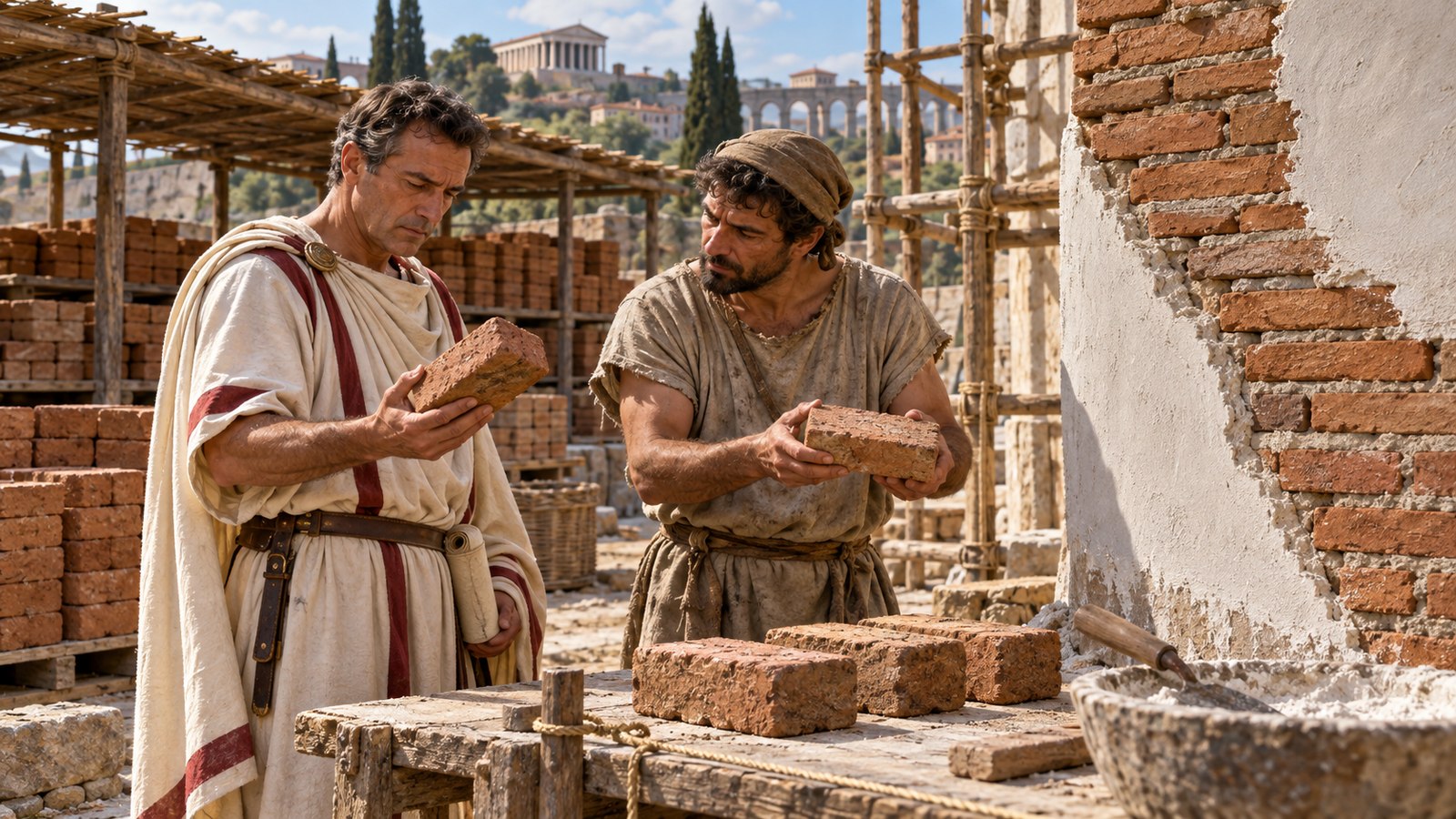
Utica pushed the principle further. According to Vitruvius, the inhabitants admitted no brick less than five years old, and a magistrate had to approve it. Material history became a public question rather than only the maker’s private assurance.
Age alone was not the entire test; official approval still mattered. The combination suggests two different controls. Elapsed years excluded newly made stock, while inspection addressed whether the surviving units were acceptable.
That approach resembles a warranty made before sale. The city required the dangerous period to pass while the brick could still be rejected, not after it had disappeared behind plaster.
Whole and half units made waiting pay off in the wall
After material and time, Vitruvius turns to dimensions. The didoron used in his own context measured one foot long and half a foot wide. Greek practice also distinguished larger pentadoron and tetradoron units, with the former used for public buildings and the latter for private work.
Names and sizes organised supply, but wall strength depended on placement. Each format had matching half bricks. Masons could show whole units on one face and halves on the other while keeping the courses aligned.
The alternation prevented vertical joints from rising uninterrupted. The middle of a brick in one course lay across the joint below it, tying separate pieces into a more continuous mass.
Vitruvius valued the varied appearance, yet he immediately connected the pattern to additional strength. Visual order and structural bonding came from the same arrangement.
This final stage helps explain why early discipline mattered. A carefully bonded wall could not rescue units that were still shrinking. Conversely, perfectly aged bricks laid with continuous joints would waste part of their potential.
The sequence also complements Vitruvius’s placement of resonant vessels in a theatre. In both cases, performance depends on relationships among components, but bricks add a long prehistory. Their correct position is only the last decision in a process that began with earth and seasons.
The chapter’s deepest lesson is procedural. Readiness cannot be read from one clean surface. The brick carries its pit, fibres, weather, storage, and inspection into the wall. By insisting on two years—and recording Utica’s five—Vitruvius made time one of architecture’s materials.
Sources
Vitruvius, On Architecture, Book 2, chapter 3.