
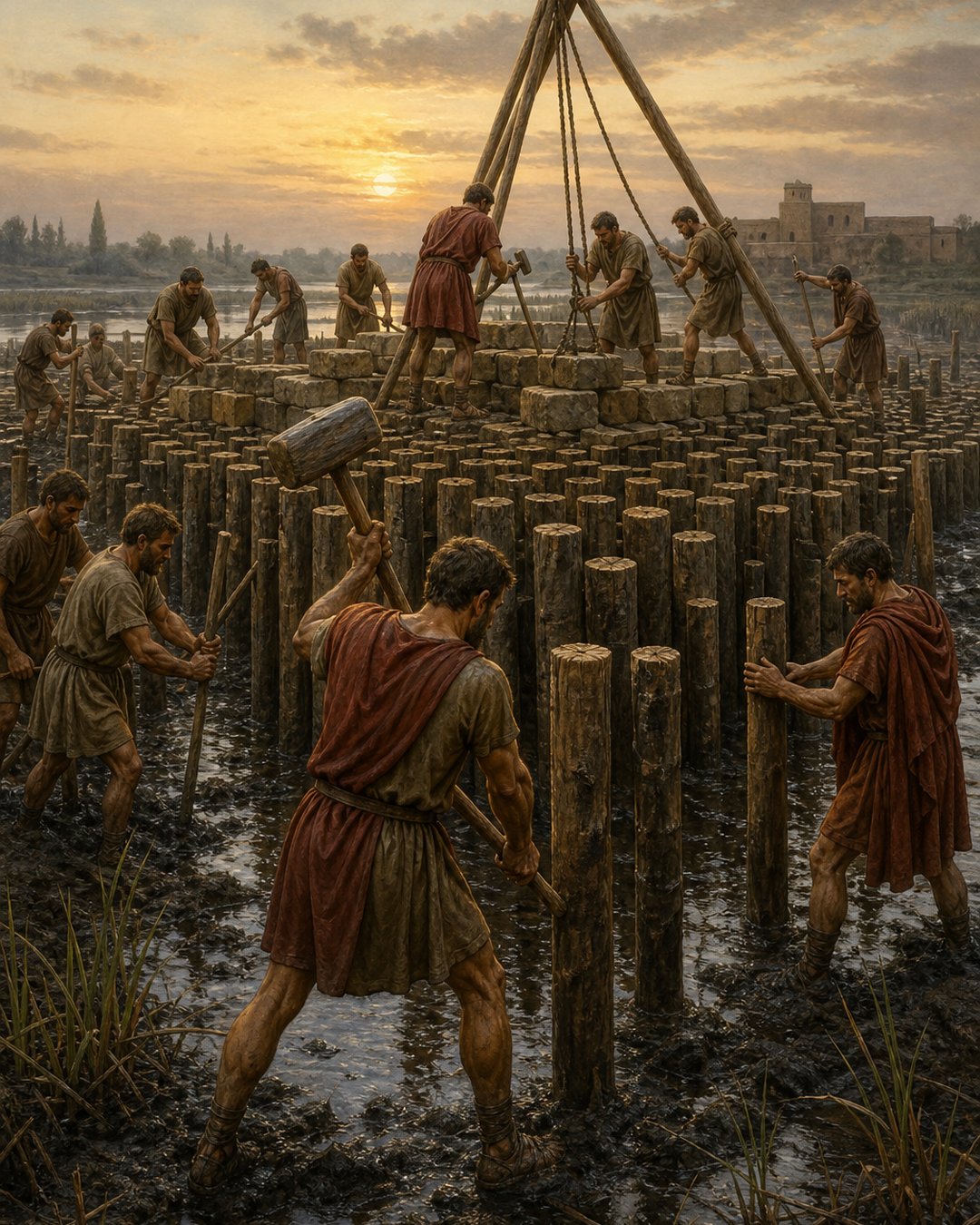
Ravenna’s buildings began below the waterline. Before walls could rise from its marshy ground, crews drove alder trunks into the wet earth and packed them close together. Masonry foundations rested above that buried grid. The timber disappeared from sight, but the city’s weight depended on it.
Vitruvius chose the example because alder seemed badly suited to architecture. He says it grew beside rivers and did not last long above ground. Put beneath a foundation in a swamp, however, the same wood behaved differently. Saturation became the condition of endurance rather than the cause of failure.
His explanation uses an ancient theory of elemental balance, not modern wood science, and his claim that the piles remained “imperishable” is rhetorical. Yet the construction logic is precise. Builders did not search for one universally superior timber. They selected a material for a particular environment, placed many members together, and kept the hidden support where its working conditions remained stable.
The Marsh Made an Ordinary Footing Impossible
A foundation must carry weight into ground capable of receiving it. On firm soil or rock, builders can spread a wall’s load through trenches, stone courses, and broad footings. Wet, yielding ground presents another problem. A heavy wall may settle unevenly as soft layers compress, opening cracks above even when the masonry itself is sound.
Ravenna supplied exactly that difficult setting in Vitruvius’s account. He calls the places swampy and presents the alder system not as decoration but as the work beneath foundations. The water could not simply be treated as a temporary nuisance to be drained before construction and forgotten. It defined the soil in which the building had to stand.
Driving piles changed the route of the load. Instead of asking a shallow surface to hold every wall directly, builders inserted repeated vertical timbers into the saturated ground. A dense field of piles created many points of support under the foundation. “Close together” is one of Vitruvius’s important details: the system relied on multiplication, not on one heroic trunk.
The hidden labor would have preceded the public architecture. Trunks had to be selected, cut, moved, aligned, and driven before a finished façade offered anything to admire. Ravenna’s streets therefore rested on a construction phase that vanished beneath later work. The success of the foundation made its own mechanism inaccessible.
Roman builders confronted difficult foundation conditions with different resources. Claudius sank Caligula’s enormous obelisk ship and used it within the foundation works of a harbour mole. Ravenna’s answer was quieter and repeatable: not one spectacular object, but closely spaced riverbank timber.
Alder Changed Character When It Disappeared Under Water
Vitruvius begins from a paradox. Alder, he says, appears altogether useless for buildings, then possesses excellent qualities in the right place. Above ground it cannot endure even for a short time. Covered with moisture beneath a swamp foundation, it lasts.
He explains that reversal through the four elements. In his material theory, alder contains much air and fire, little earth, and little moisture. Once submerged, it takes in the water its constitution lacks. The balance makes it resistant to decay and able to carry enormous weight.
That account should be read as Roman reasoning rather than translated silently into modern chemistry. Vitruvius did not know microorganisms, oxygen diffusion, or the cellular structure of timber in present scientific terms. His elemental explanation is historically important because it shows how he connected observed performance to a general theory of materials.
The observation beneath the theory remains practical. Timber exposed alternately to wet and dry conditions behaves differently from timber kept in a stable saturated environment. For the Ravenna system, continued wetness was not evidence that the foundation had failed. It was part of the placement Vitruvius praised.
This reverses the instinct to equate dryness with safety. A modern visitor seeing water around a timber foundation might imagine immediate rot. Vitruvius asks the reader to notice the position instead. The alder was not a roof beam accidentally soaked by a leak. It was a buried pile selected to live in moisture.
Close-Driven Piles Turned Many Trunks into One Support
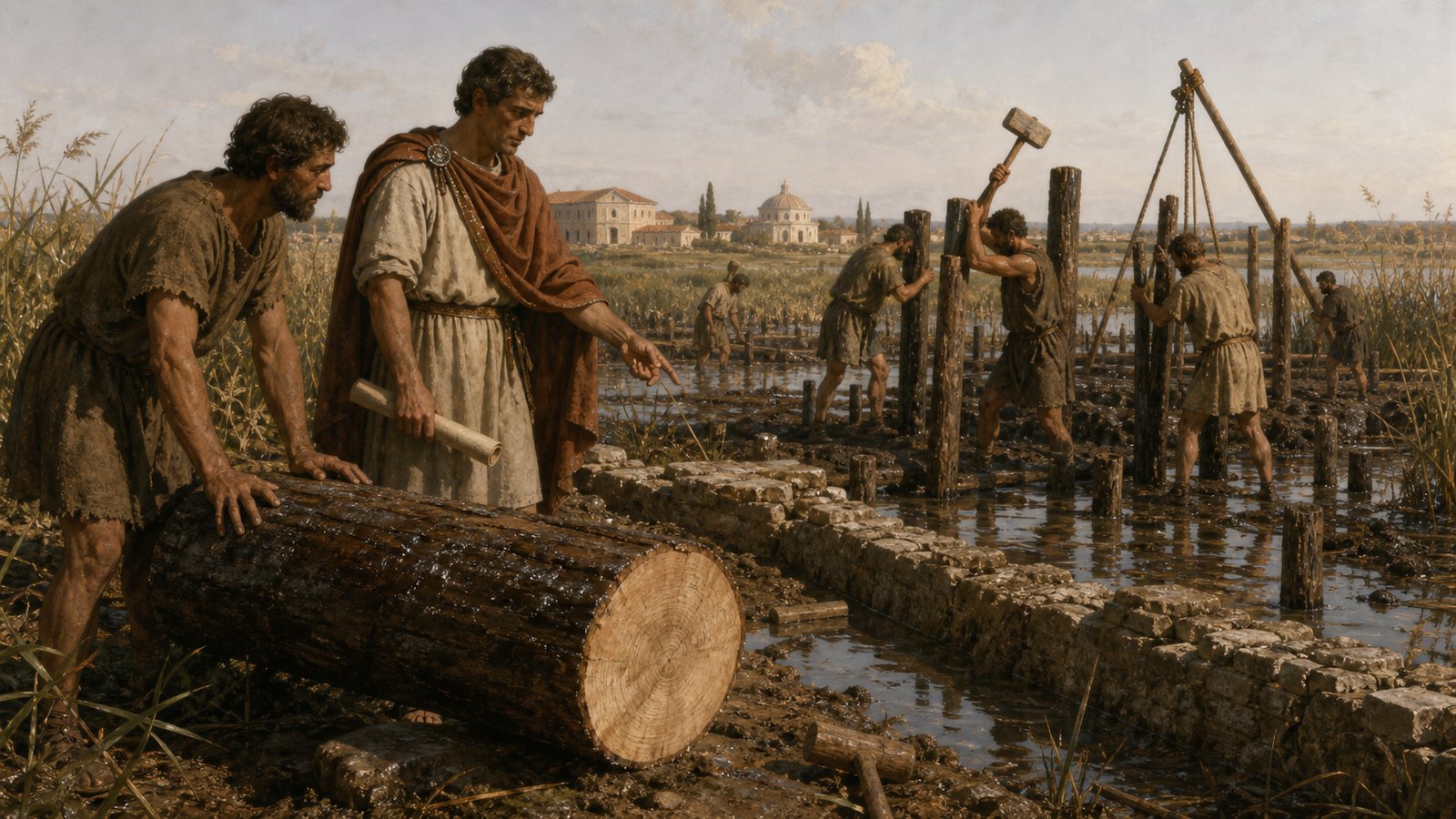
No individual alder pile had to announce itself as monumental. The strength of the foundation came from arrangement. Driven close together, the timbers formed a repeated substructure beneath walls whose mass would otherwise bear on unstable ground.
That repetition distributed risk as well as weight. A single post can lean, split, or meet an unusually soft pocket. A packed group gives the foundation many contacts with the ground and many supports under the masonry above. Vitruvius does not supply dimensions, spacing, or a construction drawing, so those details should not be invented. His wording nevertheless identifies density as deliberate.
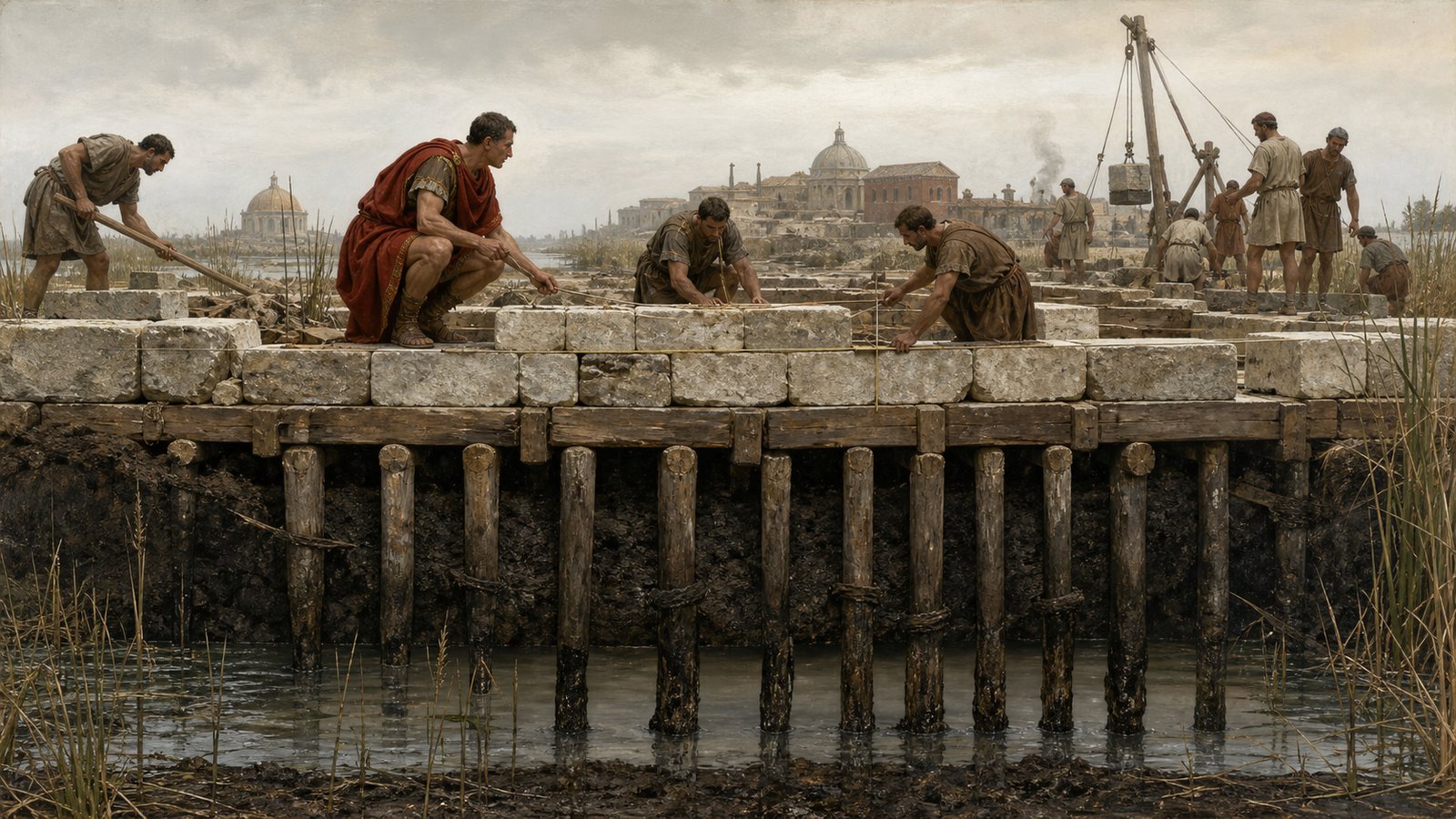
The piles also created a boundary between building and marsh. Above them, workers could organize the foundation courses that received brick or stone walls. Below, each trunk remained embedded in the environment for which it had been chosen. The system joined unlike materials by assigning each a different task.
That division resembles the material discipline behind Utica’s rule that public building bricks wait five years before use. In both cases, durability began before a wall appeared. One process tested clay through time; the other placed timber through wet ground. Neither could be repaired easily after the masonry rose.
Foundation piles were also economically legible. Alder grew near riverbanks, the same broad kind of landscape in which the problem occurred. Vitruvius does not provide a Ravenna procurement ledger, so cost and ownership remain unknown. He does reveal a practical match between a locally associated tree and a waterlogged construction need.
Public and Private Ravenna Shared the Hidden Method
Vitruvius says Ravenna offered the best demonstration because all its buildings had alder piles below them, both public and private. “All” is the language of a technical author making an emphatic example, not an archaeological census of every structure. The distinction between public and private is still meaningful. He understood the method as a citywide construction response rather than the experiment of one patron.
A temple, warehouse, bath, house, or shop could differ enormously above ground while sharing the same concealed solution below. Status appeared in columns, rooms, painted surfaces, and costly finishes. The pile field was common infrastructure in principle: repetitive, buried, and judged by whether the building stayed level.
That invisibility changed how success was remembered. A failed wall leaves a crack. A failed roof leaks. A successful marsh foundation produces no daily spectacle at all. Residents open doors and cross floors without feeling the saturated timbers transferring weight beneath them.
Vitruvius restores those timbers to view by placing them in a chapter about species of wood. He moves from tree growth to composition, from composition to suitable use, and from suitable use to a whole city. Ravenna becomes evidence that architecture begins with differences among materials rather than with a designer forcing every substance into the same role.
The claim also preserves unnamed expertise. Surveyors and builders had to know where piles were required. Laborers had to drive them closely enough to create a dependable bed. Masons had to begin foundation work over a surface they could trust. The finished building belonged to an owner; the hidden method belonged to accumulated construction practice.
Durability Came from Matching Material to Place
Vitruvius’s alder does not win a contest for the best Roman wood. He describes oak, fir, poplar, elm, ash, hornbeam, cypress, cedar, larch, and others through different combinations of weight, moisture, stiffness, rot, warping, and workability. Each species presents a set of advantages and limits.
That catalogue makes Ravenna’s lesson sharper. Alder could be poor where exposure demanded another timber and excellent where permanent saturation rewarded its behavior. The correct question was not “Is alder durable?” but “Where does alder endure?” Architecture turned that conditional answer into a foundation system.
The same logic governed maintenance. If stability depended on the wet position, then changing the surrounding conditions could threaten what had survived there. Vitruvius does not describe a Ravenna drainage project or a damaged pile, so the article cannot supply one. His contrast between above-ground failure and submerged endurance is enough to show that environment remained part of the structure.
Roman construction is often remembered through materials that remain visible: concrete vaults, brick faces, marble columns, tiled roofs. The alder piles ask us to look in the opposite direction. An unglamorous wood, buried before anyone admired the building, made the visible city possible.
Ravenna stood above its marsh because builders accepted the marsh as a design condition. They multiplied simple trunks, drove them into wet ground, and placed the foundation where wood and water could remain together. The enduring achievement was not conquering moisture. It was understanding where moisture belonged.
Sources
Vitruvius, On Architecture, 2.9.10–11.