
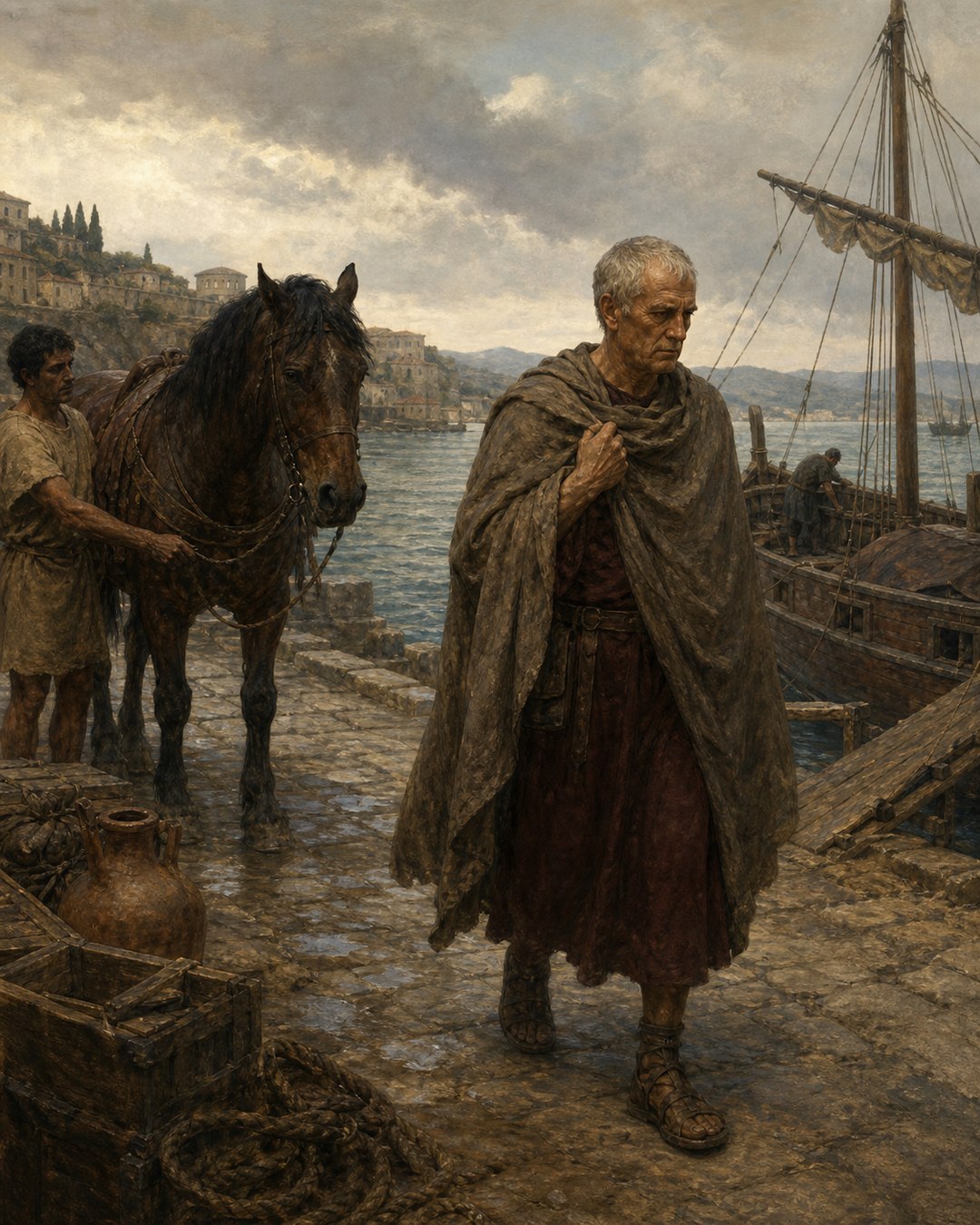
The horse had carried a Roman consul through his Spanish campaign. When Cato the Elder sailed home, he left the animal behind.
Cato supplied an austere reason. Transporting the horse would cost the city money, and he would not place that burden on the public account. In the language of republican virtue, the decision looked admirably clean: service was finished, expense avoided, commander unpampered.
Plutarch does not let the arithmetic close the case. He places Cato’s boast after a meditation on old workers and worn animals. A horse can disappear from an account when its transport line is removed; the history of what it carried does not disappear with it.
The episode is only a few lines long, but its position makes it an ethical trap. The same saving can be read as discipline toward the treasury or narrowness toward a creature whose labour made the campaign possible.
The anecdote arrives after a catalogue of discarded service
Plutarch begins the argument with Cato’s management of dependants and animals. He criticizes the habit of using them to the utmost while they were strong, then selling them when age reduced their usefulness. To the biographer, that practice recognized no bond except immediate necessity.
The passage addresses enslaved people alongside working animals, and the comparison exposes rather than softens Roman exploitation. Enslaved workers could be treated as saleable equipment in elite agricultural calculation. Plutarch condemns Cato’s lack of attachment, but he does not dismantle the institution that made such sales possible.
His narrower point is that justice does not exhaust obligation. Kindness, he says, reaches farther. A relationship created through repeated service can demand care even after enforceable exchange has ended.
The examples become deliberately domestic. A kindly person looks after horses worn out by age and dogs that need nursing after puppyhood has passed. These are not abstract symbols of generosity. They eat, require space and impose costs at the moment when their economic return is falling.
That moment is the test. Generosity toward a powerful young horse may simply protect an asset. Care for an old one reveals whether past work has any claim once future usefulness weakens.
A celebrated Athenian mule gives the horse a rival ending
Plutarch then leaves Cato and recalls an animal associated with building the Parthenon. The Athenians, he says, released mules that had laboured persistently so they could graze without restriction. One retired mule returned to the works of its own accord.
It trotted beside the teams still under yoke as they hauled wagons toward the Acropolis and seemed to lead them on. The city answered by ordering that the mule be maintained at public expense for the rest of its life.
The story forms a precise contrast. Cato avoided a public transport cost by separating the horse from his return. Athens accepted a continuing public cost because remembered labour had become honourable. Both choices could be described as civic; they disagreed over what the civic ledger ought to remember.
Plutarch adds the mares of Cimon, whose graves stood near his family’s tombs after they won three Olympic victories. He also mentions dogs honoured after close companionship. Burial, pasture and maintenance turn service into public or household memory rather than treating the end of work as erasure.
The account of the enormous animal logistics behind Poppaea’s milk bath shows elite expenditure expanding around status and bodily luxury. The horse episode faces the opposite problem: an expense can be small, practical and still reveal what kind of loyalty an owner recognizes.
The Spanish crossing converted gratitude into freight
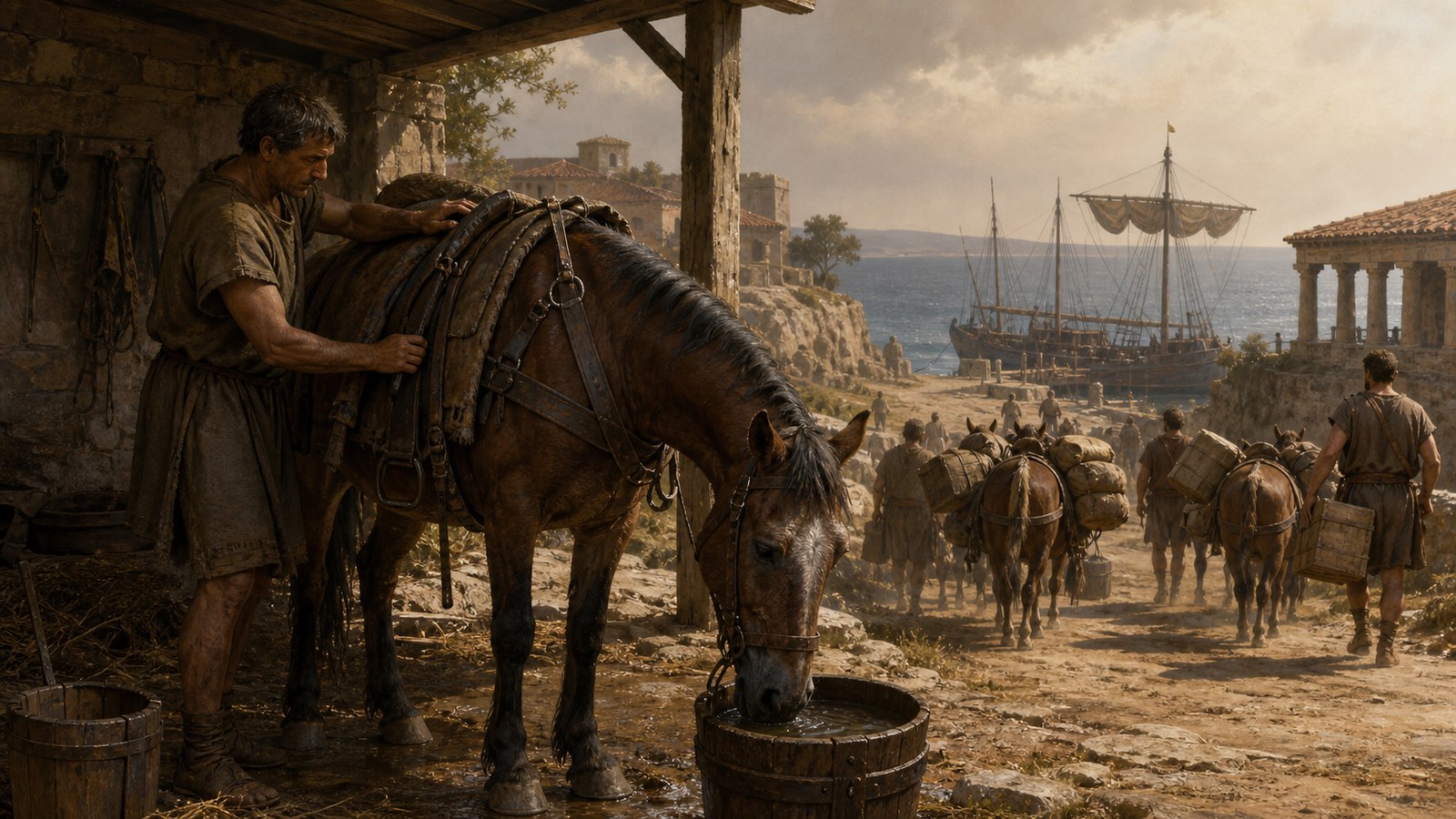
Cato’s horse was not an idle possession. In his own formulation, it had carried him through a consular campaign. The phrase gives the animal a service record before the decision removes it from the voyage.
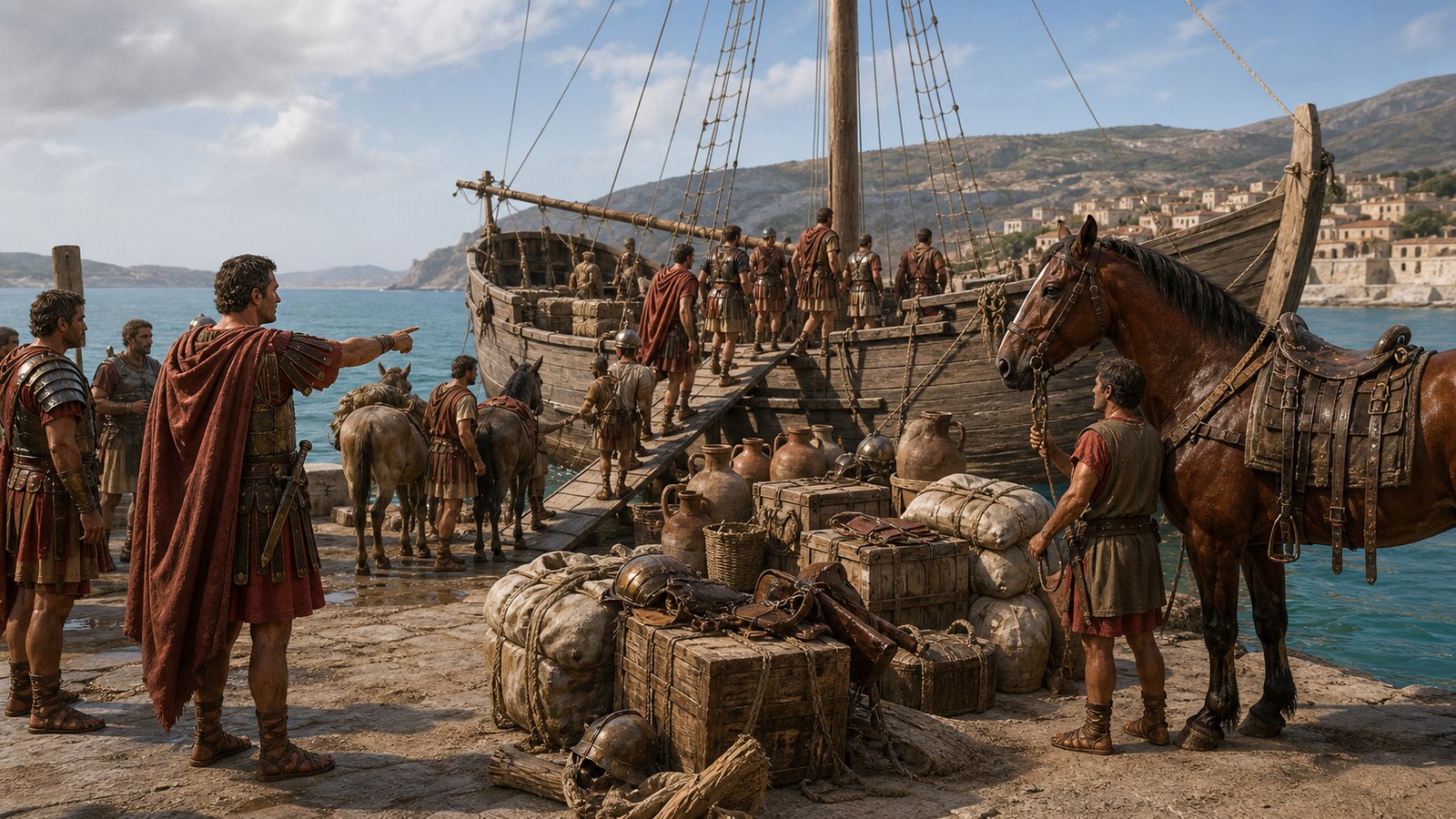
Moving a horse by sea required more than paying a passenger fare. A vessel needed suitable space, handling, fodder, water and people able to manage a large anxious animal. Keeping the horse off the ship simplified logistics and eliminated a real expense.
That practicality is why the anecdote works. Plutarch is not mocking an imaginary saving. He asks what the saving means. If every avoidable charge is evidence of virtue, then the horse’s past labour has no place in the calculation. If service creates a claim, then public economy needs a moral limit.
The location sharpens the choice. Leaving an animal in Spain was not the same as retiring it on Cato’s own Italian estate, where continued care could be observed. Plutarch does not tell us who received the horse, what condition it was in or how long it lived. Those gaps must remain gaps.
They also prevent a simple cruelty narrative. The animal may have entered competent hands. Cato’s stated motive, however, was the city’s transport cost, not a carefully described plan for the horse’s welfare. The boast values what was not charged.
Cato’s wider economy made the decision politically legible
The next chapter shows that the horse was not an isolated performance. When commanding an army, Cato limited wheat for himself and his retinue to three Attic bushels a month. His beasts of burden received less than one and a half bushels of barley a day.
In Sardinia, Plutarch contrasts him with officials who billed the treasury for pavilions, couches and apparel while burdening provincials with large retinues and elaborate meals. Cato’s stripped-down travel made a public argument before he spoke: office should not become a mechanism for private display.
That argument mattered in a political culture suspicious of luxury and provincial extraction. A commander who travelled plainly could present himself as protecting both Roman funds and subject communities from the appetite of his household.
The horse fitted that reputation. It offered a compact proof that even a victorious consul would not turn a personal convenience into a civic bill. The story could circulate because the saving was attached to a vivid absence: one campaign animal that did not board the homeward ship.
The earlier discussion of Cato’s timed calculation of estate wine shows the same desire to make resources measurable. Yet measurement cannot decide every value. Grain, transport and provisions fit a ledger more easily than gratitude does.
Plutarch makes thrift answer to memory
After recounting the boast, Plutarch refuses a final label. Whether it should be called greatness of spirit or littleness of mind, he says, remains open. The sentence transforms a reputation-building anecdote into a question for the reader.
Greatness lies in refusing privilege. Cato could have treated a return voyage for his horse as the natural reward of rank and victory. By declining it, he placed himself below the public purse rather than above it.
Littleness lies in reducing a long relationship to the expense of its final movement. The horse had helped carry the consul through danger and distance. Saving the fare could show that Cato remembered the treasury more readily than the animal.
Plutarch’s arrangement is the real achievement. He sets the Athenian mule, Cimon’s mares, old dogs and Cato’s abandoned campaign horse beside one another. None is a neutral data point. Together they test what communities and owners owe after useful labour ends.
The episode therefore reaches beyond one Roman moralist’s frugality. Institutions still praise leaders for cutting visible costs, while the displaced burden falls outside the report. A clean account can conceal who absorbed the saving.
Cato’s horse remains in Spain because the source gives it no later story. That silence is part of the verdict. Rome gained a small economy and Cato gained another example of restraint. Plutarch asks readers to notice what the boast leaves behind on the quay.
Sources
- Plutarch passage at LacusCurtius
- Plutarch in the Project Gutenberg translation
Plutarch, Life of Cato the Elder 5.1–6.2.