
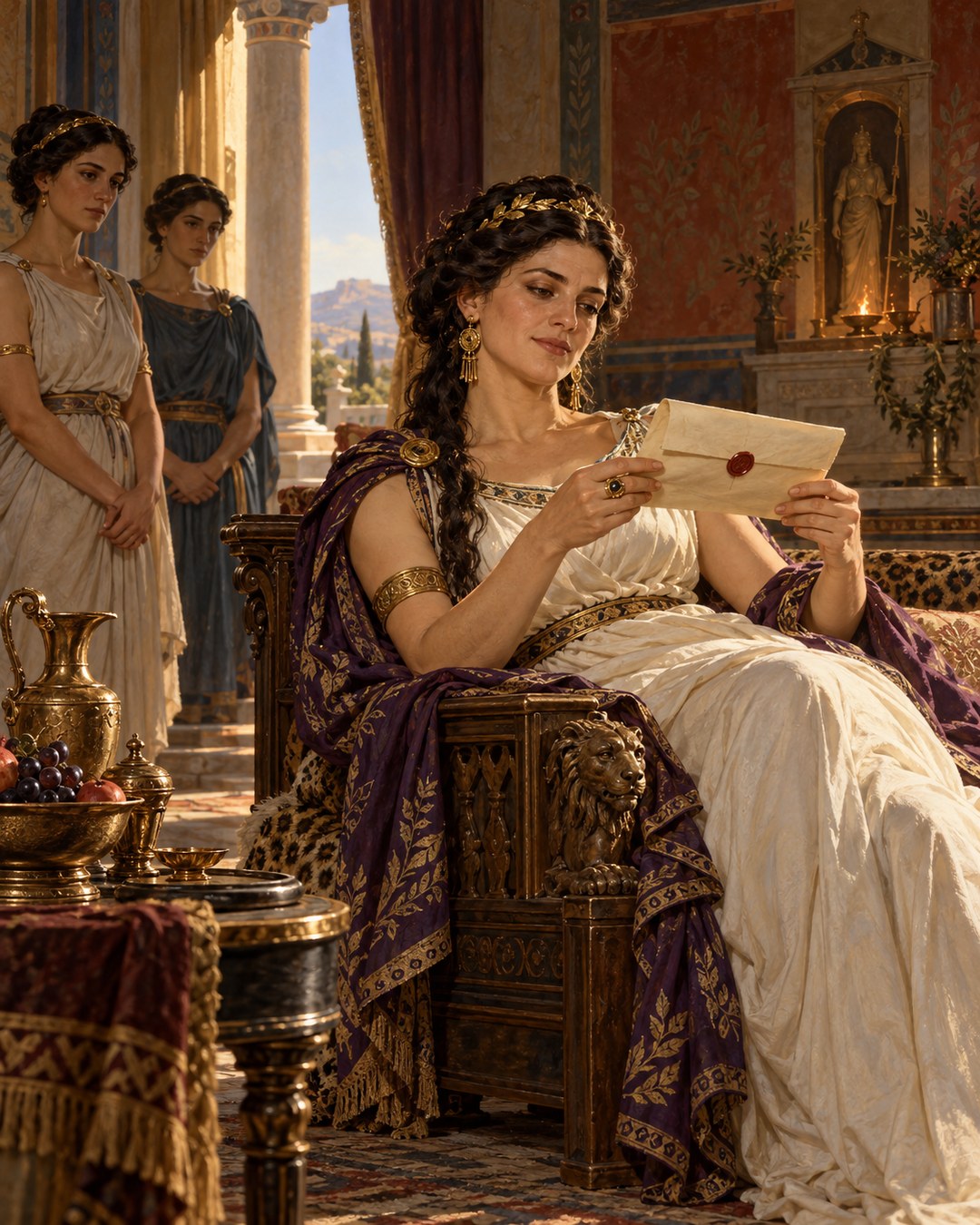
Alexander opened a letter to his mother with a title large enough to redraw his family: “King Alexander, son of Jupiter Hammon, greets his mother Olympias.” Olympias did not argue over temples, oracles, or royal theology. She asked him to stop getting her into trouble with Jupiter’s wife.
If Alexander was Jupiter’s son, she observed, then Juno could treat Olympias as her husband’s lover. One elevated greeting had unexpectedly turned a queen mother into the target of divine jealousy.
Aulus Gellius admired the answer because it was courteous as well as sharp. Olympias did not meet grandeur with louder grandeur. She let her son’s claim remain in place long enough for its domestic consequence to embarrass it.
A royal greeting tried to replace a father
Gellius says the exchange appeared in many records of Alexander’s deeds. He had also encountered it in Marcus Varro’s work Orestes or On Madness. The story therefore reached his Roman notebook through an already crowded tradition of Alexander anecdotes.
The greeting is brief but carefully ranked. Alexander names himself king before naming Olympias as mother. Between those identities he inserts a new father: Jupiter Hammon. Philip, Olympias’s husband and Alexander’s human father, disappears from the formula.
A royal letter could carry more than news. Its salutation announced the relationship the sender wished the recipient to recognize. Here the first line asks a mother to receive not merely a victorious son, but a ruler whose victories and divine association have altered the terms of kinship.
Gellius does not reconstruct when the letter travelled or what ceremony surrounded it. He preserves only the verbal machine. Alexander claims cosmic parentage; Olympias replies as the woman whom that claim necessarily implicates.
The boast belongs to the same larger career as the stories that made Bucephalas part of Alexander’s exceptional destiny. Yet this scene contains no battlefield. Its scale collapses from world conquest to a mother reading one presumptuous line.
That collapse gives Olympias room to act. She cannot out-rank the king in public office, but she can answer the son who has just rewritten her marriage.
Olympias accepted the premise and changed the audience
Her first instruction is simple: be silent. She then asks Alexander not to slander or accuse her before Juno. The vocabulary turns his self-praise into testimony against someone else.
Alexander’s title had been directed toward Olympias, but Olympias imagines a second reader. Juno now stands over the letter as an interested wife. What sounded magnificent to courtiers sounds incriminating in her presence.
The reply never needs to state that Jupiter did not father Alexander. It adopts the claim provisionally. If the divine paternity is true, Olympias must have become Jupiter’s partner. If Jupiter has a wife, that wife has grounds for anger.
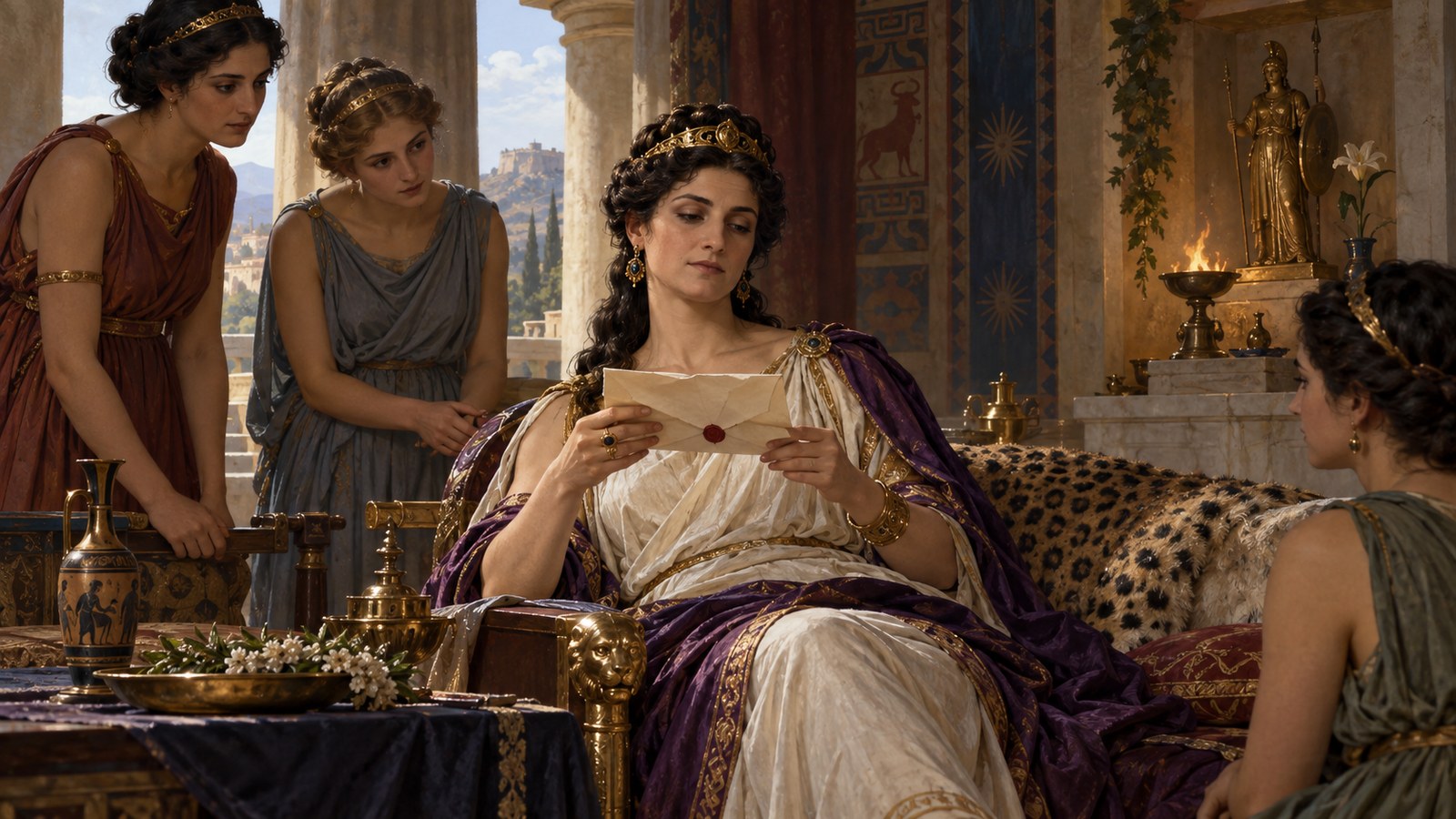
This is argument by consequence rather than contradiction. A direct denial would invite Alexander to repeat his evidence or authority. A literal acceptance makes the absurdity arrive on its own.
Olympias also shifts the risk. Alexander gains splendour from being called Jupiter’s son. His mother, in her version, receives the punishment. The title becomes less heroic when another person must pay for its mythology.
The imagined Juno is not a decorative allusion. She is the missing relationship that the greeting suppresses. Divine fatherhood cannot be added to a family tree without bringing divine marriage into it as well.
The joke gave maternal correction political cover
Gellius calls Olympias wise and prudent, and describes the reply as mild and polite. Those judgments matter because the exchange could have been retold as open defiance. Instead, he presents tact as the source of its force.
A victorious king surrounded by courtiers is not an easy person to correct. Gellius explicitly links Alexander’s idea to victories, extraordinary success, and flattery. Each of those conditions rewards agreement. The people nearest power may find it safer to enlarge a claim than to test it.
Olympias avoids the posture of a rival adviser. She writes as a mother concerned about what her son’s words have done to her. The complaint is personal, playful, and impossible to separate from the political title that caused it.
Her humour also protects Alexander’s dignity. She does not call him a liar in the surviving exchange. She gives him a route back: he can become silent, abandon the formula, and leave the joke as a private maternal warning.
That is why the answer differs from Alexander’s rejection of an architect’s spectacular Mount Athos proposal. In that episode, Alexander judges another man’s monumental flattery. Here Olympias must make Alexander recognize the inflation in his own language.
The correction works sideways. Courtly speech moves upward, attaching the ruler to a god. Olympias moves across, asking what the god’s wife would think. The horizontal relationship punctures the vertical hierarchy.
Gellius made success part of the diagnosis
Gellius does not say that Alexander formed the idea in isolation. He names three pressures: great victories, flattering courtiers, and incredible success. Together they explain how an extraordinary claim can begin to feel ordinary to the person repeatedly rewarded for it.
Victory changes what others are willing to say. Flattery converts that willingness into a surrounding chorus. Continued success then appears to confirm the chorus, even when the words have moved beyond evidence.
Olympias’s reply interrupts that loop with a consequence no court flatterer would choose. The title is no longer proof of exceptional favour. It is a confession likely to anger a powerful wife.

Gellius’s choice of source adds another layer. He notes Varro’s title Orestes or On Madness, but he does not pretend that the title alone diagnoses Alexander. Instead he identifies the foolish idea and the conditions that nourished it.
The anecdote is too small to explain Alexander’s whole religious policy or self-presentation. It records how later readers framed one boast and why they admired its answer. Its value lies in the precision of that framing.
Olympias does not defeat kingship, divine symbolism, or court ceremony in two sentences. She exposes a mismatch between a son’s new title and the family relation his mother knows. The more literally the greeting is read, the less comfortable it becomes.
That form of correction can travel where a lecture cannot. The joke is memorable because the audience completes it: Jupiter’s son implies Jupiter’s lover; Jupiter’s lover implies Juno’s anger. Alexander’s claim supplies every step.
Gellius ends by praising restraint. Olympias warned rather than humiliated, and did so mildly rather than noisily. Her wit was not an ornament added after the argument. It was the instrument that allowed the argument to reach a powerful son.
The form of the exchange matters as much as its theme. A letter fixes a title in a way that passing court praise does not. Olympias can quote its logic back to the sender, and Alexander cannot blame an overexcited herald for the wording. The greeting joins kingship, divine fatherhood, and motherhood in one compact formula. Her answer pulls those three pieces apart and asks what each would require if the divine claim were more than ceremony.
The anecdote also preserves the unequal economy of flattery. Alexander receives honour immediately, while the awkward implications are displaced onto Olympias. Her reply reverses that economy by making him hear the risk carried by the person named only at the end of his greeting. The mother is not a passive audience for the son’s self-description; her place in the sentence gives her standing to judge it.
The result is a rare royal exchange in which the grandest figure never speaks twice. Alexander gets the first line and all the titles. Olympias gets the consequence. Juno, though imaginary, gets the final authority.
Sources
Aulus Gellius, Attic Nights 13.4, preserving Alexander’s greeting and Olympias’s reply.