
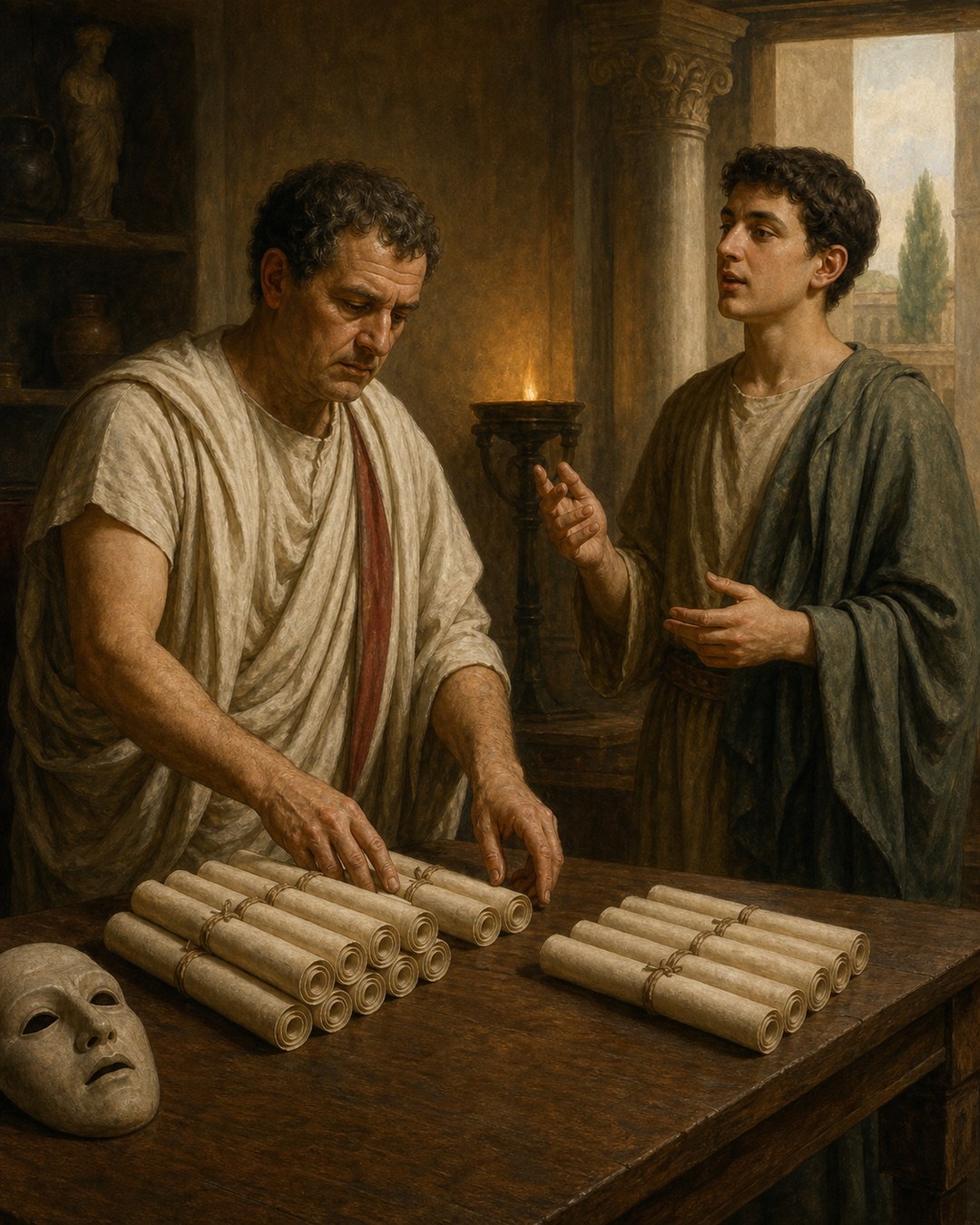
Around one hundred thirty comedies circulated under the name of Plautus. That number did not impress every Roman reader. Lucius Aelius accepted only twenty-five. Varro placed twenty-one in a group whose authorship was not disputed, then admitted further plays when their language persuaded him. The famous name written on a roll was evidence, but it was not a verdict.
Aulus Gellius describes a literary problem that feels unexpectedly modern. Popular authors attract imitation, mistaken labels, revised material, and works composed by people with confusingly similar names. Catalogues disagree. Surviving documents may repeat an old error. Faced with that mess, Roman scholars asked what Plautus sounded like: his diction, comic pace, archaic bite, and distinctive humour.
The result was not one clean master list. It was an argument about how readers know an author when handwriting, title tag, and reputation can mislead them. Roman textual criticism began not with a database but with trained ears, remembered verses, and the confidence to say that one joke carried a stronger signature than the label attached to it.
A Famous Name Made the Catalogue Unreliable
Gellius opens with the existence of both genuine and spurious comedies under Plautus’s name. His wording matters because the problem was not merely that a few anonymous plays survived. Works with different histories had been actively gathered beneath the authority of Rome’s most famous comic playwright. Once the name added value, misattribution had somewhere to grow.
Ancient scholars produced lists. Gellius names Aelius, Sedigitus, Claudius, Aurelius, Accius, and Manilius among authorities whose catalogues an experienced reader might consult. Yet the literary men he trusted would not let those catalogues settle a doubtful case. They preferred “Plautus himself”: not the dead man available for questioning, but the recurring manner and diction found across secure plays.
This explains why raw totals diverged so sharply. About one hundred thirty comedies circulated as Plautine, while Aelius thought only twenty-five belonged to the author. Varro identified twenty-one accepted by common consent—the group later known as the Varronian plays—but did not stop there. A core canon could be stable while the border remained open to argument.
The uncertainty did not make scholarship pointless. It gave scholars different levels of confidence. Some plays carried agreement strong enough to anchor comparison. Others could be tested against that anchor. Instead of treating every title as either certainly genuine or worthless, readers built a spectrum from undisputed work to plausible addition to obvious mistake.
Varro Listened for Humour and Verbal Habit
Varro’s method, as Gellius presents it, depended on style. He accepted additional comedies when their language displayed Plautus’s characteristic humour and verbal manner. This was not a mystical claim that genius could always be recognized. It was accumulated familiarity: repeated reading gave a critic expectations about word choice, rhythm, comic types, and the way a line prepared its laugh.
The Boeotian Woman demonstrates the method. The play was attributed to Aquilius and stood outside the twenty-one uncontested works. Varro nevertheless accepted it as Plautine. Gellius offered a sample: a hungry parasite curses the inventor of hours and the man who installed a sundial, because regulated time now prevents him from eating even when food is available. In childhood, the character jokes, his belly had been a truer clock.
The passage did more than raise a smile. Its rapid complaint, bodily appetite, attack on civic technology, and compact reversal supplied a cluster of traits that an experienced reader could compare with secure comedy. The sundial was therefore both a prop inside the joke and evidence in a scholarly case centuries later.
Gellius gives another small demonstration through his teacher Favorinus. On hearing one vividly archaic line from the Nervularia, Favorinus declared that the verse alone could convince him the play was Plautine. The confidence may look excessive, but it reveals what ancient critics valued: unusual vocabulary and comic compression could be more discriminating than a broad plot shared by many playwrights.
One Similar Name Could Contaminate a Shelf
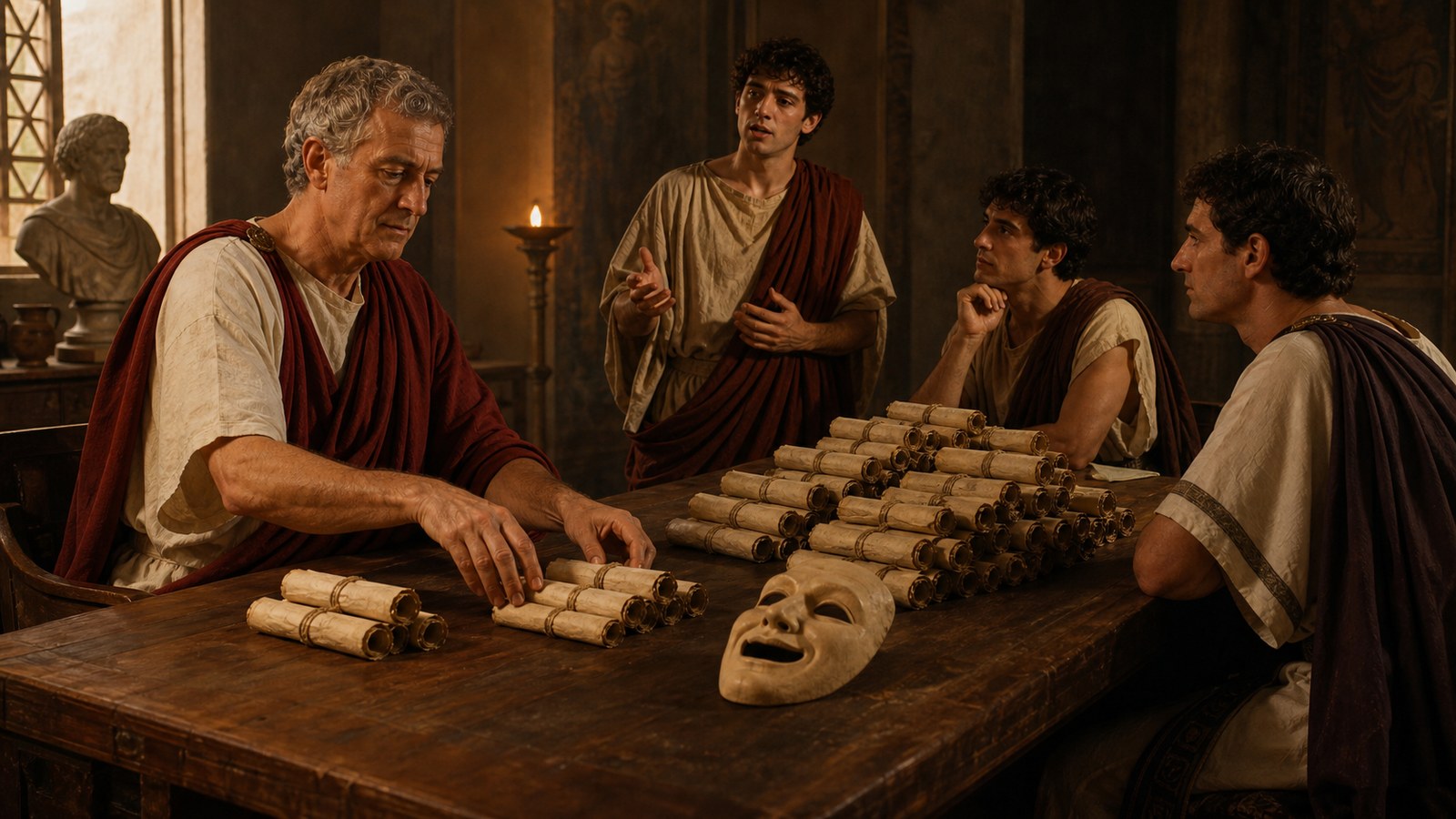
Not every false attribution required deliberate imitation. Varro recorded another writer of comedy called Plautius. The titles on his plays were described with a label that could be understood as “Plautus’s” even though it properly meant “by Plautius.” A small difference in a name became a mechanism for moving whole works across an authorial boundary.
That confusion is easy to imagine in a culture of copied rolls. A work passed from owner to owner and copyist to copyist. Its title might be shortened, its author assumed, or a grammatical label misunderstood. Once a copy entered a collection as Plautus, later catalogues could repeat the claim without preserving the first moment of error.
Other works complicated the boundary in a different way. Gellius says some had been written by older poets but revised and touched up by Plautus. Those plays could genuinely “taste” Plautine because Plautus had changed them, even if he had not originated them. Style detected contact with his hand, but contact did not automatically equal sole authorship.
This is where expert judgement needed restraint. A critic could correctly hear Plautus in a scene and still misdescribe the work’s history. The archive was not divided neatly between originals and forgeries. It included collaboration across time, revision, performance adaptation, misleading labels, and plays that survived because a famous author’s name helped carry them.
The Mill and the Prison Joined Life to Authorship
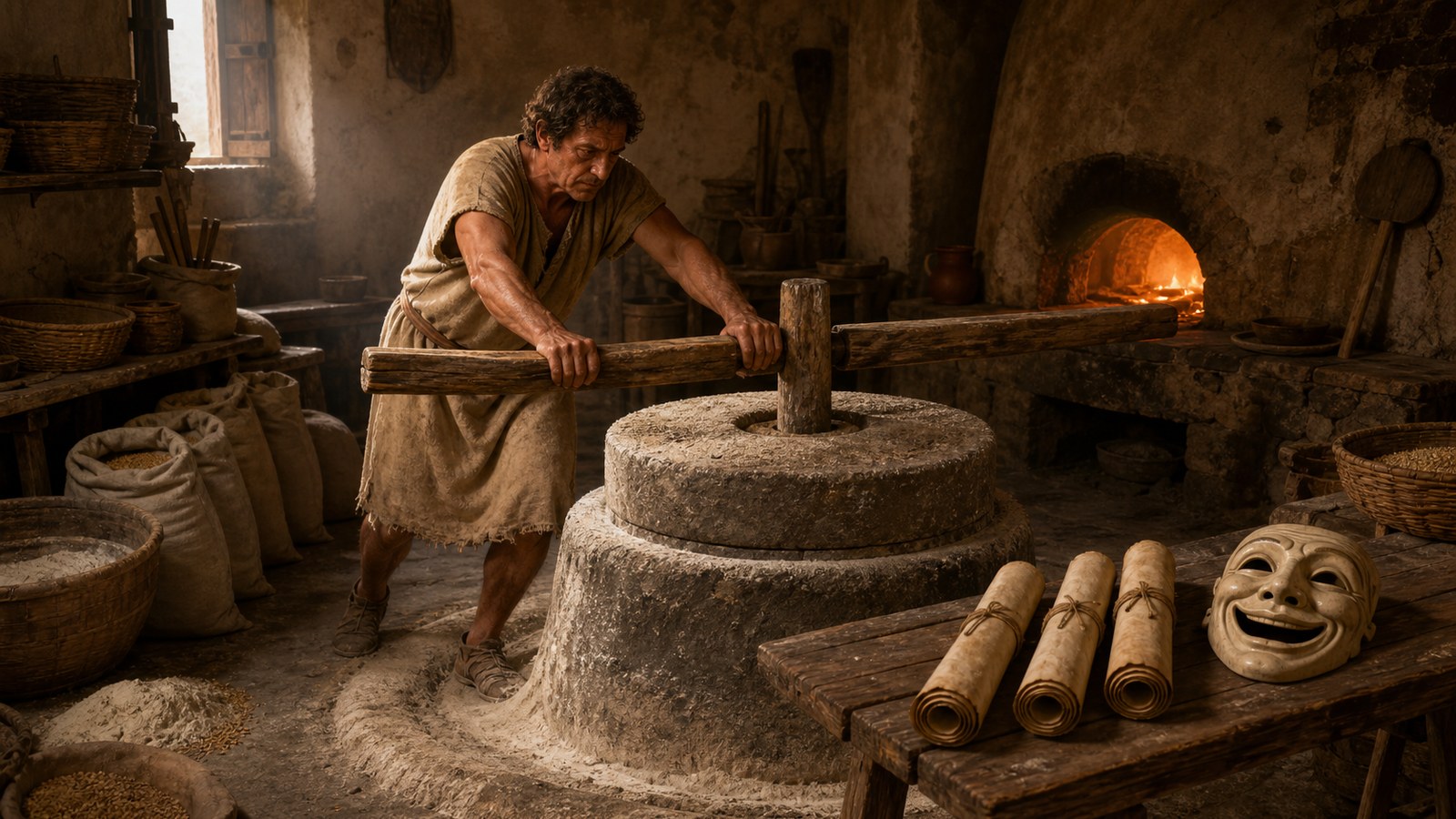
Ancient readers also used biography to explain how plays came into being. Varro and several other writers said Plautus lost the money earned through stage work in a trading venture, returned to Rome penniless, and hired himself to a baker. He turned a push-mill for his livelihood and supposedly wrote Saturio, Addictus, and a third comedy while working there.
The scene is concrete: the repeated shove of a mill, flour dust, physical fatigue, and comic composition made around hired labour. It also offered a persuasive origin for voices obsessed with hunger, debt, service, and uncertain meals. Biography became another form of attribution evidence because the hardships seemed to fit the dramatic world.
Gellius immediately pairs Plautus with Naevius. He says Naevius was imprisoned at Rome by officials after repeatedly attacking leading citizens in the manner of Greek poets. In confinement, Naevius wrote two plays, The Soothsayer and The Lion. The tribunes of the commons later freed him after he apologized for his offences and sharp language.
These accounts should not be mistaken for payroll records or prison diaries. Gellius reports what Varro and others preserved, and ancient literary biography often shaped lives to match works. But the pairing tells us what Romans thought authorship could look like. Comedy did not have to emerge from quiet leisure. It could be ground out beside a mill or composed under confinement, with poverty and political risk leaving marks that readers believed they could hear.
A Roman Canon Was an Argument Kept in Motion
The Plautus chapter does not end by announcing a final total. Gellius himself reads, compares, copies striking lines, and disagrees with inherited labels. He judged the disputed Fretum authentic after reading it. Accius, by contrast, had excluded several titles, including The Boeotian Woman. The canon remained the product of repeated encounters rather than one official decree.
That culture of comparison appears elsewhere in Roman literary memory. Pacuvius listening to Accius’s Atreus turns style into a judgement about age and ripeness. In the Plautus debate, the same attentiveness serves attribution: a critic hears whether verbal energy belongs to one writer, another writer, or an imitator.
Institutions still mattered. Scroll collections, teachers, catalogues, and Roman libraries that made literary memory available created the conditions for comparison. No one can recognize a signature from a single uncertain sample. The twenty-one undisputed plays gave Varro a reference set, while discussion among readers gave individual reactions a community in which they could be challenged.
Gellius’s numbers expose the scale of the task. If approximately one hundred thirty comedies made the claim and only twenty-one rested within the secure core, most of the shelf demanded judgement. Names, lists, life stories, and stylistic clues all competed. The scholar’s job was not simply to preserve what antiquity handed down. It was to notice that antiquity had handed down contradictions.
The hungry parasite cursing the sundial survives inside that process. The joke reached Gellius because someone copied a disputed comedy; Gellius copied the lines because they sounded unmistakably Plautine; modern readers encounter them because his argument survived. Authorship criticism did not merely narrow a list. It selected the details through which a comic voice continued to be heard.
Sources
Aulus Gellius, Attic Nights, Book 3, chapter 3.