
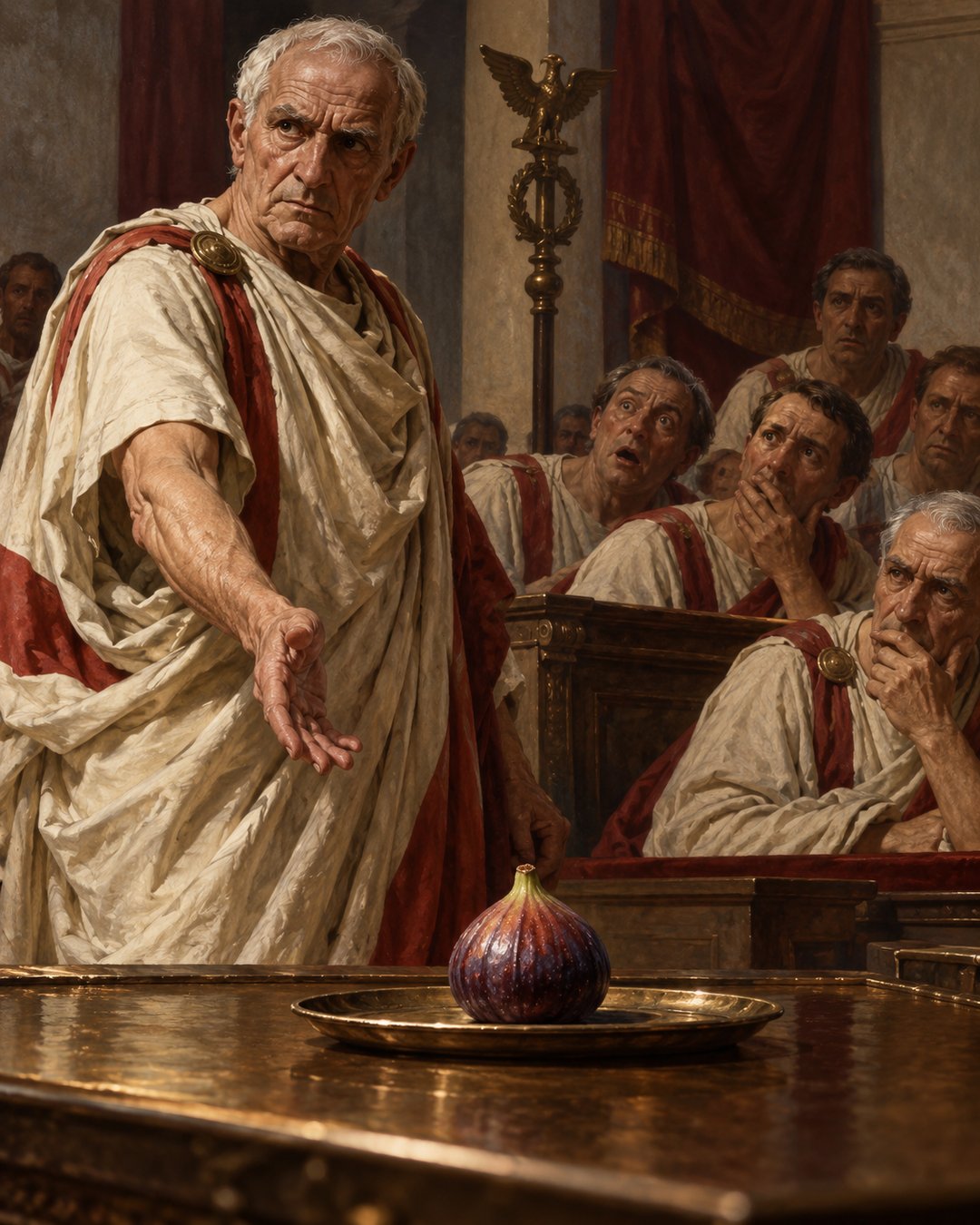
Cato the Elder shook out the folds of his toga and a fig fell onto the Senate floor. It was large, ripe and from North Africa. While senators admired it, Cato told them that the country where it had grown lay only three days’ sail from Rome.
Plutarch presents the gesture as part of Cato’s campaign for war against Carthage. The fruit was not proof that an invasion had begun. It did something more immediate: it made distance visible through freshness. A fig that had survived the crossing could be held, smelled and judged before it spoiled.
The episode is often reduced to Cato’s repeated demand that Carthage be destroyed. The object explains how he made repetition bite. He turned a strategic claim into a perishable exhibit and forced senators to consider how quickly goods—and therefore danger—could cross the sea.
An Embassy Found the Enemy Looking Prosperous
Cato had travelled to Africa as an envoy during a dispute between Carthage and Masinissa of Numidia. Rome had longstanding ties with Masinissa, while Carthage remained constrained by the treaty imposed after its defeat in the Second Punic War.
The mission was supposed to examine the quarrel. Plutarch says Cato returned with a wider alarm. He found Carthage neither poor nor humbled, but crowded with vigorous fighting men, overflowing with wealth, and filled with arms and military supplies.
This is a hostile observer’s political assessment, not a neutral census. Its details nevertheless define what changed Cato’s attention. The city he expected to supervise as a defeated power appeared capable of renewed action.
Masinissa’s conflict therefore became, in Cato’s argument, a prelude rather than a local dispute. He warned that Carthage’s former defeats had reduced its recklessness less than Romans imagined and had taught it more about war.
Rome’s own memory of the conflict remained powerful. Scipio Aemilianus’s later tears over burning Carthage belong to the end of the story. Cato’s fig belongs to the earlier fight over whether that end should be pursued at all.
The Fig Carried Distance Without a Map
Plutarch says Cato contrived to drop the fruit as he shook his toga. The verb makes the act deliberate. He did not merely share food from his journey; he staged discovery in the chamber.
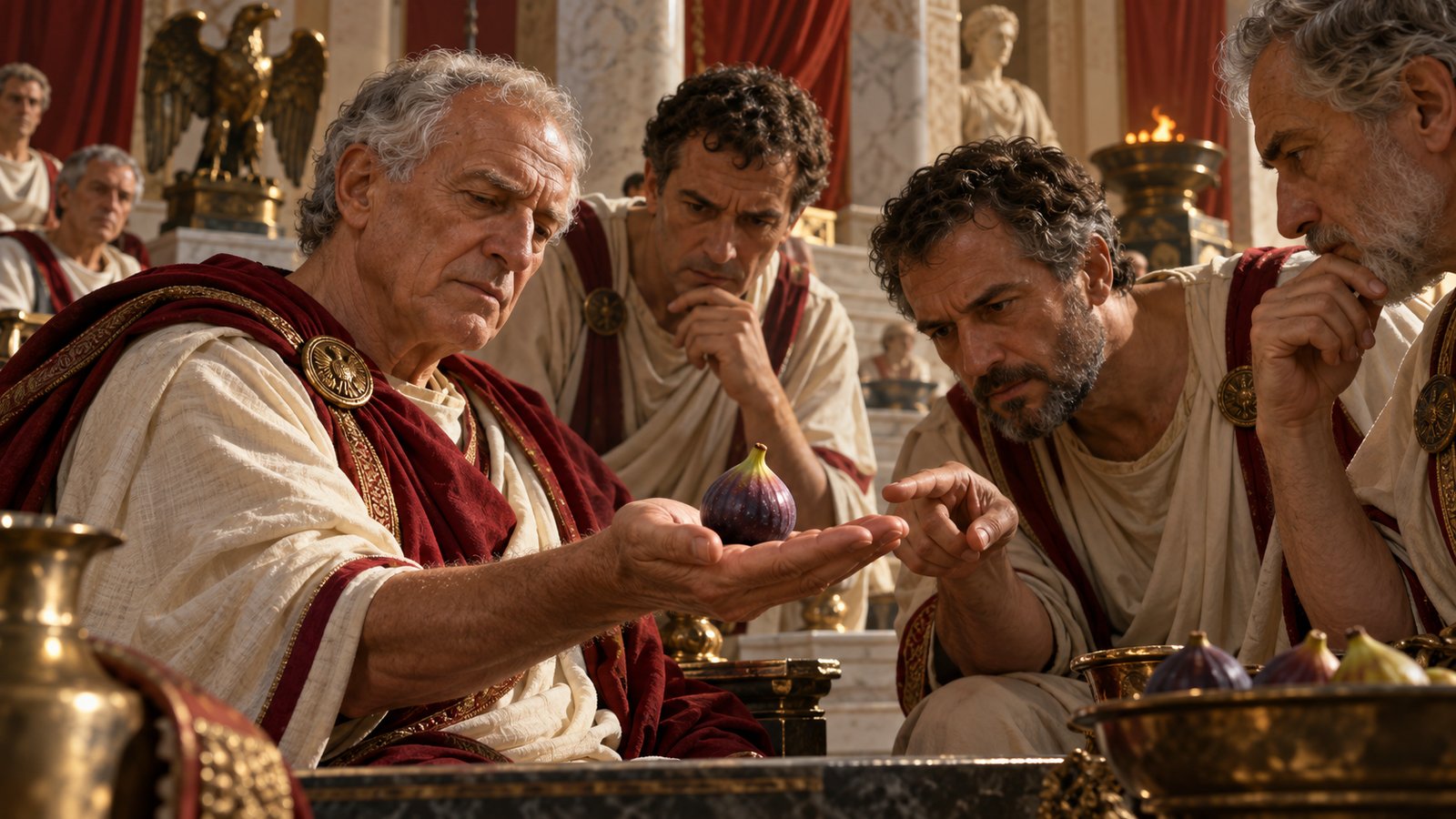
The senators first admired the fig’s size and beauty. Their response let the object establish value before Cato attached the warning. Something attractive and fresh had arrived from the place he wanted them to fear.
Then came the number: only three days’ sail separated Rome from the country where it grew. Ancient voyages varied with wind, route and vessel, so the phrase is rhetorical rather than a universal timetable. Its force rested on the fruit before them. Whatever the exact journey, it had been short enough for freshness to remain persuasive.
A map requires interpretation. The fig required senses. Its skin, weight and ripeness collapsed a line across the Mediterranean into a thing on the floor. Cato converted logistics into texture.
Roman politics often relied on objects and settings. Claudius’s speech about admitting Gauls survived because words were fixed in bronze. Cato chose the opposite medium: food whose argument weakened as it decayed.
Freshness Turned Trade into a Threat
The fig had travelled because Mediterranean routes connected North Africa and Italy. The same movement that delivered desirable produce could be described as strategic proximity. Cato made commerce and danger share a clock.
He did not claim that figs caused war or that every ship carried soldiers. The object demonstrated capacity for quick passage. If fruit crossed before losing its appeal, then Carthage could not be treated as safely remote merely because water lay between the cities.
The argument drew power from Rome’s dependence on maritime movement. Grain, oil, wine, people and information travelled through the same sea. Roman strength relied on those routes; Cato recast their speed as vulnerability.
Plutarch’s version also gives the fig a North African identity broad enough to serve the speech. He calls it Libyan, using the geographical language of his own account. We should not pretend to know the orchard, ship or hand that carried this particular fruit.
Nor does the fruit prove that Carthage itself exported it to Cato. The country in the speech supplies proximity, not a chain of custody. Keeping that distinction clear preserves the force of the demonstration without turning a biographical anecdote into customs documentation.
Perishability imposed its own deadline. A bronze tablet could wait in storage before display; ripe fruit could not. If Cato carried or arranged the fig for the debate, timing was part of the performance. The exhibit had to arrive while its surface still supported the claim he wanted to make.
Those missing details protect the story from false precision. What survives securely is the staged drop, senatorial admiration, and Cato’s three-day claim. Together they form a compact mechanism: attractive object, measured distance, implied danger.
Two Refrains Offered Opposite Futures
Cato added a conclusion to his votes regardless of the question under discussion: in his opinion, Carthage must be destroyed. Repetition kept the city inside Roman deliberation even when the immediate agenda concerned something else.
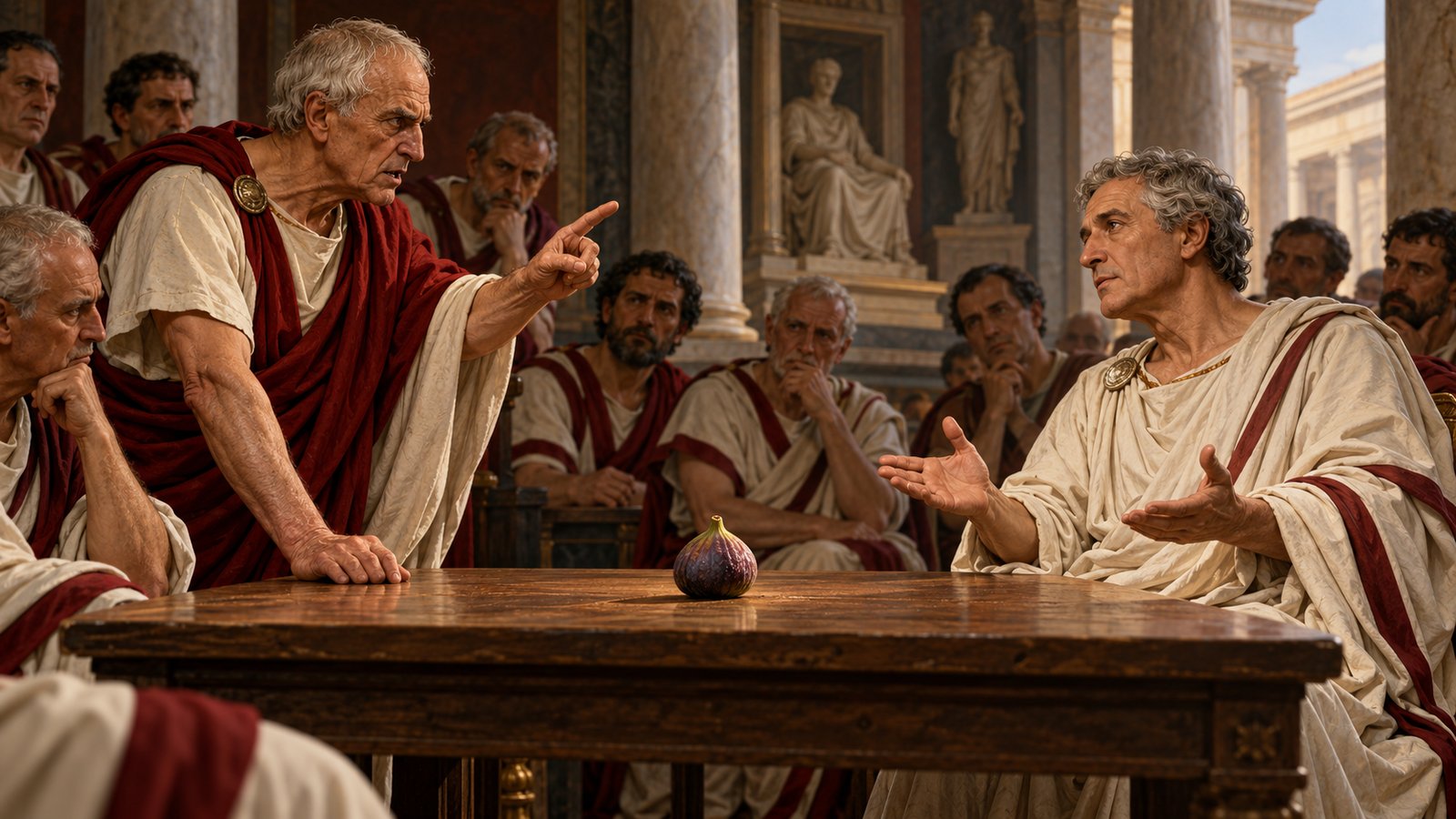
Publius Scipio Nasica answered with an opposing formula: Carthage must be spared. Plutarch does not cast this merely as sympathy for an enemy. Nasica believed fear of Carthage could restrain a Roman people already made unruly by prosperity.
The disagreement was therefore about Rome as much as Carthage. Cato saw a recovered rival whose continued existence invited future danger. Nasica saw an external check whose disappearance might release Roman excess.
Nasica’s position rested on a diagnosis of success. Plutarch says the Roman people was already guilty of excess and resisted senatorial control in the pride of prosperity. A rival that was too weak to conquer Rome but too strong to ignore could function like a bridle. Removing it might make domestic behavior harder to govern.
Cato feared the opposite timing. Rome was powerful, but Carthage had recovered enough to remain a permanent source of danger. For him, allowing that recovery to continue meant postponing a conflict under less favorable conditions. The same evidence—Carthaginian strength and Roman confidence—therefore supported two incompatible forecasts.
The fig sharpened Cato’s side because it made waiting feel risky. Nasica’s answer required senators to imagine a useful balance of fear; Cato let them look at a fresh object and imagine how little time separation might buy.
Repetition kept this disagreement active across unrelated business. Every vote gave Cato another occasion to tie the day’s decision to Carthage, and every response gave Nasica a chance to insist that destruction carried its own political cost. Their paired endings made strategic disagreement into a recognizable Senate ritual.
Neither refrain was a technical war plan. Both compressed broad political forecasts into memorable endings. Cato’s physical prop gave his forecast a sensory advantage that a repeated sentence alone could not provide.
A Perishable Prop Outlived the Debate
Cato died soon after the Third Punic War began and did not see Carthage destroyed. Scipio Aemilianus completed the siege in 146 BC. Plutarch credits Cato’s advice with helping bring the war about while still presenting the fig episode as something “said” to have happened.
That caution matters. The story comes through biography written long after the Senate debate. It is perfectly shaped for Cato’s reputation: austere, practical, hostile to Carthage and skilled at making a point with an ordinary object.
Yet later shaping does not make the rhetoric uninteresting. It shows what ancient readers believed a compelling Roman argument looked like. A successful speaker did not merely announce danger; he gave distance a body.
The fruit also reversed the meaning of freshness. In a market, freshness promised pleasure and efficient transport. On the Senate floor, it became evidence that Rome’s old enemy was near enough to remain urgent.
Cato’s refrain survived, but the fig makes the scene memorable. Words declared what he wanted. The fruit supplied the interval: three days between an African tree and Roman hands. Before senators could decide whether Carthage was strong enough to fear, they had already admired what the crossing could deliver.
Sources
Plutarch, Life of Cato the Elder 26–27.